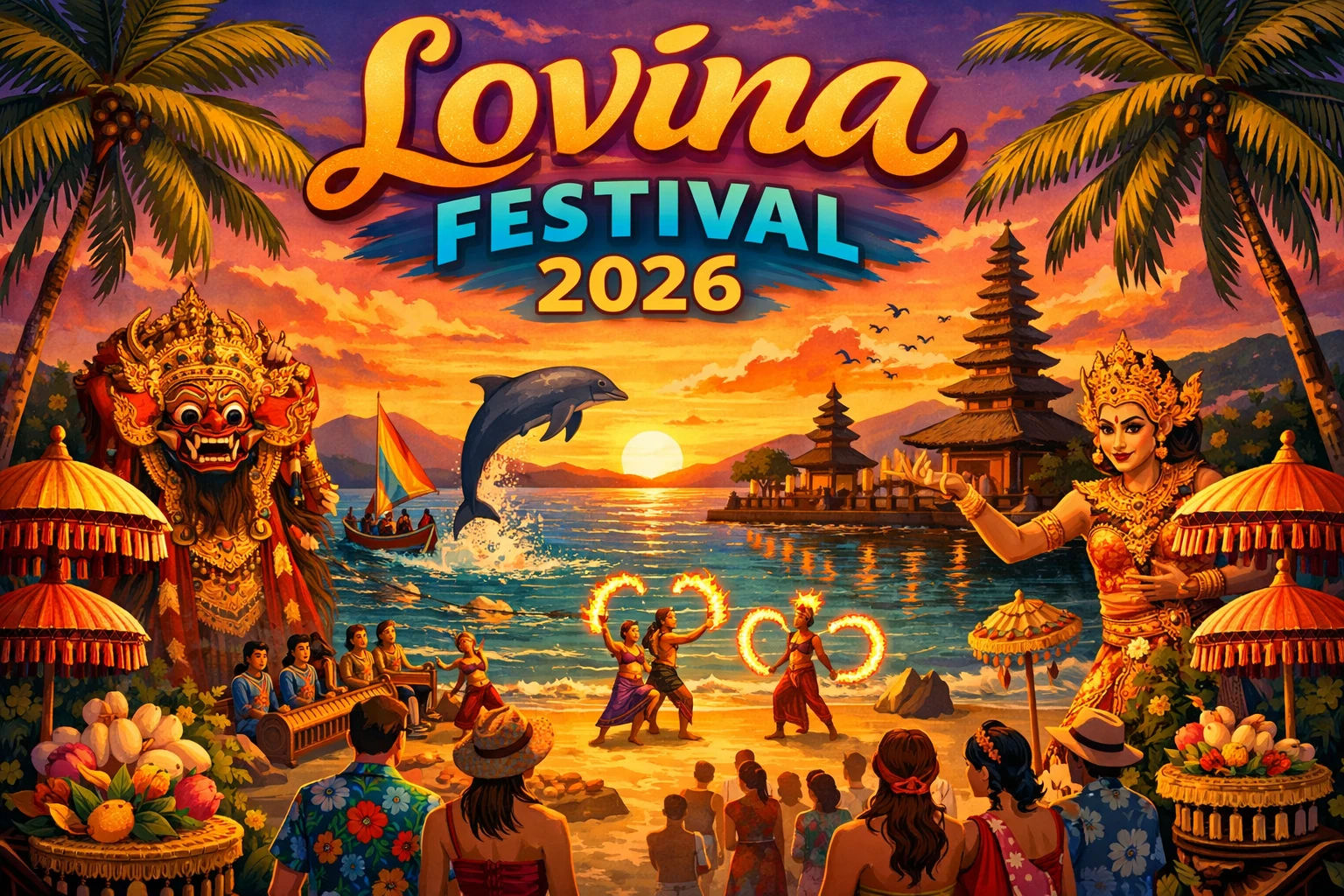
Lovina Festival 2026: North Bali's Premier Coastal Cultural Celebration
The Lovina Festival 2026, now in its 12th annual edition, is officially confirmed for July 24 to 26, 2026 at Lovina Beach, Buleleng Regency, North Bali, specifically across the coastal villages of Kalibukbuk and Kaliasem, and admission is completely free. Organized by the Buleleng Regency Government and listed in Indonesia Travel's official event calendar, this three-day festival celebrates North Bali's rich cultural heritage and natural wonders through traditional dance, gamelan, live concerts, a traditional fishing tournament, dolphin ecosystem awareness, beach cleanup initiatives, and a spectacular fireworks display.
Lovina is not the Bali of the glossy travel brochures. It doesn't have the terraced rice fields of Ubud or the party strip of Seminyak. What it has is something slower, more genuine, and in its own way far more extraordinary: a coastline of black volcanic sand stretching along the Bali Sea, sunsets that turn the water gold and purple over Menjangan Island in the distance, and just offshore, a resident pod of wild spinner dolphins that locals and visitors have been watching every sunrise for decades.
The Lovina Festival was created to celebrate exactly this: the particular character of North Bali, which is culturally distinct from the island's southern regions, shaped by the legacy of the old Buleleng Kingdom and Singaraja's history as Bali's former colonial capital. After 12 years, the festival has become the most important cultural gathering on the north coast, and the reason North Bali deserves to be on every serious Bali traveler's map.
Confirmed Dates, Venue, Location, and Admission for Lovina Festival 2026
Indonesia Travel's official listing, confirmed across multiple regional and international sources, establishes:
- Dates: July 24 to 26, 2026
- Location: Lovina Beach (Kalibukbuk and Kaliasem villages), Buleleng Regency, North Bali
- Edition: 12th annual
- Ticket price: FREE
Now Bali's annual events calendar, listing from nowbali.co.id, describes the festival as holding events across Kalibukbuk and Kaliasem villages, reflecting the beach and its surrounding neighborhood rather than a single fixed stage, and highlights the fireworks and cultural parade as the signature crowd moments.
The Origins and Evolution of Lovina Festival
Lovina Festival did not begin as a community cultural celebration. According to Indonesia Travel's official description, it originated as a welcoming event for visiting yachts that docked in Lovina on their sailing routes through Indonesian waters. That maritime welcome evolved year by year into something with its own identity, eventually growing into an independent annual cultural celebration that stands entirely on its own.
The transformation from yacht welcome to full cultural festival reflects what has happened to Lovina itself over the decades: a working fishing community that learned to share its beaches and its culture with the world while remaining stubbornly itself. The fishing boats still go out before sunrise every morning. The dolphins are still there. The local culture is still Buleleng's culture, not a version of it adapted for southern Bali tourism expectations.
The 2025 edition was included in Indonesia's prestigious Kharisma Event Nusantara, a national curated list of 110 priority cultural events. That inclusion is an endorsement of the festival's quality and authenticity from the national tourism ministry.
The Heart of the Festival: Wild Dolphins and Ocean Connection
The most iconic element of Lovina is not man-made. The wild spinner dolphins that live in Lovina's offshore waters have been one of the area's most celebrated natural attractions for generations. These are not captive animals. They are a resident pod that swims freely in the Bali Sea, and watching them from small outrigger boats as the sun rises over the mountains behind Singaraja is one of those experiences that justifies the travel to get there.
The Lovina Festival specifically highlights the wild dolphin ecosystem as its central natural icon, according to Indonesia Travel's official event description. The festival uses the dolphins as a focal point for raising awareness about marine ecosystem health and the importance of sustainable, non-intrusive wildlife tourism practices. The early morning dolphin watching excursions available throughout festival week from Kalibukbuk Beach are one of the most natural additions to any festival itinerary, offering visitors a 5:00 am to 6:30 am experience on the water before the day's cultural program begins.
The Full Festival Program: Culture, Competition, Community, and Fireworks
The Lovina Festival 2026 program, confirmed across official and festival sources, delivers a broad and genuinely diverse schedule across three days.
Cultural Parades around Kalibukbuk and Kaliasem
A community cultural parade routes through the coastal villages, with participating groups dressed in traditional Buleleng and Balinese attire, accompanied by gamelan and percussion. The parade is one of the festival's signature spectacles, bringing the two village communities together in a display of collective pride that is deeply photogenic and genuinely moving.
Traditional North Balinese Dance Performances
The performance program highlights dances specific to the Buleleng region, including:
- Joged Bungbung: a flirtatious, social dance form characteristic of North Bali, performed to bamboo percussion that creates a completely different sound from the gamelan bronze of South Bali
- Sang Hyang Penyalin: a trance-based sacred dance from the Buleleng tradition
- Mass Pendet dance: a welcoming and offering dance performed collectively by large groups
- Kecak: performed in the festival context by groups from surrounding communities
The emphasis on North and Northwest Balinese cultural forms is intentional. The Lovina Festival specifically celebrates the hyper-local traditions of Buleleng that are less visible in southern Bali's mainstream tourism, and that localism is what makes attending it so rewarding for visitors who have already experienced the better-known cultural forms of Ubud or Denpasar.
Legendary Gong Kebyar Mebarung
One of the most celebrated musical traditions of Bali, Gong Kebyar Mebarung is a head-to-head competitive performance between two gamelan orchestras that face each other and alternate in a musical duel of skill and creativity. The 2025 edition featured this performance, and it is expected in 2026. Watching two full gamelan orchestras compete in this format is unlike any other concert experience and reflects Balinese musical culture at its most vibrant and technically sophisticated.
Live Concerts Featuring Local and National Artists
After the cultural performances wind down each evening, the festival transitions into live concerts. The 2025 edition featured Gus Teja, one of Bali's most celebrated world music artists known for his bamboo flute compositions, alongside bands and a DJ set. This blend of classical Balinese music and contemporary performance gives the festival a breadth that reaches across generations.
Traditional Fishing Tournament and Fish Feast
The traditional fishing tournament is one of the festival's most community-rooted events, connecting the celebration directly to Lovina's identity as a working fishing village. Fishermen compete in traditional outrigger boats, and the event typically culminates in a traditional fish feast shared collectively among participants and visitors. Eating freshly caught Lovina fish prepared in the Buleleng style at the festival is one of the most locally authentic food experiences available during the entire Bali summer events season.
Sailboat Race and Lovina Sea Activities
The festival's maritime heritage is preserved through a sailboat race in Lovina's calm north coast waters. Combined with the morning dolphin excursions, this naval element of the program gives festival week a genuine connection to the sea that distinguishes Lovina from landlocked cultural events elsewhere on the island.
Beach Cleanup Initiative
A formal beach cleanup is built into the festival program, reflecting the community's awareness that Lovina's natural beauty is its most valuable asset and requires active protection. Visitors are welcome to join, and participation in the cleanup is a genuinely meaningful way to contribute something tangible to the community that has welcomed you.
Additional Competitive and Community Events
The Lovina Festival's community-focused programming in recent editions has also included:
- Color run: a fun run event with colored powder that draws youth participation from across the region
- Drawing competitions: open to children and young participants
- Exercise competitions: fitness events that bring community members and visiting participants together
- Community aid distribution to local fishermen: a social welfare component that reminds everyone that the festival is rooted in genuine community care, not only cultural spectacle
The Fireworks Finale
The festival's fireworks display over Lovina Beach is one of its most celebrated moments. Watched from the black sand beach with the dark Bali Sea ahead and the mountains of the Buleleng interior behind, the fireworks create a moment that brings every visitor, every local family, and every fishing boat moored offshore into the same shared experience.
What Makes North Bali Different: The Buleleng Character
North Bali has a cultural identity shaped by its own history, and the Lovina Festival reflects that distinctiveness clearly. Singaraja, the capital of Buleleng Regency and located just 10 kilometers east of Lovina, was Bali's first capital under Dutch colonial administration and served as the administrative center of all Dutch-controlled Bali and Lombok for many years. That history gave Singaraja a cosmopolitan, multi-ethnic character with Chinese, Arab, Javanese, and Dutch architectural and cultural influences layered over its Balinese Hindu foundation.
The result is a North Bali that is simultaneously Balinese and broader, with a self-confidence and cultural depth that requires time and curiosity to appreciate. The Lovina Festival is an invitation into that character, and visitors who accept it leave with an understanding of Bali that the southern tourist circuit simply cannot provide.
Practical Travel Tips for Attending Lovina Festival 2026
Getting to Lovina from Across Bali
Lovina Beach is located approximately 10 kilometers west of Singaraja, on Bali's north coast. Travel times from major southern Bali bases are:
- From Ubud: approximately 2 hours via Kintamani or Penelokan mountain route (one of Bali's most spectacular drives, with views of Mount Batur and the crater lake)
- From Kuta and the airport area: approximately 2 to 2.5 hours via the expressway and northern mountain route
- From Seminyak and Canggu: approximately 2 to 2.5 hours
- From Singaraja: approximately 20 to 30 minutes by car
The drive over the central Bali mountains via Kintamani is itself worth the trip, with panoramic views across the volcanic landscape that are among the most dramatic on the island.
Where to Stay in Lovina for the Festival
Kalibukbuk is the center of Lovina's accommodation strip, with a range of hotels and guesthouses directly on or near the beach. Staying in Kalibukbuk puts you within walking distance of most festival events and means you can step out before sunrise for dolphin watching without commuting. Book early, as July is a busy period and Lovina's accommodation inventory is modest compared to southern Bali.
Early Morning Dolphin Watching During Festival Week
Dolphin watching departures from Kalibukbuk Beach typically leave between 5:00 am and 6:00 am and return before 8:00 am. This timing leaves your full day free for festival activities. Local outrigger boat operators can be found directly on the beach, and agreeing on a price the evening before is standard practice.
Other North Bali Highlights to Pair with the Festival
A few extra days in the Lovina and Buleleng area give you access to some of the island's most underrated experiences:
- Sekumpul and Gitgit Waterfalls: two of Bali's most dramatic waterfall systems, both within 30 to 60 minutes from Lovina
- Banjar Hot Springs: naturally heated volcanic spring pools surrounded by lush jungle, approximately 15 minutes west of Lovina
- Brahmavihara-Arama Buddhist Monastery: the largest Buddhist monastery in Bali, built into the hillside above Banjar with views across to the Bali Sea
- Pulaki Temple and Pemuteran: heading west from Lovina, the temple and the diving village of Pemuteran offer ocean and reef experiences for which North Bali is genuinely world-class
Verified Information at a Glance
Item: Confirmed details
Event name: Lovina Festival 2026, 12th annual edition
Event category: Annual coastal cultural festival (traditional performing arts, live music, marine conservation, community competition, culinary)
Confirmed dates: July 24 to 26, 2026
Confirmed location: Lovina Beach, Kalibukbuk and Kaliasem villages, Buleleng Regency, North Bali
Confirmed ticket price: FREE
Organizer: Buleleng Regency Government
Festival origin: Originally a welcoming event for visiting yachts; evolved into an independent cultural celebration over 12 years
Central natural icon: Wild spinner dolphin ecosystem of Lovina Beach
Program highlights (confirmed from past editions): Cultural parade, Joged Bungbung, Gong Kebyar Mebarung, Kecak, traditional fishing tournament, fish feast, sailboat race, beach cleanup, color run, fireworks
National recognition: Included in Indonesia's Kharisma Event Nusantara (national priority events calendar, 2025 edition)
If you want to experience the Bali that most visitors never find, the one where fishing communities still honor the ocean they depend on, where gamelan orchestras compete in forms that predate modern Bali tourism by centuries, and where wild dolphins surface at sunrise outside a village that has stayed genuinely itself through all of it, then Lovina Beach at the end of July 2026 is where you need to be.