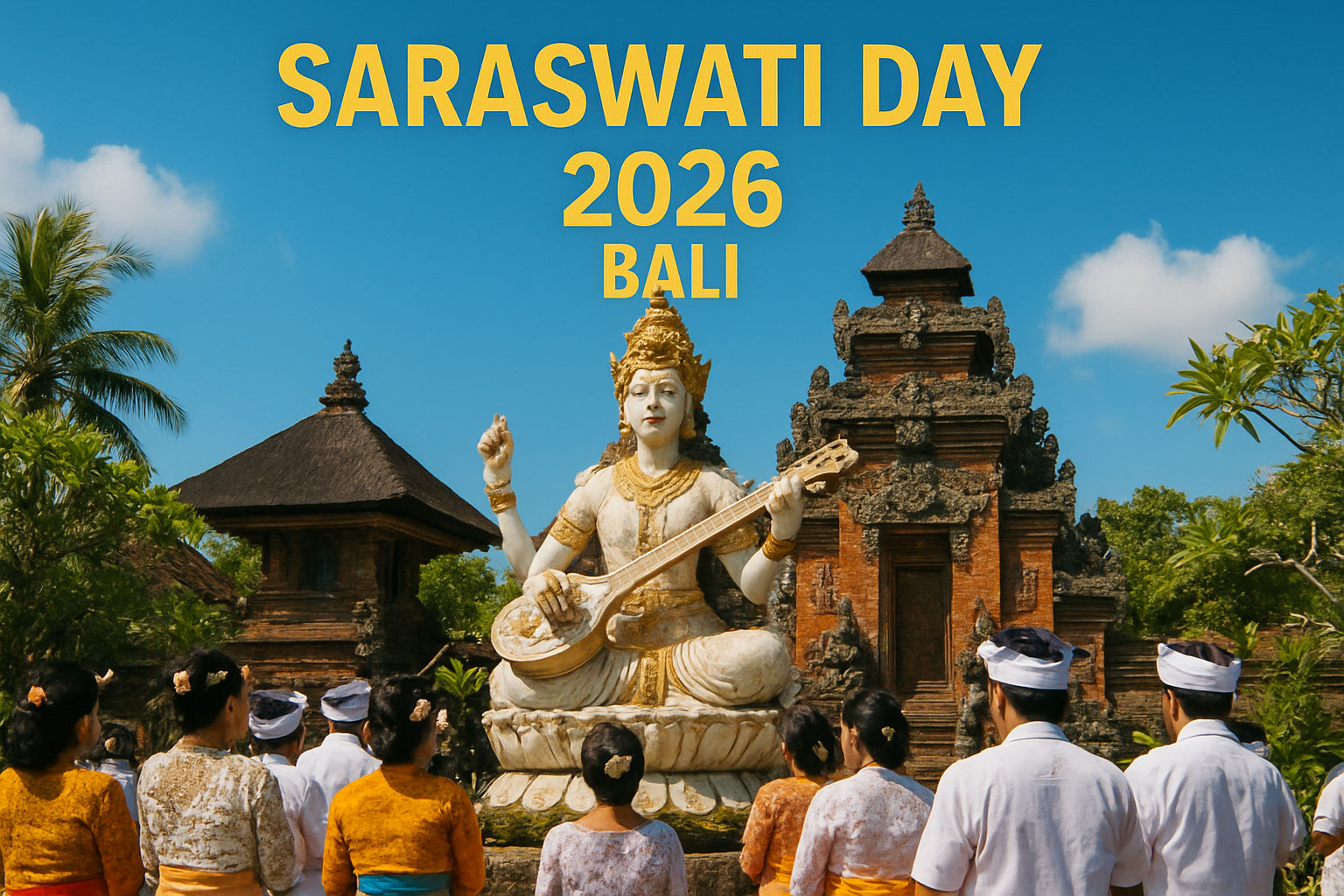
Saraswati Day is one of Bali's most beautiful and intellectually sacred ceremonies, dedicated to Dewi Saraswati, the Hindu goddess of knowledge, arts, music, and wisdom. On Friday, January 23, 2026, schools, libraries, temples, and family compounds across the island will be adorned with offerings to books, lontar manuscripts, musical instruments, and the tools of learning, as Balinese Hindus express gratitude for the gift of knowledge and pray for continued wisdom. If you are in Bali that week, you will witness a society pausing to honor the very foundation of culture: the sacred power of learning itself.
Date and the Pawukon calendar cycle
Saraswati Day falls on Saniscara (Saturday in the Balinese week) Umanis during the week of Watugunung in the 210‑day Pawukon calendar, meaning it recurs roughly every six months. In 2026, the celebration lands on Friday, January 23 by the Gregorian calendar, with a second observance on October 31, 2026. For travelers, the January date offers a window into school‑based ceremonies and community temple rituals during Bali's dry season.
- January 23, 2026: Primary Saraswati Day observance in Bali.
- October 31, 2026: Second cycle of Saraswati Day later in the year.
Both dates follow the same ceremonial structure, but the January window coincides with the school calendar's active term, amplifying the educational dimension.
Who is Dewi Saraswati?
Dewi Saraswati is depicted as a graceful, four‑armed goddess seated on a white lotus or riding a white swan, holding scriptures, a rosary, and playing the veena (a stringed instrument). She embodies knowledge, wisdom, the arts, and eloquence, and is believed to assist the Hindu trinity of Brahma, Vishnu, and Shiva in creation, preservation, and transformation. On Saraswati Day, devotees thank her for the wisdom they have received and ask for clarity, creativity, and continued learning.
What happens on Saraswati Day
The day begins early with families and students preparing offerings called banten, composed of flowers, rice cakes, fruits, incense, and symbolic items representing knowledge. Books, manuscripts, religious texts, and educational tools are gathered, cleaned, and blessed with holy water. In schools, teachers and students participate in joint ceremonies, placing offerings around libraries, classrooms, and sacred lontar palm‑leaf manuscripts.
- Morning rituals: Prayers at family shrines, school temples, and community temples; students often wear traditional dress and carry offerings.
- Offerings to books: Texts and tools of learning are arranged on special altars, sprinkled with tirta (holy water), and honored with incense and flowers.
- No reading after offerings: An important tradition is that books and sacred texts are not read once offerings have been made, symbolizing a period of "rest" for knowledge and deep respect for its sacredness.
The day before: Preparing for knowledge
The evening before Saraswati Day is called Pengeradanaan, when families and schools clean and organize books, instruments, and learning materials in preparation for the blessing. You may see students carrying stacks of textbooks home or arranging classroom shelves late into the afternoon.
The day after: Banyu Pinaruh purification
The morning after Saraswati Day is Banyu Pinaruh, literally "water of wisdom." At dawn, Balinese go to the sea, rivers, springs, or holy water sources to bathe and purify themselves, symbolizing the cleansing of mind and body so that knowledge can flow freely and bring clarity. This ritual reinforces that wisdom is not static but must be refreshed and honored like flowing water.
- What to see: Families arriving at beaches like Sanur, Kuta, or Padang Bai at sunrise; quieter springs such as Tirta Empul seeing early bathers; offerings of yellow rice and special drinks consumed after purification.
Where to witness Saraswati Day in Bali
- Schools: Ubud, Denpasar, and Sanur schools hold visible ceremonies in courtyards; ask politely if you may observe from a respectful distance.
- Temples: Major temples like Pura Jagatnatha in Denpasar or Pura Taman Saraswati in Ubud dedicate special ceremonies; arrive early and dress in sarong and sash.
- Libraries and cultural centers: Institutions with lontar collections or educational missions hold blessings; check with Gedong Kirtya in Singaraja or cultural centers in Ubud.
What visitors should know
- Respect the sacred pause: If you are invited into a home or school, do not handle books or manuscripts once offerings have been made.
- Dress modestly: Sarong and sash are required for temple visits; cover shoulders and knees.
- Photography: Ask before photographing children or ceremonies; schools may welcome quiet documentation, but always defer to teachers.
- Business hours: Offices and shops remain open; Saraswati Day is not a public holiday, but schools may hold shortened sessions to accommodate ceremonies.
Cultural foods and offerings
Traditional foods prepared for Saraswati Day include nasi kuning (yellow turmeric rice), jajan pasar (Balinese sweets), and tamba inum, a sacred drink of cendana water, white rice, and shallot consumed during purification. These offerings balance spiritual and physical nourishment, honoring the goddess while sustaining the body.
Planning your January 2026 visit
If you are in Bali around January 23, 2026:
- Arrive by January 22 to observe Pengeradanaan preparations.
- Wake early on January 24 for Banyu Pinaruh beach rituals at sunrise.
- Stay in Ubud for temple access and cultural immersion, or Sanur for proximity to family‑friendly beach purification.
Pair Saraswati Day with visits to Ubud's bookshops, lontar libraries, and art studios to deepen your understanding of Bali's living knowledge traditions.
Practical tips for respectful engagement
- Learn a few phrases: "Om Swastiastu" (peaceful greeting), "Matur suksma" (thank you).
- Support local artisans: Buy handmade offerings materials at markets to understand the craft behind ceremony.
- Read before you go: Familiarize yourself with the story of Saraswati and her role in Balinese Hinduism to appreciate the depth of what you witness.
Why Saraswati Day matters to travelers
Saraswati Day reveals Bali's foundational respect for knowledge, education, and the arts. In a world that often treats learning as transactional, witnessing an entire island pause to honor books, teachers, and the flow of wisdom offers a profound cultural reset. For visitors, it is an invitation to see Bali not just as a beach paradise but as a living repository of intellectual and spiritual heritage.
Call to action
Mark Friday, January 23, 2026 on your calendar, book a stay in Ubud or Sanur, and come prepared to observe with quiet respect. Watch students carry offerings to school temples at dawn, then join the island at the beach the next morning for Banyu Pinaruh purification. Let Bali teach you that knowledge is sacred, that wisdom flows like water, and that sometimes the best travel moments are the quietest.
Verified Information at a Glance
- Event: Saraswati Day (Hari Raya Saraswati) 2026, Bali
- Category: Hindu religious ceremony honoring Dewi Saraswati, goddess of knowledge, arts, music, and wisdom
- 2026 Dates: Friday, January 23, 2026 (primary); Friday, October 31, 2026 (second cycle)
- Calendar basis: Falls on Saniscara Umanis during the week of Watugunung in the 210‑day Pawukon calendar
- What happens: Offerings to books and learning tools; school and temple ceremonies; no reading after blessings; cultural performances
- Day before: Pengeradanaan (book cleaning and preparation)
- Day after: Banyu Pinaruh (dawn purification at beaches, rivers, springs)
- Best locations: Ubud (Pura Taman Saraswati, schools), Denpasar (Pura Jagatnatha, schools), Sanur (beach purification), Singaraja (Gedong Kirtya lontar library)
- Visitor notes: Not a public holiday; offices open; dress modestly for temples; ask before photographing; respect the sacred pause on books