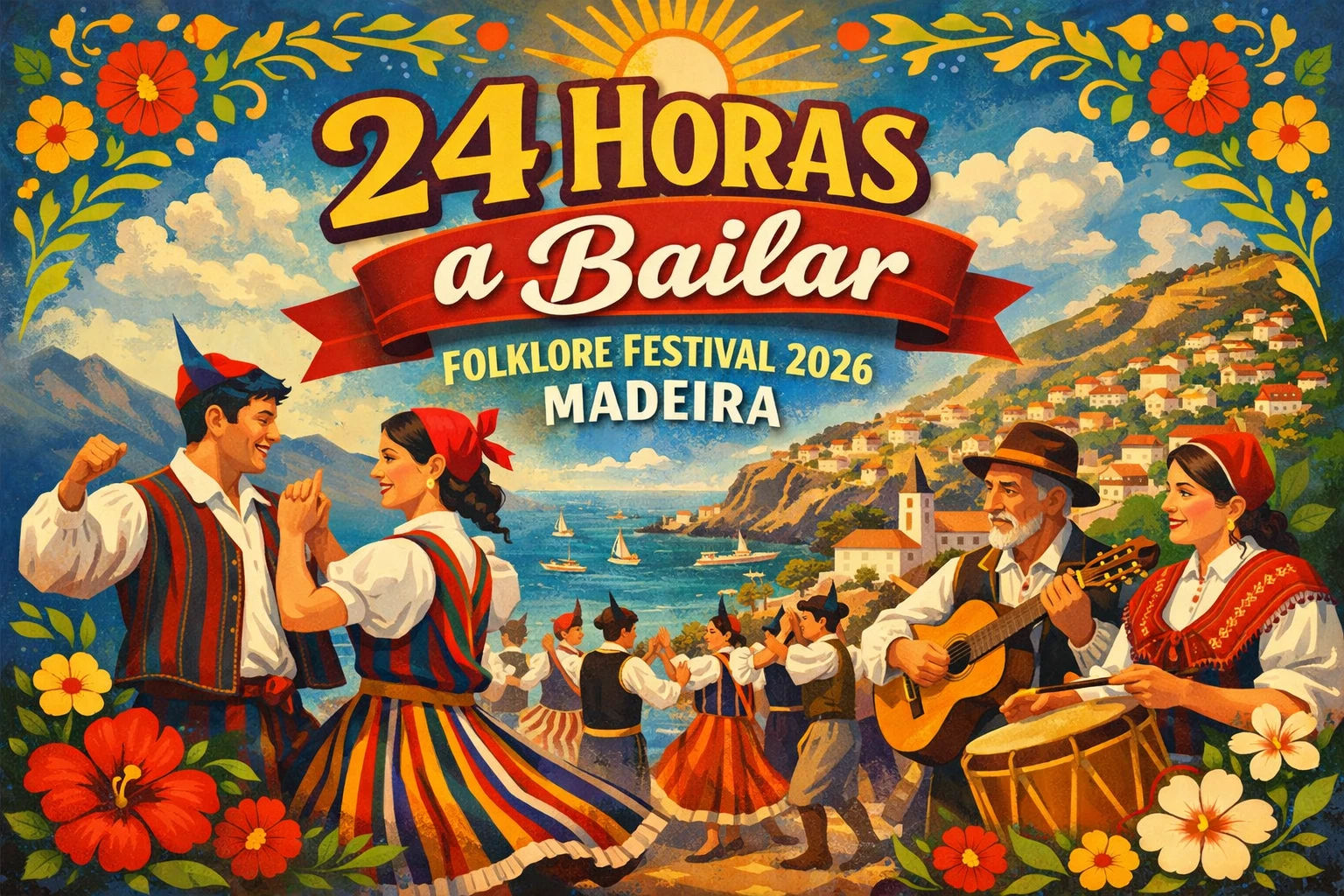
"24 Horas a Bailar" Folklore Festival 2026: Santana's 41st Year of Dancing Through the Night
There is a festival on the north coast of Madeira that has been running since 1985 and has never, in any of its now 41 editions, stopped before it was supposed to. That is not a metaphor. It is the literal description of what "24 Horas a Bailar" does: it starts on a Saturday morning and it dances, continuously, without pause, until Sunday afternoon, carrying the folklore music, traditional costumes, traditional dances, and the collective memory of Madeiran cultural identity through an entire rotation of the sun.
In 2026, the 41st Festival Regional de Folclore at Santana runs from Saturday July 4 at 09:00 to Sunday July 5 at 18:00, in the most picturesque setting that any folklore festival on any island in the Atlantic could reasonably claim for itself: the village whose iconic A-frame thatched houses, the Palheiros de Santana, are among the most photographed and most architecturally distinctive structures in all of Portugal. Entry is free, the performances run through the night, and for the thousands of Madeiran emigrants who plan their annual return to the island specifically around this weekend, the festival is less a cultural event than a homecoming.
It is, by any definition, one of the most authentic and enduring traditions in the entire Madeira events calendar.
Four Decades of Continuous Tradition: The Festival's History
The 24 Horas a Bailar festival was founded in 1985 by the Município de Santana (Santana Municipal Council) as a platform for the preservation and celebration of Madeiran traditional music, dance, and costume. The founding year places it in a moment when Madeira's regional autonomy, granted in 1976, was still taking shape as a cultural and political identity, and the decision to invest in a major annual folklore festival at the island's most traditionally distinctive northern village carried clear intent: this is who we are, this is what we have always been, and we are going to celebrate it every year for as long as it takes.
The 2025 edition, which was the 40th anniversary of the festival, was celebrated with particular intensity. The Diário de Notícias da Madeira reported the anniversary as a cultural milestone for the north coast municipality, confirming a four-decade relationship between the town of Santana and the broader tradition of Madeiran folklore that the festival has sustained year after year. The 2026 edition, as the 41st, carries the momentum of that anniversary milestone forward into a new chapter of the festival's story.
What the festival has maintained across all 41 editions is its commitment to the 24-hour format. The title is not marketing: there are genuine, continuous performances from morning through night and back to morning again, with different folklore groups taking the stage in rotation, each bringing the specific traditions and costumes of their home municipality or region. The result is a festival that, unlike any event with a standard evening-to-midnight format, captures the particular atmosphere of music in the small hours of the morning, in a village where the surrounding mountains and laurisilva forest reduce the ambient noise to near silence and the only sounds are the braguinha strings and the dancers' feet on the stage.
The Music and Dance: What "Bailinho" Sounds and Looks Like
The core musical form of the 24 Horas a Bailar festival is the Bailinho da Madeira, the traditional Madeiran dance form whose name is the direct etymological source of the festival's title. The Bailinho is an upbeat, circular group dance typically performed by pairs of dancers facing each other, with the choreography varying by municipality but sharing the same fundamental energy: light, quick footwork, expressive arm movements, and the communal joy of a dance form that was never designed for spectators but was always intended to involve everyone.
The instruments that accompany the Bailinho and the broader program of traditional Madeiran music are instruments that exist in their current form nowhere else on earth:
- Braguinha: A small four-string instrument descended from the Portuguese machete, tuned in a distinctive open tuning that traveled with Madeiran emigrants to Hawaii in the 19th century and became the direct ancestor of the Hawaiian ukulele. In its Madeiran form, the braguinha has a lighter, crisper tone than the ukulele and sits in a rhythmic role within the ensemble.
- Rajão: A five-string instrument of Madeiran origin, larger than the braguinha and providing harmonic and rhythmic grounding to the ensemble. The rajão's distinctive tuning is another instrument that Hawaiian Madeiran emigrants adapted, with the rajão's specific tuning influencing what became the standard Hawaiian ukulele tuning.
- Viola de arame: The Madeiran guitar, a twelve-string instrument with steel strings arranged in courses, producing a bright, shimmering tone that is the most immediately identifiable sound of Madeiran traditional music.
Beyond the Bailinho, the festival program includes cantigas de trabalho (work songs, traditional pieces that accompanied agricultural labor and reflect the daily life of Madeira's farming communities), despiques (improvisational singing duels in which two singers compete in improvised verse, a tradition with roots in both Portuguese and Madeiran folk culture), and jogos tradicionais (traditional games, physical and social games that form part of the ethnographic heritage the festival seeks to preserve).
The Costumes: Color and Tradition at the Heart of the Festival
The visual spectacle of the 24 Horas a Bailar festival is as much about costume as it is about music. Madeiran traditional dress is among the most immediately recognizable regional costume in Portugal:
- Women's costume: A red and yellow striped woolen skirt (saia), a white cotton blouse with embroidered detail, a red cape or shawl (capa de capelo) with a distinctive pointed hood, and a flat straw hat decorated with ribbons. The combination of red, yellow, and white is the chromatic identity of traditional Madeiran dress and makes a performing folklore group instantly visible from a distance.
- Men's costume: White shirt and trousers, a red sash at the waist, and the carapuça: a distinctive pointed woolen cap, traditionally black with a red point, that is the single most iconic item of Madeiran traditional dress and the object most associated with the island's folklore identity internationally.
The festival also features tabuleiros de flores (flower trays): large arrangements of Madeira's flowers, which are among the most spectacular in Europe, carried on the heads of participants in a display of the island's flower culture that complements the music and dance.
Santana: The Village That Belongs to This Festival
Santana is a parish on the north coast of Madeira, at an elevation of approximately 436 meters above sea level, where the island's central mountain ridge begins to descend toward the northern Atlantic coast. The name comes from a chapel dedicated to Santa Ana, built by early settlers on a plateau overlooking the sea, around which the village grew after the parish was formally constituted in 1552.
The defining feature of Santana, the one that makes every photograph of the village immediately recognizable, is the Palheiro: the traditional A-frame thatched house with walls that slope from a steeply peaked roof almost to the ground, painted in the red, white, and blue colors traditionally associated with the style. These houses, of which a cluster are preserved as heritage structures in the village center, are the most architecturally distinctive residential buildings in Madeira and among the most unusual in all of Portugal. The festival takes place in the space surrounding these structures, which means that every performance has the Palheiros as its backdrop, creating a visual context for the folklore that no purpose-built festival stage could replicate.
Madeira Island Map's description of Santana's cultural identity is precise and worth noting in full: "Daily life follows nature's tempo: farmers rise early, midday meals gather families and evenings involve card games in cafés. Before festivals, villagers sew costumes, build floats and rehearse dances, culminating in processions filled with music and grilled meat." The 24 Horas a Bailar festival is the annual culmination of that preparation cycle: months of rehearsal, costume preparation, and community anticipation expressed in 24 continuous hours of public performance.
Santana is also the gateway to some of Madeira's most spectacular northern landscapes. The nearby Queimadas Forest Park provides access to the Levada do Caldeirão Verde, one of the island's most celebrated waterfall walks through dense laurisilva forest, and the dramatic northern coastal cliffs between Santana and Ponta Delgada offer views of the Atlantic that the sheltered southern coast does not provide.
The Diaspora Dimension: Coming Home to Dance
Understanding 24 Horas a Bailar fully requires understanding the Madeiran diaspora, which is one of the most significant aspects of the island's modern social and cultural history.
Madeira has a long tradition of emigration, with substantial Madeiran communities established in Brazil, Venezuela, South Africa, the United Kingdom, the United States, Canada, and Australia from the 19th century onward. The island's population is approximately 250,000 residents, but estimates of the Madeiran diaspora suggest that as many people of Madeiran descent live outside the island as on it.
For the overseas community, the July festival weekend at Santana is one of the fixed annual occasions for return to the island. Events Madeira describes it directly: "In the city of Santana thousands of emigrants plan their annual return to the Island for this time of year." The festival is not simply a cultural showcase for tourists: it is a diaspora reunion event, a gathering of people for whom Madeiran traditional music and dance carries personal and familial memory extending back generations.
This dimension gives the festival an emotional charge that purely entertainment-focused events do not carry. When a folklore group plays the Bailinho in the early hours of Sunday morning at Santana, there are people in the audience for whom that music is the sound of their grandparents' house and their childhood summers. That is the reason the 24-hour format has been sustained for 41 years: because the event means something that a shorter or less committed version could not adequately express.
Practical Guide to Attending "24 Horas a Bailar" 2026
Getting to Santana
Santana is located approximately 40 kilometers northeast of Funchal on Madeira's north coast. The drive from Funchal via the VE4 expressway takes approximately 45 to 60 minutes, with the tunnel under the central mountain range dramatically reducing what was once a multi-hour journey on mountain roads. Public bus services connect Funchal to Santana, though the schedule is limited and the car or taxi is the most practical option for attending events with late-night programs.
Madeira Airport (FNC), located near Santa Cruz on the southeast coast, is approximately 55 to 65 kilometers from Santana via the east coast road or expressway, or approximately 75 minutes by car.
Admission and Access
The 24 Horas a Bailar festival is free to attend. No ticket, no registration, and no advance booking is required. Visitors simply arrive in Santana during the festival period and join the public audience.
Festival Dates and Hours
- Start: Saturday July 4, 2026 at 09:00
- End: Sunday July 5, 2026 at 18:00
- The full 24-plus hour program runs continuously between these times
Where to Stay
Santana has a limited selection of small hotels, guesthouses, and rural tourism properties that provide the most immersive experience of the festival and the north coast. The Quinta do Fuão and other rural tourism properties in the Santana area are popular options. Many visitors also base themselves in Funchal and drive to Santana for the festival.
For anyone planning to attend through the overnight hours of the festival, accommodation in or immediately adjacent to Santana is strongly recommended, and early booking for the July 4 to 5 weekend is essential.
Food and Drink at the Festival
The festival features fruit and flower stalls and traditional food vendors offering local specialties including bolo de mel (honey cake), espetada (beef on laurel-wood skewers), grilled corn, and poncha (the traditional Madeiran spirit). Santana's village cafes and restaurants also operate extended hours during the festival weekend.
July Weather in Santana
July on Madeira's north coast brings temperatures of approximately 20 to 22 degrees Celsius, slightly cooler than the sheltered south coast due to the exposure to the northeast trade winds. Light layering for the overnight hours is advisable, particularly after midnight when the temperature drops. The July weather is generally stable and dry, with the island's best summer conditions.
Verified Information at a Glance
Event Name: "24 Horas a Bailar" Folklore Festival 2026 / 41st Festival Regional de Folclore
Event Category: Free outdoor traditional folklore festival; Madeiran and Portuguese folk music, dance, and costume
Start Date and Time: Saturday July 4, 2026 at 09:00
End Date and Time: Sunday July 5, 2026 at 18:00
Duration: 24+ continuous hours of folklore performance
Location: Santana, Madeira Island, Portugal (north coast, approximately 40 km from Funchal)
Admission: Free
Edition: 41st (founded 1985; 40th anniversary celebrated 2025)
Organizer: Município de Santana (Santana Municipal Council) with support from Governo da Madeira
Performers: Multiple folklore groups from Madeira and mainland Portugal; groups representing different municipalities and regions
Key Traditions Featured: Bailinho da Madeira (dance), braguinha and viola de arame (instruments), cantigas de trabalho, despiques, jogos tradicionais, flower trays (tabuleiros de flores)
Costume Tradition: Women: red and yellow striped skirt, white blouse, red cape; Men: white shirt, red sash, carapuça hat
Iconic Backdrop: Palheiros de Santana (A-frame thatched houses), the architectural symbol of the village and festival setting
Distance from Funchal: Approximately 40 km / 45 to 60 minutes by car via VE4
Nearest Airport: Madeira Airport (FNC) / Cristiano Ronaldo International Airport, approximately 55 to 65 km from Santana
Official Information: eventsmadeira.com, cm-santana.pt
For 41 years, Santana has been keeping the music going without interruption, and the July 4 to 5, 2026 edition will add another 24 hours to that accumulated total. The Palheiros will stand in the background as they always have. The braguinhas will be tuned from Saturday morning onward. The emigrants will arrive from Venezuela, South Africa, the UK, and Brazil, and find the music exactly where they left it. And somewhere in the hours between midnight and dawn on Sunday July 5, with the north coast mountains invisible in the darkness and the sound of the Bailinho carrying through the village streets, the 41st edition of the most enduring folklore festival in Madeira will feel exactly like what four decades of continuous tradition looks like when it is still completely, genuinely alive. Come to Santana in July and see for yourself.

%202026.webp)