Venice

    Venice

    Italy

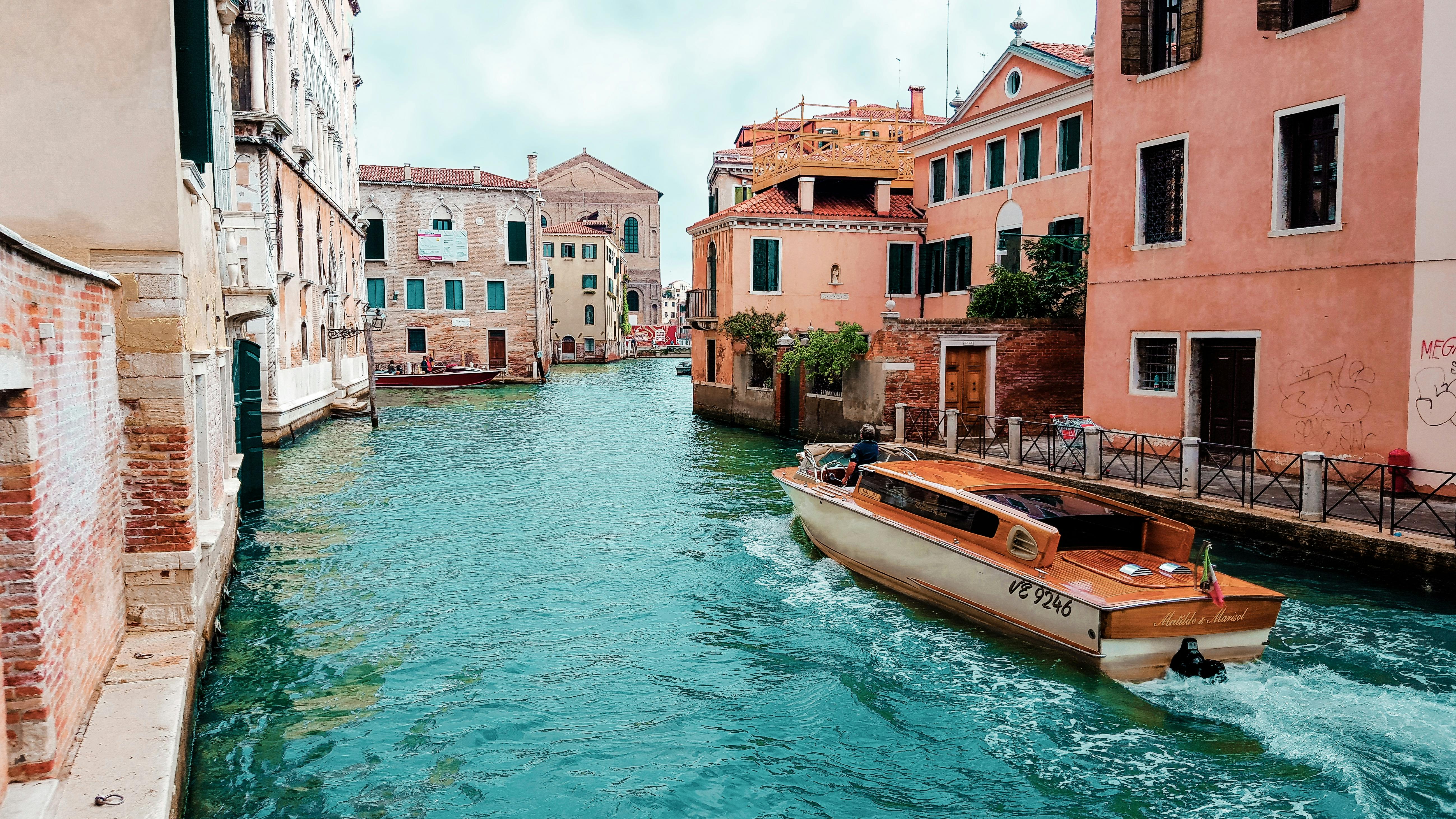
    The legendary floating city built on 118 islands, famous for its romantic canals, stunning architecture, and rich artistic heritage.

    4.8
    Guest Rating
    8°C
    Partly Cloudy
    Humidity: 86%
    Wind: 3 km/h
    Live Temperature
    10
    Active Events

    About Venice

    Venice is one of the world's most extraordinary cities, a masterpiece of human ingenuity built on a lagoon. This enchanting destination offers a unique experience where waterways replace roads and gondolas glide past centuries-old palaces.

    From the iconic St. Mark's Square to the colorful islands of Murano and Burano, Venice is a living museum of art, architecture, and culture. The city's romantic atmosphere, combined with its world-class museums, fine dining, and vibrant cultural scene, makes it an unforgettable destination.

    Climate & Weather

    Tropical climate with year-round warm temperatures and trade winds.

    Best Time to Visit

    April to June, September to October

    Top Highlights

    Iconic St. Mark's Basilica

    Romantic gondola rides

    Rialto Bridge

    World-renowned art museums

    Historic Grand Canal

    Colorful Burano island

    Popular Activities

    Gondola tours through canals
    Visiting St. Mark's Square
    Glass-making tours in Murano
    Exploring Doge's Palace
    Island hopping to Burano
    Art gallery visits

    Quick Info

    Timezone
    Central European Time (CET)
    💰Currency
    Euro (€)
    🗣️Language
    Italian
    Temperature
    22°C

    Upcoming Events

    Venice Carnival 2026
    Cultural, Festival
    TBA

    Venice Carnival 2026

    The Venice Carnival returns from January 31 to February 17, 2026, transforming the island city into a spectacular open-air theater where elaborate 18th-century costumes, exquisite handcrafted masks, and grand masked balls recreate the splendor of La Serenissima. For over two weeks, Piazza San Marco becomes the beating heart of celebrations featuring the famous Flight of the Angel, the Best Masked Costume Contest, and the Festa Veneziana water parade along the Grand Canal. From exclusive palace balls like Il Ballo del Doge to free street performances in the island's atmospheric campos, from traditional mask-making workshops to gondola parades through candlelit canals, the Venice Carnival offers experiences found nowhere else on earth where ancient traditions meet contemporary artistry.

    This extraordinary celebration represents one of the world's most iconic festivals, where every bridge, canal, and palazzo becomes a stage for timeless elegance and mystery.

    The Dates: Carnival Season 2026

    The official Venice Carnival dates for 2026 run from Saturday, January 31, through Tuesday, February 17, culminating on Martedì Grasso (Fat Tuesday), the day before Ash Wednesday begins Lent. However, some sources indicate the main carnival period specifically as February 7-17, 2026, with late January representing pre-carnival festivities.

    The pre-carnival period features the Venetian boat parade along the Grand Canal, a procession of traditional boats lasting approximately 30 minutes. While the municipality organizes street entertainment with professional actors during this preliminary phase, the true magic emerges when amateur costume enthusiasts arrive after February 7.

    These passionate devotees spend months creating extraordinary costumes themselves, transforming into living artworks that embody Venice's centuries-old Carnival traditions. Their presence distinguishes authentic Carnival from commercially extended pre-events, as these self-made masterpieces appear only during the official celebration.

    The two-week duration allows ample opportunity to experience Carnival's various facets, from opening weekend festivities through mid-week masked balls to the grand finale on Fat Tuesday. Each day brings different events, performances, and opportunities for visitors to immerse themselves in Venetian island culture at its most theatrical.

    History: A Thousand Years of Island Celebration

    People have worn masks in Venice for over a thousand years, making Carnival far more than tourist entertainment. The tradition originated as a moment of fusion between noblemen and common Venetians, when masked anonymity allowed social classes to mingle freely. This democratic aspect gave Carnival profound social importance in a rigidly hierarchical society.

    The festival's origins trace to 1162, when Venice celebrated military victory over the Patriarch of Aquileia. The Republic of Venice declared public festivities with singing, dancing, and gathering in Piazza San Marco, establishing traditions that evolved into modern Carnival.

    During the 18th century, Venice Carnival gained international fame, attracting 20,000 to 30,000 foreigners annually, including European royalty. The celebration lasted six weeks, from December 26 through Martedì Grasso, with additional mask-wearing periods throughout the year. Venetians embraced masks as symbols of freedom, allowing them to hide name, social class, religion, and social identification.

    Napoleon ended Carnival in 1797 when he conquered Venice, banning masks and festivities as threats to his authority. The tradition remained suppressed for nearly two centuries until Venice revived Carnival in 1979 as a cultural and tourism initiative. The modern renaissance successfully restored Carnival to its position as one of the world's most spectacular festivals.

    Today's celebration honors historical traditions while incorporating contemporary creativity, creating living connection between Venice's glorious past and vibrant present. The island setting, with its car-free streets and waterways, provides an unmatched backdrop impossible to replicate elsewhere.

    Piazza San Marco: The Heart of Carnival

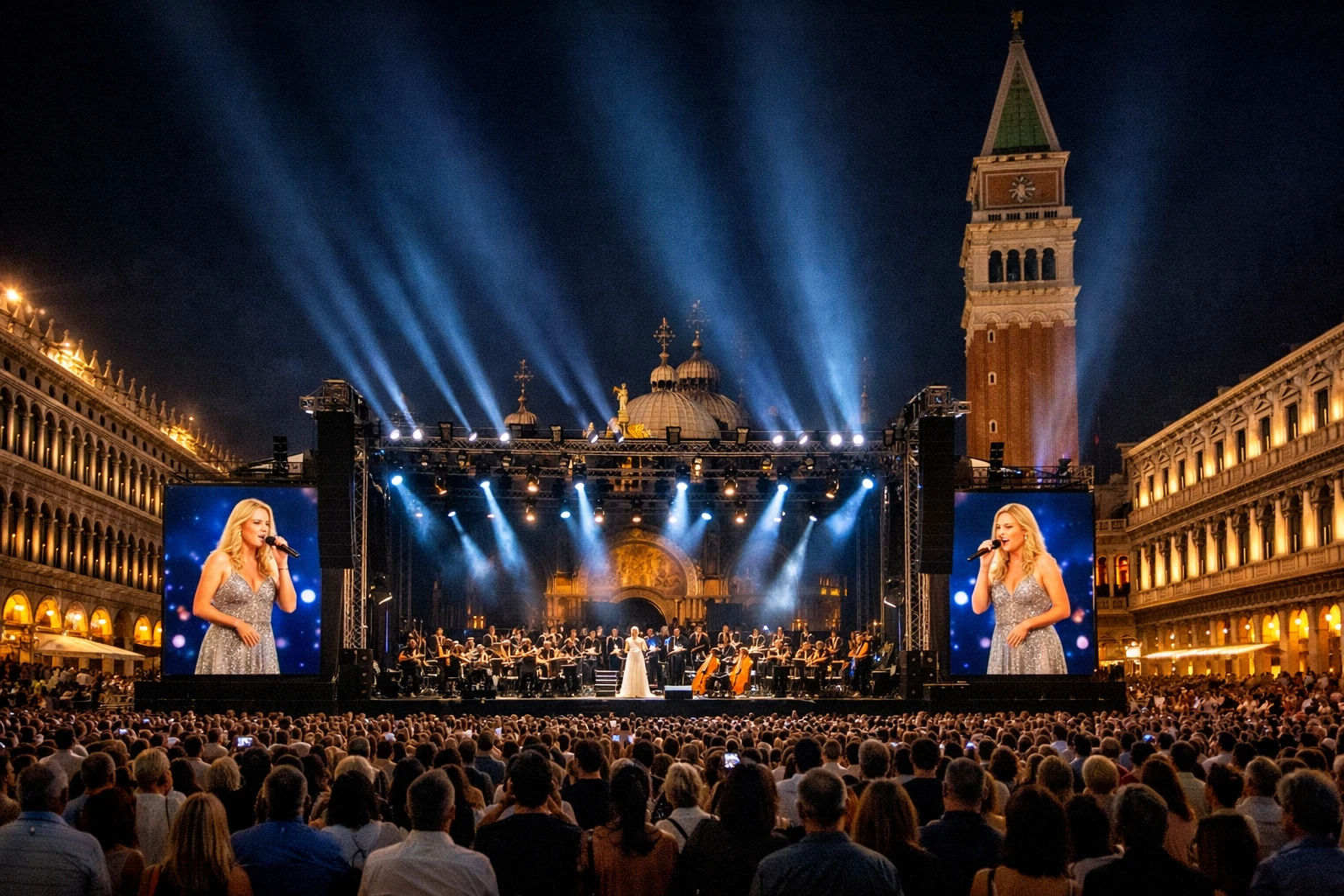
    St. Mark's Square transforms into Carnival's epicenter, hosting the festival's most iconic events. The vast piazza, surrounded by Byzantine architecture and Renaissance arcades, provides a grand stage for performances, parades, and the spontaneous theater created by thousands of elaborately costumed participants.

    The Flight of the Angel

    The Flight of the Angel (Volo dell'Angelo) represents Carnival's most anticipated spectacle. A celebrity or prominent figure, often Olympic medalists, musicians, or television personalities, descends on a cable from St. Mark's Campanile bell tower to the stage in Piazza San Marco below.

    This thrilling event has historical roots in a 16th-century tradition when a young Turkish acrobat walked a tightrope from a boat moored in the lagoon to the Campanile's top, then descended to present homage to the Doge. Modern versions feature elaborate costumes ranging from sleek contemporary designs to richly decorated traditional styles.

    Due to construction work in St. Mark's Square and the Campanile during 2025, the Flight of the Angel, Flight of the Eagle, and Flight of the Lion were cancelled. These spectacular aerial events should resume for the 2026 Carnival, though final dates and times remain provisional until late January 2026.

    Best Masked Costume Contest

    The contest for the most beautiful mask draws costume enthusiasts from worldwide, competing for the coveted title of "Best Mask". Participants spend months or even years creating their elaborate costumes, incorporating period-accurate fabrics, intricate beadwork, towering wigs, and accessories that transform wearers into moving sculptures.

    Judging considers historical accuracy, craftsmanship, creativity, and overall theatrical impact. Winners earn recognition within the international Carnival community and often return annually, creating friendly rivalries and inspiring ever more spectacular creations.

    Festa Veneziana Water Parade

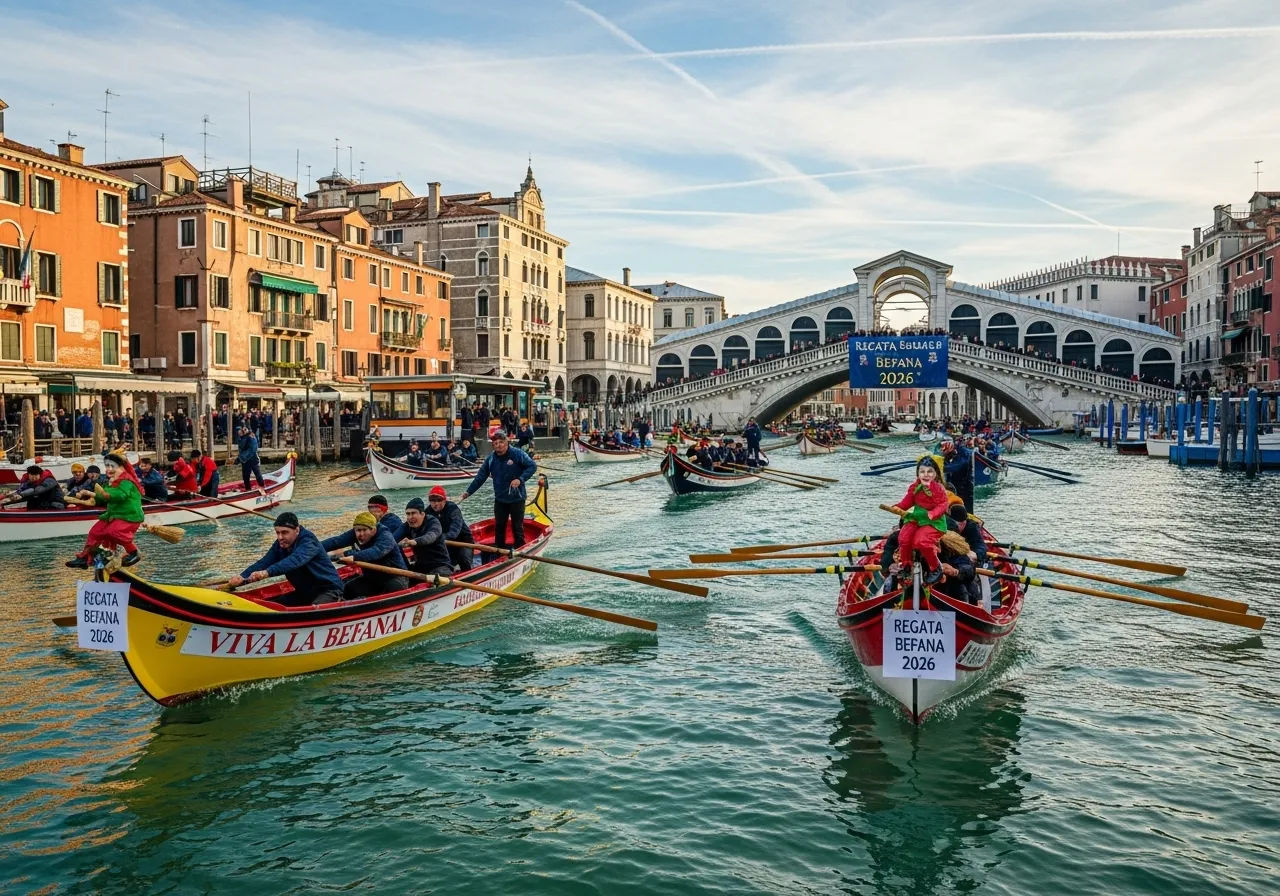
    The Festa Veneziana celebrates Venice's maritime heritage with a grand water parade along the Grand Canal. Traditional Venetian boats, decorated with Carnival colors and carrying costumed passengers, process through the canal in spectacular fashion.

    This event captures the essence of Venice as an island civilization, where celebrations naturally incorporate waterways alongside streets and squares. Spectators line canal banks and bridges, creating a festive corridor of cheering crowds.

    Venetian Masks: Art and Symbolism

    Venetian masks represent centuries of artistic evolution and social significance. Traditional masks are handcrafted from papier-mâché using techniques passed through generations of artisan families. After shaping the base, craftspeople apply layer upon layer of decorative elements including gold leaf, crystals, feathers, and intricate painting.

    Classic Mask Styles

    La Bauta consists of a rectangular mask often worn with a three-pointed tricorn hat and long black cape. This mask's distinctive feature is its ability to distort the wearer's voice, allowing anonymous expression of opinions without fear of identification. The Bauta became synonymous with Venetian freedom during Carnival and was also worn outside the festival for important political meetings.

    The Moretta represents the opposite of the Bauta's vocal freedom. This oval black velvet mask required women to hold it in place by biting a button attached inside, rendering them unable to speak. Some interpret it as the ultimate symbol of femininity, while others view it more critically.

    The Plague Doctor mask, with its distinctive long beak, originated from 17th-century physicians who stuffed the beak with aromatic herbs believing they would protect against disease. While originally functional medical gear, it has become one of Carnival's most recognizable and eerily beautiful mask styles.

    Commedia dell'Arte Masks represent theatrical characters reflecting social stereotypes, with Arlecchino (Harlequin) being the most famous. These masks, traditionally made from leather for durability during performances, showcase the connection between Venetian theater and Carnival traditions.

    Mask Shopping and Workshops

    Venice's mask shops, particularly concentrated in areas around Piazza San Marco and the Rialto Bridge, offer both ready-made masks and custom commissions. Authentic Venetian masks crafted by local artisans using traditional techniques command premium prices, ranging from €50 for simple designs to €500+ for elaborate masterpieces.

    Many workshops offer mask-making classes where visitors learn papier-mâché techniques and decorate their own creations. These hands-on experiences provide deeper appreciation for the artistry behind Carnival masks while creating personal souvenirs.

    Beware of imported plastic or plaster masks sold as "Venetian" but manufactured elsewhere. Genuine masks display quality craftsmanship, are lightweight despite elaborate decoration, and often bear the artisan's signature.

    Masked Balls: Living History

    Attending a Venice Carnival masked ball offers truly unique opportunity to experience Carnival as an active participant rather than spectator. These exclusive events take place in historic Venetian palaces normally closed to the public, providing rare access to Venice's extraordinary private architecture.

    Il Ballo del Doge

    Il Ballo del Doge (The Doge's Ball) ranks as the year's most opulent event, described by Vanity Fair as "the most sumptuous, refined and exclusive ball in the world". Scheduled for Friday, February 14, 2026, this Valentine's Day celebration combines romance with Carnival splendor.

    The ball features multiple artistic performances, cocktail reception, multi-course gourmet dinner, and after-dinner party with music extending into early morning. Period costume is mandatory, with dress codes specified at booking. Guests choose between hiring costumes from renowned Venetian ateliers, purchasing them, or creating their own elaborate ensembles.

    Tickets for Il Ballo del Doge and similar exclusive balls sell out months before Carnival, often within days of becoming available. Early booking is absolutely essential for securing places at these prestigious events.

    Other Palace Balls

    Numerous other masked balls take place throughout Carnival at venues including Palazzo Ca' Zen ai Frari, Hotel Monaco, and various historic residences. The Grand Ball Carnival in Love at Palazzo Ca' Zen ai Frari on February 14, 2026, provides alternative to Il Ballo del Doge with similar elegance at potentially more accessible pricing.

    A Masked Ball on January 31, 2026, opens Carnival season at Hotel Monaco, allowing early arrivals to experience palace party atmosphere. The Ball of Dreams on February 7, 2026, at Palazzo Ca' Zen ai Frari marks the official start of main Carnival festivities.

    Each ball features unique themes, decorative schemes, and entertainment programs. Common elements include period costume requirements, champagne toasts, elaborate buffets or seated dinners, live music, and dancing in gilded ballrooms illuminated by Murano glass chandeliers.

    The Grand Canal and Island Neighborhoods

    While Piazza San Marco concentrates Carnival's official events, the entire island city becomes a stage during February. The Grand Canal, Venice's main waterway, provides spectacular setting for boat parades, gondola processions, and spontaneous photo opportunities as costumed revelers glide past Renaissance palazzos.

    Quieter campos throughout Venice's six sestieri (districts) host impromptu gatherings where smaller groups of costumed participants create intimate theatrical scenes. Cannaregio, Dorsoduro, and Castello districts offer atmospheric alternatives to San Marco's crowds.

    Traditional bacari (Venetian wine bars) serve Carnival specialties including frittelle (Venetian doughnuts) and galani (fried pastry ribbons dusted with powdered sugar). These sweet treats, prepared fresh daily during Carnival season, provide delicious energy for exploring the island.

    The Rialto Bridge and market area maintain vibrant atmosphere throughout Carnival, with costumed shoppers and vendors creating colorful tableaux. Early morning at the Rialto fish market reveals costumed revelers returning from all-night balls, creating surreal juxtaposition of fantasy and daily commerce.

    February Weather and What to Pack

    Venice in February presents cold, damp conditions across the island city and lagoon. Average temperatures range from 3°C to 9°C (37°F to 48°F), with high humidity making the cold penetrating.

    February weather can be unpredictable, with sunny days alternating with fog, rain, and occasional acqua alta (high water) flooding. Pack versatile layers including thermal base layers, warm sweaters, waterproof coat, scarf, gloves, and hat. Waterproof boots with good traction are essential for navigating wet stone pavement and bridges.

    For masked balls and costume dinners, plan elaborate period costumes coordinating with specific event themes. Many visitors hire costumes from Venetian ateliers specializing in historical reproduction, while others ship pre-made costumes from home.

    If creating costumes yourself, consider Venice's February weather when selecting fabrics. Wool, velvet, and heavy brocades provide warmth alongside period authenticity. Bring comfortable shoes hidden beneath long gowns or capes, as cobblestone streets and bridges demand practical footwear.

    Planning Your Carnival Experience

    Venice accommodation during Carnival commands premium rates and sells out months in advance. Book hotels, apartments, or guesthouses immediately upon finalizing dates, particularly for stays including peak weekends.

    Locations in San Marco district provide closest proximity to main events but at highest prices and greatest crowds. Dorsoduro, Cannaregio, or Castello districts offer slightly more affordable options with authentic neighborhood atmosphere just minutes from central celebrations.

    For masked balls, book tickets the moment reservations open, often 6-8 months before Carnival. Il Ballo del Doge and similar exclusive events sell out within days. Costume rentals should be arranged simultaneously, especially for popular events with specific dress codes.

    Reserve restaurants for Carnival period dinners weeks in advance, particularly for February 14 Valentine's Day when demand peaks. Many establishments offer special Carnival menus featuring traditional Venetian dishes.

    Transportation to Venice becomes complicated during Carnival as the island fills beyond typical capacity. Marco Polo Airport handles increased passenger loads, while Santa Lucia train station connects to mainland Italy and Europe. Vaporetto water buses continue operating but expect extreme crowding on lines serving San Marco.

    Experience Timeless Island Magic

    The 2026 Venice Carnival from January 31 to February 17 beckons with promises of transformation, beauty, and experiences transcending ordinary tourism. Book your island accommodations now before availability disappears, arrange costume rentals or creation well in advance, and secure masked ball tickets the moment they become available.

    Pack warm layers for February's cold, bring your camera charged and ready, and prepare to surrender to Venice's most magical season. Stand in Piazza San Marco as the Flight of the Angel descends from the Campanile, surrounded by thousands of elaborately costumed figures creating living artwork.

    Wander through narrow calli where every turn reveals new scenes of theatrical splendor, from solitary figures in plague doctor masks to groups recreating 18th-century court life. Cross bridges over candlelit canals as gondolas glide past carrying costumed passengers singing romantic serenades.

    Dance until dawn at palace balls in gilded ballrooms illuminated by Murano chandeliers, champagne flowing freely while orchestras play waltzes your ancestors danced centuries ago. Taste fresh frittelle from bakery windows, their warmth combating February chill while powdered sugar dusts your elaborate costume.

    Attend mask-making workshops learning techniques perfected over centuries, creating your own wearable art to treasure long after Carnival ends. Watch traditional boat parades along the Grand Canal, understanding how Venice's island geography shapes every aspect of local celebration.

    This is not merely a festival but a portal to another time, where for two glorious weeks Venice becomes the island city of dreams where anything seems possible behind a beautiful mask. Don't just visit Venice during Carnival; become part of its living theater, contributing your own presence to traditions stretching back a millennium.

    The island awaits transformation into the world's grandest stage, and you have the opportunity to play your part in one of humanity's most spectacular celebrations. Reserve your place now in Venice Carnival 2026, where history, art, mystery, and beauty converge in extraordinary island magic found nowhere else on earth.

    Verified Information at a Glance

    Event Name: Venice Carnival 2026 (Carnevale di Venezia)

    Category: Cultural Festival / Masked Ball Celebration / Historical Tradition

    Official Dates: January 31 to February 17, 2026 (Saturday to Tuesday)

    • Main Carnival period: February 7-17, 2026
    • Pre-Carnival period: January 31-February 6, 2026
    • Culmination: Martedì Grasso (Fat Tuesday), February 17, 2026

    Main Venue: Piazza San Marco (St. Mark's Square), Venice

    Key Events:

    Flight of the Angel (Volo dell'Angelo):

    • Venue: St. Mark's Campanile to Piazza San Marco
    • Status: Should resume in 2026 after 2025 cancellation due to construction
    • Dates/times: Provisional until late January 2026
    • Features: Celebrity descends from bell tower on cable

    Best Masked Costume Contest:

    • Venue: Piazza San Marco
    • Features: International competition for most beautiful mask and costume

    Festa Veneziana Water Parade:

    • Venue: Grand Canal
    • Features: Traditional Venetian boats with costumed passengers

    Venetian Boat Parade (Pre-Carnival):

    • Venue: Grand Canal
    • Duration: Approximately 30 minutes

    Major Masked Balls 2026:

    Il Ballo del Doge (The Doge's Ball):

    • Date: Friday, February 14, 2026
    • Described as: "Most sumptuous, refined and exclusive ball in the world" (Vanity Fair)
    • Includes: Performances, cocktails, dinner, after-party
    • Booking: Must reserve months in advance; sells out quickly

    Other Palace Balls:

    • A Masked Ball: January 31, 2026, Hotel Monaco
    • The Ball of Dreams: February 7, 2026, Palazzo Ca' Zen ai Frari
    • Grand Ball Carnival in Love: February 14, 2026, Palazzo Ca' Zen ai Frari

    Traditional Masks:

    • La Bauta: Rectangular mask with voice-distorting properties
    • The Moretta: Silent mask held by biting internal button
    • Plague Doctor: Long-beaked mask from 17th-century physicians
    • Commedia dell'Arte: Theatrical character masks including Harlequin

    Mask Materials: Traditional papier-mâché and leather; avoid plastic/plaster imports

    Mask Prices: €50-€500+ for authentic artisan-made masks

    Costume Requirements: Period costumes mandatory for masked balls; themes specified at booking

    • Options: Rent from Venetian ateliers, purchase, or create yourself

    Traditional Foods: Frittelle (Venetian doughnuts), galani (fried pastry ribbons with powdered sugar)

    Weather: Temperatures 3-9°C (37-48°F); cold, damp, potentially foggy or rainy

    What to Pack:

    • Daily wear: Waterproof boots, warm layers, thermal underwear, coat, scarf, gloves, hat
    • Ball wear: Elaborate period costumes coordinating with event themes

    Historical Context:

    • Origins: 1162, celebrating victory over Patriarch of Aquileia
    • Mask wearing: Over 1,000 years of tradition
    • Golden age: 18th century with 20,000-30,000 annual foreign visitors
    • Suppression: 1797-1979 under Napoleon and subsequent regimes
    • Modern revival: 1979

    Accommodation: Book months in advance; premium rates during Carnival

    Transportation: Marco Polo Airport, Santa Lucia train station; vaporetto water buses extremely crowded

    Planning Timeline:

    • Accommodations: Book 6-12 months ahead
    • Masked ball tickets: Book 6-8 months ahead when reservations open
    • Costume rentals: Arrange simultaneously with ball tickets
    • Restaurant reservations: Book 4-6 weeks ahead

    Admission: Most street events free; masked balls €200-€500+ per person

    Verified Sources: Official Carnevale di Venezia website, Venice tourism authority, palace ball organizers, historical records confirm all details


    Historic center, Ca' Vendramin Calergi, Venice
    Jan 31, 2026 - Feb 17, 2026
    CMP Venice Night Trail (10th edition) 2026
    Sport/Running
    TBA

    CMP Venice Night Trail (10th edition) 2026

    MP Venice Night Trail (10th edition) 2026 is confirmed for Saturday, March 28, 2026, with a 9:00 PM start and a spectacular 16K night route over 51 bridges through Venice, starting and finishing at Venezia Tronchetto, Cruise Terminal 123. With entry fees starting at €41 (and rising to €47 from March 1), it’s one of Italy’s most iconic “run the city after dark” events, and a dream race-cation for travelers who want Venice at its most atmospheric.

    CMP Venice Night Trail 2026: Venice After Dark, On Foot

    There’s Venice in the daytime and then there’s Venice at night, when the calli feel quieter, the reflections grow deeper, and every turn looks like a film set. CMP Venice Night Trail is built around that magic, describing itself as a 16K run through Venice’s historic center, “up and down 51 bridges,” between the mystery and charm of Venice by night. Unlike a standard road race, this event feels like an urban adventure: tight alleyways, sudden little squares, and constant rhythm changes as you climb bridge steps and descend back to canal level.

    For event seekers, the “10th edition” factor matters too. Anniversaries tend to bring extra energy and participation, and the official site is already positioning March 28, 2026 as the big date to circle.

    Verified Date, Start Time, and Location Details

    Date, Time, and Venue Confirmed

    The official Venice Night Trail page confirms the race date as 28th March 2026. It also confirms the start time is 9 p.m., starting from Venezia Tronchetto, Cruise Terminal 123. The same page confirms the finish line is also Venezia Tronchetto, Cruise Terminal 123, making this a clean start/finish setup for travelers who want predictable logistics.

    This matters for planning your Venice stay. Tronchetto is connected to the historic center, but it’s also a transport node, which helps when you’re arriving with luggage, heading to bib pickup, or planning your post-race return to your hotel.

    Distance, Bridges, and Venice Route Highlights (Verified)

    Venice Night Trail is marketed as “16K & 51 Bridges,” and the official page confirms the route passes through Venice’s typical areas, crossing fields and small squares, reaching as far as the Biennale, and then continuing through Piazza San Marco, the Accademia bridge, and Punta della Dogana. It also confirms you’ll run along Fondamenta delle Zattere to San Basilio, alongside the Giudecca Canal, before heading back through the port area to the final straight.

    These are not minor streets. They’re some of the most recognizable parts of Venice, which is why this race is so travel-worthy: the course itself becomes your Venice sightseeing tour, only under night skies.

    Entry Fees, Participant Cap, and Registration Inclusions (Verified)

    Registration Costs

    The official page lists the 2026 entry fees clearly:

    • €41 from 1 January 2026 until 28 February 2026.
    • €47 from 1 March 2026.

    It also confirms an entry cap of 5,500 athletes. Registration includes practical race services that matter when traveling:

    • Race number with timing chip included.
    • Medical assistance.
    • Refreshment along the course and at the finish line.
    • Dressing tent and toilets at both start and finish.
    • Timing service and a finisher commemorative medal.

    The same page notes that entry fees are non-refundable, but that participants can add insurance through Endu for potential reimbursement (covering 90% of the fee, subject to recognition of compensation).

    Bib Pickup at Venice Running Village (Verified)

    The official page confirms bib pickup at the Venice Running Village at Venice Tronchetto, Cruise Terminal 123:

    • Friday, March 27 from 3 PM to 8 PM.
    • Saturday, March 28 from 9 AM to 7 PM.

    For travelers, this is a big advantage. You can arrive Friday, pick up your bib in the afternoon, and keep race day calmer. Or, if you’re arriving Saturday, you still have a wide pickup window before the 9 PM start.

    Night-Race Essentials: What to Bring and What to Expect

    The official race page describes Venice at night as part of the event’s identity, and it encourages runners to bring everything they will need during the race. It also confirms there is a refreshment station about halfway along the course with water and individually wrapped biscuits, and that the finish area includes storage service, changing rooms with toilets, and refreshments.

    For a night run through Venice, packing smart matters more than usual:

    • Wear shoes with reliable grip for bridge steps and potentially damp stone.
    • Use layers that work for a cool spring evening.
    • Carry only what you truly need, because the constant bridge work makes excess weight noticeable.

    Venice Travel Tips: Make it a Full Weekend

    Venice Night Trail being on a Saturday night is perfect for a weekend trip. Plan to arrive at least one day early so you can:

    • Handle bib pickup without stress.
    • Explore Venice in daylight, then “meet it again” at night during the race.
    • Enjoy a slow Sunday morning afterward, when Venice’s quieter corners feel especially rewarding.

    Because the race starts at 9 PM, you can also spend Saturday doing light sightseeing and a gentle walk, then rest, eat early, and head to Tronchetto in time for the start.

    Run CMP Venice Night Trail 2026

    CMP Venice Night Trail (10th edition) 2026 is confirmed for Saturday, March 28, 2026, starting at 9:00 PM from Venezia Tronchetto, Cruise Terminal 123, and taking runners through 16K across 51 bridges in the heart of Venice. With verified entry fees of €41 through February 28 and €47 from March 1, plus a cap of 5,500 athletes, it’s a race that rewards early registration and travel planning. If Venice has been on your list for years, this is your moment to experience the city in its most magical form, running bridge to bridge through moonlit calli and finishing with the satisfaction of having truly earned your Venetian night.

    Verified Information at a Glance

    Event Name:

    • CMP Venice Night Trail (10th edition) 2026

    Event Category:

    • Night running event / urban trail race

    Country/City:

    • Venice (Venezia), Italy

    Confirmed Date:

    • Saturday, March 28, 2026

    Confirmed Start Time:

    • 9:00 PM

    Confirmed Start Location:

    • Venezia Tronchetto, Cruise Terminal 123

    Confirmed Finish Location:

    • Venezia Tronchetto, Cruise Terminal 123

    Distance (Verified):

    • 16.5 km (listed on official page)

    Key Feature (Verified):

    • 51 bridges

    Entry Fees (Verified):

    • €41 (Jan 1–Feb 28, 2026); €47 (from Mar 1, 2026)

    Entry Cap (Verified):

    • 5,500 athletes

    Bib Pickup (Verified):

    • Venice Running Village, Tronchetto Cruise Terminal 123; Fri Mar 27 3 PM–8 PM; Sat Mar 28 9 AM–7 PM

    Included with Registration (Verified):

    • Timing chip, medical assistance, refreshment stations, dressing tent and toilets, timing service, finisher medal
    Venice (historic centre route), Venice
    Mar 28, 2026 - Mar 28, 2026
    Biennale Arte 2026 (61st International Art Exhibition)
    Festival/Exhibition (Art)
    TBA

    Biennale Arte 2026 (61st International Art Exhibition)

    Biennale Arte 2026 Event DescriptionBiennale Arte 2026, the 61st International Art Exhibition of La Biennale di Venezia, runs from 9 May to 22 November 2026 across Venice’s headline venues Giardini, Arsenale, and Forte Marghera, turning the lagoon city into a living map of contemporary art. With early-bird tickets already on sale, it is one of the easiest major global art events to plan in advance, whether you come for one intense day or a slow, island-style week of wandering between exhibitions, canals, and hidden courtyards.

    Biennale Arte 2026 in Venice: Contemporary Art in a Lagoon City

    Venice is a city of water and islands, and that geography changes the way you experience art. Instead of driving from museum to museum, you walk across bridges, ride vaporetto boats, and drift through neighborhoods where art appears behind old doors and along quiet canals. Biennale Arte 2026 fits Venice perfectly because it uses the city itself as part of the exhibition language.

    La Biennale di Venezia’s official information page confirms the event name and dates, and places the heart of the exhibition in the Giardini and Arsenale, with Forte Marghera also listed as a venue for 2026. For travelers, this matters because it helps you plan your days by geography: one day for Giardini, one for Arsenale, and a flexible day for anything off the main route.

    Confirmed 2026 Dates, Venues, and Opening Pattern

    The official Biennale Arte 2026 information page confirms the exhibition runs 9 May > 22 November 2026 at Giardini / Arsenale / Forte Marghera. It also confirms the weekly closure pattern: Biennale Arte 2026 is closed on Mondays, except 11 May and 16 November, which are open.

    Opening Hours You Can Plan Around

    La Biennale’s official page lists:

    • Summer opening hours (May to September): 11:00 am to 7:00 pm, last admission 6:45 pm.
    • Extended Arsenale hours until end of September: Fridays and Saturdays open until 8:00 pm, last admission 7:45 pm.
    • Autumn opening hours (October to 22 November): 10:00 am to 6:00 pm, last admission 5:45 pm.

    That one extra evening hour at the Arsenale on Fridays and Saturdays can be a game changer. Venice is beautiful at dusk, and visiting the Arsenale later lets you pair art with a golden-hour walk through Castello or along the waterfront.

    What Biennale Arte Is: A Brief Background and Why It Matters

    The Biennale Arte is not a single exhibition by one museum. It’s a global-scale contemporary art event produced by La Biennale di Venezia, with multiple layers including the curated international exhibition and national participations, plus collateral events around the city.

    For visitors, the real joy is the range. You might start your morning with a museum-like experience in the Giardini, then spend the afternoon in the Arsenale’s long, dramatic spaces, and end the day discovering a smaller show in a palazzo you would never have entered otherwise. This variety is exactly why the Biennale has a reputation for rewarding curiosity.

    Biennale Arte 2026 Theme and Curatorial Direction (What’s Confirmed)

    La Biennale’s early-bird ticket announcement confirms the 61st International Art Exhibition is titled In Minor Keys. The same official notice explains that the exhibition will be produced by La Biennale di Venezia with contributions from professionals selected and directly involved by the curator Koyo Kouoh, and it notes that she passed away on 10 May 2025.

    The announcement also confirms an important planning detail for art fans: the Biennale will reveal the project details, including invited artists and participating countries, at the customary presentation in Venice on 25 February 2026. If you like building a trip around specific pavilions or artists, that date is when you can start mapping your must-sees more precisely.

    Ticket Prices for Biennale Arte 2026 (Early Bird and Extras)

    Ticketing is clearly outlined by La Biennale di Venezia, and the official site states that tickets and guided tours are purchasable online only. It also lists a presale fee of €0.50.

    Early Bird Ticket Prices (Confirmed)

    The official Biennale Arte 2026 information page lists these early-bird prices:

    • Early Bird 3-day ticket: €30 instead of €40, valid for 3 consecutive days (weekly closing day excluded).
    • Early Bird ticket (one-access): €25 instead of €30, valid for 1 entrance at Giardini and 1 entrance at Arsenale.
    • Early Bird Student ticket: €12 instead of €16, valid for 1 entrance at Giardini and 1 entrance at Arsenale.
    • Early Bird Accreditation: €60 instead of €80, valid until 22 November 2026.
    • Early Bird Accreditation for students and/or under 26: €30 instead of €45, valid until 22 November 2026.

    La Biennale’s news announcement confirms the early-bird campaign runs until the end of March, after which ticket sales continue at full price.

    Guided Tours (Confirmed Price)

    Both the information page and the early-bird announcement list guided tours at scheduled hours for €8 per venue, per person, instead of €10 during the early-bird promotion. If you want structure without over-planning, this is a straightforward add-on for one venue, then you can explore freely afterward.

    How to Experience Venice Biennale Like a Traveler, Not a Checklist

    Biennale Arte can overwhelm even serious art lovers. Venice helps if you let the city set your pace.

    Plan Your Days by Geography: Giardini, Arsenale, Then “The City”

    The official venues list makes planning simple: Giardini and Arsenale are your two core days, and Forte Marghera can be a third day if you want to go deeper. Instead of trying to see everything, choose one anchor venue per day and treat everything else as a bonus.

    Pick a Neighborhood Base That Matches Your Style

    • Castello is ideal if you want to be near the Arsenale and enjoy a calmer, local feel in the evenings.
    • San Marco is convenient for classic Venice sights, but it can be busier.
    • Dorsoduro suits travelers who love galleries, sunsets, and a slightly slower rhythm.

    Venice is effectively an island city, so walking is part of the experience. Choose accommodation that reduces long back-and-forth trips so your energy goes to the art, not logistics.

    Eat Like a Venetian Between Venues

    Between Giardini and Arsenale visits, build in time for cicchetti and a calm lunch. The Biennale is mentally intense, and small breaks help you stay present and curious. A good Venice day is art, water, food, then art again.

    Practical Travel Tips for Biennale Arte 2026 Visitors

    Best Time to Visit: May, Early Summer, or Autumn

    Biennale Arte runs from May into late November, which gives you many travel styles. May and early summer can feel vibrant and social, while autumn offers a softer atmosphere and fewer crowds as the season shifts.

    Know the Monday Closures

    Because the Biennale is closed on Mondays except two specific dates, build your itinerary around that pattern so you don’t arrive on a closed day and lose momentum.

    Use the Extended Arsenale Hours

    If you are visiting before the end of September, the Friday and Saturday late openings at the Arsenale let you avoid peak times and enjoy the venue in a calmer evening light.

    Verified Information at a Glance

    Item: Confirmed details

    • Event name: Biennale Arte 2026 (61st International Art Exhibition)
    • Event category: International contemporary art exhibition (La Biennale di Venezia)
    • Confirmed dates: 9 May to 22 November 2026
    • Confirmed main venues: Giardini / Arsenale / Forte Marghera
    • Confirmed closure pattern: Closed Mondays, except 11 May and 16 November (open).
    • Confirmed opening hours: May–Sep: 11:00–19:00 (last admission 18:45); Arsenale Fri/Sat until 20:00 (last admission 19:45) until end of Sep; Oct–22 Nov: 10:00–18:00 (last admission 17:45).
    • Confirmed theme/title: In Minor Keys
    • Confirmed early-bird ticket prices: 3-day €30 (instead of €40); one-access €25 (instead of €30); student €12 (instead of €16).
    • Confirmed early-bird accreditation prices: €60 (instead of €80); students/under 26 €30 (instead of €45).
    • Confirmed guided tour price (early bird): €8 per venue (instead of €10).
    • Ticket purchase method (confirmed): Tickets and guided tours purchasable online only; presale fee €0.50.
    • Next official announcement date (confirmed): Project details to be announced at presentation in Venice on 25 February 2026.

    If Venice has ever felt like a city you wanted to experience slowly, Biennale Arte 2026 gives you the perfect reason to wander the Giardini and Arsenale, follow contemporary art across canals and island-like neighborhoods, and let the lagoon light lead you from one unexpected exhibition doorway to the next.

    , Venice
    May 9, 2026 - Nov 22, 2026
    Salone Nautico Venezia 2026 (Venice Boat Show)
    Exhibition (Boating)
    TBA

    Salone Nautico Venezia 2026 (Venice Boat Show)

    Salone Nautico Venezia 2026: Venice’s boat show in its most iconic maritime venue

    Salone Nautico Venezia 2026 (Venice Boat Show) is officially scheduled for May 27 to May 31, 2026 in Venice, Italy, hosted in the spectacular historic Arsenale di Venezia, where boats are displayed on the water inside the city’s lagoon-side shipyard setting. It’s one of the most atmospheric boat shows in Europe, combining yacht premieres, tech and sustainability showcases, sea trials, and a uniquely Venetian cultural backdrop of canals, islands, and maritime history.

    Venice is not just a beautiful city. It is a maritime idea, built on shipbuilding, navigation, trade, and a lagoon that still shapes everyday life. That’s why Salone Nautico Venezia feels different from a standard exhibition hall boat show. At the Arsenale, vessels sit where they belong, floating in water inside one of the most historically important naval complexes in Europe.

    The event is positioned as a “Great Event” by the City of Venice, and it consistently attracts boating professionals, sailing lovers, design fans, and travelers who simply want to experience Venice from a new angle. If you are planning a spring trip to Italy, these five days offer a perfect reason to pair classic Venice sightseeing with a modern, future-focused maritime exhibition.


    Confirmed 2026 dates and venue (plus what’s officially stated)

    The City of Venice’s Venezia Unica events listing confirms the Venice Boat Show returns from May 27 to May 31, 2026. The official Salone Nautico Venezia site confirms the show takes place along the quays of the Arsenale, and notes it is promoted by the Municipality of Venice and organized by Vela Spa in collaboration with the Italian Navy.


    What “Arsenale” means for your visit

    The Arsenale is not a generic venue. It is a waterfront world of docks, quays, and historic structures that gives the show its signature look and feel. Expect a setting that is visually dramatic, walkable, and full of those Venice-only views where masts, modern hulls, and ancient brickwork share the same frame.


    A quick history and why the Venice Boat Show stands out

    Salone Nautico Venezia is designed to feel immersive, not just informative. The official site describes it as one of the main international exhibitions in the sector and highlights scale figures such as 270 exhibitors, 300 boats, and a 55,000 sqm water basin, pointing to a major show footprint rather than a niche gathering.

    It also highlights a program beyond static displays, mentioning five days of presentations and thematic congresses, water trials, and sporting regattas, which signals that visitors can expect a mix of learning, hands-on experiences, and on-water action. Even if you arrive as a curious traveler rather than a buyer, this variety makes the event easy to enjoy for a full day.


    What you’ll see at Salone Nautico Venezia 2026: boats, innovation, and water experiences

    The Venice Boat Show is the kind of event where you can switch between design admiration and practical boating questions in the same afternoon. According to the official site, the show features a blend of motor and sailing segments, plus catamarans and new concepts in onboard livability. It also notes that 15 world premieres are scheduled to be on display along the Arsenale quays, adding excitement for visitors who love spotting what’s new before the rest of the market sees it.


    Highlights to build your day around

    • New boats and world premieres, especially if you enjoy comparing hull styles, deck layouts, and design ideas.
    • Thematic congresses and presentations, a good fit if you care about propulsion trends, materials, or sustainable boating.
    • Water trials, which bring the show to life by moving from “look” to “experience.”
    • Sporting regattas, adding a sense of motion and competition inside a city already famous for waterborne tradition.


    Venice, the lagoon, and local flavor: turning a boat show into a full travel experience

    Calling Venice an island destination is not a stretch. The historic center functions like a compact archipelago of neighborhoods separated by canals, and the lagoon is dotted with islands that make perfect day trips. Visiting the Venice Boat Show can be the anchor for a week that feels both urban and coastal.


    Pair the show with classic Venice landmarks

    Before or after your Arsenale visit, you can explore nearby lagoon-side areas and iconic viewpoints. Because the boat show sits in a maritime setting, it naturally connects with Venice’s identity as a city shaped by shipbuilders, sailors, and naval power, making sightseeing feel more meaningful.


    Add island time in the Venetian lagoon

    If you want a quieter counterbalance to show crowds, schedule one lagoon-island afternoon. Many travelers pair Venice visits with lagoon exploration, and it complements the boat show beautifully because you shift from “boats on display” to “boats as daily life.”


    Practical travel tips for Salone Nautico Venezia 2026

    Best time to visit during the five days

    If you prefer less crowding, aim for a weekday visit early in the show run. If you enjoy peak energy and the widest mix of visitors, the weekend dates tend to feel livelier.

    What to wear and bring

    • Comfortable walking shoes, because even a waterfront venue involves a lot of walking on stone paths and quays.
    • A light layer, since lagoon breezes can shift quickly in late May.
    • A phone power bank, because the Arsenale setting is extremely photo-friendly.

    Plan your Venice logistics smartly

    Venice rewards early starts. Arrive near opening, enjoy the boats with space to breathe, then take a long lunch away from the busiest routes before returning for late-afternoon talks or on-water activities.


    Ticket pricing and entry costs: what’s verified right now

    The official sources retrieved here confirm the dates and identify the Arsenale as the venue, but they do not provide a verified 2026 ticket price or 2026 pricing tiers in the visible text. Because ticket costs can change year to year and may include online discounts, concessions, or timed entry, it’s best to check the official Salone Nautico Venezia ticketing page once 2026 sales go live, then book as soon as your travel dates are fixed.


    Verified Information at a glance

    Item: Confirmed details

    • Event name: Salone Nautico Venezia 2026 (Venice Boat Show)
    • Event category: International boat show and maritime exhibition, with presentations, congresses, water trials, and sporting regattas.
    • Confirmed dates: May 27–31, 2026
    • Confirmed venue: Arsenale (Arsenale di Venezia), Venice, Italy
    • Official promoters/organizers: Promoted by the Municipality of Venice; organized by Vela Spa in collaboration with the Italian Navy.
    • Verified scale indicators (from official site): “270 exhibitors,” “300 boats,” water basin of “55,000 sqm,” plus “15 world premieres” scheduled.
    • Pricing: 2026 ticket prices not confirmed in the retrieved official text; verify on official ticket channels closer to the event.


    If you’ve been waiting for the perfect reason to visit Venice when the city feels sunlit and alive, set your sights on May 27 to 31, 2026, step into the Arsenale’s waterfront corridors, and let Salone Nautico Venezia guide you through the future of boating in a place where the sea has always been part of the city’s soul.

    , Venice
    May 27, 2026 - May 31, 2026

    Past Events

    Regata della Befana 2026
    Sports, Traditional
    Free

    Regata della Befana 2026

    Every January 6, Venice's Grand Canal becomes the stage for one of Italy's most delightful and unique traditions as fifty rowers dressed as La Befana, Italy's beloved gift-giving witch, race from San Tomà to the Rialto Bridge in the spirited Regata della Befana. On Monday, January 6, 2026, this ancient island celebration returns, combining athletic competition with folkloric pageantry as members of the historic Bucintoro rowing club navigate traditional Venetian mascaretas through the canal wearing tattered shawls, pointy hats, and carrying broomsticks. The race concludes at an enormous sock hanging from the Rialto Bridge, filled with sweets and treats for the winner in a spectacle that perfectly captures Venice's ability to preserve centuries-old customs while delighting contemporary audiences along the island city's most famous waterway.

    This charming event marks the conclusion of Italy's holiday season and offers visitors an authentic window into Venetian culture far removed from typical tourist experiences.

    La Befana: Italy's Christmas Witch

    Understanding the Regata della Befana requires knowing the legend of La Befana, one of Italy's most cherished folkloric figures. La Befana is depicted as a kind old woman, often in tattered clothes, who flies on a broomstick through the night of January 5-6 delivering gifts to Italian children.

    According to the most popular legend, the Three Wise Men stopped at La Befana's home while journeying to Bethlehem to visit baby Jesus. They invited her to join them, but she declined, preoccupied with household chores. Later regretting her decision, La Befana set out to find the Christ child, carrying gifts. Unable to locate him, she has wandered ever since, leaving presents for children on Epiphany night in hopes one might be Jesus.

    The tradition holds that La Befana fills stockings hung by fireplaces or windows with candy and small toys for well-behaved children, while naughty ones receive coal (now typically sugar coal that's actually edible). Her name derives from "Epifania," the Italian word for Epiphany, corrupted through regional dialects into "Befana".

    While La Befana's legend connects to Christian tradition, her origins reach back to pre-Christian pagan customs celebrating the winter solstice and the agricultural cycle. Ancient Romans believed flying witches visited homes during winter nights to bless crops for the coming growing season. When Christianity spread through Italy, these pagan traditions merged with Epiphany celebrations, creating the distinctive figure of La Befana.

    Unlike Santa Claus's jolly appearance, La Befana presents as an old, sometimes ugly witch covered in soot from climbing down chimneys. Despite her frightening appearance, Italian children love her as a benevolent gift-giver who rewards good behavior. She represents the grandmother archetype, wise and caring despite her rough exterior.

    The Grand Canal Race: Tradition Meets Competition

    The Regata della Befana transforms this beloved folklore into athletic competition on Venice's most iconic island waterway. The race begins at 11:00 AM on January 6, 2026, starting from the San Tomà area and proceeding along the Grand Canal to finish beneath the Rialto Bridge.

    Approximately fifty participants, all members of Venice's oldest rowing club, the Bucintoro, founded in 1882, dress in elaborate Befana costumes. They don black shawls, pointy witch hats, and carry broomsticks as they board their mascaretas, traditional single-oared Venetian boats. Some competitors enhance their costumes with exaggerated makeup, crooked noses, and gray wigs, fully embracing the witch persona.

    The race format features "veterans" over 55 years old demonstrating their rowing prowess along the Grand Canal's historic waters. These experienced rowers, many with decades of Venetian rowing tradition behind them, prove that age enhances rather than diminishes skill in the voga alla veneta (Venetian rowing) technique.

    Spectators line both sides of the Grand Canal, creating a festive corridor of cheering crowds as the costumed Befanas race past Renaissance palazzos and beneath ancient bridges. The atmosphere combines sporting competition with carnival-like celebration, as participants ham up their witch roles, cackling and gesturing to the crowds between vigorous rowing strokes.

    The finish line at the Rialto Bridge features an enormous stocking suspended from the bridge's famous arches, stuffed with candies, sweets, and small gifts. This giant sock serves as both finish marker and prize container, with the winning Befana claiming the honor of reaching this symbolic bounty first. The sight of determined "witches" racing toward a massive stocking hanging from Venice's most photographed bridge creates unforgettable imagery that encapsulates the event's whimsical nature.

    Venice's Island Geography and the Race Course

    The race route showcases the Grand Canal's role as Venice's main thoroughfare, winding through the heart of the historic island city. Starting from San Tomà in the San Polo district, the course proceeds northeast toward the Rialto Bridge, covering approximately 1.5 kilometers of the canal.

    The Grand Canal itself forms an S-shape through central Venice, dividing the island into two main sections connected by only four bridges. This watery highway has served as Venice's primary transportation route for over a thousand years, making it the perfect venue for a regatta celebrating local maritime traditions.

    Palazzo-lined banks create a spectacular backdrop for the race, with Gothic, Renaissance, and Baroque facades rising directly from the water. Famous buildings including Ca' d'Oro, Ca' Rezzonico, and Palazzo Grassi appear along the route, though racers focus more on speed than sightseeing.

    The Rialto Bridge, completed in 1591, represents one of Venice's most iconic landmarks and serves as the perfect finish line for this traditional event. The bridge's single stone arch spans 28 meters across the canal at one of its narrowest points, creating a dramatic gateway that racers must navigate.

    Venice's unique island geography, where canals replace streets and boats substitute for cars, makes rowing regattas natural expressions of local culture. The city's relationship with water defines every aspect of Venetian life, from daily commuting to festive celebrations like the Regata della Befana.

    Epiphany Traditions Beyond the Regatta

    The Regata della Befana represents just one aspect of Venice's Epiphany celebrations on January 6. This date marks a national holiday throughout Italy, commemorating when the Three Wise Men visited baby Jesus bearing gifts of gold, frankincense, and myrrh.

    In Piazza San Marco, the Clock Tower (Torre dell'Orologio) stages an extraordinary spectacle every hour beginning at noon. Wooden figures representing the Three Magi emerge from a side panel, preceded by an angel with trumpet, and process before statues of the Virgin Mary and baby Jesus before disappearing back into the ancient tower. This mechanical procession, operating since the 15th century with 18th-century replacement figures, creates a giant carillon effect visible from the square below.

    Italian families observe Epiphany as the final day of the Christmas season, traditionally taking down decorations and nativity scenes after January 6. Children awaken to find stockings filled by La Befana during the night, creating excitement comparable to Christmas morning.

    Traditional Epiphany foods include the Befana cake, ring-shaped cakes containing hidden surprises similar to king cakes in other cultures. Families also enjoy leftover Christmas treats like panettone and pandoro alongside new sweets delivered by La Befana.

    Churches throughout Venice hold special Epiphany masses celebrating the manifestation of Christ to the Gentiles through the Magi's visit. These religious observances emphasize the feast's sacred significance beyond folkloric traditions.

    The holiday represents the last day of school vacation for Italian children, adding bittersweet notes to the celebration. La Befana's arrival signals that normal routines resume the following day, making her final treats especially treasured.

    Viewing the Regata della Befana

    Prime viewing locations for the race include any point along the Grand Canal between San Tomà and the Rialto Bridge. The most popular spot is directly at the Rialto Bridge itself, where crowds gather to watch competitors approach the finish and reach for the giant stocking.

    Arriving early is essential for securing good viewing positions, particularly at the Rialto Bridge. By 10:00 AM, spectators begin claiming spots along the bridge and canal-side fondamente (walkways). The narrow pathways and limited space mean popular areas fill quickly.

    Alternative excellent viewing positions include the Ca' d'Oro vaporetto stop and the Riva del Vin alongside the Rialto market. These locations provide slightly less crowded perspectives while maintaining clear sightlines of the racing Befanas.

    For truly unique views, consider booking a table at one of the restaurants with Grand Canal terraces along the race route. Establishments including Ristorante Terrazza Sommariva and other canal-side venues offer breakfast or lunch seating with front-row race perspectives. Reservations for January 6 should be made well in advance.

    Some visitors choose to view from vaporetto water buses, though this presents challenges. ACTV Line 1, which follows the Grand Canal route, continues operating during the race with modified schedules. However, crowding and the boats' movement make photography difficult and views fleeting.

    The race itself lasts only 15-20 minutes from start to finish, with skilled rowers covering the distance quickly despite their cumbersome costumes. However, the pre-race pageantry, costume displays, and post-race celebrations extend the spectacle to approximately one hour.

    January Weather and Island Exploration

    Venice in early January presents crisp winter conditions across the island city and lagoon. Average temperatures range from 2°C to 7°C (36°F to 45°F), with humidity from surrounding water creating penetrating cold.

    The weather can be unpredictable, alternating between cold sunny days and foggy, damp conditions. January occasionally brings acqua alta (high water), when exceptional tides flood low-lying areas including parts of Piazza San Marco. The city provides elevated walkways during these events, and most Grand Canal viewing areas sit above flood levels.

    Dress in warm layers including thermal base layers, wool sweaters, waterproof winter coat, warm scarf, gloves, and hat. Waterproof boots with good traction prove essential for navigating potentially wet stone pavement and bridges. The extended outdoor viewing for the regatta requires serious cold-weather preparation.

    January represents Venice's quietest tourist season, creating ideal conditions for exploring beyond the regatta. Major attractions including St. Mark's Basilica, Doge's Palace, and the Accademia Gallery have shorter queues compared to peak seasons. Museums and churches offer refuge from cold weather while showcasing Venice's extraordinary artistic heritage.

    The mysterious fog that often envelops Venice in January adds atmospheric charm to the island city, softening edges and creating dreamy perspectives photographers treasure. Walking through misty campos and along quiet canals reveals Venice at its most romantic and enigmatic.

    Traditional Venetian restaurants serve hearty winter specialties perfect for cold January days. Dishes including fegato alla veneziana (Venetian-style liver), sarde in saor (sweet and sour sardines), and risi e bisi (rice and peas) warm both body and spirit.

    The Bucintoro Rowing Club Legacy

    The Regata della Befana's organization by the Bucintoro rowing club connects the event directly to Venice's maritime heritage. Founded in 1882, Bucintoro ranks among Venice's oldest and most prestigious rowing associations, preserving traditional Venetian rowing techniques passed through generations.

    The club's name references the Bucintoro, the ceremonial barge of Venice's Doges used for the annual Sposalizio del Mare (Marriage of the Sea) ceremony. This magnificent gilded vessel symbolized Venice's maritime power and the city's unique relationship with the surrounding waters.

    Venetian rowing (voga alla veneta) differs significantly from Olympic rowing styles, with rowers standing and facing forward while using a single oar. This technique evolved from Venice's narrow canals and the need to navigate while maintaining visibility. The mascareta boats used in the Befana regatta represent traditional Venetian watercraft designed specifically for this rowing style.

    The club's participation in the Befana regatta demonstrates commitment to preserving Venetian traditions beyond mere museum displays. By staging living demonstrations of maritime culture infused with humor and community spirit, the Bucintoro ensures younger generations appreciate their island heritage.

    Cultural Significance and Community Spirit

    The Regata della Befana transcends simple sporting competition to embody Venice's distinctive approach to cultural preservation. The event combines athletic prowess, theatrical performance, folkloric tradition, and community celebration into one cohesive experience.

    The race's humorous elements, from exaggerated costumes to playful interactions with spectators, demonstrate how Venetians refuse to treat tradition with excessive solemnity. This lighthearted approach makes cultural heritage accessible and enjoyable rather than intimidating or boring.

    The event also strengthens community bonds, as Venetian families gather along the Grand Canal to cheer friends and neighbors participating in the race. Children delight in seeing these "witches" transformed from bedtime stories into flesh-and-blood competitors navigating their city's waters.

    For visitors, the Regata della Befana offers rare opportunity to witness authentic Venetian culture in action rather than staged for tourists. Unlike many European cities where traditional festivals have become commercialized spectacles, Venice's Befana regatta maintains its character as a local celebration that welcomes but doesn't cater to outsiders.

    The race's timing at the end of the holiday season creates poignant transition from celebration to ordinary life. La Befana represents the last magical visitor before reality resumes, making her appearance especially treasured by children and nostalgic adults alike.

    Experience Island Magic and Whimsy

    Mark your calendar for Monday, January 6, 2026, and witness one of Venice's most delightful traditions as fifty "witches" race down the Grand Canal in the spirited Regata della Befana. Arrive at the Rialto Bridge or along the canal banks by 10:00 AM to secure prime viewing positions for the 11:00 AM start.

    Bundle up in warm winter clothing, bring your camera charged and ready, and prepare to experience Venice at its most playfully authentic. Watch skilled rowers in outrageous costumes demonstrate centuries-old techniques while entertaining crowds with theatrical witch antics.

    After the race, explore the Rialto market area, cross the famous bridge for photographs from both sides, and duck into traditional bacari for warm cicchetti and wine. Visit the Clock Tower in Piazza San Marco to witness the Magi procession, connecting your morning's folkloric celebration with the sacred Epiphany observance.

    Wander Venice's quiet January streets, discovering the island city without summer crowds, experiencing cafes and campos where locals outnumber tourists. Taste traditional Venetian winter dishes in family-run restaurants, warming yourself with hearty fare that has sustained islanders through cold lagoon winters for generations.

    This is Venice revealing itself not as postcard perfection but as living, breathing community maintaining traditions that blend sacred and playful, athletic and theatrical, ancient and contemporary. Don't settle for reading about La Befana's magical gift-giving or Venetian rowing traditions; witness them firsthand as they unfold on the Grand Canal's historic waters.

    The Regata della Befana offers something increasingly rare in our modern world: authentic cultural expression rooted in centuries of island heritage yet vibrant with contemporary energy and humor. Join Venetian families lining the canals, cheer for costumed competitors, and understand why this whimsical race endures year after year as beloved conclusion to the holiday season.

    Book your Venice accommodations now for January 5-7, 2026, choosing locations near the Grand Canal for easy regatta access. Pack warm clothes, embrace the winter chill, and discover that January in Venice offers extraordinary rewards for travelers willing to venture beyond peak season.

    The island city awaits with open arms, flying witches, and the promise of experiences found nowhere else on earth. Let La Befana guide you to Venice this Epiphany for memories that will warm you through countless winters to come.

    Verified Information at a Glance

    Event Name: Regata della Befana 2026 (Befana Regatta)

    Category: Traditional Rowing Race / Cultural Festival / Epiphany Celebration

    Date: Monday, January 6, 2026 (Epiphany Day)

    Start Time: 11:00 AM

    Location: Grand Canal, Venice

    Race Route:

    • Start: San Tomà area, San Polo district
    • Finish: Rialto Bridge
    • Distance: Approximately 1.5 kilometers

    Participants: Approximately 50 rowers, members of Bucintoro rowing club (founded 1882)

    Age Category: Veterans over 55 years old

    Boats: Traditional Venetian mascaretas (single-oared boats)

    Costumes: Befana witch costumes including black shawls, pointy hats, broomsticks, exaggerated makeup

    Finish Line: Giant sock filled with sweets and gifts hanging from Rialto Bridge

    Admission: Free public event

    Best Viewing Locations:

    • Rialto Bridge (arrive by 10:00 AM)
    • Grand Canal banks between San Tomà and Rialto
    • Ca' d'Oro vaporetto stop area
    • Riva del Vin near Rialto market
    • Canal-side restaurant terraces (advance reservations required)

    Race Duration: 15-20 minutes (total event approximately 1 hour with pre/post activities)

    Additional Epiphany Events:

    • Clock Tower Magi procession: Every hour from noon, Piazza San Marco
    • Epiphany masses: Various churches throughout Venice

    La Befana Tradition: Italian folkloric witch who delivers gifts to children on Epiphany Eve (night of January 5-6)

    • Good children receive: Candy, sweets, small toys
    • Naughty children receive: Coal (typically edible sugar coal)

    Historical Context:

    • Pre-Christian origins in pagan winter solstice traditions
    • Merged with Christian Epiphany celebrations
    • Commemorates Three Wise Men's visit to baby Jesus

    National Holiday: January 6 is a public holiday throughout Italy

    Weather: Temperatures 2-7°C (36-45°F); cold, potentially foggy or damp

    What to Pack: Waterproof winter boots, warm coat, thermal layers, scarf, gloves, hat

    Tourist Season: Low season; fewer crowds, shorter museum queues

    Transportation: Vaporetto Line 1 follows Grand Canal route (modified schedule during race)

    Photography: Excellent opportunities from bridges and canal sides; arrive early for positioning

    Cultural Significance: Living demonstration of Venetian maritime heritage and folkloric traditions

    Organizing Body: Bucintoro Rowing Club (Società Canottieri Bucintoro)

    Verified Sources: Official Venice tourism authority, cultural heritage documentation, rowing club records, and Italian tradition authorities confirm all details


    Grand Canal, Venice
    Jan 6, 2026 - Jan 6, 2026
    New Year's Eve Venice 2026
    Holiday, Celebration
    Free

    New Year's Eve Venice 2026

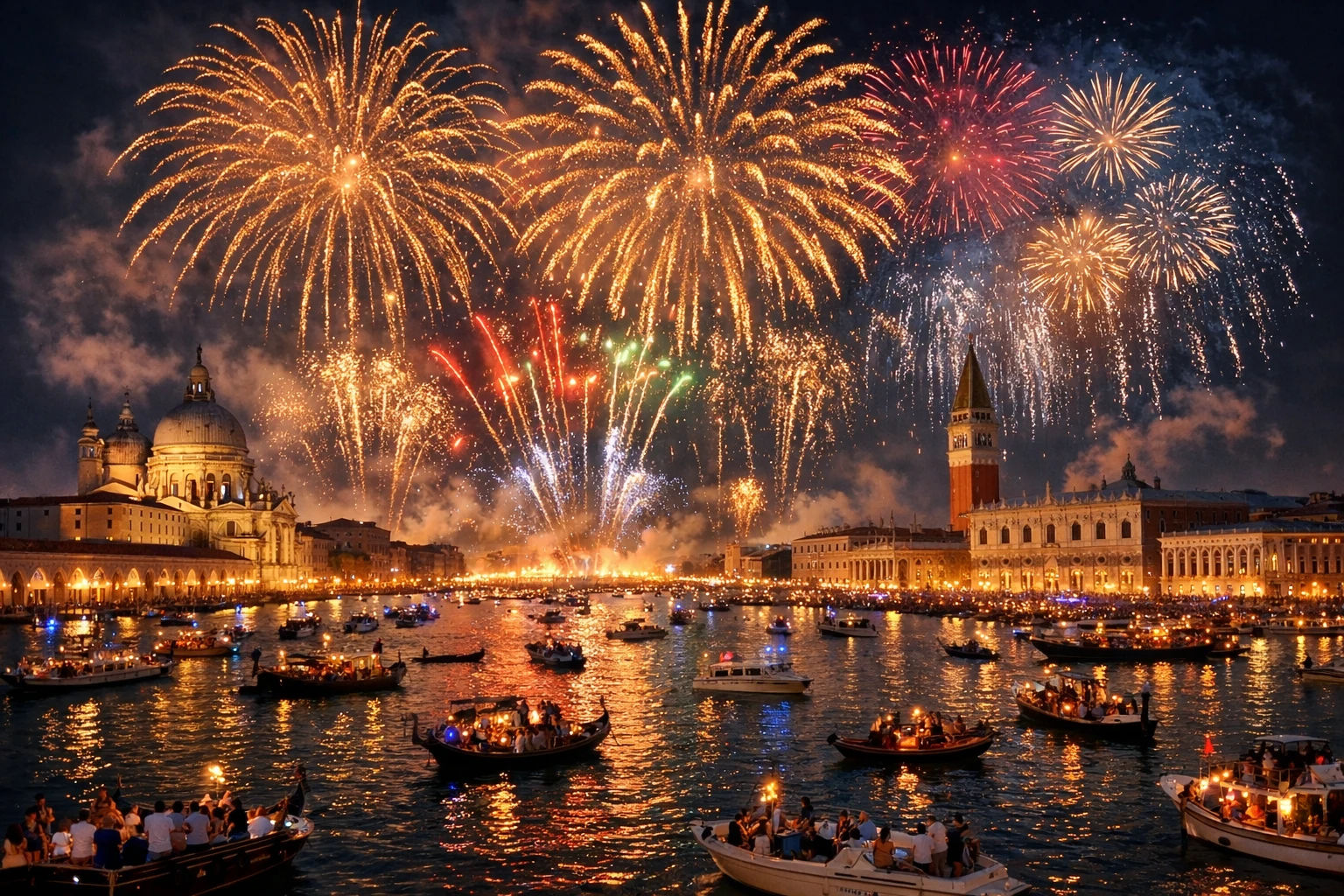
    Venice welcomes 2026 with spectacular celebrations on Wednesday, December 31, 2025, transforming the island city's historic squares, canals, and theaters into a magical New Year's destination. The midnight fireworks display over the Bacino di San Marco creates a dazzling spectacle reflecting off lagoon waters, while thousands gather in Piazza San Marco for the traditional "Bellini Brindisi" toast beneath the illuminated campanile. From elegant gala dinners aboard vaporetto boats to the prestigious New Year's Concert at Teatro La Fenice featuring conductor Michele Mariotti, from traditional Cenone di Capodanno feasts to the festive atmosphere in Mestre's Piazza Ferretto, Venice offers island celebrations combining centuries-old Italian traditions with contemporary sophistication.

    This unique blend of sacred and secular, intimate and grand, creates New Year's Eve experiences impossible to replicate in any other destination.

    Piazza San Marco: The Heart of Island Celebrations

    St. Mark's Square represents the epicenter of Venice's New Year's Eve festivities, where locals and visitors converge to welcome 2026 in the shadow of Byzantine grandeur. The celebration begins around 9:00 PM with live music filling the historic piazza, creating an atmosphere of anticipation that builds steadily toward midnight.

    Access to Piazza San Marco becomes increasingly regulated as evening progresses, with security checks ensuring public safety in this historic space. Authorities restrict bottles of alcohol and other prohibited objects to protect both revelers and the priceless architecture surrounding the square. Despite these practical measures, the atmosphere remains joyous and welcoming as thousands gather for the island's most iconic countdown.

    At the stroke of midnight, the bells of the Campanile di San Marco ring out across the island city, their ancient peals marking the transition to 2026. Couples embrace beneath the starlit sky in passionate kisses that have become synonymous with Venetian New Year's tradition. The crowd erupts in cheers, toasts, and celebratory embraces as Venice officially enters the new year.

    The fireworks spectacular launches from the Bacino di San Marco near the Arsenale, creating an extraordinary pyrotechnic display illuminating both sky and lagoon waters. While the fireworks are not visible from Piazza San Marco itself due to sight lines, the square's central location allows revelers to quickly move to better viewing positions after the midnight countdown.

    The traditional Bellini Brindisi sees Venetians and visitors raising glasses filled with the famous Venetian cocktail of Prosecco and peach juice to toast the new year. This elegant tradition epitomizes Venice's ability to blend celebration with sophistication, turning a simple toast into a memorable cultural moment.

    The celebration in Piazza San Marco continues well past midnight, with music, dancing, and revelry extending into the early hours of January 1, 2026. The illuminated facades of St. Mark's Basilica and the Doge's Palace create an incomparable backdrop for these festivities, reminding celebrants that they're welcoming the new year on one of humanity's most extraordinary island achievements.

    Fireworks Over the Bacino di San Marco

    The highlight of Venice's New Year's Eve celebrations is undoubtedly the spectacular fireworks display launched at midnight over the Bacino di San Marco. The pyrotechnic show illuminates the historic basin in front of the Arsenale, with colorful explosions reflecting off lagoon waters in mesmerizing patterns.

    For optimal viewing, position yourself along Riva degli Schiavoni, Riva Ca' di Dio, Riva San Biagio, or Riva dei Sette Martiri. These waterfront locations provide unobstructed views of the fireworks with the spectacular backdrop of San Giorgio Maggiore island rising across the basin. The nearest ACTV vaporetto stop is Arsenale, making these prime viewing areas easily accessible via water bus.

    Arriving early proves essential for securing good positions, as thousands of spectators claim spots along these waterfront promenades throughout the evening. Many seasoned revelers arrive by 10:00 PM to guarantee front-row locations, bringing warm clothing and thermoses of hot beverages for the December chill.

    The fireworks' reflection on the lagoon waters creates a doubled spectacle, with explosions appearing simultaneously in sky and sea. This unique effect, possible only in Venice's island setting, transforms the pyrotechnics into an immersive experience surrounding viewers with light and color.

    Alternatively, experience the fireworks from the water itself aboard specially chartered boats and gondolas. Several companies offer exclusive New Year's Eve cruises featuring gala dinners, live music, and prime viewing positions in the middle of the lagoon as midnight approaches. These packages typically range from €250-400 per person, providing all-inclusive experiences with Venetian elegance.

    Teatro La Fenice: New Year's Concert 2026

    For those seeking refined cultural celebration, Teatro La Fenice presents its prestigious New Year's Concert 2026 conducted by Michele Mariotti from December 29, 2025, through January 1, 2026. This annual tradition, broadcast live on Italian television and internationally, ranks among Europe's most celebrated New Year's concerts.

    The program follows La Fenice's established two-part structure. The first half features purely orchestral repertoire performed by the Teatro La Fenice Orchestra, showcasing masterworks from the classical and romantic periods. The second half focuses on operatic selections, with prestigious soloists soprano Eleonora Buratto and tenor Fabio Sartori joined by the La Fenice Chorus under chorus master Alfonso Caiani.

    The concert tradition concludes with two Giuseppe Verdi masterpieces that have become synonymous with La Fenice New Year's celebrations. The stirring chorus "Va' pensiero sull'ali dorate" from Nabucco evokes profound emotion with its meditation on exile and homeland. The festive finale presents "Libiam ne' lieti calici," the famous drinking song from La Traviata, inviting the entire theater to toast the joy of living as the new year begins.

    Multiple performance times accommodate different schedules, with concerts on December 29 at 8:00 PM, December 30 at 8:00 PM, December 31 at both 4:00 PM and 8:00 PM, and January 1 at 11:15 AM. The December 31 evening performance offers the most dramatic experience, allowing attendees to celebrate in operatic splendor before joining street festivities for midnight.

    Tickets went on sale February 14, 2025, through the Teatro La Fenice website and authorized vendors. Prices vary by seating section, with gallery seats offering excellent acoustics at accessible rates and stalls and boxes providing premium proximity to the stage. Early booking is essential, as the New Year's Concert traditionally sells out months in advance.

    The theater itself, rebuilt after the devastating 1996 fire and reopened in 2004, provides a gilded baroque setting of extraordinary beauty. Attending a performance at La Fenice represents a pilgrimage for opera lovers worldwide, and experiencing the New Year's Concert adds special significance to this cultural journey.

    Cenone di Capodanno: The Traditional Feast

    No proper Italian New Year's celebration is complete without the Cenone di Capodanno, the grand New Year's Eve supper that anchors the evening's festivities. This multi-course feast typically begins around 8:00 PM or 9:00 PM, allowing ample time for digestion before midnight celebrations commence.

    Traditional Venetian restaurants throughout the island create special New Year's Eve menus featuring seafood-based courses that honor the lagoon's maritime heritage. An elegant first course might include Champagne risotto or spaghetti vongole (pasta with Venus clams), followed by roasted whole fish or mixed seafood platters.

    The meal's structure follows classic Italian progression: antipasti (appetizers), primo (first course, usually pasta or risotto), secondo (main course of meat or fish), contorni (vegetable sides), and dolce (dessert), often tiramisù or panettone. Between courses, conversation flows as freely as Prosecco, creating the warm communal atmosphere central to Italian celebration.

    At the stroke of midnight, the traditional dish of lenticchie con cotechino makes its ceremonial appearance. This hearty combination features brown lentils served with cotechino, a rich spiced pork sausage from Emilia-Romagna. The lentils, resembling coins in both shape and golden-brown color, symbolize wealth and prosperity for the coming year.

    Italian tradition holds that the more lentils consumed at midnight, the greater the prosperity in 2026. This ancient custom dates to Roman times, when friends exchanged leather purses filled with lentils, wishing they would transform into gold. The lentils' tendency to expand when cooked further symbolizes abundance and growth.

    Cotechino, a boiled sausage made from various pork cuts seasoned with salt and spices, represents abundance and good fortune. An alternative is zampone, a similar mixture wrapped in pig trotter casing, equally popular throughout Italy. Most contemporary cooks purchase pre-cooked versions in vacuum-sealed pouches, simplifying preparation while maintaining tradition.

    Reservations at Venetian restaurants for Cenone di Capodanno must be made weeks or even months in advance, as this represents the year's most important dining occasion. Expect special pricing for New Year's Eve menus, typically ranging from €100-200 per person at upscale establishments, with the experience, atmosphere, and multi-course meal justifying the premium.

    Bacaro Tour: Budget-Friendly Island Celebration

    For travelers seeking authentic Venetian experience without formal dining expense, the Bacaro Tour offers perfect New Year's Eve alternative. Bacari are traditional Venetian wine bars, often centuries old, serving cicchetti (small snacks of local products) and excellent wines at modest prices.

    The concept involves moving from bacaro to bacaro throughout the evening, sampling different cicchetti and wines at each stop while toasting the approaching new year. Typical cicchetti include baccalà mantecato (creamed salt cod on polenta), sarde in saor (sweet and sour sardines), polpette (meatballs), and various crostini topped with local ingredients.

    The Cannaregio district offers the highest concentration of authentic bacari frequented by Venetian locals rather than tourists. This residential neighborhood's narrow streets and quiet canals provide atmospheric settings for discovering hidden gems where neighborhood residents gather for their own New Year's celebrations.

    Not all bacari remain open for casual drop-ins on New Year's Eve, as some organize seated dinners requiring advance reservations. Research and potentially book spots in advance while maintaining flexibility to discover spontaneous options. The joy of bacaro touring lies in serendipitous discoveries and chance encounters with fellow revelers.

    Budget approximately €30-50 per person for a complete evening of bacaro hopping, including multiple cicchetti servings and glasses of wine at various locations. This represents significant savings compared to formal restaurant dinners while providing arguably more authentic insight into Venetian island culture.

    Piazza Ferretto in Mestre: Mainland Party

    Mestre, Venice's mainland district located 10 kilometers from the historic island center, hosts an extraordinary free musical event in Piazza Ferretto on December 31, 2025. This alternative celebration brings contemporary Italian pop culture to Venice's New Year's festivities with performances by Virgin Radio personalities.

    DJ Ringo, Alteria, Ketty Passa, and special guest Bonzo take the stage from 10:00 PM until 2:30 AM, playing Virgin Radio's greatest hits to energetic crowds. The event includes KareOche, an interactive karaoke format popular in Italian clubs, making its first appearance in an outdoor piazza setting.

    Free admission makes this an accessible option for budget-conscious travelers and young people seeking lively party atmosphere. Attendees receive exclusive Virgin Radio-branded gadgets, adding collectible souvenirs to the experience.

    Mestre's celebration appeals to those preferring contemporary music and casual atmosphere over historic island elegance. The 15-minute train journey from Mestre to Santa Lucia station on Venice island means revelers can easily combine both mainland and island festivities in one evening.

    Lido Beach: New Year's Day Traditions

    On January 1, 2026, continue the celebrations on the Lido island with the annual "Auguri di Capodanno sulla spiaggia" (New Year's Greetings on the Beach) at Blue Moon Beach. This unique tradition brings Venetians to the Adriatic shoreline for wine, lentils with cotechino, and children's entertainment.

    The highlight for brave souls is the polar plunge, where "ibernisti" (hibernators) dive into the cold January waters of the Venetian Lagoon. This refreshing tradition offers symbolic cleansing and invigoration for the year ahead, though most participants watch from the warmth of the beach rather than joining the swim.

    Families appreciate the child-friendly atmosphere, with entertainers Nico e Mamma Bolle providing activities before the traditional lunch service. The combination of beach setting, traditional food, and community gathering creates quintessentially Venetian start to 2026.

    December 31 Weather and What to Pack

    Venice on December 31 presents classic winter conditions across the island city and surrounding lagoon. Temperatures typically range from 3°C to 8°C (37°F to 46°F), with high humidity from surrounding water making the cold feel more penetrating than inland locations.

    The lagoon's open waters create wind conditions that can be bone-chilling, particularly at exposed locations like Piazza San Marco and waterfront viewing areas for fireworks. Dressing in warm layers proves absolutely essential for comfortable outdoor celebration.

    Start with thermal base layers or long-sleeved t-shirts as foundation. Add warm middle layers including wool sweaters or fleece pullovers. Top with a waterproof winter coat that blocks wind effectively. Many travelers underestimate Venice's winter cold due to Italy's Mediterranean reputation, but December nights on the water demand serious winter protection.

    Warm accessories including scarf, hat, and gloves are non-negotiable for extended outdoor time. These items prove crucial when standing in one spot for fireworks viewing or waiting in Piazza San Marco for midnight countdown.

    Waterproof boots with good traction protect feet from wet stone pavement and provide support for navigating Venice's countless bridges. The island's pedestrian-only geography means extended walking over uneven medieval surfaces, making comfortable, supportive footwear essential.

    For Teatro La Fenice performances or upscale restaurant dining, pack one dressier outfit, though Venice maintains relatively relaxed dress codes even at elegant venues. Smart casual attire works perfectly for most New Year's Eve activities.

    Consider bringing a small backpack for carrying extra layers, snacks, water, and personal items during long evening celebrations. Venice's lack of public restrooms means strategic planning, though cafes and restaurants accommodate customers.

    Getting Around Venice's Islands on New Year's Eve

    Venice's vaporetto water bus system provides essential transportation on New Year's Eve, though expect modified schedules and crowded conditions. ACTV operates extended service to accommodate late-night revelers, with boats running past normal schedules.

    Key vaporetto lines include Line 1 (the Grand Canal route stopping at major locations) and Line 2 (express service with fewer stops). For reaching prime fireworks viewing areas near Arsenale, take Line 1, 4.1, or 5.1. A day pass (€25-30) offers unlimited travel and proves economical when making multiple trips.

    Walking remains the primary mode of transportation within Venice's historic center, with yellow directional signs pointing toward major landmarks. From Santa Lucia train station to Piazza San Marco requires approximately 30-40 minutes on foot under normal conditions, though expect slower progress amid New Year's Eve crowds.

    Water taxis offer luxury transportation directly to specific locations, though prices increase significantly on New Year's Eve, potentially exceeding €100 for journeys within the historic center. These become worthwhile for groups or when convenience outweighs cost.

    Many hotels and restaurants offer private boat shuttle services for guests dining or staying with them on New Year's Eve. Inquire about these options when making reservations, as they provide comfortable alternatives to crowded public transport.

    Cultural Significance of Capodanno

    Capodanno (literally "head of the year") represents one of Italy's most important secular holidays, celebrated with enthusiasm matching religious festivals. The celebration reflects Italian values of family, community, abundance, and optimism for the future.

    The emphasis on elaborate multi-course meals demonstrates how central food remains to Italian cultural expression. Sharing Cenone di Capodanno creates bonds between diners while honoring culinary traditions passed through generations.

    Lentils and cotechino, rooted in ancient Roman customs, connect contemporary Italians directly to their ancestors who similarly wished for prosperity and abundance. These dishes transcend mere superstition to become tangible links with historical continuity.

    Venice adds unique island character to these broader Italian traditions. The fireworks reflecting off lagoon waters, the Bellini toast in Piazza San Marco, and the polar plunge on Lido beach all incorporate Venice's distinctive geography into nationwide customs.

    The combination of sacred and secular elements creates inclusive celebration welcoming both religious observers and those focused on social aspects. Church bells marking midnight carry spiritual significance for some while providing dramatic punctuation for all.

    Book Your Venetian New Year's Adventure

    December 31, 2025, beckons with extraordinary opportunities to welcome 2026 in one of the world's most magical island settings. Whether choosing elegant opera at Teatro La Fenice, lively street celebration in Piazza San Marco, traditional restaurant feast, casual bacaro hopping, or unique combinations of all these experiences, Venice delivers New Year's memories treasured forever.

    Reserve accommodations now for December 30 to January 2, selecting locations in San Marco for proximity to main celebrations or quieter neighborhoods for authentic residential atmosphere. December 31 represents peak demand, making early booking essential.

    Purchase tickets immediately for the Teatro La Fenice New Year's Concert if classical music appeals, as performances sell out months ahead. Book restaurant reservations for Cenone di Capodanno no later than November to secure tables at preferred establishments.

    Pack warm layers, waterproof boots, festive spirit, and appetite for both culinary delights and cultural immersion. Prepare for crowds, embrace the communal energy, and surrender to the magic of celebrating where canals replace streets and palazzos frame every view.

    Imagine standing in Piazza San Marco as the Campanile bells ring out at midnight, surrounded by joyful strangers becoming friends through shared toast, all united in gratitude for the past and hope for the future. Picture fireworks painting the Bacino di San Marco with brilliant colors that double in lagoon reflections, creating light shows possible only in this singular island setting.

    Experience the Teatro La Fenice gilded in festive glory, Verdi's jubilant melodies filling baroque halls where opera legends premiered masterworks centuries ago. Taste lentils and cotechino at midnight, continuing traditions older than most nations, hoping they indeed bring prosperity as Italians have believed for millennia.

    Wander through Venice's narrow calli in the early hours of January 1, 2026, when the island returns to peaceful silence after midnight's exuberance, lights reflecting in still canals, and the lagoon mist creating ethereal atmosphere. Watch brave souls plunge into cold Adriatic waters on Lido beach, laughing and celebrating the invigoration of new beginnings.

    This is how Venice welcomes the new year: with fireworks and feasts, with opera and lentils, with ancient traditions and contemporary joy, with island beauty that transcends seasons to create moments of timeless magic. Don't just read about Capodanno in Venice; live it, taste it, celebrate it surrounded by a thousand years of history reflected in lagoon waters as 2025 becomes 2026.

    The island city awaits your arrival with open arms, warm wine, and the promise of unforgettable New Year's celebration. Reserve your place now in Venice's most magical night.

    Verified Information at a Glance

    Event Name: New Year's Eve Venice 2026 (Capodanno Venezia)

    Category: New Year's Celebration / Public Festival / Cultural Event

    Date: Wednesday, December 31, 2025 (transitioning to January 1, 2026)

    Main Celebrations:

    Piazza San Marco Celebration:

    • Time: Music from 9:00 PM; midnight countdown and Bellini toast
    • Location: St. Mark's Square, Venice
    • Admission: Free (security checks at entrances)
    • Features: Live music, midnight bells, traditional Bellini Brindisi toast

    Fireworks Display:

    • Time: Midnight, December 31, 2025
    • Location: Launched from Bacino di San Marco near Arsenale
    • Best viewing: Riva degli Schiavoni, Riva Ca' di Dio, Riva San Biagio, Riva dei Sette Martiri
    • Nearest vaporetto: Arsenale stop
    • Admission: Free from public waterfront areas

    Teatro La Fenice New Year's Concert 2026:

    • Dates: December 29, 30, 31, 2025, and January 1, 2026
    • Performance times:
    • Dec 29: 8:00 PM
    • Dec 30: 8:00 PM
    • Dec 31: 4:00 PM and 8:00 PM
    • Jan 1: 11:15 AM
    • Conductor: Michele Mariotti
    • Soloists: Soprano Eleonora Buratto, Tenor Fabio Sartori
    • Location: Teatro La Fenice, Campo San Fantin, San Marco
    • Tickets: On sale since February 14, 2025; prices vary by seating section
    • Traditional finale: "Va' pensiero" from Nabucco and "Libiam ne' lieti calici" from La Traviata

    Mestre Celebration:

    • Location: Piazza Ferretto, Mestre (mainland Venice)
    • Time: 10:00 PM to 2:30 AM
    • Performers: DJ Ringo, Alteria, Ketty Passa, Bonzo (Virgin Radio)
    • Features: KareOche interactive karaoke, free Virgin Radio gadgets
    • Admission: Free

    Lido Beach New Year's Day Event:

    • Date: January 1, 2026
    • Location: Blue Moon Beach, Lido di Venezia
    • Features: Traditional lentils and cotechino, children's entertainment, polar plunge swim

    Traditional Foods:

    • Cenone di Capodanno (New Year's Eve feast): Multi-course seafood dinner
    • Lenticchie con cotechino (lentils with pork sausage): Served at midnight for prosperity
    • Bellini cocktail: Prosecco with peach juice for traditional toast

    Gala Dinner Cruises:

    • Price range: €250-400 per person
    • Includes: Multi-course dinner, entertainment, fireworks viewing from water

    Bacaro Tour:

    • Budget: Approximately €30-50 per person
    • Best district: Cannaregio
    • Features: Cicchetti (small snacks) and wine at multiple traditional bars

    Weather: Temperatures 3-8°C (37-46°F); cold, humid, potentially windy conditions

    What to Pack: Waterproof winter boots, warm coat, thermal layers, scarf, hat, gloves, umbrella

    Transportation: Vaporetto extended service until late; day pass €25-30; expect crowds

    Reservations: Book restaurants by November; theater tickets sell out months in advance; accommodations fill early

    Dress Code: Casual for street celebrations; smart casual for restaurants; formal optional for opera

    Public Safety: Security checks at Piazza San Marco; alcohol bottles restricted; no personal fireworks permitted in Venice

    Verified Sources: Official Venice tourism authority, Teatro La Fenice, ACTV transport, cultural heritage documentation confirm all details


    St. Mark's Square, Grand Canal, Venice
    Dec 31, 2025 - Jan 1, 2026
    Christmas Markets Venice 2025
    Market, Holiday
    Free

    Christmas Markets Venice 2025

    Venice transforms into a sparkling winter wonderland throughout the 2025 holiday season, with Christmas markets illuminating the island city's historic campos and squares from late November through early January. The main Christmas Village at Campo Santo Stefano runs from November 23 to December 24, 2025, featuring approximately 30 wooden chalets selling Murano glass ornaments, Venetian carnival masks, and local delicacies against a backdrop of Byzantine architecture and canal reflections. Combined with the enchanting ice-skating rink at Campo San Polo, festive markets on the Lido island beaches, and the spectacular Natale di Vetro (Christmas of Glass) celebration on Murano island, Venice offers travelers an unforgettable holiday experience where centuries-old island traditions meet contemporary festive cheer.

    This unique blend of sacred and secular, authentic Venetian craftsmanship and joyful celebration creates a Christmas atmosphere impossible to replicate in any other destination.

    Campo Santo Stefano: Venice's Main Christmas Village

    The Christmas Village at Campo Santo Stefano represents the heart of Venice's holiday market tradition, transforming one of the island city's most elegant squares into a festive wonderland. Located in the San Marco district near the Ponte dell'Accademia, this spacious campo sits just 400 meters from the Rialto Bridge, making it easily accessible from all parts of the historic island center.

    Running from November 23 to December 24, 2025, the market operates daily from approximately 10:00 AM to 7:00 PM or 8:00 PM, with free admission allowing visitors to browse at leisure. Approximately 30 wooden chalets create charming pathways through the square, their warm lights reflecting off the facades of surrounding Renaissance palazzos.

    The market specializes in authentic Venetian products and locally-made handicrafts, distinguishing it from generic Christmas markets found elsewhere. Stalls overflow with exquisite Murano glass ornaments ranging from delicate baubles to elaborate chandeliers, priced from €10 to €50 depending on size and complexity. The distinctive cranberry red, emerald green, and sapphire blue colors characteristic of Murano glasswork catch the December light beautifully.

    Traditional Venetian carnival masks, handcrafted by local artisans, provide another signature offering. These theatrical creations range from simple domino masks to elaborate full-face pieces adorned with feathers, gold leaf, and intricate painting. Purchasing a mask at Campo Santo Stefano connects visitors directly to centuries of Carnival tradition, as Venice's famous February celebration follows immediately after the Christmas season.

    Food stalls tempt with fritelle, delicious Venetian doughnuts traditionally filled with Nutella, custard, or raisins and pine nuts, priced around €3 each. These sweet treats, light and airy despite their fried nature, represent essential Christmas fare for Venetian families. Vendors also serve vin brulé, the Italian version of mulled wine spiced with cinnamon, cloves, and orange peel, warming hands and spirits for approximately €4 per cup.

    Live classical music fills the square throughout market hours, with local musicians performing everything from traditional Christmas carols to Vivaldi compositions. The acoustics created by the surrounding buildings and the open square create an immersive soundscape that enhances the festive atmosphere. Children's activities including ornament-making workshops and Santa visits add family-friendly charm.

    The square itself provides stunning architectural context for the Christmas market. The Church of Santo Stefano, with its distinctive leaning campanile (bell tower), anchors one end of the campo. Palazzo Loredan, Palazzo Morosini Gatterburg, and Palazzo Pisani a Santo Stefano create the elegant perimeter that gives the square its refined character. This combination of festive market and historic Venetian splendor creates photographs and memories treasured long after the holidays end.

    Campo San Polo: Ice Skating and Island Fun

    Campo San Polo, Venice's largest square after Piazza San Marco, hosts a delightful ice-skating rink paired with a small Christmas market from December 1, 2025, to January 12, 2026. Located in the San Polo district approximately 300 meters from the Rialto vaporetto stop, this festive installation brings winter sports magic to the car-free island city.

    The ice rink operates daily from 10:00 AM to 8:00 PM, with skating sessions priced at €8 per hour. Skate rental is included in the price, making this an accessible activity for families and couples seeking active holiday fun. The unique experience of gliding across ice in the center of a historic Venetian campo, surrounded by Gothic palazzos and medieval architecture, creates surreal and enchanting moments.

    Approximately 10 wooden stalls ring the ice rink, selling Christmas gifts, decorations, and the beloved fritelle doughnuts. The smaller scale compared to Campo Santo Stefano creates intimate, neighborhood atmosphere where locals and visitors mingle freely. Many Venetian families make evening visits to Campo San Polo a holiday tradition, children skating while parents enjoy warm drinks and conversation.

    The campo itself, measuring roughly 122 by 96 meters, provides ample space for both the rink and surrounding market without feeling crowded. Historic buildings including the Church of San Polo and several noble palaces create an atmospheric backdrop. The square's slightly off-the-beaten-path location means fewer tourists compared to San Marco area, allowing more authentic interaction with Venetian island culture.

    Evening visits prove particularly magical when lights illuminate the ice and surrounding buildings create dramatic shadows. The combination of physical activity, festive shopping, and architectural beauty makes Campo San Polo a must-visit destination during Venice's Christmas season.

    Lido di Venezia: Seaside Christmas Markets

    The Lido island, Venice's barrier island separating the Venetian Lagoon from the Adriatic Sea, hosts weekend Christmas markets from November 13, 2025, to January 20, 2026. Spread across Parco delle Quattro Fontane and Gran Viale, these markets operate Sundays from 10:00 AM to 6:00 PM with free admission.

    The Lido's Christmas markets offer a distinctly different atmosphere compared to the historic center, combining beachside holiday charm with family-friendly activities. Craft stalls showcase local artisans' work including jewelry, textiles, ceramics, and woodwork. Food vendors serve seasonal specialties and sweets, while entertainment areas feature children's rides and games.

    Visiting the Lido during Christmas season allows travelers to experience Venice's residential island culture away from tourist crowds. The Gran Viale, the Lido's main street connecting the lagoon-side vaporetto stops to the Adriatic beaches, takes on festive character with lights and decorations. Families enjoy the markets as part of weekend outings, combining shopping with walks along the winter beach.

    The Lido's unique geography as a barrier island creates microclimate conditions slightly different from central Venice. The exposure to sea breezes and open horizons provides refreshing contrast to the enclosed spaces of the historic center's narrow streets. Winter on the Lido reveals the island's authentic character, when summer beach crowds have departed and local life dominates.

    Reaching the Lido requires only a 15-minute vaporetto ride from Venice proper, with Lines 1, 6, and others serving the island regularly. This easy accessibility makes the Lido markets perfect for visitors seeking alternative Christmas experiences beyond the main tourist areas.

    Murano Island: Christmas of Glass Celebration

    Murano island, legendary for 700 years of glassmaking tradition, celebrates Christmas with the spectacular Natale di Vetro (Christmas of Glass) festival from December 5, 2025, to January 6, 2026. This unique event transforms the glassmaking island into an illuminated wonderland showcasing the artistry that has made Murano famous worldwide.

    The festival begins on December 5 with celebrations for St. Nicholas, the patron saint of glassmakers and sailors. A special mass at the Church of San Pietro Martire kicks off festivities that include the mesmerizing Tunnel of Light. This installation features hundreds of Murano chandeliers suspended overhead, creating a glittering pathway that visitors walk through in wonder.

    The centerpiece of the celebration is an extraordinary Christmas tree crafted entirely from Murano glass. Standing 2.5 meters tall and adorned with 40 lights, the 2025 tree by Seguso Vetri d'Arte honors St. Nicholas with symbolic details. Crystal green glass evokes purity and tradition, while red and white candy cane shapes reference Venetian pastoral chandeliers. Three golden spheres pay tribute to St. Nicholas's legendary gift-giving, while 40 glass lightbulbs symbolize the Murano glassmaking community's enduring creative flame.

    On display at the Church of San Salvador in central Venice from December 15 to January 15, this masterpiece demonstrates how Murano's artisans continue innovating within ancient traditions. The tree represents teamwork, community connection, and celebration of island heritage through the medium that defines Murano's identity.

    Live glassblowing demonstrations throughout Murano during the festival allow visitors to witness master craftsmen at work. The hypnotic process of transforming molten glass into delicate ornaments, vases, and sculptures fascinates audiences of all ages. Many furnaces open their doors for special viewing opportunities rarely available during regular seasons.

    The Glasswork Regatta provides another festival highlight, featuring caorlina boats rowed by costumed angels and festive characters representing different Murano glass factories. This colorful water procession combines Venetian maritime tradition with glassmaking heritage in uniquely entertaining fashion.

    Furnace Food events offer dinners prepared in glass factory ovens by the glassworkers themselves, creating memorable culinary experiences in working artistic spaces. These intimate gatherings, limited in number and requiring reservations, connect visitors directly with the island's living artisan culture.

    Throughout December and early January, brilliantly lit glass trees and light installations transform Murano into a sparkling island destination. The combination of artistic exhibitions, live demonstrations, traditional celebrations, and illuminated displays makes Natale di Vetro essential for understanding Venice's lagoon island heritage.

    Mestre: Mainland Christmas Markets

    Mestre, Venice's mainland district located 10 kilometers from the historic island center, hosts the Mercatino di Natale Christmas market from November 29, 2025, to January 6, 2026. Set in Piazza Erminio Ferretto, Mestre's central square, this market operates daily from 9:00 AM to 9:00 PM with free admission.

    Featuring over 20 stalls selling crafts, decorations, and traditional foods including sarde in saor (sweet and sour sardines, a Venetian specialty), the Mestre market provides budget-friendly alternatives to historic center prices. Dazzling light displays throughout Piazza Ferretto and surrounding streets create festive atmosphere rivaling the island locations.

    Mestre's markets appeal particularly to travelers staying on the mainland for more affordable accommodations while day-tripping to Venice proper. The 15-minute train journey from Mestre to Santa Lucia station on the island makes combining both mainland and island Christmas experiences easy.

    The Mestre markets reflect contemporary Italian holiday traditions with slightly less emphasis on historic craftsmanship compared to Campo Santo Stefano, but with equally enthusiastic local participation. Families from throughout the Venetian mainland region visit Piazza Ferretto for holiday shopping, making this a window into broader Veneto regional culture.

    December Weather and What to Pack

    Venice in December presents classic winter conditions across the island city and surrounding lagoon. Average temperatures range from 3°C to 8°C (37°F to 46°F), with humidity from the water making the cold feel more penetrating than inland locations.

    December ranks among Venice's wettest months, with rain possible on 8-10 days throughout the month. The phenomenon of acqua alta (high water) occurs most frequently in late autumn and winter, when exceptional high tides can flood low-lying areas including Piazza San Marco. However, the city provides elevated walkways during these events, and most Christmas markets sit in elevated campos less affected by flooding.

    Layering proves essential for comfortable market visits and general island exploration. Start with thermal base layers or long-sleeved t-shirts as your foundation. Add warm middle layers including wool sweaters, cardigans, or fleece pullovers. Top with a waterproof winter coat or jacket that blocks wind from the lagoon.

    Waterproof winter boots with good traction are absolutely essential for navigating wet stone pavement, numerous bridges, and uneven surfaces throughout the car-free island. Venice's geography requires extensive walking, often over medieval bridges with steep steps, making comfortable, supportive footwear crucial.

    Accessories including warm scarf, gloves or mittens, and a hat provide necessary protection against lagoon winds. An umbrella or compact rain jacket handles December showers. Darker, neutral colors in classic styles blend well with Venetian elegance while hiding inevitable splashes from puddles and rain.

    For evening concerts, theater, or upscale restaurant dining, pack one slightly dressier outfit, though Venice maintains relaxed dress codes even at higher-end establishments during winter. Casual, comfortable clothing works perfectly for Christmas market visits and daytime exploration.

    Venetian Christmas Traditions and Culture

    Christmas in Venice blends sacred religious observance with joyful secular celebration, creating holiday experiences reflecting the island's unique cultural heritage. Venetian families observe La Vigilia (Christmas Eve) as their primary celebration, traditionally gathering for elaborate multi-course fish dinners before attending Midnight Mass.

    St. Mark's Basilica offers Midnight Mass beginning at 11:30 PM on Christmas Eve, conducted in Italian, English, French, and German to accommodate international visitors. The Byzantine golden mosaics illuminated by candlelight create an unforgettable sacred atmosphere. Arriving well in advance is essential for securing seats in this popular service.

    Christmas Day itself finds most Venetian families at home exchanging gifts and enjoying traditional festive lunch, meaning many shops and restaurants close. However, booking ahead allows visitors to find establishments serving special Christmas menus. The bells of St. Mark's Campanile ring throughout Christmas Day, their peals echoing across the island city.

    December 26, the Feast of Santo Stefano, represents another public holiday celebrated with concerts throughout Venice. The free afternoon concert at Santa Maria Gloriosa dei Frari Church provides perfect conclusion to the Christmas period.

    December 8, the Feast of the Immaculate Conception (also called the Feast of the Lady of Fire), features processions, traditional food stalls, and the opening of new wines accompanied by sweets. This beloved holiday marks the official beginning of the Christmas season throughout the Venetian islands.

    The Santa Claus Water Parade on the last Sunday before Christmas (December 21, 2025) brings hundreds of Santas traveling by boat along the Grand Canal and through the city's waterways. This whimsical event perfectly captures Venice's ability to adapt global traditions to its unique island geography.

    New Year's Eve transforms Piazza San Marco into a massive celebration with countdown, music, and spectacular fireworks over the lagoon. Arriving early is essential for prime viewing positions, as thousands gather for this free public celebration.

    Getting Around Venice's Christmas Markets

    Venice's vaporetto water bus system provides efficient transportation between Christmas market locations spread across the historic center and lagoon islands. A day pass (€25-30) offers unlimited travel, making market-hopping economical.

    For Campo Santo Stefano, the nearest vaporetto stops are Accademia (Lines 1 and 2) or Giglio (Line 1), both within 5-minute walks. Campo San Polo sits approximately 5 minutes from the Rialto or San Tomà vaporetto stops.

    Reaching Murano requires Lines 3, 4.1, 4.2, or 12 from Fondamente Nove, with the journey taking 10-15 minutes. The Lido is accessible via Lines 1, 5.1, 5.2, 6, or others from various Venice stops, requiring 15-25 minutes depending on departure point.

    Walking between markets in the historic center provides the most atmospheric experience, with Christmas decorations lighting narrow streets and squares. Allow extra time for navigation, as Venice's labyrinthine layout creates delightful disorientation even with maps.

    The car-free island environment means all movement occurs on foot or by water, creating uniquely peaceful holiday shopping experiences without traffic noise or exhaust fumes. This pedestrian-only character allows children to explore safely and families to stroll at relaxed pace.

    Beyond the Markets: December in Venice

    December reveals Venice at its most authentic, with fewer crowds allowing genuine connection with island culture. Major attractions including St. Mark's Basilica, Doge's Palace, and the Accademia Gallery remain open with shorter queues compared to peak season.

    The city's churches host numerous concerts throughout December, featuring baroque music in settings where these compositions premiered centuries ago. The Interpreti Veneziani ensemble and other local groups perform regularly at venues including San Vidal and La Pietà.

    Gondola rides take on special romance during winter, with blankets provided and fewer boats crowding the canals. The mist rising from the lagoon and Christmas lights reflecting in the water create atmospheric conditions unique to the season.

    Traditional Venetian restaurants serve seasonal specialties including baccalà mantecato (creamed salt cod), seppie in nero (cuttlefish in ink), and the beloved fritelle. Caffè Florian in Piazza San Marco, Europe's oldest continuously operating café, serves exceptional hot chocolate perfect for warming up after market visits.

    The lagoon islands of Burano with its colorful houses and Torcello with its ancient Byzantine church make excellent day trips during the quieter December period. These destinations reveal Venice's island geography and the communities that have inhabited the lagoon for over a millennium.

    Experience Island Christmas Magic

    The 2025 Christmas markets across Venice's islands offer unparalleled opportunities to experience authentic Venetian holiday traditions in settings of extraordinary beauty. From the elegant chalets of Campo Santo Stefano to the ice-skating fun at Campo San Polo, from the Lido's seaside markets to Murano's dazzling glass celebrations, each location provides unique perspectives on how this singular island city celebrates the season.

    Mark your calendar for November 23 through December 24, 2025, for the main Campo Santo Stefano Christmas Village, arriving early for the best selection of handcrafted Venetian masks and Murano glass ornaments. Extend your visit through early January to experience the ice rink at Campo San Polo and the continued Natale di Vetro celebrations on Murano.

    Book accommodations now for December 2025, choosing locations in San Marco for proximity to the main market or in less touristy neighborhoods for authentic Venetian atmosphere. December represents one of the year's quietest periods for Venice tourism, offering better hotel rates and reservation availability compared to peak seasons.

    Pack warm layers, waterproof boots, and an adventurous spirit ready to explore an island city where Christmas traditions stretch back centuries yet remain vibrantly alive. Taste fritelle fresh from vendors' fryers, sip vin brulé while live music fills historic squares, and discover why Venice's Christmas markets rank among Europe's most enchanting.

    Cross bridges decorated with lights, navigate canals reflecting festive illumination, and experience the magic of Christmas celebrated on islands where every journey involves walking on ancient stone pathways between the water. Watch Murano masters transform molten glass into holiday treasures, skate on ice in a medieval campo, and join Venetian families in traditions that connect contemporary celebration with centuries of island heritage.

    This December, discover that Christmas in Venice offers more than beautiful scenery but genuine cultural immersion in how one of Europe's most unique island civilizations honors the holiday season. The combination of spectacular setting, authentic craftsmanship, living traditions, and warm Venetian hospitality creates memories cherished long after ornaments are packed away and winter becomes spring.

    Don't just visit Venice in December; experience Christmas as Venetians have celebrated it for generations, on islands where history, art, faith, and community converge in extraordinary beauty. The 2025 Christmas markets await with open arms, mulled wine, and magic found nowhere else on earth.

    Verified Information at a Glance

    Event Name: Venice Christmas Markets 2025

    Category: Christmas Markets / Holiday Festivals / Cultural Celebrations

    Main Market - Campo Santo Stefano Christmas Village:

    • Dates: November 23 to December 24, 2025
    • Location: Campo Santo Stefano, San Marco district, Venice
    • Hours: Approximately 10:00 AM to 7:00-8:00 PM daily
    • Admission: Free
    • Number of stalls: Approximately 30 wooden chalets
    • Features: Murano glass ornaments (€10-€50), Venetian masks, local crafts, fritelle (€3), vin brulé (€4), live music

    Campo San Polo Ice Rink & Market:

    • Dates: December 1, 2025, to January 12, 2026
    • Location: Campo San Polo, San Polo district, Venice
    • Hours: 10:00 AM to 8:00 PM daily
    • Admission: €8 per hour for ice skating (includes skate rental)
    • Number of stalls: Approximately 10
    • Features: Ice rink, Christmas gifts, fritelle, festive atmosphere

    Lido di Venezia Christmas Markets:

    • Dates: November 13, 2025, to January 20, 2026 (weekends)
    • Location: Parco delle Quattro Fontane and Gran Viale, Lido di Venezia
    • Hours: Sundays, 10:00 AM to 6:00 PM
    • Admission: Free
    • Features: Crafts, food stalls, children's rides, seaside location

    Murano Island - Natale di Vetro (Christmas of Glass):

    • Dates: December 5, 2025, to January 6, 2026
    • Location: Murano island, Venice
    • Opening: St. Nicholas Day mass on December 5
    • Features: Glass Christmas tree, Tunnel of Light, Glasswork Regatta, live glassblowing demonstrations, Furnace Food events
    • Glass Christmas Tree Display: Church of San Salvador, Venice (December 15 to January 15)

    Mestre Christmas Market:

    • Dates: November 29, 2025, to January 6, 2026
    • Location: Piazza Erminio Ferretto, Mestre (mainland Venice)
    • Hours: 9:00 AM to 9:00 PM daily
    • Admission: Free
    • Number of stalls: 20+
    • Features: Crafts, decorations, local foods, light displays

    Special Events:

    • Feast of Immaculate Conception: December 8, 2025
    • Santa Claus Water Parade: December 21, 2025 (last Sunday before Christmas)
    • Christmas Eve Midnight Mass: St. Mark's Basilica, 11:30 PM, December 24
    • Santo Stefano Concerts: December 26, 2025
    • New Year's Eve Fireworks: Piazza San Marco, December 31, 2025, 9:00 PM onward

    Traditional Foods: Fritelle (Venetian doughnuts, €3), vin brulé (mulled wine, €4), sarde in saor (sweet and sour sardines, €5)

    Weather: Average temperatures 3-8°C (37-46°F); rainy conditions common

    What to Pack: Waterproof winter boots, warm layers, thermal underwear, winter coat, scarf, gloves, hat, umbrella

    Transportation: Vaporetto day pass (€25-30) for unlimited travel; nearest stops vary by market location

    District Locations:

    • Campo Santo Stefano: San Marco district
    • Campo San Polo: San Polo district
    • Murano: Separate lagoon island
    • Lido: Barrier island between lagoon and Adriatic

    Verified Sources: Official Venice tourism websites, market organizers, cultural heritage documentation, and travel authorities confirm all details

    Campo San Polo, Rialto, Venice
    Nov 23, 2025 - Dec 24, 2025
    Festa della Salute  2025
    Religious, Traditional
    Free

    Festa della Salute 2025

    Every November 21, Venice transforms into a living testament of gratitude as thousands of islanders and visitors cross the Grand Canal on a temporary pontoon bridge to honor the Madonna della Salute at the magnificent Basilica di Santa Maria della Salute. The 2025 celebration falls on Friday, November 21, continuing a tradition nearly four centuries old that commemorates the island city's deliverance from the devastating plague of 1630-1631. This deeply spiritual festival represents one of Venice's most authentic expressions of faith and community, where pilgrims light candles, pray for health, and share traditional castradina soup in an atmosphere combining sacred devotion with island fellowship.

    Unlike Venice's famous Carnival or Film Festival, the Festa della Salute belongs entirely to the Venetian people, offering visitors a rare window into the island's spiritual heart and centuries-old customs.

    The Plague That Changed Venice Forever

    In 1630, Venice faced an existential threat as bubonic plague swept through the island city with terrifying speed. The epidemic began when the Duke of Mantua sent Ambassador Alessandro Strigi to Venice seeking military aid against invading forces, unaware his delegation carried the deadly contagion. The Venetian Sanitary Magistrate wisely quarantined the Mantuan nobles on the island of San Clemente in the lagoon, but a fatal error occurred when two carpenters working on the island were allowed to return to Venice.

    The carpenters brought back clothes to have them cleaned, unknowingly spreading the infection throughout the island city. Within two weeks of the first carpenter's death, hundreds perished across Venice's interconnected neighborhoods. The plague struck with such fury that by winter's end, the entire island population faced potential extinction.

    Between 1630 and 1631, the pestilence killed approximately 46,000 people within Venice proper and another 94,000 throughout the lagoon islands. This represented nearly one-third of the total population, transforming the vibrant island republic into a city of mourning. Traditional medical responses proved futile, as did processions to churches dedicated to plague saints San Rocco and San Lorenzo Giustiniani.

    In desperation, Doge Nicolò Contarini and Patriarch Giovanni Tiepolo organized an unprecedented procession lasting three days and three nights. Approximately 10,000 survivors circled St. Mark's Square carrying torches and votive statues, their desperate prayers rising toward the heavens. On October 22, 1630, the Venetian Senate made a solemn vow: if the Virgin Mary would intercede to save the island city, they would build a church of unprecedented beauty and grandeur in her honor.

    Miraculously, within weeks of the vow, the plague began receding. The infection slowly retreated, and by early 1631, Venice was free from the pestilence that had threatened to erase it from existence. The Venetians attributed this deliverance to the Virgin Mary's intercession, cementing a bond of gratitude that endures to this day.

    The Basilica di Santa Maria della Salute: A Promise Fulfilled

    To honor their vow, Venice launched a competition among architects and engineers to design the promised temple. Young Baldassare Longhena, a proponent of the fashionable Baroque style who studied under Vincenzo Scamozzi, won the commission with his visionary octagonal design. Construction began in 1631 on the Punta della Dogana, the strategic point where the Grand Canal meets the Giudecca Canal at the entrance to St. Mark's Basin.

    The site selection proved symbolically powerful, as historical accounts suggest the plague entered Venice at this very location through the unfortunate carpenter. Building on this narrow finger of land presented extraordinary engineering challenges in the marshy lagoon environment. Workers drove over 110,000 wooden piles into the unstable ground to create a foundation capable of supporting the massive structure.

    The construction continued for decades, consuming enormous resources from the Venetian Republic. The octagonal plan features a main dome 60 meters high surrounded by six lateral chapels, creating a harmonious composition that became an instant landmark on the Venice skyline. The facade features 125 statues, while the interior houses masterworks by Titian, Tintoretto, and other Venetian masters, many bearing references to the plague and deliverance.

    On November 21, 1687, the Basilica di Santa Maria della Salute was finally consecrated, exactly 57 years after the vow was made. This date, coinciding with the Presentation of the Blessed Virgin Mary, became the official feast day celebrating the island city's salvation. The church's name "Salute" carries double meaning in Italian, referring both to "health" and "salvation," perfectly encapsulating its purpose.

    Inside the basilica's high altar sits the icon of the Mesopanditissa, brought to Venice from Heraklion, Crete, in 1670 by Captain Francesco Morosini. Venetians call this the Madonna della Salute, recognizing in her image the source of their miraculous deliverance. The inscription carved in the circle at the basilica's center proclaims "Unde origo inde salus," meaning "Venice was born from Mary and Mary was the salvation".

    The Votive Bridge: Walking on Water

    One of the most striking features of the Festa della Salute is the temporary pontoon bridge constructed specifically for the celebration. The votive bridge, or "ponte votivo," spans approximately 80 meters across the Grand Canal, connecting the Santa Maria del Giglio landing to the Basilica della Salute on the Dorsoduro island district.

    The bridge typically opens on Friday, November 17, 2025, with an inauguration ceremony attended by Venice's mayor, the Patriarch of Venice, and civilian and military authorities. The structure comprises eight distinctive boats anchored in the Grand Canal, with a 10-meter-wide central passage allowing vaporetto water buses and cargo vessels to navigate beneath.

    Wooden planking covers the floating pontoon structure, creating a stable walking surface that nevertheless sways gently with the water's movement. The bridge remains open continuously until 10:00 PM on November 21, allowing pilgrims to cross at any hour during the feast day. Many devoted Venetians cross barefoot as an act of humility and connection to tradition, carrying plastic bags for their shoes.

    Walking across this temporary bridge provides an extraordinary experience unique to Venice's island geography. Pilgrims find themselves literally walking on water, suspended between the Grand Canal below and the open sky above, with palazzo facades rising on both sides. The procession moves slowly as thousands make the crossing, creating an atmosphere of shared devotion and community.

    Historical paintings by 18th-century Venetian artist Francesco Guardi capture this tradition, showing the Doge's annual visit across the pontoon bridge surrounded by crowds of faithful and countless gondolas. These artworks demonstrate how deeply embedded this custom is in Venetian island culture, transcending centuries while maintaining its essential character.

    The Pilgrimage Experience

    On November 21, 2025, the Basilica di Santa Maria della Salute opens at dawn and remains accessible throughout the day and evening. Religious celebrations occur every hour from 6:00 AM until 10:00 PM, with the solemn High Mass at 10:00 AM presided over by the Patriarch of Venice.

    Pilgrims arrive carrying candles of various sizes, which they light and place before the high altar as offerings and prayers for continued health. The tradition calls for purchasing these candles from small stalls that spring up in Campo San Gregorio and the area fronting the church, often featuring images of the black Madonna. Adults navigate the crowds reverently while children enjoy the festive atmosphere created by vendors selling toys and sweets.

    Inside the basilica, the faithful queue to approach the icon of the Madonna della Salute, many kneeling in prayer and thanksgiving. The ritual involves offering prayers for personal and communal health, acknowledging the Virgin Mary's protective intercession over the island city. This intimate act of devotion connects contemporary Venetians with their ancestors who survived the plague nearly four centuries ago.

    The atmosphere blends solemnity with warmth, as strangers exchange greetings, families reunite, and the entire island community gathers in shared purpose. For many older Venetians, the Festa della Salute represents the most important religious observance of the year, even surpassing Christmas in personal significance.

    Visitors are welcome to participate respectfully in the pilgrimage, though modest dress is expected when entering the basilica. Covering shoulders and knees shows appropriate reverence for this sacred occasion. Photography is permitted but should be discreet, avoiding flash during religious services and respecting worshippers' private moments of prayer.

    Castradina: The Traditional Feast

    No Festa della Salute celebration is complete without castradina, the traditional Venetian dish enjoyed on this day for nearly four centuries. This hearty soup features salted, smoked, and seasoned leg of mutton slow-cooked with cabbage leaves, onions, and wine until meltingly tender.

    The dish's origins connect directly to the plague's aftermath. As Venice recovered from the devastating epidemic, the first food shipments arrived from Dalmatia, including this preserved mutton that helped starving survivors regain strength. The meat is smoked and seasoned with juniper berries and other aromatic spices, creating an intensely flavorful base for the soup.

    Castradina preparation begins days in advance, as the dried meat requires extended soaking to rehydrate and reduce saltiness. The cooking process itself takes hours, with the mutton simmered slowly until it becomes fall-apart tender. Cabbage leaves add body and slight sweetness, while the cooking liquid becomes a rich, warming broth perfect for November's chill.

    Venetian families gather on the evening of November 21 to share steaming bowls of castradina, continuing a ritual that binds them to their island heritage. Many traditional restaurants and bacari (Venetian wine bars) throughout the Dorsoduro district and beyond feature castradina on their menus specifically for this occasion. The dish's humble origins as survival food have been elevated to a cherished culinary tradition that tastes of history, gratitude, and continuity.

    For visitors wishing to experience this authentic aspect of the celebration, reservations at traditional Venetian restaurants are essential, as locals fill dining rooms throughout the day and evening. The combination of hearty soup, local wine, and warm conversation perfectly complements the spiritual aspects of the festival.

    Exploring the Dorsoduro Island District

    The Basilica della Salute sits at the heart of Dorsoduro, one of Venice's six historic sestieri (districts) and among the island city's most charming neighborhoods. The name "Dorsoduro" means "hard back," referring to the more stable land formation compared to other parts of the lagoon islands.

    Punta della Dogana, the sharp point where the basilica stands, offers spectacular views across St. Mark's Basin toward San Giorgio Maggiore island and the Giudecca. The former customs house adjacent to the church now serves as a contemporary art space, creating interesting juxtaposition between baroque spirituality and modern culture.

    The Accademia Bridge, Venice's most photographed wooden span across the Grand Canal, provides the classic view of the Salute's distinctive dome dominating the skyline. This perspective, captured by countless artists from Canaletto and Guardi to Turner and Sargent, epitomizes Venetian island beauty.

    Dorsoduro's narrow streets reveal authentic island life away from tourist crowds, with local shops, neighborhood churches, quiet canals, and residential squares where Venetian children play. The Zattere, a long waterfront promenade along the Giudecca Canal, offers pleasant walking with views across to Giudecca island and opportunities to enjoy Venetian gelato or coffee at sunny outdoor cafes.

    The Accademia Gallery, housing Venice's greatest collection of Venetian painting from the 14th to 18th centuries, sits just minutes from the Salute. The Peggy Guggenheim Collection occupies Palazzo Venier dei Leoni along the Grand Canal, showcasing modern masterworks in an intimate palazzo setting.

    November Weather and What to Pack

    Venice in November presents variable weather as autumn transitions toward winter across the lagoon islands. Average temperatures range from 8°C to 14°C (46°F to 57°F), with conditions generally cool and damp. The lagoon's humidity makes the air feel colder than actual temperatures suggest, particularly when winds sweep across the open water.

    November ranks among Venice's wettest months, with rain possible on 8-10 days. The phenomenon of "acqua alta" (high water) occurs most frequently in November, when exceptional high tides can flood St. Mark's Square and low-lying areas of the island. However, the city has implemented protective systems and provides elevated walkways during these events.

    For the Festa della Salute on November 21, pack warm layers that can adapt to changing conditions. Start with thermal base layers or long-sleeved t-shirts, add a sweater or cardigan as a middle layer, and top with a waterproof jacket or trench coat. This layering system allows adjustment for indoor church visits versus outdoor bridge crossing.

    Waterproof, closed-toe shoes with good traction are essential for navigating wet stone pavement and bridges. Venice's countless bridges and uneven surfaces demand comfortable, supportive footwear. If planning to cross the votive bridge barefoot as Venetians do, bring plastic bags to carry your shoes.

    Accessories including a warm scarf, gloves, and possibly a hat provide comfort during extended outdoor waiting or procession participation. An umbrella or compact rain jacket protects against November showers. Darker colors and classic styles blend well with Venetian elegance and practical November conditions.

    For church visits, ensure shoulders and knees are covered out of respect for the sacred setting. A lightweight scarf can serve both practical warming and modest covering purposes.

    Getting Around Venice's Islands

    Venice's car-free island geography makes navigation wonderfully simple yet uniquely challenging. The vaporetto water bus system connects all major islands and districts, with tickets available for single rides or multi-day passes. During Festa della Salute, expect increased crowds on vaporetti serving stops near the Salute basilica.

    The most convenient vaporetto stops for reaching the Salute are "Salute" (Line 1) directly at the church or "Accademia" (Line 1 or 2) followed by a pleasant walk across the Accademia Bridge through Dorsoduro. Alternatively, Line 1 stops at "Santa Maria del Giglio," providing easy access to the votive bridge starting point.

    Many visitors choose to walk through Venice's labyrinthine streets, following yellow signs pointing toward major landmarks. From St. Mark's Square to the Salute via the votive bridge requires only 10-15 minutes on foot under normal conditions, though expect slower progress during the festival's peak hours.

    Water taxis offer luxury transportation directly to landing stages near the basilica, though at significantly higher cost than vaporetti. Gondola rides provide romantic transport but follow set routes that may not align with your specific destination.

    Venice comprises over 100 small islands connected by more than 400 bridges, creating an interconnected urban archipelago. This unique island geography means getting lost is part of the adventure, with new discoveries around every corner. Allow extra time for navigation and embrace the slower pace inherent to pedestrian island life.

    Other Venice Traditions and Festivals

    The Festa della Salute represents one of several major festivals deeply meaningful to Venetian islanders. The Festa della Sensa in May celebrates Venice's historic marriage to the sea, when the Doge ceremonially cast a gold ring into the lagoon. This tradition, taking place on June 1, 2025, includes processions and the ceremonial boat called the Bucintoro.

    The Vogalonga in June brings thousands of rowers from around the world for a 30-kilometer non-competitive journey through Venice and the lagoon islands. The Festa del Redentore in July commemorates the end of another plague epidemic in 1576, featuring fireworks, a pontoon bridge to Giudecca island, and traditional picnics on boats.

    The Historical Regatta in September showcases traditional Venetian rowing competitions in historic boats along the Grand Canal. These festivals, less known internationally than Carnival, offer authentic insights into island culture and living traditions passed through generations.

    The Cultural Significance of Faith and Community

    What distinguishes the Festa della Salute from tourist-oriented events is its profound authenticity as a living expression of Venetian island identity. This celebration belongs to the people of Venice, marking a covenant between the island community and the Virgin Mary that transcends individual belief to encompass collective gratitude.

    The festa demonstrates how Venice's island geography shapes its spiritual life. The temporary bridge literally connects different parts of the island city, symbolizing unity and shared purpose. The basilica's location at Punta della Dogana, where lagoon waters meet, places the Madonna as protector of all who navigate the islands' watery pathways.

    For nearly 400 years, this tradition has persisted through wars, floods, political changes, and modern tourism, maintaining its essential character while the world transforms around it. Participating in the Festa della Salute, even as a visitor, offers rare opportunity to witness and respectfully share in customs that predate most European-American settlements.

    The combination of solemn religious observance, communal meal, and public gathering creates social cohesion increasingly rare in modern urban life. In an age of digital disconnection, the Festa della Salute reminds us that physical presence, shared ritual, and collective memory form the foundations of true community.

    Experience Venice's Living Tradition

    Mark your calendar for Friday, November 21, 2025, and discover why the Festa della Salute remains one of Venice's most meaningful celebrations. This is not a performance staged for tourists but a living tradition where Venetian islanders reaffirm their identity, express gratitude, and maintain connections spanning nearly four centuries.

    Cross the temporary pontoon bridge as thousands have done before you, experiencing the unique sensation of walking on water while the Grand Canal flows beneath your feet. Feel the gentle sway of the floating structure, hear the prayers and conversations in Venetian dialect, and observe the candles flickering before the high altar in the magnificent baroque basilica.

    Join local families lighting votives, witness generations united in shared devotion, and understand the depth of connection between Venice's island people and the Madonna della Salute who saved them from extinction. Taste authentic castradina in a traditional bacaro, savoring the flavors that have marked this day since the 17th century.

    November may not be high tourist season, but that's precisely why the Festa della Salute offers such authentic cultural immersion. The island city reveals its true character when Venetians gather for their own celebrations rather than performing for visitors.

    Book your accommodations now for November 20-22, 2025, choosing the Dorsoduro district for closest proximity to the basilica or any island location connected by vaporetto. Pack warm layers, comfortable waterproof shoes, and an open heart ready to witness one of Europe's most enduring expressions of faith and community.

    The Festa della Salute invites you to step beyond typical tourism into the living soul of Venice, where island geography, spiritual tradition, and collective memory converge in extraordinary beauty. Experience Friday, November 21, 2025, not just as a visitor but as a respectful participant in traditions that have sustained Venice through plague, war, flood, and the relentless passage of time. This is Venice at its most authentic, most generous, and most profoundly moving.

    Verified Information at a Glance

    Event Name: Festa della Salute 2025 (Feast of Madonna della Salute)

    Category: Religious Festival / Traditional Pilgrimage / Cultural Celebration

    Date: Friday, November 21, 2025

    Location: Basilica di Santa Maria della Salute, Punta della Dogana, Dorsoduro district, Venice

    Historical Origin: Commemorates the end of the 1630-1631 plague that killed approximately 46,000 Venetians (one-third of the population)

    Basilica Consecration: November 21, 1687

    Architect: Baldassare Longhena

    Votive Bridge Details:

    • Opens: Friday, November 17, 2025 (inauguration ceremony at 12:00 PM)
    • Remains open until: 10:00 PM on November 21, 2025
    • Length: Approximately 80 meters
    • Structure: 8 boats with wooden planking, 10-meter central passage for navigation
    • Route: Connects Santa Maria del Giglio to Basilica della Salute

    Religious Services on November 21:

    • Basilica open: Dawn until evening
    • Masses: Every hour from 6:00 AM to 10:00 PM
    • Solemn High Mass: 10:00 AM, presided by Patriarch of Venice

    Traditional Activities:

    • Crossing the votive bridge (many Venetians walk barefoot)
    • Lighting candles at the high altar
    • Praying to the Madonna della Salute icon
    • Eating castradina (traditional mutton and cabbage soup)
    • Purchasing candles and treats from street vendors

    Traditional Food: Castradina (salted, smoked mutton soup with cabbage, onions, and wine)

    Admission: Free entry to basilica and votive bridge

    Weather: Average temperatures 8-14°C (46-57°F); rainy conditions possible

    Dress Code: Modest attire covering shoulders and knees for church entry

    Nearest Vaporetto Stops:

    • Salute (Line 1)
    • Accademia (Lines 1 and 2)
    • Santa Maria del Giglio (Line 1)

    District: Dorsoduro, Venice

    Symbolic Meaning: "Salute" means both "health" and "salvation" in Italian

    Latin Inscription: "Unde origo inde salus" (Venice was born from Mary and Mary was the salvation)

    Historical Context: One of Venice's most important local festivals alongside Festa della Sensa, Vogalonga, Redentore, and Historical Regatta

    Duration: Single-day festival with preparations beginning November 17

    Verified Sources: Official Venice tourism websites, basilica records, cultural heritage documentation, and local tradition authorities confirm all details


    Santa Maria della Salute Basilica, Venice
    Nov 21, 2025 - Nov 21, 2025
    Venice Marathon  2025
    Sports, Running
    TBA

    Venice Marathon 2025

    The 39th Wizz Air Venice Marathon returns on Sunday, October 26, 2025, offering 8,000 runners the extraordinary opportunity to race through one of the world's most iconic island destinations. Starting at the magnificent Villa Pisani in Stra on the mainland and finishing at Riva Sette Martiri on Venice's historic island waterfront, this Bronze Label World Athletics event combines athletic challenge with unparalleled cultural immersion. The 42.195-kilometer course winds along the Riviera del Brenta, crosses the legendary Ponte della Libertà bridge over the Venetian Lagoon, and culminates with an unforgettable final stretch through Venice's island heart, including a specially constructed pontoon bridge over the Grand Canal and passage through Piazza San Marco.

    This unique marathon transforms the challenge of 26.2 miles into a moving celebration of Venetian island heritage, where runners experience architecture, art, and waterways that have captivated travelers for centuries.

    The Birth of a Legendary Island Race

    The Venice Marathon was first held on May 18, 1986, with 713 pioneering athletes embarking on an unprecedented sporting event in the history of the island city. Created by Piero Rosa Salva's visionary idea, the inaugural edition attracted over 2,000 registered runners from various nations, immediately establishing itself as one of the season's most important events.

    The original course began at Stra on the banks of the Brenta River and concluded at Campo Santi Apostoli in Venice's working-class Cannaregio district, one of the island's most picturesque neighborhoods. Large crowds of spectators welcomed this unusual spectacle of runners moving through a city where not only cars were banned, but jogging had been outlawed until recent days. The organizers overcame static bureaucracy and numerous natural challenges unique to Venice's island geography for this incredible debut.

    Italian runners swept the inaugural podium, with young Salvatore Bettiol winning the men's race in 2:18:44, while Paola Moro claimed the women's competition in 2:38:10. The next editions quickly became essential appointments in the international running calendar, with the event moving to its traditional October date and expanding to include multiple race distances.

    Throughout its 39-year history, the Venice Marathon has weathered unique challenges inherent to an island city built on water. In 2011, organizers included Piazza San Marco in the course for the first time, enhancing the spectacular finale. High tides in 2012 and 2018 forced route modifications, with the 2018 edition requiring runners to navigate ankle-deep water through some sections. These dramatic moments only added to the marathon's legendary status as one of the world's most distinctive races.

    Today, the Venice Marathon holds World Athletics Bronze Label status and continues exercising true fascination for runners worldwide, with registration requests consistently exceeding the 8,000-entry cap set by organizers to protect the island's delicate infrastructure.

    The Magnificent 42K Course: Mainland to Island

    The full marathon starts at 9:45 AM at Villa Pisani in Stra, approximately 25 kilometers west of Venice. Known as the Queen of Venetian Villas, Villa Pisani exceptionally opens the gates of its magnificent park to welcome marathon runners before the start, providing an elegant beginning to this journey.

    The first section along the Riviera del Brenta develops through landscapes rich in history, art, and culture, characterized by ancient Venetian villas overlooking the river. These 18th-century mansions create a spectacular backdrop as runners settle into their pace through the flat, fast terrain.

    The course proceeds through central Marghera and Mestre, passing the new M9 Museum of the 20th Century, a colorful contemporary complex offering technological and interactive knowledge. Here runners experience modern Venice before entering San Giuliano Park, the second-largest park in Europe, where the course snakes over 2 kilometers through green spaces.

    Crossing to the Island: Ponte della Libertà

    The most dramatic transition comes as runners approach the Ponte della Libertà (Liberty Bridge), a flat, straight bridge stretching almost 4 kilometers across the Venetian Lagoon. Designed by engineer Eugenio Miozzi and opened in 1933, this architectural marvel serves as the only vehicular access connecting Venice's historic island center to the mainland.

    Running across the Ponte della Libertà provides an extraordinary experience as the island city's silhouette gradually emerges across the shimmering lagoon waters. The 3.85-kilometer bridge offers panoramic views in all directions, with the Adriatic Sea to the south and the lagoon's numerous small islands visible in the distance. This section epitomizes the unique character of the Venice Marathon, where runners literally transition from mainland Italy to the floating island city.

    At sunrise and sunset, the bridge becomes particularly enchanting as the sky paints hues of orange and pink across the water, though marathon runners experience this passage in late morning light as they approach the historic center. The gentle breeze off the lagoon and the sight of boats navigating the canals below create sensory experiences impossible to replicate in any other marathon.

    The Spectacular Island Finale

    After crossing the bridge, the race proceeds through Venice's renewed harbor area before reaching the historic island center for the final, most unforgettable kilometers. Runners follow the Canale della Giudecca along the Zattere, a 2-kilometer embankment where athletes run close to the water with spectacular views across to the island of Giudecca.

    The course passes the Church of Saint Mary of the Rosary, the Venice Academy of Fine Arts, and the Church of the Holy Spirit before reaching Punta della Dogana. Here awaits one of the marathon's most extraordinary moments: crossing the Grand Canal on a 170-meter pontoon bridge built specifically for the race and dismantled the night after.

    Subject to high tide conditions, runners then pass through Piazza San Marco itself, running beside the Campanile bell tower and the Doge's Palace, Venice's most iconic island landmarks. The final 3 kilometers present 14 bridges covered with wooden ramps to allow hand-bikers and wheelchairs to participate, though these bridges can be challenging for tired legs.

    The course transitions from asphalt to large rectangular stone slabs characteristic of Venice's island pathways for this concluding section. The finish line at Riva Sette Martiri sits on the picturesque waterfront of St. Mark's Basin, facing the island of San Giorgio Maggiore across the water, providing a triumphant conclusion to this journey through island beauty.

    The entire course is flat and fast except for three short uphill sections of approximately 100 meters each, making it suitable for runners seeking personal records alongside those prioritizing the scenic experience.

    Half Marathon and 10K Options

    Beyond the full marathon, the Venice Marathon weekend offers additional race distances that showcase the island's spectacular scenery. The half marathon (21.1K) starts from Piazza Ferretto in Mestre at 9:30 AM, proceeding through the renewed central area including the M9 museum complex.

    The half marathon course joins the traditional Venice Marathon route along the Salso Canal, through San Giuliano Park's green avenues, across the Ponte della Libertà bridge, and into Venice's island heart. Runners experience the extraordinary water-flush route appreciated worldwide for its uniqueness, finishing at Riva Sette Martiri alongside the full marathon finishers.

    The 10K race provides the most accessible option for experiencing Venice Marathon magic, open to athletes aged 10 and older, including Nordic walkers and fit walkers. Three waves start from San Giuliano Park in Mestre between 8:25 AM and 8:40 AM.

    The 10K follows the last 10.7 kilometers of the full marathon course, beginning on solid ground in the park before continuing across the 4-kilometer Ponte della Libertà bridge to reach Venice and its new harbor area. Like the longer distances, 10K runners experience the breathtaking island finale, running alongside the Giudecca Canal, crossing the Grand Canal on the pontoon bridge, and finishing at Riva Sette Martiri with views of St. Mark's Basin and San Giorgio island.

    Registration and Pricing

    Registration for the 2025 Venice Marathon operates on tiered pricing that rewards early commitment. For the full 42K marathon, fees are €80 from November 4, 2024, to March 31, 2025; €90 from April 1 to June 30, 2025; €105 from July 1 to August 31, 2025; and €120 from September 1, 2025, until the race cap is reached.

    The half marathon offers more accessible pricing at €44 (November 4, 2024-March 31, 2025), €50 (April 1-June 30, 2025), €55 (July 1-August 31, 2025), and €60 (from September 1, 2025). The 10K distance provides the most budget-friendly option at €32, €35, €39, and €44 for the respective registration periods.

    Registration fees include race bib and timing chip, medical assistance throughout the course, refreshment and sponging stations, commemorative finisher medal, technical bag with gadgets, personal clothes transportation from start to finish, and pre-race and post-race shuttle transportation. All distances are capped to preserve the island experience and prevent overcrowding on Venice's narrow pathways and bridges.

    Runners can register online through the official Venicemarathon website at venicemarathon.it. For competitive runners seeking FIDAL/IAAF ranking inclusion and prize eligibility, membership in a foreign sports federation affiliated with World Athletics is required, along with appropriate documentation. Tourist-sporting participants need only register online and sign the liability waiver.

    Optional insurance coverage through ERGO protects registration fees in case of illness, accident, or other unforeseen circumstances preventing participation, with refunds covering all services except the policy cost. This provides peace of mind for international travelers booking flights and accommodations months in advance.

    Race Week Activities and Expo

    The Venice Marathon transforms into a week-long celebration of running, wellness, and island culture. San Giuliano Park, the second-largest park in Europe, becomes the heart of pre-race activities, hosting the Venicemarathon Expo Village.

    The Expo opens Friday, October 24, 2025, from 9:00 AM to 8:00 PM at San Giuliano Park in Mestre, Porta Blu (Blue Entrance). All runners must collect their race bibs at the Expo, which continues Saturday, October 25, from 9:00 AM to 8:00 PM. The Expo features running industry exhibitors, nutrition and training advice, pasta parties, and opportunities to connect with runners from around the world.

    Saturday afternoon features the Family Run, a 4K fun race attracting thousands of school children and youngsters from the Venetian province. Additional Family Runs take place in nearby towns during the weeks leading to the marathon, building community excitement for the main event.

    The Venicemarathon Charity Program emphasizes solidarity, with Alex Zanardi, the Paralympic gold medalist and former auto racing star, serving as the main promotional figure. This program allows runners to raise funds for various causes while pursuing their athletic goals on the island course.

    October Weather and What to Pack

    Venice in October offers ideal marathon conditions, with average temperatures ranging from 18°C to 9°C (64°F to 48°F). Early October tends to be warmer than late October, though the October 26 race date typically provides pleasantly mild weather perfect for distance running.

    Runners should prepare for variable conditions, as October marks the transition to autumn in the Venetian Lagoon. While daytime temperatures remain comfortable, evenings cool significantly, particularly on the exposed island where breezes off the Adriatic and lagoon can create chill.

    For race day, lightweight technical running gear suited to temperatures in the mid-teens Celsius works well. Consider bringing arm sleeves or a light jacket for the pre-race wait at Villa Pisani, which can be discarded in the personal clothes bag transported to the finish. The flat course and moderate temperatures allow most runners to focus on pacing without weather extremes affecting performance.

    For the days surrounding the marathon, pack layers including cardigans, light sweaters, and jackets for evening exploration of the island city. Rain remains a possibility in October, with 8-9 rainy days typical for the month, so a compact raincoat or umbrella proves useful. Comfortable walking shoes are essential for exploring Venice's pedestrian island, where every journey involves navigating countless bridges, stone pathways, and uneven surfaces.

    Light clothing including sun dresses, shorts, and t-shirts remains appropriate for warm October days, while long pants and closed-toe shoes provide comfort for cooler conditions. The key is versatile layering that adapts to changing conditions throughout your island visit.

    Accommodations and Getting Around

    Venice offers diverse accommodation options from budget hostels to luxury island hotels, though booking well in advance for marathon weekend is essential. Many runners choose to stay in Mestre on the mainland, where hotels offer better value and easy access to both the Expo at San Giuliano Park and shuttle buses to the Stra starting line.

    Staying on Venice's historic island provides unmatched atmosphere and allows runners to soak in the unique ambiance of the car-free island city. However, navigating with luggage through narrow streets and over bridges requires consideration. The vaporetto water bus system connects various island neighborhoods efficiently, though services can be crowded during marathon weekend.

    Official marathon packages through Venicemarathon's partner agencies include accommodation, race entry, and transportation, simplifying logistics for international visitors. These packages typically offer stays in Mestre with guaranteed shuttle service to the start and from the finish.

    On race morning, official shuttle buses transport runners from designated pickup points in Venice and Mestre to the start at Villa Pisani in Stra. After finishing at Riva Sette Martiri on the island, runners can either walk to their Venice accommodations or take the return shuttle service to Mestre. The finish location on the island's eastern waterfront provides easy access to central Venice attractions.

    Exploring Venice Beyond the Race

    The marathon weekend offers perfect justification for extended exploration of Venice and the surrounding Venetian Lagoon islands. The island city's historic center, a UNESCO World Heritage site, reveals new wonders around every corner, from grand palazzos along the Grand Canal to hidden neighborhood squares where locals gather.

    St. Mark's Basilica and Square represent Venice's spiritual and civic heart, with Byzantine architecture and golden mosaics creating an atmosphere of timeless grandeur. The adjacent Doge's Palace showcases centuries of Venetian political history through magnificent halls decorated by Renaissance masters. The Rialto Bridge and market area offer glimpses of daily island life alongside tourist attractions.

    Venture beyond the main island to discover Murano, famous for centuries of glass-making tradition, and Burano, where brightly painted houses create one of Italy's most photogenic island settings. These lagoon islands accessible by vaporetto provide peaceful contrasts to central Venice's busier thoroughfares.

    The Riviera del Brenta, which runners experience during the first section of the marathon, deserves dedicated exploration by bicycle or boat to fully appreciate the Venetian villas that line this historic waterway connecting Venice to Padua. Villa Pisani itself offers tours of its magnificent baroque interiors and extensive gardens.

    Training and Preparation Tips

    The Venice Marathon's flat profile makes it suitable for runners targeting personal records alongside those prioritizing the scenic experience over speed. The course's only significant challenges come from three short uphill sections of approximately 100 meters each and the 14 bridges in the final 3 kilometers.

    The bridges, while covered with wooden ramps for accessibility, can stress tired legs late in the race. Training should include hill repeats to prepare for these short climbs and build strength for the final island section. The stone slab surface in the last kilometers also differs from typical asphalt, potentially causing slight adjustments to stride.

    Be aware of tram rails in some Mestre-Venice sections that require careful foot placement. The pontoon bridge crossing the Grand Canal may sway slightly with runner traffic, requiring focus and balance. These unique elements add character to the course while demanding adaptable running technique.

    Proper pacing proves crucial for finishing strong through Venice's island finale, where the spectacular surroundings and crowd energy can inspire runners to push through late-race fatigue. The flat initial sections along the Riviera del Brenta allow establishing rhythm before the more demanding island conclusion.

    Altitude is not a factor, as the entire course remains at sea level along the lagoon and island waterways. Humidity from the surrounding water can affect perceived temperature, particularly on warmer October days.

    The Venice Marathon Experience

    What distinguishes the Venice Marathon from other major international races is the profound connection between athletic challenge and cultural immersion. Every kilometer offers visual rewards, from Renaissance villas to baroque churches, from lagoon panoramas to intimate island neighborhoods rarely seen by typical tourists.

    The local crowds supporting runners throughout Venice's island center create extraordinary energy, with Venetians treating the marathon as a beloved annual tradition. Spectators line the Giudecca waterfront, pack the bridge crossing the Grand Canal, and fill Piazza San Marco, creating a festival atmosphere that carries runners toward the finish.

    The logistical complexity of hosting a marathon through a car-free island city built on water makes this event organizationally remarkable. Temporary infrastructure including the Grand Canal pontoon bridge, wooden bridge ramps, refreshment stations in historic squares, and finish line facilities on the island waterfront requires meticulous planning.

    Running through Piazza San Marco, past the Doge's Palace, and along island waterways where gondolas glide creates surreal moments where athletic endeavor blends with artistic masterpieces. The final approach to Riva Sette Martiri, with St. Mark's Basin spreading before you and San Giorgio island rising across the water, provides a finish line view unmatched in world marathon running.

    Claim Your Place in Venice Marathon History

    The 39th Venice Marathon on October 26, 2025, awaits with 8,000 starting positions connecting mainland to island through one of running's most spectacular courses. Whether targeting the full 42K marathon, the half marathon, or the accessible 10K distance, this event promises athletic challenge wrapped in incomparable beauty.

    Register now at venicemarathon.it to secure early-bird pricing and guarantee your bib number before the race cap is reached. International demand consistently exceeds available spots, making early registration essential for this Bronze Label World Athletics event.

    Imagine the moment you transition from mainland to island on the Ponte della Libertà, with Venice's silhouette emerging across the shimmering Venetian Lagoon. Picture yourself crossing the Grand Canal on the specially built pontoon bridge, running through Piazza San Marco as dawn light illuminates the Campanile's golden angel, and approaching the waterfront finish with the entire Adriatic horizon spreading before you.

    This is not merely a marathon but a journey through living history, where every stride carries you deeper into the island city's timeless beauty. The combination of flat, fast terrain and spectacular surroundings creates potential for both personal records and unforgettable memories.

    Book your accommodations now for October 25-27, 2025, whether choosing mainland Mestre's convenience or Venice island's atmospheric charm. Mark your calendar for bib pickup at the Expo Village on October 24-25, where pre-race excitement builds among runners from around the world.

    Join thousands of athletes who will experience the magic of running through Italy's most enchanting island city. Cross bridges that arch over canals, pass palazzos that have stood for centuries, and finish on a waterfront that epitomizes Venetian splendor. The Venice Marathon transforms athletic achievement into cultural pilgrimage, where the journey matters as much as the destination.

    Don't let this opportunity pass to be part of Venice Marathon history on October 26, 2025. Register today, begin your training, and prepare for a running experience that transcends sport to become art in motion through one of humanity's greatest island cities.

    Verified Information at a Glance

    Event Name: 39th Wizz Air Venice Marathon (Venicemarathon 2025)

    Category: International Marathon / Road Race / World Athletics Bronze Label

    Date: Sunday, October 26, 2025

    Start Times:

    • Full Marathon (42K): 9:45 AM
    • Half Marathon (21K): 9:30 AM
    • 10K Race: 8:25 AM (competitive), 8:30 AM and 8:40 AM (fun run waves)

    Start Locations:

    • Full Marathon: Villa Pisani, Stra (VE), approximately 25 km west of Venice
    • Half Marathon: Piazza Ferretto, Mestre
    • 10K: San Giuliano Park, Mestre

    Finish Location: Riva Sette Martiri, Venice (all distances)

    Distance: 42.195 km (26.224 miles) for marathon; 21.1 km for half marathon; 10.7 km for 10K

    Course Certification: Measured and certified by AIMS/World Athletics

    Participant Cap: 8,000 runners for full marathon

    Registration Fees (Full Marathon 42K):

    • €80 (November 4, 2024-March 31, 2025)
    • €90 (April 1-June 30, 2025)
    • €105 (July 1-August 31, 2025)
    • €120 (From September 1, 2025)

    Half Marathon Fees:

    • €44, €50, €55, €60 (same date ranges)

    10K Fees:

    • €32, €35, €39, €44 (same date ranges)

    Bib Pickup: October 24-25, 2025, 9:00 AM-8:00 PM at Expo Sport Venice Marathon Village, San Giuliano Park, Mestre, Porta Blu

    Course Highlights:

    • Villa Pisani start
    • Riviera del Brenta with Venetian villas
    • M9 Museum complex in Mestre
    • San Giuliano Park
    • Ponte della Libertà bridge (3.85 km across Venetian Lagoon)
    • Giudecca Canal waterfront
    • Pontoon bridge crossing Grand Canal
    • Piazza San Marco (weather permitting)
    • Doge's Palace
    • 14 bridges in final 3 km

    Registration Includes:

    • Race bib and timing chip
    • Finisher medal
    • Medical assistance and refreshment stations
    • Personal clothes transportation
    • Pre-race and post-race shuttle transportation
    • Technical bag with gadgets

    Official Website: www.venicemarathon.it[3]

    Historical Note: First held May 18, 1986, with 713 athletes; 2025 marks the 39th edition

    Weather: Average temperatures 9-18°C (48-64°F) in late October

    Course Profile: Flat and fast with three short uphill sections (~100m each) and 14 bridges in final 3 km

    Verified Sources: Official Venicemarathon website, World Athletics, race rulebooks, and authorized registration partners confirm all details


    Venice historic center (Stra to Riva Sette Martiri), Venice
    Oct 26, 2025 - Oct 26, 2025
    Teatro La Fenice Opera Season 2025
    Opera, Music
    $30 - $300

    Teatro La Fenice Opera Season 2025

    Teatro La Fenice's magnificent 2025-2026 opera season transforms Venice's historic island into the cultural heartbeat of Europe from November 2025 through October 2026. Rising from the ashes of destruction not once but twice, this legendary opera house presents eleven extraordinary operas, four ballet performances, and a spectacular symphony season that celebrates Venice's unmatched artistic heritage. Set in the enchanting San Marco district on Campo San Fantin, just steps from the island city's famous canals and bridges, La Fenice offers opera lovers an unparalleled experience where Mozart's La clemenza di Tito, Verdi's Simon Boccanegra and La traviata, Wagner's Lohengrin, and Bizet's Carmen come alive in Italy's most storied operatic venue.

    The season showcases Venice's unique position as an island cultural capital where centuries of operatic tradition meet contemporary innovation in a setting accessible only by water or winding pedestrian pathways.

    The Phoenix Rises: La Fenice's Legendary History

    Teatro La Fenice, meaning "The Phoenix Theatre," earned its name through extraordinary resilience, rising from devastating fires three times throughout its history. The opera house was built between 1790 and 1792 after the city's leading Teatro San Benedetto burned in 1774, establishing itself as Venice's premier operatic venue. Located in the Sestiere of San Marco on Campo San Fantin, the theater sits on a small island surrounded by the canals Rio della Veste, Rio de la Verona, and Rio de l'Barcaroli, embodying Venice's unique island geography.

    The first major fire struck on December 13, 1836, during preparations for Donizetti's Lucia di Lammermoor, likely caused by a faulty stove. The flames consumed everything except the facade and glass roof, but Austrian authorities commissioned Giovanni Battista Meduna and his brother Tommaso to rebuild the theater in less than a year. La Fenice reopened in December 1837 with Giuseppe Lillo's Rosmunda in Ravenna, demonstrating the phoenix's mythical ability to rise swiftly from ashes.

    Tragedy struck again on January 29, 1996, when arson destroyed the interior, leaving only exterior walls standing. The irony was profound, as the theater was installing new fire protection systems at the time. Venetians rallied with the motto "Where it was, how it was," rejecting modern redesigns in favor of faithful restoration. After eight years of meticulous reconstruction, La Fenice reopened in November 2004, inaugurating the tradition of the Venice New Year's Concert to celebrate its rebirth.

    Throughout the 19th century, La Fenice became one of the most famous and renowned landmarks in Italian theater history, hosting premieres of works by Rossini, Bellini, Donizetti, and Verdi that shaped the bel canto era. The theater's intimate connection with Giuseppe Verdi proved particularly significant, as several of his masterpieces premiered on this very stage, cementing Venice's reputation as an island capital of operatic innovation.

    La Clemenza di Tito: Opening Night Splendor

    The 2025-2026 season opens with Wolfgang Amadeus Mozart's La clemenza di Tito from November 20 to 30, 2025, in a new production by Paul Curran with musical direction by acclaimed conductor Ivor Bolton. This opera seria premiered in Prague on September 6, 1791, just months before Mozart's death, composed for Emperor Leopold II's coronation as King of Bohemia.

    The libretto by Caterino Mazzolà revises Metastasio's celebrated text, one of the 18th century's most admired theatrical works praised even by Voltaire. After its premiere, La clemenza di Tito became one of Mozart's greatest international successes, triumphantly received in Vienna in 1794 and becoming the first Mozart opera staged in London in 1806.

    The production features stage design and costumes by Gary McCann, with an exceptional cast including Daniel Behle in the title role, Cecilia Molinari making her debut as Sesto, Nicolò Balducci debuting as Annio, and Francesca Aspromonte interpreting Servilia for the first time. Five performances will take place at Teatro La Fenice on November 20, 23, 25, 27, and 30, 2025.

    Verdi's Venetian Masterpieces

    The season celebrates Giuseppe Verdi with two operas specifically written for Venice, honoring the profound connection between the composer and La Fenice. Simon Boccanegra runs from January 23 to February 14, 2026, in a new production directed by Luca Micheletti with musical direction by Renato Palumbo.

    Commissioned by La Fenice in spring 1856, Simon Boccanegra premiered on March 12, 1857, with a libretto by Murano-born Francesco Maria Piave, who simultaneously served as the theater's director. The premiere proved unsuccessful, comparable to La traviata's initial reception. Unlike Traviata, however, Boccanegra required substantial revision before achieving success at La Scala in 1881.

    The production features an outstanding cast including Luca Salsi in the title role, Francesco Meli as Gabriele Adorno, Alex Esposito making his debut as Fiesco, and Francesca Dotto debuting as Amelia. Eight performances take place at Teatro La Fenice on January 23, 25, 27, 29, February 1, 10, 12, and 14, 2026.

    La traviata returns February 8-17, 2026, in Robert Carsen's historic production that inaugurated La Fenice after its 1996 fire reconstruction. This staging, with scenes and costumes by Patrick Kinmonth, has become a symbol of the Venetian theater and a milestone of La Fenice's repertoire over its twenty-year history. Conducted by Stefano Ranzani, the cast includes Rosa Feola as Violetta, Stefan Pop as Alfredo, and Roberto Frontali as Giorgio Germont, with five performances on February 8, 11, 13, 15, and 17, 2026.

    Vivaldi's Venetian Legacy: Ottone in Villa

    Continuing La Fenice's exploration of Antonio Vivaldi's operatic works, Ottone in villa receives a new production from March 20 to 29, 2026, at Teatro Malibran. This three-act opera premiered in Vicenza on May 17, 1713, marking Vivaldi's operatic debut when he was already recognized as one of the era's most important instrumental composers.

    The commission came from Vicenza's new Teatro delle Grazie, which sought an unprecedented work to rival the older Teatro di Piazza. The libretto by Neapolitan Domenico Lalli adapts Francesco Maria Piccioli's Messalina. Direction by Giovanni Di Cicco and musical direction by Baroque specialist Diego Fasolis bring authenticity to this rarely performed masterpiece.

    Principal performers include Margherita Maria Sala in the title role and Michela Antenucci as Tullia. Five performances at Teatro Malibran on March 20, 22, 24, 26, and 29, 2026, showcase this cornerstone of Venetian operatic heritage by the island city's most famous composer.

    Wagner's Lohengrin Returns to Venice

    Richard Wagner's Lohengrin returns to the Venetian stage after a long absence, with performances from April 12 to 26, 2026. This romantic opera, Wagner's sixth work, premiered in Weimar on August 28, 1850, under Franz Liszt's aegis. The Italian premiere occurred at Bologna's Teatro Comunale on November 1, 1871, marking the first Wagner opera staged in Italy.

    Acclaimed director Damiano Michieletto makes his debut with a German title in this international co-production with Rome Opera and Valencia's Palau de les Arts Reina Sofía. Markus Stenz, a German repertoire specialist, conducts an exceptional cast including Brian Jagde in the title role, Chiara Mogini as Ortrud, and Äneas Humm as Der Heerrufer des Königs.

    The libretto draws from Wolfram von Eschenbach's medieval German epic Parzival, featuring Lohengrin the swan knight, son of Parsifal and guardian of the Holy Grail. Five performances at Teatro La Fenice on April 12, 15, 19, 22, and 26, 2026, present this monumental work in the intimate island setting.

    Carmen's Controversial Passion

    Georges Bizet's Carmen returns May 24 to June 3, 2026, in Calixto Bieito's controversial and fascinating production. This masterpiece debuted at Paris's Opéra-Comique on March 3, 1875, three months before Bizet's untimely death. The opera revolutionized the Opéra-Comique tradition with its tale of cigar makers, smugglers, and morally questionable characters engaged in corruption and sensuality.

    Bieito's production, featuring set designer Alfons Flores, costume designer Mercè Paloma, and lighting designer Alberto Rodriguez Vega, sets the action in an infamous borderland between Spain and Africa. The staging's rough theatricality unfolds through vital and sometimes shocking snapshots synchronized with the score's crucial moments.

    Francesco Ivan Ciampa conducts an impressive international cast including Annalisa Stroppa, Marina Comparato, Jean-François Borras, Stefan Pop, and Serena Gamberoni. Created in co-production with Barcelona's Gran Teatre del Liceu, Turin's Teatro Regio, and Palermo's Teatro Massimo, eight performances take place at Teatro La Fenice on May 24, 26, 27, 28, 29, 30, 31, and June 1, 2026.

    Rare Donizetti and Contemporary Premieres

    Following the success of last season's Anna Bolena, La Fenice presents Gaetano Donizetti's rarely staged Enrico di Borgogna from June 12 to 20, 2026, at Teatro Malibran. This heroic opera premiered at Venice's Teatro Vendramin San Luca on November 14, 1818, marking the first staged opera in Donizetti's prolific catalog.

    Corrado Rovaris conducts a cast including Teresa Iervolino, Giuseppina Bridelli, Dave Monaco, and Omar Montanari, all debuting in their respective roles. The production by Silvia Paoli, created in collaboration with Bergamo's Donizetti Festival, offers five performances on June 12, 14, 16, 18, and 20, 2026.

    Salvatore Sciarrino's Venere e Adone receives its Italian premiere June 26 to July 1, 2026, following its Hamburg Staatsoper debut in May 2023. Musical direction by Kent Nagano leads a prestigious cast including Layla Claire, Randall Scotting, and Evan Hughes in Georges Delnon's production. The libretto draws from Giovan Battista Marino's Adonis with additions from John Blow's Venus and Adonis. Five performances at Teatro La Fenice present this contemporary exploration of myth on June 26, 27, 28, 30, and July 1, 2026.

    Beloved Classics Complete the Season

    Donizetti's L'elisir d'amore returns August 26 to September 1, 2026, at Teatro Malibran in Bepi Morassi's highly successful production. This comic masterpiece premiered at Milan's Teatro alla Canobbiana on May 12, 1832, becoming an immediate classic of 19th-century opera. Francesco Ivan Ciampa conducts four performances on August 26, 28, 30, and September 1, 2026.

    Ruggero Leoncavallo's verismo masterpiece Pagliacci receives a new production September 18-26, 2026, at Teatro Malibran. Premiered at Milan's Teatro Dal Verme on May 21, 1892, under Arturo Toscanini's direction, this opera continues captivating audiences worldwide. Daniele Callegari conducts a cast including Gregory Kunde and Selene Zanetti, who debuts as Nedda. Director Andrea Bernard collaborates with Venice's Academy of Fine Arts for scenes and costumes in five performances on September 18, 20, 22, 24, and 26, 2026.

    The season concludes with a 20th-century diptych pairing Gian Carlo Menotti's The Telephone with Leonard Bernstein's Trouble in Tahiti from October 9 to 14, 2026, at Teatro Goldoni. This marks the Venetian premiere of Bernstein's dark one-act opera, while celebrating the 80th anniversary of Menotti's comic masterpiece. Gianmaria Aliverta directs with Francesco Lanzillotta conducting five performances on October 9, 10, 11, 13, and 14, 2026.

    Ballet and Dance Performances

    Four exceptional dance performances complement the opera season from February through October 2026. The Nutcracker Suite opens the dance program February 25 to March 1, 2026, in a new version by Canadian choreographer Wayne Eagling performed by the Budapest National Opera's étoiles, prima ballerinas, and corps de ballet. Gábor Hontvári conducts La Fenice Orchestra for five performances at Teatro La Fenice.

    The legendary Martha Graham Dance Company returns to Venice after 51 years to celebrate its centennial with performances May 6-10, 2026. The Washington Post-acclaimed company presents three Graham creations: Diversion of Angels (1948), Lamentation (1930), and Chronicle (1936), plus Hope Boykin's new work Imagine set to Leonard Bernstein's music. Five performances at Teatro La Fenice honor this pioneering modern dance company.

    The Hamburger Kammerballett, founded in 2022 to support Ukrainian refugee dancers, debuts in Venice October 16-17, 2026, at Teatro Malibran. Artistic director Edvin Revazov presents two John Neumeier choreographies: Hamlet Connotations and Petruška Variations. The program concludes with Dear Son on October 23-24, 2026, a choreographic portrait by Sasha Riva and Simone Repele exploring a family shaken by war's loss.

    Symphony Season and New Year's Concerts

    The symphony season runs November 28, 2025, through October 31, 2026, featuring internationally renowned conductors at Teatro La Fenice and Teatro Malibran. Ivor Bolton opens with Brahms on November 28-29, 2025, followed by Japanese conductor Kazuki Yamada making his La Fenice debut with Takemitsu and Rachmaninov on December 13-14, 2025.

    The crown jewel arrives December 29, 2025, to January 1, 2026, with Michele Mariotti conducting the New Year's Concert featuring soprano Rosa Feola and tenor Jonathan Tetelman. This prestigious event, broadcast live on Rai1, continues the tradition inaugurated after La Fenice's 2004 reopening.

    Additional highlights include Gidon Kremer with Kremerata Baltica (February 9, 2026), Riccardo Muti with Orchestra Giovanile Luigi Cherubini (October 9, 2025), and renowned conductors Markus Stenz, Kent Nagano, Ton Koopman, and Daniele Callegari leading diverse programs throughout the season.

    Visiting Teatro La Fenice: Practical Information

    Teatro La Fenice occupies a central location in the San Marco district on Campo San Fantin, just minutes from St. Mark's Square. The theater sits on a small island accessible only on foot through Venice's charming streets and bridges or via vaporetto water bus.

    The nearest vaporetto stops are Santa Maria del Giglio and San Marco, both within a 5-10 minute walk. From these stops, follow signs through picturesque alleyways and over small bridges to Campo San Fantin. Alternatively, alight at the Rialto Bridge stop for a beautiful 10-15 minute walk through historic neighborhoods.

    Tickets for the 2025-2026 season went on sale Thursday, September 11, 2025, exclusively through La Fenice's official website. Performance tickets vary significantly by production and seating location, typically ranging from €50 to over €200 for prime seats. Stalls (platea) provide the closest stage proximity, boxes (palchi) offer private viewing areas, and galleries (gallerie) feature excellent acoustics at more accessible prices.

    The theater operates box offices at both Teatro La Fenice and Teatro Malibran from 9:00 AM to 6:00 PM Monday through Friday, with phone reservations at +39 041 272 2699. Advance booking is essential for popular productions, particularly opening nights and gala performances.

    Smart casual to formal attire is recommended for opera and ballet performances, with many attendees dressing elegantly to match the theater's historic grandeur. Performances typically begin at 7:00 PM or 8:00 PM for evening shows, with some Sunday matinees at 3:30 PM or 5:00 PM.

    Teatro Malibran: La Fenice's Island Sister

    Due to essential stage machinery maintenance at Teatro La Fenice from mid-July through mid-October 2026, several productions take place at Teatro Malibran and one title at Teatro Goldoni. Teatro Malibran, located in the Cannaregio district, has served as La Fenice's sister theater since 1992.

    Built on the site of the Marco Polo residence destroyed by fire in 1597, Teatro Malibran was inaugurated during Carnival 1678. The theater underwent complete renovation in the 1990s, creating a modern facility that preserves historic character while meeting contemporary technical standards.

    The renovation work at La Fenice, costing approximately two million euros, addresses upper stage machinery damaged during 2019 floods, with completion expected between June and August 2027. This temporary relocation to Teatro Malibran allows La Fenice to maintain its full season while ensuring long-term operational excellence.

    Exploring Venice's Island Culture

    Teatro La Fenice's location in the heart of Venice places visitors at the epicenter of island cultural treasures. St. Mark's Basilica sits just five minutes away, its Byzantine gold mosaics and architectural splendor representing over a thousand years of Venetian artistic achievement. The adjacent Doge's Palace showcases masterworks by Tintoretto, Veronese, and Titian within rooms where the Venetian Republic governed for centuries.

    The Rialto Bridge, Venice's most iconic crossing of the Grand Canal, lies a pleasant 10-minute walk from La Fenice. The surrounding Rialto district buzzes with markets, traditional bacari (wine bars), and authentic Venetian restaurants serving fresh seafood from the lagoon.

    Venice's unique island geography creates an urban landscape unlike any other, where water buses replace cars and pedestrian pathways wind through neighborhoods connected by over 400 bridges. The islands of Murano and Burano, accessible by vaporetto, offer excursions to witness legendary glass-blowing craftsmanship and colorful lace-making traditions.

    The Venetian lagoon comprises over 100 small islands, creating an archipelago where La Fenice and Venice's historic center represent the cultural heart. This island setting imbues every opera performance with unique character, as audiences arrive by water taxi or walk through centuries-old streets before entering the gilded theater.

    Education Programs and Special Performances

    La Fenice's Education program presents two family-oriented productions during the 2025-2026 season. Giovanni Sollima's world premiere Piccolo orso e la montagna di ghiaccio (Little Bear and the Ice Mountain) runs January 31 to February 1, 2026, at Teatro Malibran. This new work with libretto by Giancarlo De Cataldo celebrates World Glacier Day and the 2025 International Year for the Conservation of Glaciers.

    Pierangelo Valtinoni's Il piccolo principe (The Little Prince) receives performances April 15-18, 2026, at Teatro Malibran. Based on Antoine de Saint-Exupéry's beloved story, this opera for children features collaboration between La Fenice and the Benedetto Marcello Conservatory in Venice. Both productions include performances reserved for schools and public performances, introducing younger generations to operatic art.

    La Fenice's Artistic Leadership

    Superintendent and artistic director Nicola Colabianchi leads Fondazione Teatro La Fenice with a commitment to top-quality programming that balances repertoire classics with innovative discoveries. Artistic and organizational manager of dance activities Franco Bolletta curates the ballet and contemporary dance programming. General director Andrea Erri oversees operations, ensuring La Fenice maintains its position among Europe's leading opera houses.

    This leadership team presented the 2025-2026 season in June 2025 alongside Venice Councilor Giorgia Pea, emphasizing the theater's central role in the island city's cultural identity. Their vision combines great repertoire works with titles long absent from the Venetian stage, fascinating rediscoveries, and contemporary commissions.

    Securing Your Operatic Experience

    Don't let this extraordinary season pass without experiencing opera in one of the world's most legendary theaters. With eleven operas, four ballet performances, and a spectacular symphony season, Teatro La Fenice's 2025-2026 program offers something for every music lover.

    Book your tickets now through La Fenice's official website at teatrolafenice.it or call the box office at +39 041 272 2699. Popular productions sell out quickly, particularly opening nights and performances featuring international stars. Secure your preferred dates and seating categories while availability remains.

    Imagine settling into plush velvet seats as the orchestra tunes, surrounded by gilded boxes and crystal chandeliers in a theater that has witnessed operatic history for over 230 years. Picture Verdi's passionate melodies filling the same hall where they premiered, Mozart's sublime harmonies floating through air thick with tradition, and Wagner's epic soundscapes resonating off walls rebuilt from ashes with loving precision.

    This is opera as it was meant to be experienced: intimate, elegant, and profoundly moving in a setting that embodies the art form's grandest traditions. Venice's island location creates an atmosphere impossible to replicate, where arriving by gondola or vaporetto becomes part of the magic, where walking through medieval streets to reach the theater builds anticipation, and where the lagoon's romantic beauty enhances every moment.

    Whether you're an opera aficionado seeking rare Donizetti works and contemporary premieres, a Verdi devotee eager to experience his masterpieces where they debuted, or a first-time operagoer ready to be swept away by theatrical splendor, La Fenice welcomes you to its stage. Reserve your place at Teatro La Fenice now and become part of the continuing story of the phoenix that rises eternal on Venice's magical islands.

    Verified Information at a Glance

    Event Name: Teatro La Fenice Opera Season 2025-2026

    Category: Opera Season / Ballet Performances / Symphony Concerts

    Season Dates: November 20, 2025, to October 14, 2026

    Main Venue: Teatro La Fenice, Campo San Fantin, San Marco, Venice

    Additional Venues: Teatro Malibran (Cannaregio district), Teatro Goldoni

    Ticket Sales Start Date: Thursday, September 11, 2025

    Opera Productions (2025-2026):

    • La clemenza di Tito (Mozart): November 20-30, 2025
    • Simon Boccanegra (Verdi): January 23-February 14, 2026
    • La traviata (Verdi): February 8-17, 2026
    • Ottone in villa (Vivaldi): March 20-29, 2026
    • Lohengrin (Wagner): April 12-26, 2026
    • Carmen (Bizet): May 24-June 3, 2026
    • Enrico di Borgogna (Donizetti): June 12-20, 2026
    • Venere e Adone (Sciarrino): June 26-July 1, 2026
    • L'elisir d'amore (Donizetti): August 26-September 1, 2026
    • Pagliacci (Leoncavallo): September 18-26, 2026
    • The Telephone & Trouble in Tahiti (Menotti/Bernstein): October 9-14, 2026

    Ballet Performances:

    • The Nutcracker Suite: February 25-March 1, 2026
    • Martha Graham Dance Company: May 6-10, 2026
    • Hamburger Kammerballett: October 16-17, 2026
    • Dear Son: October 23-24, 2026

    Special Events:

    • New Year's Concert: December 29, 2025-January 1, 2026
    • Symphony Season: November 28, 2025-October 31, 2026

    Ticket Prices: From approximately €50 to €200+ depending on production and seating

    Box Office: +39 041 272 2699 (9:00 AM-6:00 PM, Monday-Friday)

    Email: ticketing@velaspa.com

    Getting There: Vaporetto to Santa Maria del Giglio or San Marco stops, then 5-10 minute walk

    Official Website: www.teatrolafenice.it[21]

    Theater Location: Small island in San Marco district surrounded by canals

    Dress Code: Smart casual to formal attire recommended

    Performance Times: Typically 7:00-8:00 PM evenings, some 3:30-5:00 PM matinees

    Verified Sources: Official Teatro La Fenice website, season press releases, and authorized ticket vendors confirm all programming details


    Teatro La Fenice, Venice
    Oct 1, 2025 - Jan 31, 2026

    Photo Gallery

    Venice gallery 1
    Venice gallery 2
    Venice gallery 3
    Venice gallery 4
    Venice gallery 5

    Popular Events at Venice

    Vogalonga

    Vogalonga

    <h2>Experience the Joy of Venice Vogalonga</h2><p>Venice Vogalonga is a joyful, non-competitive rowing event where thousands of oars glide through the Venetian Lagoon and Grand Canal, celebrating traditional rowing and protecting Venice’s fragile waterways from motorboat wake. Typically held in <strong>May</strong> (often on a Sunday), Vogalonga turns Venice into a moving, water-based festival that’s perfect for travelers who want to experience the city as an island community shaped by boats, not cars.</p><p><br></p><h2>What is Venice Vogalonga?</h2><p>Vogalonga is a non-competitive rowing regatta in Venice, open to many types of rowing boats and designed in the spirit of historical Venetian water festivities. The idea emerged after a 1974 rowing gathering in Burano, leading to a non-competitive event created to protest the growing use of powerboats and the damage their swell causes to Venice.</p><p>This purpose is still central today. The official Vogalonga rules describe it as a historic recreational and amateur regatta, non-competitive, held over a course of about <strong>30 kilometers</strong> in the Venice Lagoon.</p><p>For visitors, it’s one of the rare Venice events where the spectacle is not on land but on water, and where the crowd isn’t only watching from bridges; it’s literally rowing through the city’s iconic canals.</p><p><br></p><h2>When Vogalonga is Typically Held</h2><p>Vogalonga is typically held in <strong>May</strong>. The official rules page describes an edition taking place in May and confirms the event runs on a course of about 30 kilometers.</p><p>Because the exact Sunday changes each year, the best planning approach is to treat May in Venice as “Vogalonga season,” then confirm dates through the official site when you book. The official FAQ provides registration windows for one edition, reinforcing that participant sign-ups open in mid-April and close in late May, which aligns with a late-spring event calendar.</p><p><br></p><h2>Where It Happens: Venice Lagoon, Islands, and the Grand Canal</h2><p>Vogalonga’s route is a highlight in itself, designed to showcase Venice’s lagoon geography. The official Vogalonga site describes the event as a <strong>30-kilometer</strong> route between the lagoon, its small islands, and the Grand Canal.</p><p>The event passes through lagoon islands and returns through Venice’s canals, making it a floating tour of the city’s most photogenic waterways. The route is typically associated with lagoon landmarks such as Burano and Murano and a return through Cannaregio before reaching the Grand Canal.</p><p>Even if you’re not rowing, you can plan your day around these areas to catch the densest “river of oars” as it moves through the city.</p><p><br></p><h2>Why Vogalonga Matters: An “Act of Love” for Venice</h2><p>Venice is an island city built on water, and it’s sensitive to wave motion and erosion. Vogalonga’s origin story is directly tied to that reality.</p><p>The first Vogalonga began the year after the 1974 Burano gathering, with the message to protest the damage that motorboats’ swell causes to the historic city. The official Vogalonga history echoes this mission with a vivid quote describing it as “a rare victory of the oar over the engine” and frames the event as solidarity with Venice against the adverse effects of wave motion caused by motor traffic.</p><p>For travelers, this gives the event a meaningful emotional tone. You’re not just watching sport; you’re seeing civic care in action, with thousands of people choosing quiet rowing as a statement of respect for the lagoon.</p><p><br></p><h2>What to Expect: The Vogalonga Experience</h2><p>Vogalonga feels like a festival because it combines mass participation with a celebratory mood on the water and on the bridges.</p><h3>A Rainbow of Boats, from Kayaks to Venetian Classics</h3><p>Vogalonga welcomes a wide range of rowing craft. The official rules state that registrations are accepted from all types of rowing boats without restrictions on weight, size, or number of rowers, making it one of the most inclusive water events in Venice.</p><p><br></p><h3>A Huge Field of Participants</h3><p>This is not a small regatta. The official rules state the organizing committee may cap participation at about <strong>8,000 people</strong> or <strong>2,000 boats</strong>, showing how large the event can become.</p><p><br></p><h3>The Pure Visual Joy of Rowing Through Venice</h3><p>Watching boats glide through the Grand Canal and Cannaregio is the kind of Venice moment you can’t replicate on an ordinary day. Bridges and waterfronts become viewing galleries, with locals cheering and visitors taking photos as oars slice the water in near-unison.</p><p><br></p><h2>Best Ways to Enjoy Vogalonga as a Visitor</h2><p>You can experience Vogalonga in two ways: as a spectator or as a participant.</p><h3>If You’re Watching</h3><p>Pick one of these viewing styles:</p><ul><li>Bridge viewing in Cannaregio for dense, close-up boat traffic as the route returns toward central Venice.</li><li>Grand Canal viewing for the classic Venice backdrop of palazzi and boats.</li><li>Lagoon island viewing (Murano or Burano) if you want a more spacious, scenic atmosphere.</li></ul><h3>If You’re Rowing</h3><p>Plan early, because registration is time-limited. The official rules explain registration is exclusively online through the official website and that the committee can close registrations early if the maximum number of participants is reached.</p><p><br></p><h2>Registration Fees and Pricing</h2><p>Vogalonga has a participant registration fee, while spectating from public areas is generally free.</p><p>The official rules list a registration fee of <strong>€25.00 per participant</strong> (plus additional fees noted on the page) for one edition. The official FAQ for another edition lists a fee of <strong>€28 per person</strong> on board, confirming that pricing can vary by year and that you should check the current official fee when registering.</p><p>For spectators, your main costs are transport, accommodation, and optionally a vaporetto pass if you plan to move between viewing points.</p><p><br></p><h2>Practical Travel Tips for Vogalonga Weekend</h2><ul><li>Book accommodation early for May weekends, because Vogalonga draws participants and supporters into Venice.</li><li>If you’re watching, arrive early at your chosen bridge or waterfront spot, since the best views fill quickly in central Venice.</li><li>Use vaporetti wisely, because boat traffic and crowd flow can be different on event day.</li><li>Pack sun protection and water, since May can still bring warm afternoons on the lagoon.</li></ul><p><br></p><h2>Verified Information at a Glance</h2><ul><li>Event name: <strong>Venice Vogalonga</strong></li><li>Event category: <strong>Non-competitive rowing event / water festival</strong> (recreational amateur regatta celebrating rowing culture).</li><li>Typically held: <strong>May</strong> (date varies by year).</li><li>Typical distance: <strong>About 30 kilometers</strong> through the Venice Lagoon and canals.</li><li>Purpose / origin: <strong>Began after a 1974 rowing gathering</strong>; created to protest motorboat use and swell damage to Venice and promote traditional rowing.</li><li>Scale (capacity stated by organizers): <strong>About 8,000 people</strong> or <strong>2,000 boats</strong> maximum, per official rules.</li><li>Registration fee (examples from official sources): <strong>€25 per participant</strong> in one edition; <strong>€28 per person</strong> on board in another edition, so fees can vary.</li><li>Where to verify current details: Official website registration windows and instructions are published on <strong>vogalonga.com</strong>.</li></ul><p>Plan your Venice island-city trip for May, choose your viewpoint on a bridge or join the rowers if you’re ready for the full experience, and let Vogalonga show you a gentler, more authentic Venice where the sound of oars, not engines, becomes the heartbeat of the lagoon for a day.</p>

    Typically in May
    Festa del Redentore (Feast of the Redeemer)

    Festa del Redentore (Feast of the Redeemer)

    <p>Venice Festa del Redentore Event DescriptionVenice Festa del Redentore (Feast of the Redeemer) is Venice’s most beloved summer celebration, when the lagoon becomes a floating party of decorated boats and the night sky explodes in fireworks over St. Mark’s Basin. Typically held on the <strong>third weekend of July</strong>, it combines a centuries-old religious vow with one of Italy’s most spectacular waterfront fireworks shows, making it a perfect Venice trip for travelers who want local tradition with unforgettable island-city atmosphere.</p><p><br></p><h2>What is Venice Festa del Redentore?</h2><p>Festa del Redentore began as a thanksgiving feast for the end of the devastating plague in Venice. Wikipedia explains the celebration was created to give thanks for the end of the plague of <strong>1576</strong>, which killed <strong>50,000</strong> people, and that the Doge Alvise I Mocenigo vowed to build a magnificent church if the plague ended.</p><p>Today, it remains both religious and deeply popular with Venetians. Italy Heaven describes it as an authentically local event, very important to the people of Venice, and emphasizes the way the festival “takes over the waters” with a pontoon bridge, fireworks, and weekend events.</p><p><br></p><h2>When the Feast of the Redeemer is typically held</h2><p>Festa del Redentore is traditionally celebrated on the <strong>third Sunday of July</strong>, with major festivities starting the Saturday night before. Italy Heaven notes the religious celebrations are held on the third Sunday of July and that Saturday night is the big party followed by the fireworks.</p><p>For travelers, that weekend structure is ideal. You can arrive Friday, enjoy the buildup Saturday, experience the religious side Sunday, and still have time for classic Venice sightseeing before you leave.</p><p><br></p><h2>Where it happens: Giudecca Canal, Zattere, and St. Mark’s Basin</h2><p>Venice is an island city, and during Redentore the water is the main stage.</p><p><br></p><h2>The votive bridge between Zattere and Giudecca</h2><p>One of the festival’s defining features is the temporary floating bridge across the Giudecca Canal. Venice Welcome describes the opening of the votive bridge connecting the Zattere with the Chiesa del Redentore on Giudecca, allowing people to cross on foot as part of the traditional pilgrimage.</p><p>Italy Heaven also confirms that a temporary bridge floating on pontoons is erected between the Zattere and the Church of the Redentore. This bridge is not just a convenience, it’s a living symbol of Venice’s vow and gratitude, repeated each year in the most Venetian way possible: by building a path over water.</p><p><br></p><h2>St. Mark’s Basin: fireworks reflected on the lagoon</h2><p>The fireworks are the festival’s most famous public spectacle. Venice Welcome states that the fireworks display takes place in the San Marco Basin at night, making the waterfront around St. Mark’s Basin one of the most sought-after viewing zones.</p><p><br></p><h2>Giudecca: the church and the heart of the vow</h2><p>The destination of the pilgrimage is the Church of the Redeemer on Giudecca. Venice Welcome describes the votive Mass taking place at the Redeemer Church on the island of Giudecca, reinforcing that the religious core remains central even amid the Saturday-night celebrations.</p><p><br></p><h2>The story behind Redentore: plague, promise, and Palladio</h2><p>The religious side of the festival is tied to Venice’s vow during the plague. Wikipedia notes the Doge’s promise to build the church if the plague ended, anchoring the festival in civic faith and survival.</p><p>The church itself deepens the cultural value of the festival because it connects the celebration to Venetian art and architecture. A detailed history summary explains that the Venetian Senate ordered construction of the church on Giudecca and that Andrea Palladio was commissioned, linking Redentore to one of Italy’s most important architects.</p><p>For visitors, this means Redentore is not only fireworks and boats. It’s also a chance to see how Venice marks collective memory through architecture, ritual, and a community tradition that has outlived centuries of change.</p><p><br></p><h2>What to do: Redentore weekend highlights</h2><p>Redentore is best experienced as a weekend with a clear rhythm: preparation, celebration, then ritual.</p><p><br></p><h2>Saturday: the boat party and the grand fireworks</h2><p>Saturday night is when Venice feels like it’s celebrating on the water. Italy Heaven describes Saturday as a great party with feasting, followed by nighttime fireworks.</p><p>Venice Welcome provides a program reference that includes the opening of the votive bridge in the evening and fireworks in the St. Mark’s Basin later at night. Many Venetians decorate boats and gather with friends and family, turning the lagoon into a floating picnic with a front-row seat.</p><p><br></p><h2>Sunday: regatta and the religious heart</h2><p>The weekend doesn’t end with the fireworks. Venice Welcome describes a Regatta of the Redeemer in the Giudecca Canal and a votive Mass at the Redeemer Church on Sunday, showing that the festival closes by returning to its devotional origins.</p><p><br></p><h2>How to experience Redentore like a local</h2><h3>Choose your viewing style</h3><p>You have three classic options:</p><ul><li><strong>Waterfront viewing</strong> from public areas near the basin, great atmosphere, bigger crowds.</li><li><strong>Giudecca</strong> for a more local perspective and proximity to the church and bridge, but expect crowd management.</li><li><strong>On a boat</strong>, the dream experience if you can arrange it, often through tours or private hire.</li></ul><p><br></p><h2>Respect crowd controls and reservations</h2><p>Some areas may require advance reservation for access during peak moments. CasaVio notes that to avoid overcrowding and ensure usable space, reservations have been required in recent years to access Giudecca Island, with the ticket being free and collected through the Municipality of Venice online portal.</p><p><br></p><h2>Travel tips for visiting Venice during Festa del Redentore</h2><ul><li>Book accommodation early, because this is one of Venice’s most loved summer weekends and it concentrates crowds around the lagoon.</li><li>Plan your movement by vaporetto and on foot, since bridges and waterfront areas can become packed near fireworks time.</li><li>Arrive at your chosen viewing area well before fireworks, especially if you want a clear sightline over the basin.</li><li>If you want to cross the bridge to Giudecca, go earlier in the evening to avoid peak congestion and to enjoy the pilgrimage atmosphere.</li></ul><p><br></p><h2>Pricing: what does Festa del Redentore cost?</h2><p>Many core Redentore experiences are free to enjoy in public spaces. A festival guide states that watching the fireworks and enjoying festivities along public areas is completely free, while special viewing platforms or restaurant packages require payment.</p><p>You may also encounter free reservation systems for access management rather than paid tickets. CasaVio notes that required reservations for access to Giudecca can be free, even though they still must be obtained through the municipality portal.</p><p><br></p><h2>Verified Information at a glance</h2><ul><li><strong>Event name:</strong> Festa del Redentore (Feast of the Redeemer), Venice</li><li><strong>Event category:</strong> Religious and cultural festival (votive pilgrimage, pontoon bridge, fireworks, regatta).</li><li><strong>Typically held:</strong> Third Sunday of July, with major celebrations on the Saturday night before.</li><li><strong>Main locations:</strong> Giudecca Canal and Zattere (pontoon bridge), Giudecca (Church of the Redentore), St. Mark’s Basin (fireworks).</li><li><strong>Historical origin:</strong> Thanksgiving for the end of the plague of 1576, which killed 50,000 people; vow by Doge Alvise I Mocenigo to build the church.</li><li><strong>Pricing:</strong> Public viewing is typically free; some paid packages exist; some access areas may require free reservations.</li></ul><p>Plan your Venice island-city getaway for the third weekend of July, cross the floating bridge to Giudecca as the sun sets, then find your spot by the water for fireworks over St. Mark’s Basin, because Festa del Redentore is the rare Venice night when history, faith, and pure celebration meet on the lagoon and invite you to join in like a local.</p>

    Typically in third weekend of July
    Venice Film Festival (Mostra del Cinema)

    Venice Film Festival (Mostra del Cinema)

    <h2>Welcome to the Venice Film Festival</h2><p>Venice Film Festival, officially the Venice International Film Festival, is the world’s oldest film festival and one of cinema’s most prestigious red-carpet events, staged on the island of the Lido in the Venice Lagoon. Typically held in late August and early September, it blends glamorous premieres and awards with a real program of public screenings you can book in advance, making it a dream trip for film lovers who want both culture and classic Venice atmosphere.</p><p><br></p><h2>What is the Venice Film Festival?</h2><p>The Venice International Film Festival is the cinema arm of La Biennale di Venezia and is widely recognized as the oldest film festival in the world. La Biennale’s official history page states the festival was organized for the first time in 1932, originally as part of the Venice Biennale, and quickly gained popularity.</p><p>It’s also a festival with serious awards prestige. Reuters’ explainer on the Golden Lion describes it as the top prize at the Venice Film Festival and references the festival’s status as the world’s oldest international film festival.</p><p>For travelers, the appeal is the setting as much as the schedule. The Lido gives the festival a resort-meets-cinema vibe: sea air, elegant promenades, and a concentrated cluster of venues and red-carpet moments.</p><p><br></p><h2>When it’s typically held</h2><p>The Venice Film Festival takes place every year in late August and early September on the Lido di Venezia. Wikipedia’s overview notes that the festival branch is held in late August and early September on the island of the Lido in the Venice Lagoon.</p><p>Even though exact dates change annually, this late-summer window is consistent enough to plan a Venice trip around it. A Venice hotel guide likewise states the festival takes place every year between late August and early September on the Lido.</p><p><br></p><h2>Where it happens: Lido di Venezia and the festival venues</h2><p>The festival is based on Lido di Venezia, the long barrier island that separates the Venetian Lagoon from the Adriatic Sea. La Biennale’s official information page notes that the festival is held every year at Lido di Venezia and is easily accessible by public and private transport.</p><p>The main screening venues include the <strong>Sala Grande</strong> at the Palazzo del Cinema and additional halls such as <strong>PalaBiennale</strong> and <strong>Sala Corinto</strong>, which are referenced in the official ticket information. This matters for visitors because each venue has different ticket pricing and a different feel, from high-glamour premieres to more accessible screenings.</p><p><br></p><h2>A quick history: how Venice became cinema’s grand stage</h2><p>The Venice Film Festival began as an exhibition rather than a typical modern “festival circuit” event. La Biennale’s official history notes the first festival, the Esposizione d’Arte Cinematografica, began in 1932 and that an audience referendum was used because there were no official awards at the beginning.</p><p>This early origin is part of why the event still feels ceremonial. The same history page describes the first screening being followed by a grand ball at the Hotel Excelsior, a detail that captures the festival’s enduring mix of cinema and high-society atmosphere.</p><p><br></p><h2>What to expect: highlights and experiences</h2><p>Venice Film Festival can be enjoyed in two main ways: as a spectator of world-class cinema or as a traveler soaking up the red-carpet spectacle.</p><p><br></p><h3>Film premieres and red-carpet nights</h3><p>The Lido becomes a magnet for filmmakers, actors, photographers, and industry press. Wikipedia describes that during the festival Venice hosts many events and parties, interviews and meetings with filmmakers and actors, and venues open late.</p><p>If you want to catch a glimpse of celebrities, hang around key entrances near major evening screenings, especially around the Palazzo del Cinema area.</p><p><br></p><h3>Public screenings you can book</h3><p>This is the part many first-timers miss: the festival isn’t only for VIPs. La Biennale’s ticket information lists public ticket prices by venue and screening time, confirming that regular audiences can buy tickets for scheduled screenings.</p><p><br></p><h3>The awards: the Golden Lion moment</h3><p>The Golden Lion is the festival’s top prize. Reuters’ video explainer describes the Golden Lion as the top prize at the Venice Film Festival and ties it to the festival’s global prestige.</p><p>Even if you don’t attend awards events, the awards conversation shapes the atmosphere. Critics, cinephiles, and industry insiders create a “buzz” around titles that often become major awards-season contenders.</p><p><br></p><h2>Ticket prices and practical booking notes</h2><p>Ticket pricing varies by venue and screening time, and premium evening screenings can be significantly more expensive than daytime shows. On La Biennale’s official ticket information page, example ticket prices include:</p><ul><li><strong>Sala Grande:</strong> €15 full price (€12 concession) for 2:00 pm screenings, €20 (€15) for 4:30 pm, €50 (€40) for 7:00 pm, €40 (€30) for 9:30 pm, and €20 (€15) for midnight.</li><li><strong>PalaBiennale:</strong> €12 (€9) for 2:30 pm and 5:00 pm, €22 (€18) for 8:00 pm, and €14 (€10) for 9:00 pm.</li><li><strong>Sala Corinto:</strong> €10 (€7) for all screenings.</li></ul><p>The official page also notes how to reach the Lido by vaporetto from Venezia Santa Lucia station, naming ACTV lines and stops such as Lido S. Maria Elisabetta or Lido Casinò.</p><p>Because tickets can sell fast for high-demand screenings, it’s wise to plan your must-see films early, then keep a flexible list of backup choices for the day.</p><p><br></p><h2>Travel tips for a smooth Venice Film Festival trip</h2><h3>Stay on the Lido or plan transport carefully</h3><p>Staying on the Lido gives you the easiest access to morning screenings and late-night events. If you stay in Venice proper, build in extra time for vaporetto travel, especially around popular screening windows.</p><p><br></p><h3>Mix festival time with classic Venice</h3><p>A great rhythm is: screenings on the Lido by day, then return to Venice’s historic center for dinner and an evening walk. This way you get the festival experience without missing the magic of Venice itself.</p><p><br></p><h3>Dress codes and comfort</h3><p>You don’t need to dress formally for every screening, but Venice Film Festival culture tends to be stylish. Pack one smart outfit for an evening screening, plus comfortable shoes for standing, walking, and boat travel.</p><p><br></p><h2>Verified Information at a glance</h2><ul><li><strong>Event name:</strong> Venice Film Festival (Venice International Film Festival)</li><li><strong>Event category:</strong> International film festival (premieres, public screenings, awards, red-carpet events).</li><li><strong>Typically held:</strong> Late August to early September</li><li><strong>Main location:</strong> Lido di Venezia (Venice Lagoon), accessible by public transport.</li><li><strong>Founded:</strong> First organized in 1932 (official festival history).</li><li><strong>Top award:</strong> Golden Lion (festival’s top prize).</li><li><strong>Ticket pricing (examples from official info):</strong> Sala Grande €15–€50 depending on time; PalaBiennale €12–€22 depending on time; Sala Corinto €10.</li><li><strong>Getting there:</strong> Vaporetto access from Venezia S. Lucia station to Lido stops such as Lido S. Maria Elisabetta or Lido Casinò is described in official visitor information.</li></ul><p><br></p><p>Plan your Venice escape for late August or early September, choose a few screenings that excite you, spend golden-hour on the Lido promenade, and let the Venice Film Festival pull you into cinema’s most historic spotlight where every boat ride feels like part of the premiere.</p>

    Typically in late August and early September
    Venice Biennale (Art Biennale)

    Venice Biennale (Art Biennale)

    <p>Venice Biennale (Art Biennale) Event DescriptionVenice Biennale (Art Biennale) is the world’s most influential contemporary art exhibition, when Venice’s lagoon neighborhoods turn into a citywide gallery of national pavilions, monumental installations, and cutting-edge ideas. Typically running from <strong>May to November</strong> in alternating years, it’s anchored at the <strong>Giardini</strong> and <strong>Arsenale</strong> in the Castello district, with additional exhibitions spread across palazzi, churches, and unexpected corners of the floating city.</p><h2>What is the Venice Biennale (Art Biennale)?</h2><p>The Venice Biennale is an international cultural institution and a landmark event for contemporary art, widely known as the International Art Exhibition of the City of Venice. Encyclopaedia Britannica describes it as an international art exhibition held every two years in Venice, founded in <strong>1895</strong> to promote modern creative activity without distinction of country, and notes the first Biennale welcomed more than 200,000 visitors and included artists from 16 countries.</p><p>While “Venice Biennale” can refer to a broader umbrella organization (including architecture, film, theatre, and dance), the Art Biennale is the flagship visual arts exhibition that draws global attention. It’s the event that makes Venice feel less like a museum city and more like a living laboratory of contemporary culture.</p><h2>When the Venice Art Biennale is typically held</h2><p>The Art Biennale generally runs from <strong>May through November</strong>, giving travelers a long window to plan a visit. The official Biennale Arte information page confirms a May-to-November run and provides seasonal opening hours, reinforcing that this is a multi-month exhibition rather than a short festival weekend.</p><p>Because the exhibition is long, you can choose your preferred Venice travel style:</p><ul><li>Late spring for fresh weather and the feeling of opening-season energy.</li><li>Early autumn for milder temperatures and a more relaxed pace after peak summer crowds.</li></ul><p>Just note that the official venues have a weekly closing day. The official information states the exhibition is <strong>closed on Mondays</strong> (with limited exceptions), which matters for itinerary planning.</p><h2>Where it takes place: Giardini, Arsenale, and across Venice</h2><p>The Venice Biennale is anchored by two primary venues, with a third venue sometimes included depending on the edition.</p><h2>Giardini and Arsenale (the essentials)</h2><p>The Giardini and the Arsenale are the core sites of the Art Biennale experience. The official Biennale Arte information page lists <strong>Giardini / Arsenale / Forte Marghera</strong> as exhibition venues and provides venue-specific opening hours, confirming these are the main visitor hubs.</p><h2>The wider city: collateral events and national presence</h2><p>A major part of the Biennale magic is that you’ll stumble into exhibitions beyond the main sites. Tripadvisor’s attraction description notes that, beyond Giardini and Arsenale, some “real treasures” are found in collateral events held in palazzos and gardens that are usually closed to the public.</p><p>This citywide spread makes the Biennale especially memorable. Venice is already an island-like maze of canals and bridges, and during Biennale season, art appears where you least expect it.</p><h2>A bit of history: why it’s such a big deal</h2><p>The Biennale’s age and continuity are part of its prestige. Britannica explains it was founded in 1895 and became a leading showplace for contemporary art and the international avant-garde after World War II.</p><p>The scale is also significant. Britannica notes that in the early 21st century it typically attracted more than <strong>300,000 visitors</strong>, showing how deeply it shapes Venice’s cultural tourism and accommodation demand.</p><p>For visitors, these facts translate into one practical truth: the Venice Biennale isn’t “an exhibit.” It’s a season when Venice becomes a global art capital, with an audience that includes collectors, curators, students, and first-time travelers who simply want to feel inspired.</p><h2>What to expect: highlights and experiences at the Art Biennale</h2><p>The Art Biennale is so large that the best strategy is to focus on the kinds of experiences you want, rather than trying to see everything.</p><h3>National pavilions and global perspectives</h3><p>One of the Biennale’s signature features is its national pavilion structure, especially in the Giardini. You move from country to country in minutes, encountering completely different artistic languages and curatorial approaches.</p><h3>Large-scale installations at the Arsenale</h3><p>The Arsenale is often where you’ll see bigger, more industrial-scale works. Walking its long corridors can feel like moving through a cinematic sequence of installations, light, sound, sculpture, and video.</p><h3>“Collateral” exhibitions in historic Venice spaces</h3><p>The collateral events are where your Venice sightseeing and Biennale viewing blend into one. As noted by Tripadvisor, these events can take place in palazzos and gardens that are usually closed, making Biennale season a rare chance to step into spaces many visitors never see.</p><h2>Tickets and pricing: what it costs to visit</h2><p>Ticket options and prices vary by edition, but the official Biennale site publishes detailed ticket information and offers multiple-access options.</p><p>For the Art Biennale, the official information page lists early-bird prices such as:</p><ul><li>Early Bird one-access ticket: <strong>€25 instead of €30</strong>, valid for 1 entrance at Giardini and 1 at Arsenale.</li><li>Early Bird 3-day ticket: <strong>€30 instead of €40</strong>, valid for 3 consecutive days (excluding the weekly closing day).</li><li>Early Bird student one-access ticket: <strong>€12 instead of €16</strong>.</li><li>Early Bird accreditation: <strong>€60 instead of €80</strong> for multiple admissions through the exhibition period (with a separate under-26/student rate listed).</li><li>Guided tours (scheduled hours): <strong>€8 per venue per person instead of €10</strong>.</li></ul><p>The official page also notes that tickets and guided tours are purchasable online only, with an online sale fee of <strong>€0.50</strong>.</p><h2>Travel tips for first-time Biennale visitors</h2><p>A Venice Biennale trip rewards planning, but it also rewards curiosity.</p><ul><li>Give yourself at least <strong>two days</strong> if possible, because Giardini and Arsenale together can be a full-day experience even without collateral shows.</li><li>Visit midweek for a calmer pace, and remember the venues are closed on Mondays.</li><li>Use vaporetto routes strategically, especially if you plan to hop between Castello, San Marco, and Dorsoduro for collateral exhibitions.</li><li>Balance art with Venice basics: plan one quiet evening walk in Cannaregio or Dorsoduro so your trip still feels like Venice, not only a checklist.</li></ul><h2>Verified Information at a glance</h2><ul><li>Event name: Venice Biennale (International Art Exhibition / Art Biennale)</li><li>Event category: International contemporary art exhibition (biennial visual arts event with main venues and citywide collateral exhibitions).</li><li>Typically held: <strong>May to November</strong> (dates vary by edition).</li><li>Main venues: <strong>Giardini and Arsenale</strong> (officially listed alongside Forte Marghera for the Art Biennale exhibition venues).</li><li>Founded: <strong>1895</strong>.</li><li>Visitor scale (statistic): Typically attracted more than <strong>300,000 visitors</strong> in the early 21st century (Britannica).</li><li>Ticket pricing (examples from official info): Early Bird one-access <strong>€25</strong>; Early Bird 3-day <strong>€30</strong>; student one-access <strong>€12</strong>; guided tours <strong>€8</strong> per venue; online-only purchase with <strong>€0.50</strong> fee.</li><li>Opening days note: Closed on <strong>Mondays</strong> (with limited exceptions depending on edition).</li></ul><p>Plan your Venice island-city getaway for Biennale season, reserve a multi-day ticket so you can take your time, and let the Giardini, Arsenale, and hidden collateral shows pull you into Venice’s most inspiring cultural moment, where every bridge can lead to another world of art.</p>

    Typically in May to November
    Venice Carnival (Carnevale di Venezia)

    Venice Carnival (Carnevale di Venezia)

    <p>Venice Carnival (Carnevale di Venezia) Event DescriptionVenice Carnival (Carnevale di Venezia) is Italy’s most iconic masked festival, when the lagoon city becomes a living theater of elaborate costumes, historic rituals, and street performances in Piazza San Marco and along Venice’s canals. Typically held in February or early March and ending on Shrove Tuesday (the day before Ash Wednesday), it’s the perfect cultural escape for travelers who want romance, artistry, and centuries of tradition wrapped into one unforgettable celebration.</p><h2>What is Venice Carnival (Carnevale di Venezia)?</h2><p>Carnevale di Venezia is an annual festival held in Venice, famous worldwide for its masks and costumes. Wikipedia describes it as an annual Venetian festival celebrated for elaborate costumes and masks, ending on Shrove Tuesday just before Lent begins.</p><p>What makes it different from many carnivals is the atmosphere. Venice doesn’t just host events, it becomes the event. Narrow alleys, candlelit palazzi, bridges over quiet canals, and the grand stage of St. Mark’s Square create a setting that naturally feels theatrical, even before the first mask appears.</p><h2>When Venice Carnival is Typically Held</h2><p>Venice Carnival timing follows the pre-Lent calendar and varies each year, but it generally runs for about two weeks in February or early March. One travel guide notes the festival begins around two weeks before Ash Wednesday and ends on Shrove Tuesday, which aligns with the festival’s traditional endpoint before Lent.</p><p>The most reliable planning rule is simple: if you want to catch Venice Carnival at its peak, book for the final weekend and Shrove Tuesday, when Venice is packed with masked participants and the main public events build to a finale.</p><h2>Where the Magic Happens: St. Mark’s Square and Venice’s Sestieri</h2><p>Venice Carnival is experienced across the city, but some areas are especially important for first-time visitors.</p><h2>Piazza San Marco (St. Mark’s Square)</h2><p>St. Mark’s Square is the visual and social heart of Carnival, where costumed people gather for photos and where key public moments often unfold. Wikipedia highlights that Venice Carnival’s origins include people gathering and dancing in St. Mark’s Square, showing how central this location has been to the tradition.</p><h2>Canal-Side Venice: Bridges, Campos, and Hidden Corners</h2><p>Part of Venice Carnival’s charm is that you don’t need a ticket to “see it.” You’ll find masks in quiet campos (small squares), on bridges at sunset, and stepping out of cafés and palaces, creating a citywide treasure hunt for beautiful costumes.</p><h2>History and Cultural Roots: Why Masks Matter</h2><p>Venice Carnival has medieval origins and a long historical arc. Wikipedia notes that the Carnival traces its origins to the Middle Ages, existed for several centuries, was abolished in 1797, and was revived in 1979.</p><p>That revival is a key modern milestone. Wikipedia states the tradition was revived in 1979 and that the modern Carnival now attracts approximately 3 million visitors annually, which explains both its global fame and the high-demand travel reality for accommodations.</p><p>Masks are not only decoration in Venice. They’re a symbol of transformation and identity, and Venice’s mask-making craft has deep history. Wikipedia notes that maskmakers (mascherari) had their own guild with a statute dated 1436, underscoring that masks were once a serious and regulated part of Venetian society.</p><h2>The Signature Venice Carnival Experience</h2><p>Venice Carnival is best enjoyed as a mix of iconic rituals, open-air strolling, and optional ticketed evenings in historic palaces.</p><h2>The Masks: From Classic to Creative</h2><p>Venice is famous for a range of mask styles, from full-face designs to half masks with feathers and gems. Wikipedia explains that Venetian masks can be made of leather or porcelain and that modern masks often use gesso and gold leaf and are hand-painted and decorated with feathers and gems.</p><p>If you want a practical souvenir, look for handcrafted pieces rather than low-cost imports. This supports the local craft tradition that helped define Carnival’s identity.</p><h2>Public Street Atmosphere: Costumes, Photos, and Performances</h2><p>Many of the best moments are unplanned. You’ll see costumed groups posing on bridges, musicians playing in squares, and masked couples appearing like characters from a painting.</p><h2>A Famous Public Tradition: The Most Beautiful Mask Contest</h2><p>Venice Carnival often features a public contest for “the most beautiful mask.” Wikipedia describes this as one of the most important events and notes it is judged by a panel of international costume and fashion designers.</p><p>Even if you don’t attend a formal contest moment, the “soft competition” happens everywhere. People dress to be seen, photographed, and remembered.</p><h2>Things to Do During Venice Carnival</h2><p>A good Carnival itinerary balances must-see hotspots with breathing room to avoid turning your trip into a crowd marathon.</p><h2>Walk Venice Early, Then Return to the Square Later</h2><p>The best photo light is often morning and late afternoon, and crowds can be thinner earlier in the day. Use that time to explore quieter sestieri, then head back toward San Marco when the atmosphere builds.</p><h2>Try One Ticketed Experience if You Love Glamour</h2><p>Venice Carnival is known for masked balls and private events in historic venues, which can be expensive but unforgettable. A Venice Carnival events guide notes that tickets for masked balls and concerts can be purchased online, reinforcing that some experiences are paid and organized separately from public street festivities.</p><h2>Enjoy Venice’s Cultural Layers Beyond Carnival</h2><p>If you’re visiting Venice during Carnival, pair the masks with Venice’s year-round icons: a vaporetto ride on the Grand Canal, a quiet church visit, or an evening stroll in Dorsoduro away from the densest crowds.</p><h2>Travel Tips for Visiting Venice Carnival Smoothly</h2><p>Venice Carnival is magical, but it is also one of the busiest times to visit.</p><ul><li><strong>Book accommodation well in advance</strong>, since the modern Carnival attracts about 3 million visitors annually.</li><li><strong>Stay in Venice proper</strong> if your budget allows, because evening atmosphere is half the magic and late-night travel back to the mainland can limit spontaneity.</li><li><strong>Wear comfortable shoes</strong>; you’ll walk a lot, and Venice’s bridges add up quickly.</li><li>If you buy a mask, choose one you can wear comfortably for hours, especially if you plan to attend nighttime events.</li></ul><h2>Pricing: What Does Venice Carnival Cost?</h2><p>Venice Carnival can be enjoyed on a wide range of budgets. Many experiences are free: wandering the city, watching street performances, and seeing masks in the squares.</p><p>However, some of the most formal events are ticketed. A schedule and ticketing guide notes that tickets for events like masked balls and concerts can be purchased online via ticket platforms or official event websites, indicating that “premium” Carnival experiences have separate costs.</p><p>If you’re cost-conscious, you can still have an incredible Carnival by focusing on daytime public atmosphere and selecting only one paid evening experience, or none at all.</p><h2>Verified Information at a Glance</h2><ul><li><strong>Event name:</strong> Venice Carnival (Carnevale di Venezia)</li><li><strong>Event category:</strong> Cultural festival (masked celebrations, costumes, public events, performances; plus ticketed balls and concerts).</li><li><strong>Typically held:</strong> February or early March, ending on Shrove Tuesday (the day before Ash Wednesday).</li><li><strong>Location:</strong> Venice, Italy (with major gathering in Piazza San Marco).</li><li><strong>Historical notes:</strong> Origins in the Middle Ages; abolished in 1797; revived in 1979.</li><li><strong>Attendance statistic:</strong> Modern Carnival attracts approximately 3 million visitors annually (reported by Wikipedia).</li><li><strong>Pricing:</strong> Public street atmosphere is free; some events such as masked balls and concerts are ticketed and sold online.</li></ul><p>Plan your trip for Venice’s Carnival season, bring a mask or choose one from a local artisan, step into St. Mark’s Square as the costumes gather like a living painting, and let yourself wander the canals after dark, because Carnevale di Venezia is one of the rare festivals where simply showing up turns you into part of the spectacle.</p>

    Typically in February or early March

    Fall in Love with Venice

    Discover the magic of this tropical paradise. From stunning beaches to vibrant culture,Venice offers unforgettable experiences for every traveler.