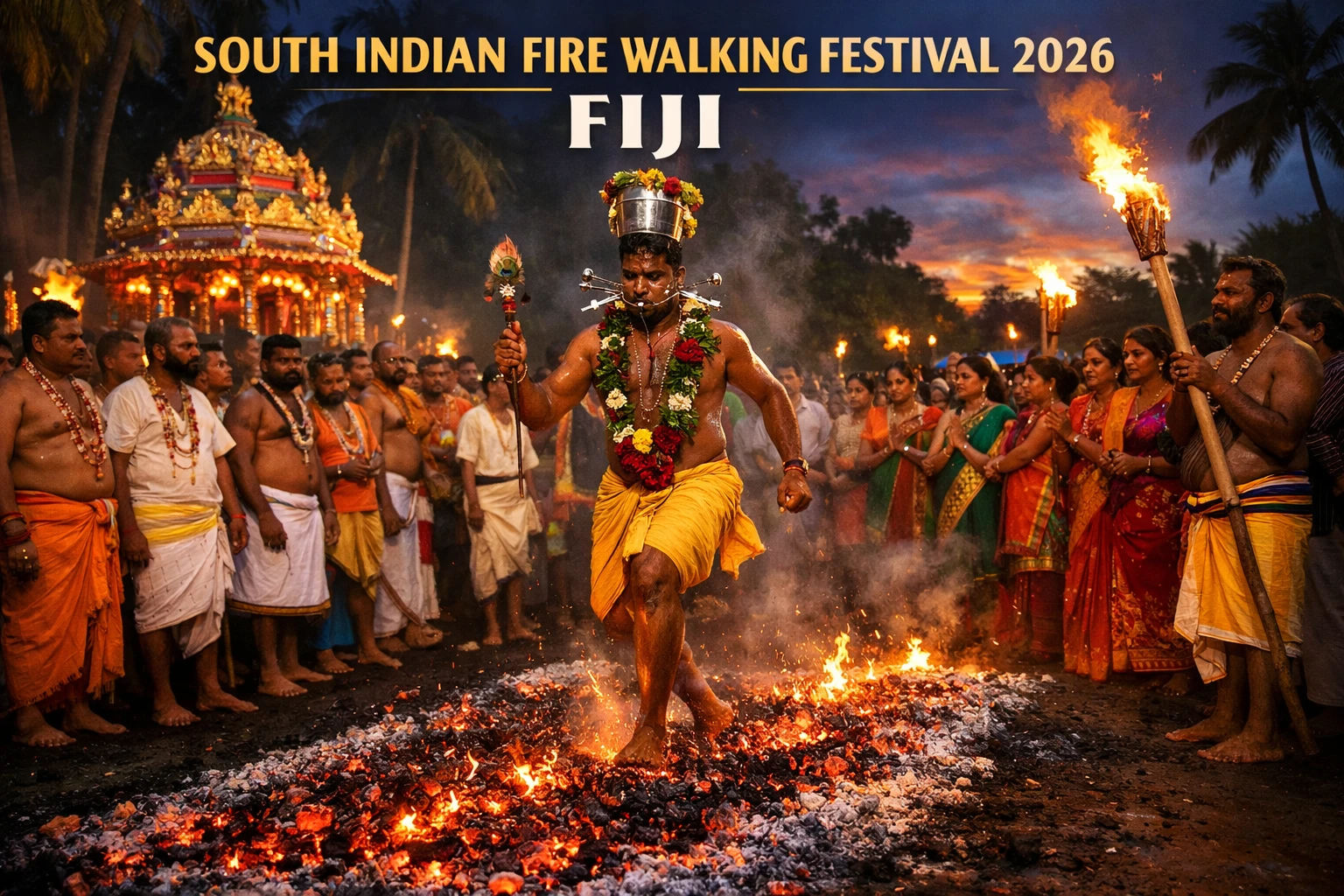
South Indian Fire Walking Festival 2026 Fiji: A Profound Act of Faith on the Islands of the South Pacific
Of all the cultural and religious events that take place across the islands of the South Pacific, few carry the raw intensity, spiritual depth, and sheer visual power of the South Indian Fire Walking Festival in Fiji. Bare-footed men, their bodies smeared with red and yellow turmeric paste, their faces composed in expressions of absolute calm, walk the full length of a pit of blazing wood embers without hesitation, without pain, and without injury, watched by hundreds of devotees who have spent days preparing themselves spiritually to witness and participate in one of the most ancient and significant Hindu rituals still practiced in the modern world.
This is not a performance. It is not a tourist attraction organized for the benefit of visitors, though visitors are welcome to witness it. The South Indian fire walking ceremonies held annually across Fiji's temples between April and September are living religious events, rooted in Tamil South Indian devotional tradition, carried to these Pacific islands more than 140 years ago by the indentured laborers who came from South India to work Fiji's sugar plantations, and preserved in remarkable cultural continuity by the Indo-Fijian community ever since.
The History Behind the Ritual: From South India to the South Pacific
The story of fire walking in Fiji begins not in the Pacific but in the villages of Tamil Nadu and Andhra Pradesh in South India, where the tradition of walking barefoot across burning embers as an act of devotion to the goddess Maha Devi (also worshipped as Mariamman, Draupadi, and Maha Mariamman, among other forms) has been practiced for centuries.
The ritual's theological basis draws on the Mahabharata epic, specifically the story of Draupadi, who was forced to walk through fire to prove her chastity after her husbands wagered and lost her in a dice game. In Tamil devotional tradition, reenacting this fire walk is an act of identification with Draupadi's faith and an expression of the devotee's own willingness to submit to purification through fire.
When indentured Indian laborers began arriving in Fiji from 1879 onward under British colonial contracts to work the expanding sugarcane plantations, they brought their religion, their language, their music, and their ritual practices with them. The Then India Sanmarga Ikya (TISI) Sangam, the organization that became the primary institutional custodian of South Indian cultural life in Fiji, was founded in the early 20th century by Sadhu Kuppuswami, a former indentured laborer from South India who recognized that the cultural and religious identity of the South Indian community in Fiji required organized support to survive across generations.
The TISI Sangam built temples across Fiji, established schools, and created the organizational infrastructure through which the annual fire walking ceremonies have been conducted continuously for over a century. The Navua TISI Sangam Maha Mariamman Kovil celebrated its 90th annual fire walking ceremony in 2022, meaning the 2026 ceremony at that temple will mark approximately the 94th annual edition. The Sri Raj Maha Mariamman Temple on Howell Road in Suva (the Howell Road Sangam Temple) recorded its 94th fire walking ceremony in 2020, meaning 2026 marks a historically significant 100th ceremony milestone at that location.
These numbers put the cultural depth of this tradition in immediate perspective. These ceremonies have been running annually, without interruption except during the years of World War Two, for over a century on a South Pacific island that is more than 10,000 kilometers from the South Indian communities where the tradition originated.
The Primary Venues: Where Fire Walking Takes Place in Fiji in 2026
The South Indian Fire Walking Festival is not a single event with a single date. It is a living religious tradition observed by the Hindu communities of multiple towns and temples across Fiji throughout the April to September season, with each temple conducting its own annual ceremony according to its own schedule.
Mariamma Temple, Suva (Howell Road, TISI Sangam Temple)
The Sri Raj Maha Mariamman Temple on Howell Road, Suva is the most prominent venue for the South Indian Fire Walking Festival and the one most consistently cited by international tourism sources.
Lonely Planet describes it directly: "The South Indian fire-walking festival is held here during July or August. Of all Fiji's cultural rituals, the extraordinary art of fire walking is perhaps the most impressive." The temple sits within the TISI Sangam compound on Howell Road in central Suva, which also houses the TISI Suva Sangam High School, making it a campus of South Indian cultural life that functions as a community hub for Suva's Indo-Fijian community year-round.
For international visitors based in Suva, the July to August Mariamma Temple ceremony is the most accessible and best-documented opportunity to witness the South Indian fire walking tradition in Fiji.
Navua Maha Mariamman Kovil (TISI Navua)
The Maha Mariamman Kovil in Navua, approximately 45 kilometers west of Suva along the Queens Highway, is one of the oldest and most continuously active fire walking temples in Fiji. Its annual ceremony follows a seven-day ritual preparation period culminating in the fire walking, typically in July or August, and the 2022 ceremony attracted hundreds of Hindu devotees for the sixth night of rituals before the climactic fire walk on the final evening.
The Fijian Government's official website covered the 90th Navua ceremony in 2022 in detail, quoting government ministers who specifically highlighted the fire walking as "a good reflection of the goal of the Fijian Government to ensure that all Fijians are able to fully and effectively engage in their religious, traditional and cultural activities of choice."
Malolo Temple and Nadi Region (April Ceremony)
The Malolo Temple, south of Nadi on the western side of Viti Levu, hosts its annual fire walking ceremony in April, making it one of the first of the season. The Rove.me travel guide describes it specifically: "Another famous location to watch the fire-walking ceremony is south of Nadi at the Malolo Temple, where devotees walk across a pit of burning wood embers. It's held annually in April."
For visitors arriving through Nadi International Airport early in the season (April or May), this temple provides the most geographically accessible opportunity to witness the tradition.
Coral Coast Temples (April to September, Full Moon Schedule)
The Coral Coast stretching from Sigatoka to Pacific Harbour along Viti Levu's southern shore is home to multiple temple communities that hold annual fire walking ceremonies throughout the season. Global Traveler's confirmed account notes: "In most of Fiji's Hindu temples, fire-walking occurs annually sometime between May and September during the full moon. It's a purification and gratitude ritual borrowed from South India."
The full moon timing is not arbitrary: the lunar calendar governs many South Indian Hindu ritual observances, and the alignment of fire walking with the full moon reflects the tradition's deep integration with astronomical and seasonal cycles in the original South Indian practice.
The Ritual in Detail: Ten Days of Preparation, One Evening of Fire
Understanding what visitors witness at a South Indian Fire Walking Festival in Fiji requires understanding the ten-day preparation period that precedes the fire walking itself.
The ritual observance begins three to ten days before the fire walking ceremony, depending on the specific tradition of the organizing temple. During this period, participants who have committed to walking the fire:
- Completely isolate themselves from normal social life
- Abstain from meat and follow a strict vegetarian diet
- Abstain from sexual activity and other physical pleasures
- Meditate continuously in devotion to Maha Devi
- Attend daily temple ceremonies conducted by the presiding priest
The spiritual logic of this preparation is that the fire walking itself is not the main event: it is the culmination of a process of purification and devotional surrender. The fire walker who steps onto the burning embers does so in a state of spiritual transformation achieved through days of fasting, prayer, and meditation. The physical experience of walking uninjured across fire is understood not as a trick or a technique but as the direct consequence of the goddess's protection, extended to those who have prepared themselves appropriately.
On the day of the ceremony, the fire pit is prepared from wood that has been burning for hours, building a bed of embers typically reaching temperatures between 400°C and 700°C. The pit itself, traditionally approximately 3 to 4 meters long, is positioned in front of the temple's main facade, allowing the fire walkers to emerge from the temple, cross the fire, and enter the water or milk cooling pit on the far side in a symbolic arc of purification.
The chief priest or pandaram walks first, typically carrying a karagam (a decorated pot of sacred water) on his head, which must remain balanced throughout the fire walk. After him, the committed devotees walk in succession, typically dressed in yellow garments with red and yellow turmeric paint on their faces and bodies, their feet cooling in a pit of cow's milk or cold water after they cross the embers.
The entire fire walking event, from first priest to last devotee, may take one to three hours depending on the number of participants. The atmosphere surrounding the pit is one of intense drumming (urumi and tavil drums), chanting in Tamil, and the collective devotional energy of hundreds of witnesses creating a crowd sonic environment unlike any other cultural event in the Pacific.
Fire Walking in Fiji: Two Traditions, One Island
What makes fire walking in Fiji uniquely interesting from a comparative cultural perspective is that it exists in two completely distinct and historically unrelated traditions on the same islands.
The indigenous iTaukei Fijian fire walking tradition, associated specifically with the island of Beqa (pronounced "Benga"), located approximately 25 kilometers south of Pacific Harbour, is practiced by the Sawau clan, who believe their ancestor was given the gift of fire resistance by a spirit god he captured. The Sawau clan's fire walking uses flat river stones heated in a fire until they glow red-hot rather than a bed of wood embers, and the Beqa ceremony is performed on these stones. The Beqa tradition predates the arrival of Indian laborers by many generations and represents a completely independent development of fire walking practice, making Fiji one of the only places in the world where two culturally unrelated communities practice fire walking as a sacred tradition on the same island group.
Lonely Planet notes this specifically: "Even more mystifying is the fact that, originally, this ritual was practised in Fiji only on the tiny island of Beqa, and by two neighbouring and disparate cultures, indigenous Fijian and Hindu, for completely different reasons."
Witnessing the Festival: Practical Guidance for Respectful Visitors
The South Indian Fire Walking Festivals in Fiji are open to respectful visitors who approach them with cultural sensitivity. Guidelines for attending:
Before you go:
- Contact the specific temple directly, or inquire through your hotel concierge or a local guide, to confirm the exact date and timing of the ceremony you plan to attend. The lunar calendar and temple-specific schedules mean that dates shift year to year.
- The Fiji Tourism Board and local travel operators in Suva, Nadi, and Pacific Harbour can often assist with ceremony date confirmation in the weeks before your visit.
At the ceremony:
- Dress modestly and conservatively: shoulders and legs must be covered.
- Remove your shoes when entering the temple grounds.
- Photography is generally permitted from designated viewing areas, but always seek permission from temple officials before pointing a camera at participants during the ceremony itself.
- Maintain silence during the ritual sections and follow the guidance of the temple officials regarding where visitors may stand.
- Do not attempt to touch the fire pit or approach participants during the fire walking.
Offerings and participation:
- As an observer, you are a guest at a religious ceremony. A small offering or donation to the temple fund is a respectful gesture.
- Do not consume alcohol before attending the ceremony.
Practical Travel Guide to Attending Fire Walking in Fiji 2026
Key Dates Framework for 2026 Planning
- April: Malolo Temple (near Nadi), the earliest ceremony of the season
- May to June: Multiple Coral Coast temples on full moon dates
- July to August: Mariamma Temple (Howell Road, Suva) and Navua Maha Mariamman Kovil
- August to September: Further ceremonies at various temples island-wide
Getting to the Major Venues
- Mariamma Temple, Howell Road, Suva: Suva city center, accessible from the main Suva hotel district by taxi (approximately 10 minutes)
- Navua Maha Mariamman Kovil: 45 kilometers from Suva on the Queens Highway, approximately 45 to 60 minutes by car or bus
- Malolo Temple (Nadi area): accessible from Nadi town by taxi, approximately 20 to 30 minutes south of the airport
International Access
Nadi International Airport (NAN) is the main entry point for all international visitors to Fiji. Direct flights operate from Australia, New Zealand, and North America year-round.
Verified Information at a Glance
Item: Confirmed details
Event Name: South Indian Fire Walking Festival, Fiji (annual Hindu religious ceremony)
Event Category: Annual Hindu religious fire walking ceremony; South Indian Tamil devotional tradition (Maha Mariamman / Maha Devi)
Confirmed 2026 Season: April to September 2026 (temple-specific dates vary; lunar calendar determines exact date at each temple)
Suva (Mariamma Temple): July or August 2026, Howell Road TISI Sangam Temple (Sri Raj Maha Mariamman Temple), Suva
Navua Ceremony: July or August 2026, Maha Mariamman Kovil, Navua (approx. 94th annual edition)
Nadi / Malolo Temple: April 2026
Coral Coast Temples: May to September 2026, full moon dates
Entry: Free for observers at most temples; respectful conduct and appropriate dress required
Preparation Period: 3 to 10 days of fasting, meditation, and vegetarian diet observed by fire walkers before the ceremony
Organizer: TISI Sangam (Then India Sanmarga Ikya Sangam) at major temples; individual temple committees at community level
Dress Code for Visitors: Modest and conservative: shoulders and legs covered; shoes removed at temple grounds
Nearest Airport: Nadi International Airport (NAN) for western and central Fiji ceremonies
Local Tourism Contact: Tourism Fiji: tourism.com.fj
From the moment the drumbeats begin and the first fire walker appears at the temple doorway wearing yellow, moving toward the glowing pit with the absolute certainty that faith will protect him, the South Indian Fire Walking Festival in Fiji delivers an experience that no cultural or nature tourism encounter on these islands can quite match in its combination of spiritual intensity, historical depth, and sheer human courage. Whether you stand at the Mariamma Temple in Suva in July, at the Navua kovil at the end of a seven-day ritual, or at the Coral Coast during a full moon in June, what you are watching is not Fiji performing its culture for visitors. It is a community honoring a tradition that its ancestors carried across an ocean more than a century ago and have kept alive, fire by fire, every year since.