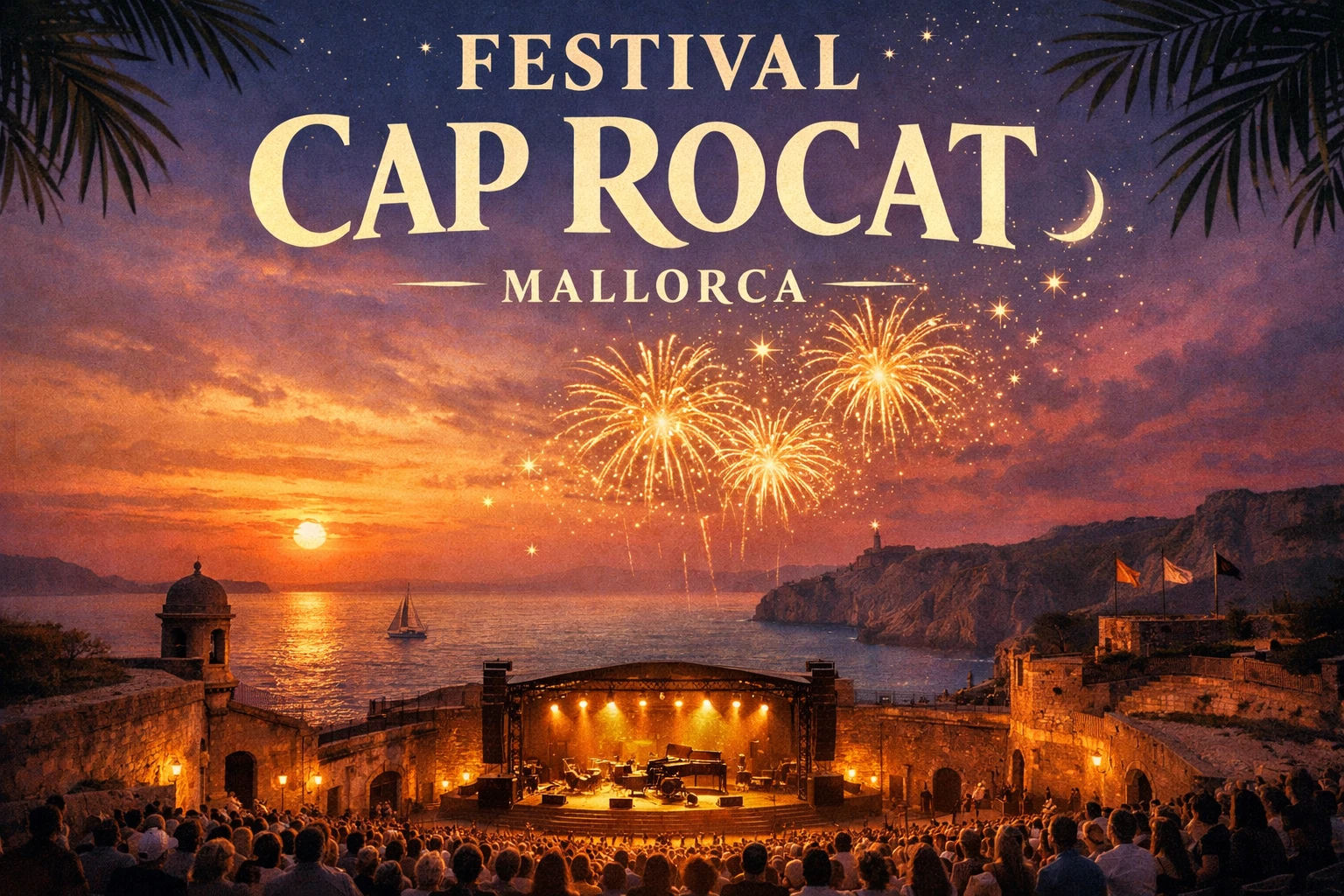
Festival Cap Rocat - Event DescriptionFestival Overview
There are very few music festivals anywhere in Europe where the venue itself is as compelling as the program. The Festival Cap Rocat in Mallorca is one of the few. Held across three nights at the end of July and the beginning of August inside a 19th-century military fortress perched on a clifftop above the Bay of Palma, the festival pairs some of the most significant names in contemporary classical music and opera with what may be the most architecturally and atmospherically extraordinary concert setting in Spain.
This edition runs from Friday July 31 to Sunday August 2, with a program that its artistic director Ilias Tzempetonidis and the festival's general director María Obrador presented in Madrid as confirming the event's position among the most prestigious boutique classical music festivals in southern Europe. The lineup includes Juan Diego Flórez (one of the world's finest living tenors), the legendary pianist Rudolf Buchbinder, and a concert version of Tosca featuring Lise Davidsen, Freddie de Tommaso, and Ludovic Tézier, accompanied throughout by the Orquestra Simfònica de les Illes Balears and the Festival Cap Rocat Choir.
For three nights in late July and early August, a clifftop fortress that was built to defend Mallorca with cannons will host music that needs no defense at all.
The Fortress: A Military History That Became a Musical Stage
Understanding the Festival Cap Rocat fully requires understanding the building that hosts it, because the venue is not simply a luxury backdrop: it is a structure whose specific history gives the festival a dimension that no conventional concert hall could replicate.
The fortress at Cap Rocat was built in the years following 1898, a year of profound national trauma for Spain. The Spanish-American War of that year ended with Spain ceding the Philippines, Guam, Puerto Rico, and effectively Cuba to American control, stripping the country of what remained of its once-global colonial empire. In the aftermath, the Spanish military constructed a series of coastal fortifications around the Bay of Palma to defend against any potential future naval assault, and the fortress at Cala Blava on the bay's southern headland was among the most significant of these.
The fortress was built directly into the rocky cape, its walls following the natural contours of the cliff so precisely that from the sea it is barely visible: an invisible fortress, as much geological feature as human construction, with stone ramparts, underground tunnels, artillery batteries, and observation posts carved into the living rock above the Mediterranean. It served as an active military base, most recently housing new army recruits, until 1996, when it was decommissioned.
It would have become a ruin or a museum had Mallorcan architect and designer Antonio Obrador not known the place since childhood and seen something else entirely in its abandoned walls. In June 2010, after years of meticulous restoration and conversion work, he opened Hotel Cap Rocat: a five-star luxury property with approximately 30 suites and rooms carved directly into the fortress stone, with views over the bay that no other hotel on the island can claim. The former ammunition carts became coffee tables. The ammunition casings became door handles. The entrance to the hotel remains through the original stone tunnel that troops once marched through, and it leads visitors into a space where the sea fills every view.
The Festival Cap Rocat was born from this space in 2021, under the artistic direction of Ilias Tzempetonidis, who serves simultaneously as the artistic director of the Vienna Concert Hall (Konzerthaus Wien), one of the most important classical music venues in the world. His involvement is not a commercial arrangement: it is a statement that the festival aspires to the same level of artistic ambition as the major European summer festivals at which its artists regularly appear.
The Program: Three Extraordinary Nights, Three Different Worlds of Music
Night One, Friday July 31: Juan Diego Flórez and the Inaugural Gala
The festival opens with a performance by Juan Diego Flórez, the Peruvian tenor who has been considered one of the finest singers in opera since his career-defining early appearances in the 1990s and who holds a particular place among Rossini tenors: the flexibility, precision, and sheer beauty of his upper register have made his Rossini recordings and live performances the reference point for a generation.
For the Cap Rocat gala, Flórez will be accompanied by the Orquestra Simfònica de les Illes Balears and the Coro Festival Cap Rocat, under the musical direction of Pablo Mielgo, director of the Balearic symphony orchestra. The program includes arias by Rossini and fragments from the Spanish zarzuela tradition, a pairing that makes particular sense in a Spanish setting: the zarzuela's combination of spoken dialogue and operatic music is the specifically Iberian contribution to the European lyric theater repertoire, and hearing it in the open air of a Mallorcan fortress cliff at the end of July is one of those experiences that the word "extraordinary" almost undersells.
Joan Company directs the festival choir for this opening night and will continue throughout the three-day program.
Night Two, Saturday August 1: Rudolf Buchbinder in Solo Recital
The second night belongs to Rudolf Buchbinder, the Austrian pianist who has been performing at the highest level of the classical world since the 1970s and who is described in the festival's own press release as "one of the most outstanding pianists of his generation" and an "habitual guest at the Salzburg Festival and other major festivals around the world." He is, in other words, exactly the sort of artist who appears at Salzburg, Verbier, and Edinburgh, and his appearance at Cap Rocat is a direct measure of the festival's standing in the European summer circuit.
His recital program spans Mozart, Beethoven, and Schubert, the three composers who most completely define the classical and early Romantic tradition and whose combined work represents, for many listeners, the summit of the piano repertoire. The intimate character of the fortress setting, described consistently as particularly well-suited to recital format, means that this will be an encounter between one of the great pianists of the age and a very small audience in a space of extraordinary acoustic and visual character. There is nothing at scale about a Buchbinder recital at Cap Rocat: it is the deliberate opposite of scale, and that is precisely the point.
Night Three, Sunday August 2: Tosca in Concert Version
The festival closes with its most operatically ambitious offering: Tosca by Giacomo Puccini, presented in concert version with a cast that could fill any opera house in the world.
Lise Davidsen sings the title role. The Norwegian soprano has emerged in the past decade as one of the truly significant voices of her generation in Wagnerian and verismo repertoire, with a voice described consistently as combining exceptional power with remarkable clarity and control. Her Tosca at Cap Rocat is a performance that will draw operagoers from across Europe regardless of other factors.
Freddie de Tommaso sings Cavaradossi and Ludovic Tézier sings Scarpia, the opera's antagonist. Tézier, the French baritone who has been performing the great Verdi and Puccini baritone roles at the Vienna State Opera, the Met, and Covent Garden for over two decades, is one of the most authoritative Scarpias currently active.
The orchestra and choir are the Orquestra de les Illes Balears and the Coro del Festival Cap Rocat, under the musical direction of Giacomo Sagripanti, the Italian conductor with an extensive international career in Italian opera repertoire.
A concert version of Tosca, without staging, forces the music and the voices to carry the full dramatic weight of one of the most intense and emotionally direct operas in the repertoire, and in the natural theatrical environment of the fortress cliff above the Mediterranean, the absence of stage scenery is compensated by a setting that no theater can provide.
The Location: Cala Blava, Bay of Palma
Hotel Cap Rocat is located at Ctra. d'Enderrocat s/n, 07609 Llucmajor, Mallorca, on the southern edge of the Bay of Palma in the Cala Blava area of the Llucmajor municipality. It is approximately 16 to 18 kilometers from Palma city center by road, or roughly 20 to 25 minutes by car or taxi, sitting on the far side of the airport from the city and accessed via the coastal road that follows the bay's southern shoreline.
The location has the specific quality of being simultaneously accessible and hidden: close enough to Palma and the airport to be reached in a short drive but positioned on a rocky headland in such a way that it feels genuinely separate from the island's tourist infrastructure, looking across the Bay of Palma toward the cathedral skyline from a distance that gives the view a quality of considered separation.
The Forbes profile of the hotel described it precisely: "Cap Rocat Mallorca is a place where history resonates. As a former military fort, it takes full advantage of its elevated position in a secluded yet strategic location on a rocky headland right on the Bay of Palma de Mallorca. Merging effortlessly into the landscape, the essential essence of the military architecture adds an extra dimension to the overall hotel experience."
Staying at Cap Rocat: The Full Experience
The Festival Cap Rocat experience is available in its most complete form to guests staying at the hotel itself, whose approximately 30 suites are carved directly into the fortress stone with views over the bay. The hotel, which has only 30 suites, operates at a level of exclusivity that matches the festival's artistic ambition: this is not a property that scales its experience for volume, and the combination of the festival program with hotel residence creates a total immersion in music, history, Mediterranean landscape, and architecture that no day-visit to the festival can fully replicate.
The hotel's seasonal wine evenings and cultural events that run alongside the festival program are part of a broader philosophy of using the extraordinary setting for experiences proportionate to its character. The former military architecture, with its tunnels, ramparts, and artillery batteries, provides a series of spaces that the hotel and festival have repurposed for dining, gathering, and performance with a creativity that preserves rather than obscures the original structure.
Practical Information for Festival Visitors
Getting to Cap Rocat
Palma de Mallorca Airport (PMI), one of Spain's busiest airports in summer with direct connections from London, Amsterdam, Frankfurt, Paris, Berlin, Madrid, Barcelona, and dozens of other European cities, is approximately 8 to 10 kilometers from the Cap Rocat fortress, making it one of the closest airport-to-festival-venue distances of any major cultural event in Europe. The transfer takes 10 to 15 minutes by taxi.
From Palma city center, the drive to Cap Rocat takes approximately 20 to 25 minutes via the coastal road around the southern bay.
Tickets and Booking
The Festival Cap Rocat programs for an intimate audience consistent with the hotel's scale and setting, which means total capacity per evening is dramatically smaller than any conventional concert hall or outdoor festival. Tickets and program information are managed through the festival's official website at festivalcaprocat.com. Given the combination of world-class artists and strictly limited capacity, early inquiry and booking through official channels is essential.
The Surrounding Area
The Cala Blava coastline south of the airport is one of the less-visited sections of the Bay of Palma, providing a quieter and more genuinely Mallorcan coastal experience than the more tourist-saturated areas further north. The nearby S'Arenal beach and the natural areas of the Cala Pi and Cap Blanc headlands to the south are accessible for daytime exploration before the evening festival program.
Palma city with all its cultural offerings, including La Seu Cathedral, the Gothic Quarter, and the dining and nightlife of Paseo del Born and Santa Catalina, remains easily accessible throughout the festival period for anyone based at the hotel or staying in Palma and traveling to Cap Rocat for the concerts.
July and August Weather
Late July and early August represent peak Mallorcan summer: temperatures typically reaching 30 to 34 degrees Celsius during the day, with evenings settling around 23 to 26 degrees after sunset. The outdoor concert settings within the fortress receive the consistent sea breeze that the clifftop position provides, moderating the evening heat into conditions that are genuinely comfortable for classical music listening under the stars.
Verified Information at a Glance
- Event Name: Festival Cap Rocat, Mallorca
- Event Category: Boutique international classical music and opera festival; outdoor fortress setting; intimate format
- Typical Months: Late July to early August
- Dates: Friday July 31, Saturday August 1, Sunday August 2
- Venue: Hotel Cap Rocat (former 19th-century military fortress), Ctra. d'Enderrocat s/n, 07609 Llucmajor (Cala Blava), Mallorca, Balearic Islands, Spain
- Night 1 (July 31): Juan Diego Flórez (tenor) + Orquestra Simfònica de les Illes Balears + Coro Festival Cap Rocat; conductor: Pablo Mielgo; Rossini arias + zarzuela
- Night 2 (August 1): Rudolf Buchbinder (piano recital); repertoire: Mozart, Beethoven, Schubert
- Night 3 (August 2): Tosca (Puccini) in concert version; Lise Davidsen (soprano), Freddie de Tommaso (tenor), Ludovic Tézier (baritone); conductor: Giacomo Sagripanti; Orquestra de les Illes Balears + Coro Festival Cap Rocat, choir director: Joan Company
- Artistic Director: Ilias Tzempetonidis (also Artistic Director, Vienna Concert Hall / Konzerthaus Wien)
- General Director: María Obrador (Fundación Madina Mayurqa)
- Festival Founded: 2021
- Hotel Suites: Approximately 30 suites carved into fortress stone; 5-star luxury
- Ticket Pricing: Premium; available through festivalcaprocat.com (face-value pricing not publicly confirmed; limited capacity per night)
- Distance from PMI: Approximately 8 to 10 km, around 10 to 15 min by taxi
- Distance from Palma City: Approximately 16 to 18 km, around 20 to 25 min by taxi
- Nearest Airport: Palma de Mallorca Airport (PMI)
- Late July Climate: 30 to 34°C by day; 23 to 26°C evenings; dry; sea breeze at clifftop venue
Three nights. A Peruvian tenor, an Austrian pianist, and a Norwegian soprano delivering Tosca. A 19th-century military fortress carved into a Mallorcan clifftop above the Bay of Palma, built to defend an empire that was already slipping away, now hosting music that needs no defense and no apology. The Festival Cap Rocat is not the biggest event on the Mallorca summer calendar. It is simply the most singular: the one where the venue matches the music, where the architecture deepens the listening, and where the Mediterranean night does the work that no lighting designer or stage technician could replicate. Visit
%202026.webp)
%202026.webp)
