Discover the Makawao Stampede Rodeo and Parade
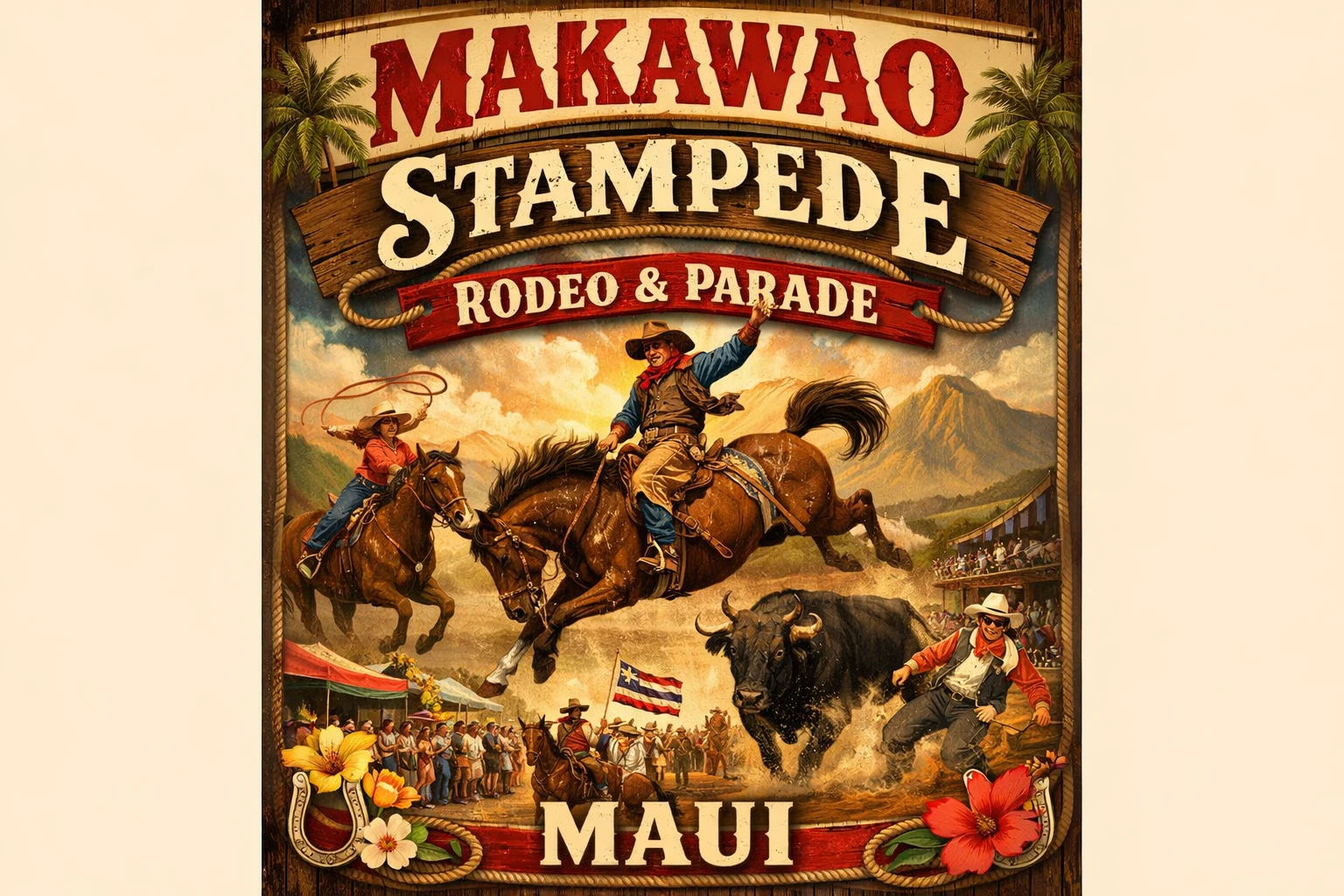
Most visitors who come to Maui for the first time expect beaches, resorts, and the kind of tropical beauty that every photograph of the island confirms. Very few expect to find, on a green hillside nearly 3,000 feet above sea level, a cowboy town that has been running one of the most authentic and beloved rodeos in the United States every Fourth of July weekend for nearly seventy consecutive years. But that is exactly what Makawao is, and exactly what the Makawao Stampede Rodeo and Parade delivers every summer: an upcountry Maui celebration of paniolo culture, Hawaiian cowboy heritage, and community pride that draws competitors from across the Hawaiian Islands and the continental United States and spectators who come back year after year because there is nothing else quite like it anywhere in the Pacific.
The schedule is built across multiple days: the Makawao Town Parade on Saturday June 27 at 9:00 AM along Baldwin Avenue, followed by the Bull Bash on Friday July 3, the first night rodeo performance on Saturday July 4, Paniolo Day on Sunday July 5, and the Championship Patriotic Day on Sunday July 6, all at the Oskie Rice Event Center, 523 Olinda Road, Makawao. This edition marks a milestone worth noting: 110 years of Kaonoulu Ranch, the upcountry operation that has been central to Makawao's paniolo heritage, with nearly 250 competitors from across Hawai'i and around the country.
The Paniolo Tradition: How Hawai'i Got Its Cowboys
The story of the Hawaiian cowboy is one of the more surprising chapters in Pacific cultural history, and understanding it gives the Makawao Stampede its full meaning.
In the early 1800s, King Kamehameha III faced a cattle management crisis. The cattle population, descended from livestock given to the kingdom by British navigator Captain George Vancouver, had grown far beyond what local Hawaiians knew how to handle. To solve the problem, the king brought in vaqueros from Mexico and California: highly skilled Spanish-speaking horsemen who knew cattle, roping, and riding. The Hawaiian men who trained under them became the first paniolo, a Hawaiian pronunciation of the Spanish españoles.
The paniolo tradition took hold most deeply in the upcountry highlands of Maui, where the grassy slopes of Haleakalā and the wide-open ranch lands provided exactly the terrain that cattle ranching required. By the late 19th century, Upcountry Maui was home to some of the most skilled horsemen in the Pacific, competing not just locally but on the mainland. In 1908, three Hawaiian paniolo: Ikua Purdy, Archie Ka'au'a, and Jack Low traveled to the Frontier Days Rodeo in Cheyenne, Wyoming, then considered the most prestigious rodeo in the world, and Ikua Purdy won the world steer roping championship, defeating the best cowboys from across the United States and stunning an audience that had never seen Hawaiian competitors. That victory remains one of the most celebrated moments in Hawaiian sports history, and it established once and for all that the paniolo tradition was not a derivative of mainland cowboy culture but a genuinely world-class equestrian tradition in its own right.
The Makawao Stampede Rodeo grew directly from that heritage. The rodeo started in 1956, and today the family of its original organizers, the Miranda family, continues to run the event as an annual Upcountry Maui tradition, with nearly 250 competitors gathering each July 4th weekend for what the official festival website describes as "110 years of tradition." PBS Hawai'i featured the event in its documentary series Home Is Here, describing it as the defining Fourth of July gathering for paniolo and spectators from across the islands.
The official tourism site for Hawai'i describes it plainly: "The Makawao Rodeo, held yearly on the Fourth of July, is Hawai'i's largest paniolo competition and has been an Upcountry tradition for more than 50 years."
The Full Event Calendar: Parade, Bull Bash, and Rodeo Days
What makes the Makawao Stampede exceptional among Hawaiian summer events is not a single afternoon but a multi-day program that builds progressively from the parade through to the championship finale.
The Makawao Town Parade, Saturday June 27
The festivities begin the weekend before the rodeo with the Makawao Town Parade on Saturday June 27 at 9:00 AM, running along Baldwin Avenue and Makawao Avenue in the heart of town. Now in its late 50s as an annual event, the parade is an expression of community identity as much as a pre-rodeo warm-up.
The parade lineup includes paniolo in formal cowboy attire, marching bands, classic cars, floats from local organizations, and the always-popular pā'ū riders: women dressed in traditional Hawaiian riding attire, on horseback, representing each island of Hawai'i with their island's signature flower color woven into their clothing, their horses' manes, and their lei. The pā'ū riders are among the most visually distinctive elements of any traditional Hawaiian parade, and the Makawao version draws some of the finest riders on the island.
The fun begins even before the official parade start: a stick horse race for adults and youth takes place at 8:00 AM along Baldwin Avenue in front of the Designing Wahine Emporium, and free shuttle service from the Oskie Rice Event Center parking area brings visitors into town without the frustration of limited street parking.
The Bull Bash, Friday July 3
The rodeo weekend proper opens on Friday July 3 at the Oskie Rice Event Center with the Bull Bash, gates opening at 3:00 PM and the bull riding beginning at 7:00 PM after a preshow concert at 5:00 PM. The Bull Bash is the most concentrated and arguably most adrenaline-charged single event of the entire weekend: pure bull riding, where competitors attempt to ride some of the most powerful animals in the sport for the required eight seconds that separates a successful ride from an immediate dismount.
For many first-time rodeo visitors, the bull riding is the event that rewires their understanding of what professional rodeo actually is. The combination of an 1,800-pound bull, a rider, eight seconds, and a dirt arena in an upcountry Maui evening is something that no description fully prepares you for.
Rodeo Performances, July 4 to 6
The main rodeo program unfolds across three days from Saturday July 4 through Monday July 6, progressing from the first night performance through Paniolo Day and culminating in the Patriotic Day championship performance that closes the Stampede with the winners of each event confirmed.
The competitive events span the full traditional rodeo repertoire:
- Bull riding: Eight seconds on a bucking bull; scoring on both the bull's performance and the rider's control
- Barrel racing: Rider and horse navigate a precise three-barrel cloverleaf pattern at speed; one of the most technically demanding equestrian events in rodeo
- Calf roping (tie-down roping): Rider ropes a calf, dismounts, and ties three legs in the fastest possible time
- Bareback bronc riding: Rider on a bucking horse with only a rigging handle, no saddle; one of rodeo's most physically demanding events
- Team roping: Two riders working together to rope a steer by head and heels in minimum time; one of the most distinctively paniolo-influenced events in the sport
- Steer wrestling, saddle bronc, and additional events completing the full traditional program
The nearly 250 competitors come from across the Hawaiian Islands and from the continental United States, bringing a range of professional experience and regional styles together in a single arena in ways that make the Makawao Stampede a genuine cross-section of American rodeo at its most culturally specific.
The Oskie Rice Event Center: A Venue With a Name Worth Knowing
The Oskie Rice Event Center at 523 Olinda Road, Makawao, HI 96768 is the spiritual home of the Makawao Stampede, and the name it carries is itself a piece of Hawaiian rodeo history. Oskie Rice was one of Maui's most beloved paniolo figures, a horseman and rodeo competitor whose memory the venue honors as the permanent guardian spirit of upcountry competition.
The facility sits in the green upcountry highlands above Makawao town, at an elevation that gives the arena an atmospheric quality entirely unlike the beach-level resort venues that most Maui visitors experience. The surrounding landscape of pasture, eucalyptus, and the distant slopes of Haleakalā creates the visual context for a rodeo that feels genuinely embedded in its environment rather than staged within it. The air is cooler, cleaner, and carries a distinctive upcountry quality that Maui residents describe as one of the essential pleasures of the highlands.
The venue hosts food vendors, craft stalls, and the kind of festival-ground atmosphere that builds through the multi-day program into a community gathering with real momentum by the final championship Sunday.
Makawao Town: Baldwin Avenue and the Upcountry Character
Makawao town is worth at least half a day of exploration before or after the rodeo, and its Baldwin Avenue main street is one of the most genuine small-town commercial strips in the Hawaiian Islands. Western-fronted buildings house a mix of art galleries, boutiques, bakeries, local restaurants, and the kind of independent businesses that arrive when a community decides it prefers its own identity to a franchise-based alternative. The famous Komoda Store and Bakery, a family-run institution that has been producing cream puffs and other baked goods since 1916 and regularly sells out by mid-morning, is the most cited single destination on Baldwin Avenue and functions as an unofficial test of how early you are willing to get up for a cream puff.
The surrounding Upcountry Maui region encompasses some of the island's most productive agricultural land: lavender farms at Alii Kula Lavender, protea flowers growing at commercial scale on the Haleakalā slopes, Surfing Goat Dairy on the lower slopes, and the vast Ulupalakua Ranch on the southwestern side of the volcano, where cattle still graze on rolling grasslands in the shadow of the summit crater.
Tickets, Pricing, and Practical Information
Tickets and Pricing
Face-value tickets for the Makawao Stampede Rodeo events start at approximately $47 to $55 per performance, with an average price around $68 on resale platforms. The Bull Bash on July 3 and the Saturday night July 4 performance tend to carry the highest demand and the most competitive availability. The parade on June 27 along Baldwin Avenue is a free community event that requires no ticket.
Tickets are available through etix.com, the Oskie Rice Event Center website, and major ticketing resellers. Rodeo event queries can be directed to Morag Miranda at 808-960-0137 or Ken Miranda at 808-960-4708.
Getting to Makawao and Upcountry Maui
Kahului Airport (OGG) is approximately 20 to 25 minutes from Makawao by car via the Haleakalā Highway and the Makawao Avenue approach through Pukalani. Rental cars are the most practical transport option for upcountry Maui, where public transport is limited and the distances between the coast and the highlands require flexibility. The free shuttle service from the Oskie Rice Event Center to the parade route is available for those attending the Saturday June 27 parade.
Where to Stay
Most Maui hotel zones (Kāʻanapali, Wailea, Kīhei) are accessible within 30 to 45 minutes of Makawao, making a beach-based stay entirely compatible with day trips for rodeo events. For visitors who specifically want to be in the upcountry character, vacation rentals in Makawao, Kula, and Pukalani offer a genuinely different and cooler experience of Maui during the hot summer months.
July Weather in Upcountry Maui
While the coastal resort areas of Maui experience 30 to 33 degrees Celsius in July, Makawao at around 1,500 feet elevation sits significantly cooler, typically around 22 to 26 degrees Celsius by day and 18 to 20 degrees in the evenings. Layering for evening rodeo performances is advisable, as the temperature drops noticeably after sunset in the upcountry.
Verified Information at a Glance
Event Name: Makawao Stampede Rodeo and Parade (4th of July Makawao Stampede)
Event Category: Professional rodeo, paniolo cultural celebration, parade, community festival
Typical Month: Late June (parade) and July 4th weekend (rodeo)
Parade Date: Saturday, June 27, 9:00 AM along Baldwin Avenue and Makawao Avenue, Makawao Town
Bull Bash: Friday, July 3; Gates 3:00 PM; Preshow Concert 5:00 PM; Bull Bash 7:00 PM
1st Night Rodeo: Saturday, July 4
Paniolo Day: Sunday, July 5
Championship/Patriotic Day: Monday, July 6
Venue: Oskie Rice Event Center, 523 Olinda Road, Makawao, HI 96768
Competitors: Nearly 250 from across Hawai'i and the continental United States
Edition Milestone: 110 years of Kaonoulu Ranch celebration
Rodeo Events: Bull riding, barrel racing, calf roping, bareback bronc, saddle bronc, steer wrestling, team roping
Ticket Prices: From approximately $47 to $55 face value; average $68 on resale platforms
Parade Admission: Free
Organizer: Miranda Family / K Ranch Roping LLC
Rodeo Contact: Morag Miranda: 808-960-0137; Ken Miranda: 808-960-4708
Rodeo Founded: 1956 (nearly 70 years of annual tradition)
Nearest Airport: Kahului Airport (OGG), approximately 20 to 25 min from Makawao by car
July Upcountry Climate: 22 to 26°C daytime; 18 to 20°C evenings; cooler than coast; layering advisable for evening performances
Official Website: maui-rodeo.com / oskiericeeventcenter.com
Seventy years of paniolo, nearly 250 riders and ropers from across the Pacific and the continental United States, upcountry Maui air that is nothing like what any beach resort prepares you for, and a Baldwin Avenue parade that starts at 9:00 AM on a June Saturday with horses, marching bands, and pā'ū riders in full island regalia. The Makawao Stampede Rodeo and Parade is the Fourth of July the way Maui has always done it, rooted in the ground, shaped by community, and celebrating a way of life that the island's paniolo have been carrying forward since the days of the first Spanish vaqueros on Haleakalā's slopes. Grab your tickets from maui-rodeo.com before the Bull Bash sells out, plan your June 27 parade morning on Baldwin Avenue, and spend the Fourth of July weekend in Makawao discovering the Maui that lives above the beach line.