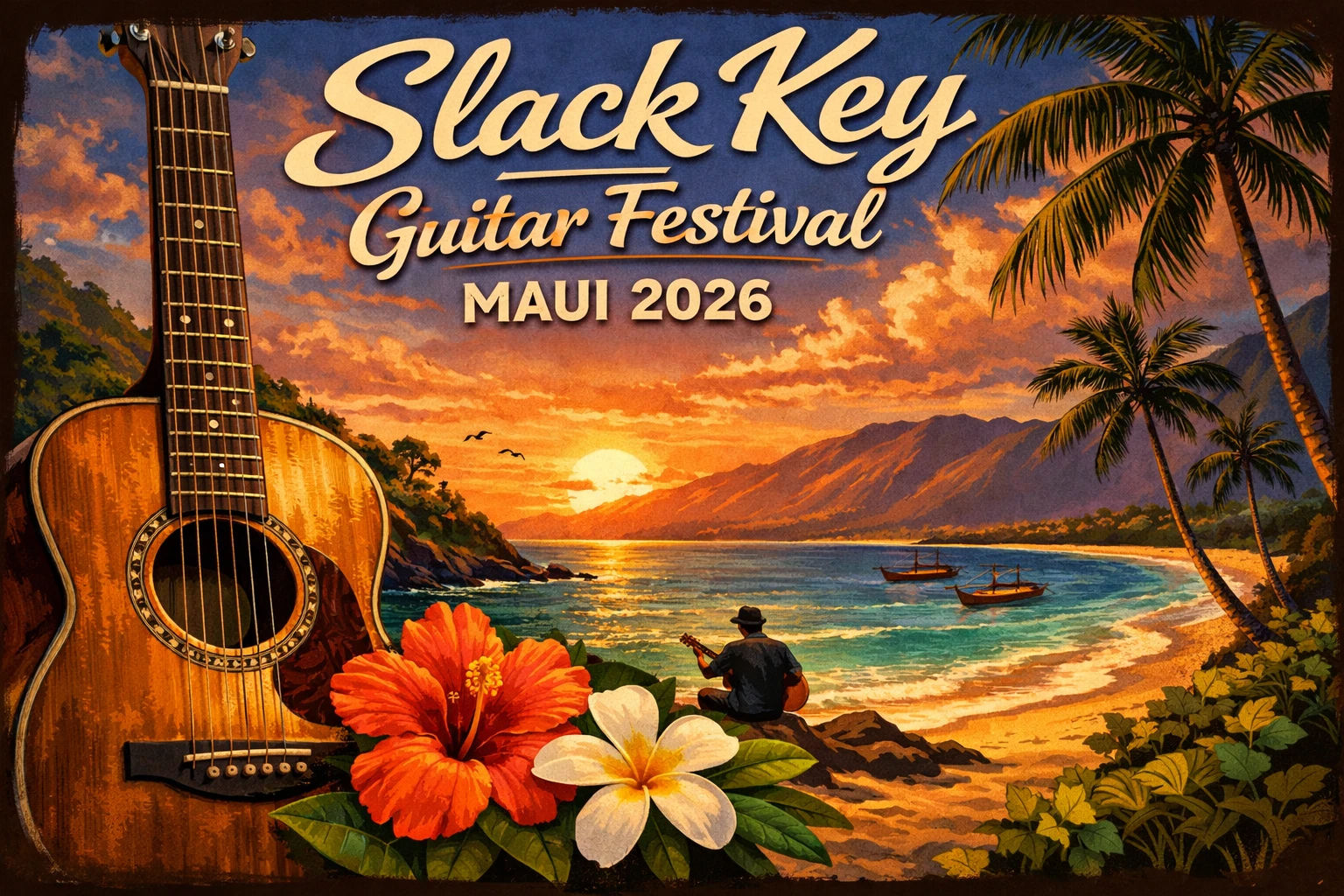
35th Annual Hawaiian Slack Key Guitar Festival – Maui StyleThere are only a few musical traditions in the world that belong so completely to a single place that hearing them instantly and unmistakably conjures that place in the listener's imagination. Ki ho'alu, Hawaiian slack key guitar, is one of them. The moment you hear the open, resonant, fingerpicked sound of a slack key guitar, the tuning producing that characteristic lush chord underneath the melody, you are somewhere in Hawai'i whether you are physically there or not.
And if you happen to be on Maui on Sunday June 28, you can hear the real thing live, outside, in a beautiful amphitheater, surrounded by Maui's favorite local food and island crafts, at absolutely no cost. The 35th Annual Hawaiian Slack Key Guitar Festival - Maui Style, organized by the Ki-ho'alu Foundation, Inc. under the direction of Milton Lau, runs from 2:00 PM to 6:00 PM at the Maui Arts and Cultural Center (MACC) Amphitheater in Kahului, with doors opening at 1:00 PM for those who want to arrive early, settle in, and let the island take over.
Free admission. All ages. Thirty-five years of doing this on Maui. Those three facts say most of what needs to be said about what this festival is and what it values.
Ki Ho'alu: The Guitar Sound That Belongs to Hawai'i Alone
To fully understand the Hawaiian Slack Key Guitar Festival Maui Style, it helps to understand what slack key guitar actually is and how a uniquely Hawaiian music tradition was born from one of the more unlikely cultural encounters in Pacific history.
The story begins in the early 1800s, when King Kamehameha III was dealing with a cattle problem. The islands' cattle population, originally gifted to the kingdom by British explorer Captain George Vancouver, had grown beyond what local Hawaiians knew how to manage. To teach Hawaiians herding and livestock management, the king brought in vaqueros from Mexico: skilled Spanish-speaking cowboys who arrived with their horses, their herding techniques, and their guitars. The Hawaiians who learned from them became the first paniolo (a Hawaiianization of españoles), and in their off-hours, sitting around after work in the style that Hawaiians call kanikapila (informal music-making among friends), they began experimenting with the guitars the vaqueros had left behind.
The experimentation produced something entirely new. Instead of using the standard tunings brought from the mainland, the Hawaiian paniolo began "slacking" the strings, loosening the tuning pegs to create open chord tunings where the open strings themselves produced a full, resonant major chord or a chord with a major seventh. The Hawaiian-language name for the technique, ki ho'alu, means literally "loosen the key": loosen the tuning peg to produce the open, ringing resonance that defines the sound.
Over the following century, the tradition was passed down through families as a private and deeply personal art form, often kept deliberately secret: certain tunings were closely guarded family possessions, passed from parent to child in a lineage of musical inheritance that gave individual families their own distinctive sound. Many guitarists chose to play only for family and friends rather than recording or performing professionally. As George Kuo, one of the great masters of the tradition, observed: "Sometimes the older players would lock into a groove (keeping the same tempo and feeling) and stay there all night."
The tradition found its modern beginning in 1946, when Gabby Pahinui, the legendary guitarist from O'ahu, recorded "Hi'ilawe", the first known commercial recording of ki ho'alu. Released in 1946, the song sparked a musical movement that eventually drew the wider world's attention to the tradition and inspired a generation of guitarists to play and record.
The tradition received further institutional support from an unexpected direction when King David Kalākaua, Hawai'i's last king, whose reign in the 1880s and 1890s was defined by a deliberate Hawaiian cultural renaissance, supported the preservation of ancient music while encouraging the guitar and the 'ukulele as instruments that could carry traditional Hawaiian song. His coronation in 1883 and his Jubilee in 1886 both featured guitar alongside traditional instruments and chant, cementing the guitar's place in the Hawaiian musical tradition at the highest cultural level.
In the decades since, ki ho'alu has been recognized by the Grammy Awards as a distinct and significant musical tradition, with a dedicated Grammy category (Best Hawaiian Music Album) that has been won by artists including Ledward Kaapana, George Kahumoku Jr., Keola Beamer, and others who are regulars on the Maui festival circuit.
Thirty-Five Years on Maui: The Festival's Place in Island Culture
The Hawaiian Slack Key Guitar Festival - Maui Style has been running continuously since its first edition, making it one of the longest-running annual music events in the state of Hawai'i. Organized by the Ki-ho'alu Foundation, Inc. under the direction of Milton Lau, the festival has maintained an unwavering commitment to two things that define its character: the highest quality of Hawaiian musical performance and free admission for all ages.
That combination is rarer than it should be. A four-hour program of Grammy-caliber Hawaiian music, available without charge, specifically designed to be welcoming to families, kama'āina (local residents), and visitors from around the world alike, reflects a set of values about what music is for that the festival has held for 35 years without compromise.
As the event description says: "Come and celebrate our special culture with us and walk away knowing you experienced something special." That is not marketing language. It is an accurate description of what the festival delivers to everyone who attends.
The Artists: Hawaii's Finest Slack Key Musicians on One Stage
The 35th Annual Hawaiian Slack Key Guitar Festival - Maui Style will feature some of Hawaii's dynamic and exciting musicians in the slack key guitar and Hawaiian music genre across the full four hours.
Looking at the 34th edition lineup for context, the festival regularly brings together the most significant names in the living ki ho'alu tradition:
- Ledward Kaapana: One of the most celebrated slack key guitarists in Hawaiian music history, a National Heritage Fellowship recipient, Grammy-nominated artist, and a figure whose playing embodies the Big Island paniolo tradition at its most expressive
- Michael Kaawa: A highly respected figure in the contemporary slack key scene
- Stephen Inglis: Multi-instrumentalist and frequent Grammy participant in the Hawaiian music category
- Ken Makuakane: Award-winning composer and recording artist
- Darrell Aquino: Accomplished guitarist in the ki ho'alu tradition
- Shem Kahawa'i: Protégé of George Kahumoku Jr. and regular at the weekly Napili Kai Slack Key Show
- Kailua Moon (Danny & Nani Carvalho): One of Maui's most beloved husband-and-wife performing duos
- Walter Keale, Dwight Kanae, Kevin Brown & Friends, and others completing a lineup of extraordinary depth
The specific artist roster for the 35th edition will be announced as the June date approaches, but the curatorial standards the festival has maintained across three and a half decades make the lineup announcement something Maui's music community looks forward to each year as much as the event itself.
The MACC Amphitheater: The Perfect Stage for an Open-Air Musical Celebration
The Maui Arts and Cultural Center (MACC) Amphitheater at 1 Cameron Way, Kahului, HI 96732 is one of the most beloved outdoor performance venues on the island, and it serves as the festival's home with good reason. The open-air amphitheater configuration, with its natural acoustic properties and the Maui sky above, creates an environment where ki ho'alu's characteristic open, resonant sound can breathe in a way that enclosed indoor venues do not allow.
Kahului sits at the heart of Maui's central isthmus, the natural convergence point of the island where the two volcanic masses of Haleakalā and the West Maui Mountains meet. From the MACC, you can look toward Haleakalā, the massive shield volcano whose summit crater sits at 10,023 feet, across the cane-field flatlands that once defined the central valley's agricultural identity. The MACC itself is a significant cultural institution that hosts the full range of performing arts on Maui year-round, and its amphitheater has hosted some of the island's most memorable outdoor performances.
The festival's practical layout includes food vendors offering some of Maui's favorite foods and snacks, and island craft vendors presenting handmade goods from Maui artisans under the umbrella of the festival's "Made in Maui" marketplace philosophy. This is not simply a concert: it is a full afternoon of music, food, craft, and community gathering that carries the spirit of the traditional Hawaiian backyard kanikapila into a public celebration accessible to everyone.
The Weekly Slack Key Show: More Hawaiian Music While You Are on Maui
For visitors who want to experience ki ho'alu in an even more intimate setting during their time on the island, the George Kahumoku Jr. Slack Key Show: Masters of Hawaiian Music runs every Wednesday evening at the Napili Kai Beach Resort in Napili, on Maui's northwest coast.
Established in 2003, the show is hosted by George Kahumoku Jr., a four-time Grammy Award-winning slack key guitarist who is one of the most important figures in the preservation and popularization of ki ho'alu. Each Wednesday features a different guest artist drawn from the top tier of Hawaiian guitar, 'ukulele, and vocal performance, creating a series that has introduced thousands of visitors to the living tradition of slack key music in a setting of extraordinary intimacy.
Doors open at 5:45 PM, the show runs from 6:30 PM to 8:00 PM, and tickets are available at Priority Reserved seating ($60) for the front four rows, General Admission ($40) for open seating from row five onward, and a Kama'āina discount of $30 at the door for Hawai'i residents with a Hawaiian driver's license.
The Napili Kai Beach Resort setting adds its own dimension to the experience: the stage faces Napili Bay, one of the most sheltered and picturesque small bays on the west side of Maui, with Moloka'i visible across the channel on clear evenings. Attending a Wednesday Slack Key Show at Napili Kai and then the annual festival at the MACC in the same Maui visit gives a visitor the full spectrum of what ki ho'alu sounds like in both its intimate and its celebratory forms.
Maui in June: The Island Setting for Slack Key Season
A June trip to Maui built around the Slack Key Guitar Festival gives visitors access to one of the most appealing versions of the island's character. June is the sweet spot before the peak summer crowds of July and August fully arrive, with warm and largely dry weather across the south and west sides of the island and the trade winds producing comfortable conditions on the central isthmus where Kahului and the MACC are located.
Average June temperatures across Maui's lower elevations sit around 28 to 30 degrees Celsius by day, dropping to a comfortable 22 to 24 degrees in the evening. The 2:00 PM to 6:00 PM festival window encompasses the late afternoon, when Maui's light has the warm golden quality that makes even a parking lot amphitheater look like a postcard.
Haleakalā National Park
The summit of Haleakalā at 10,023 feet is accessible on a day trip from Kahului via the Haleakalā Highway, a winding ascent through cloud layer and high desert that takes approximately 90 minutes and arrives at a volcanic crater landscape unlike anything else in the Pacific. The sunrise view from the summit is among the most frequently cited natural experiences in all of Hawai'i. A summit visit in the early morning, a drive back to sea level, and an afternoon at the Slack Key Festival is one of those Maui days that no organized itinerary could improve on.
Ho'okipa Beach Park
Ho'okipa Beach Park on Maui's North Shore, approximately 20 minutes east of Kahului, is the global capital of professional windsurfing and kitesurfing, where world champions train in conditions that bring consistent large swells and strong trade winds to one of the most visually dramatic beach parks on the island. The bluff above the beach provides one of the best spectator vantage points in Hawaiian water sports culture.
Pā'ia Town
Pā'ia, the funky North Shore surf town strung along the Hāna Highway a few miles east of Kahului, is Maui's most distinctive dining and alternative retail destination: farm-to-table restaurants, independent coffee shops, surf shacks, and vintage clothing stores in a stretch of buildings that has maintained its character against the tide of resort development. A morning in Pā'ia before driving to the MACC for the afternoon festival makes a natural circuit of the island's cultural geography.
'Iao Valley State Monument
'Iao Valley, minutes from Kahului via the Wailuku approach, offers the 'Iao Needle, a 1,200-foot basalt pinnacle rising from a narrow valley of extraordinary green intensity, alongside the cultural history of one of the most significant sites in Hawaiian history: the valley where Kamehameha I won the decisive Battle of Kepaniwai in 1790 in his campaign to unify the Hawaiian Islands. It is a 10-minute drive from the MACC and a completely different kind of engagement with the Maui landscape.
Practical Information: Getting There, Getting Around, Staying on Maui
Arrival
Kahului Airport (OGG) is Maui's primary airport, located approximately 5 minutes by car from the MACC, making this one of the most convenient airport-to-venue situations of any cultural event in the Pacific. Direct flights serve Kahului from Los Angeles, San Francisco, Seattle, Phoenix, and other West Coast cities, alongside multiple daily inter-island connections from O'ahu, Kaua'i, and the Big Island.
Getting to the MACC
The Maui Arts and Cultural Center at 1 Cameron Way, Kahului is centrally located on the island, easily accessible from all parts of Maui by car in 15 to 40 minutes depending on starting point. Ample parking is available on-site.
Where to stay
Kahului and Wailuku provide the most central base for visitors attending the festival, with a range of budget-to-mid-range accommodation options and proximity to the island's main commercial and cultural facilities. The resort areas of Kā'anapali and Wailea offer luxury beach accommodation within 30 to 45 minutes of the MACC. Kīhei on the south shore provides mid-range to budget options with beach access at around 20 minutes from Kahului.
Verified Information at a Glance
Event name: 35th Annual Hawaiian Slack Key Guitar Festival – Maui Style
Event category: Outdoor live music festival; Hawaiian slack key guitar (ki ho'alu); Hawaiian cultural celebration; free community event
Typical month: June (annual, last Sunday of June historically)
Date: Sunday, June 28
Time: 2:00 PM to 6:00 PM (4 hours); Doors open at 1:00 PM
Venue: Maui Arts and Cultural Center (MACC) Amphitheater, 1 Cameron Way, Kahului, HI 96732
Admission: FREE for all ages
Organizer: Milton Lau / Ki-ho'alu Foundation, Inc.
Edition: 35th annual
Program length: 4 hours of live performance
Past artists (34th edition): Ledward Kaapana, Michael Kaawa, Stephen Inglis, Ken Makuakane, Darrell Aquino, Kahiau Lam-Ho, Namaka Cosma White, Kailua Moon, Walter Keale, Dwight Kanae, Kevin Brown & Friends, Shem Kahawa'i
On-site vendors: Food vendors (Maui's favorite foods and snacks); island craft vendors ("Made in Maui"); festival merchandise
Weekly ki ho'alu show: George Kahumoku Jr. Slack Key Show, every Wednesday, Napili Kai Beach Resort, Napili; 6:30 to 8:00 PM; Priority seating $60, GA $40, Kama'āina $30
Nearest airport: Kahului Airport (OGG), approximately 5 minutes from the MACC
June climate: 28 to 30°C daytime; 22 to 24°C evenings; dry; trade wind conditions
Phone: (808) 226-2697 (Ki