King Kamehameha Celebration Floral Parade 2026 Oahu: A Royal Tradition Unlike Anything Else in the Pacific
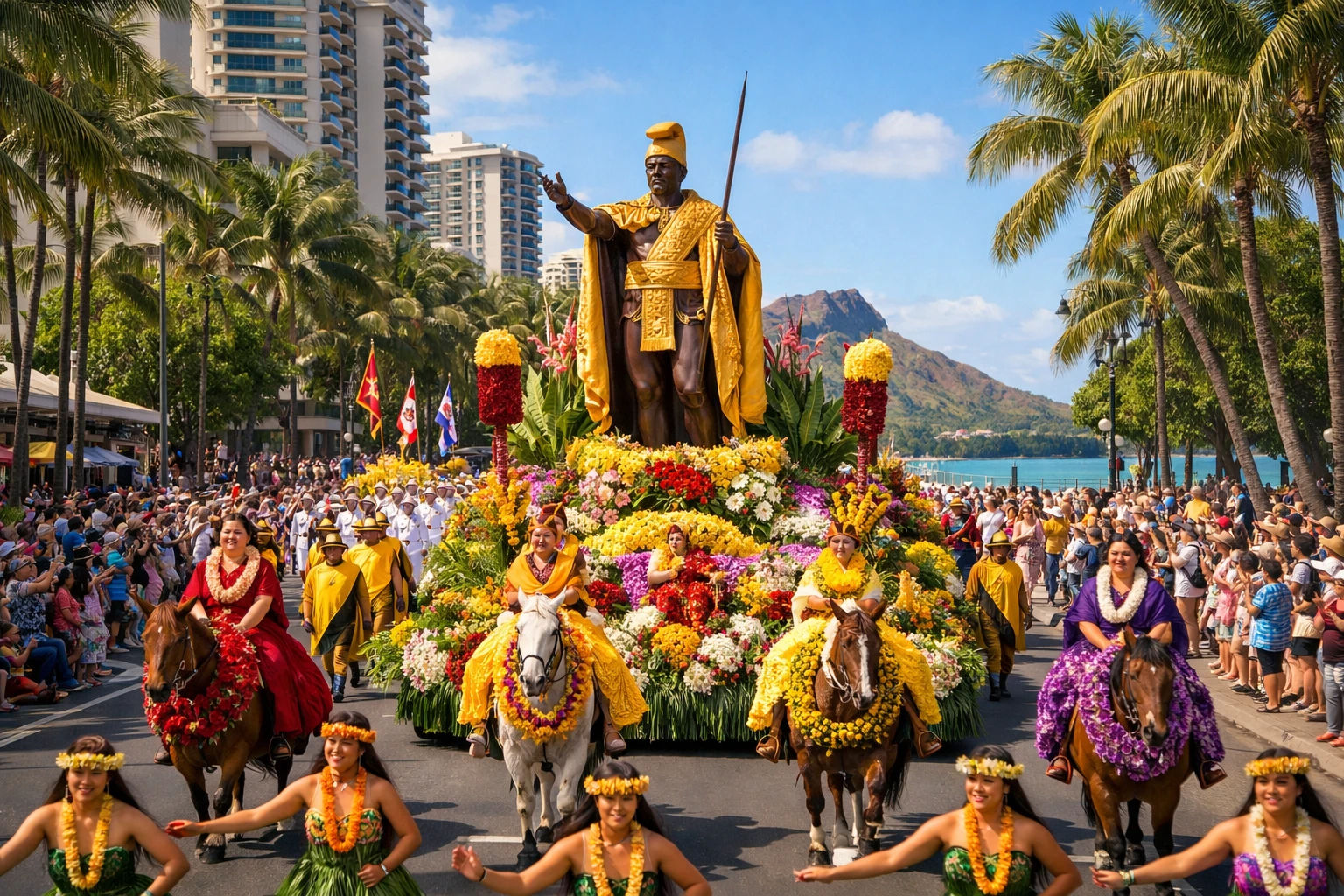
There is a moment on Kalakaua Avenue every June when time seems to slow down. Horses adorned with cascading lei move through the sunlit street. Women in sweeping nineteenth-century riding gowns, their dresses trailing in colors that represent each of the eight Hawaiian islands, pass in dignified procession. The scent of fresh flowers mingles with the salt air blowing in from the Pacific. Crowds lining the sidewalks grow quiet for just a breath before erupting in applause.
That moment is the King Kamehameha Celebration Floral Parade, and in 2026 it returns to Honolulu for its 109th edition.
The 109th King Kamehameha Celebration Floral Parade will take place on Saturday, June 13, 2026, running from 9:00 AM to 1:00 PM, following the route from ʻIolani Palace to Kapiʻolani Park. It is one of the oldest and most beloved public traditions in the state, a celebration of the man who unified the Hawaiian Islands and the culture he worked fiercely to protect. For residents of Oahu, it is an anchor on the annual calendar. For visitors fortunate enough to be on the island that weekend, it is one of those rare experiences that reshapes how you understand a place.
The History Behind Kamehameha Day and Why June 11 Matters
To understand the parade, you need to understand the man it honors and the holiday that surrounds it.
King Kamehameha I was the monarch who first established the unified Kingdom of Hawaiʻi, bringing together the islands of Niʻihau, Kauaʻi, Oʻahu, Molokaʻi, Lānaʻi, Kahoʻolawe, Maui, and Hawaiʻi under one rule. His unification, completed in 1810, was the result of decades of strategic diplomacy, military strength, and a profound sense of kuleana, or responsibility, toward the Hawaiian people and their way of life.
On December 22, 1871, King Kamehameha V proclaimed a national holiday to honor his grandfather and the father of the Hawaiian Kingdom. Originally, the people of Hawaiʻi wanted to mark the legacy of Lot Kapūaiwa (Kamehameha V) on his birthday, December 11. Being the humble chief that he was, he opted to honor his grandfather instead and pushed the holiday as far away from his own birthday as possible, which is why June 11 was chosen. The very first Kamehameha Day holiday was celebrated on June 11, 1872.
That means the tradition stretching through this parade reaches back more than 150 years. Kamehameha Day was one of the first holidays proclaimed by the Governor of Hawaiʻi and the Hawaiʻi State Legislature when Hawaiʻi achieved statehood in 1959, and in contemporary Hawaiʻi, the day is treated with elaborate events harkening back to ancient Hawaiʻi, respecting the cultural traditions that Kamehameha defended as his society slowly shifted toward European influences.
The floral parade, now in its 109th year on Oahu, is the most public and spectacular expression of that enduring commemoration.
What Makes the King Kamehameha Floral Parade Unlike Any Other
Floats Decorated with Native Hawaiian Flowers
The word "floral" in the parade's name is not decorative. It is a commitment. This popular parade features floats decorated with Hawaiian flowers and greenery, marching bands and other parade units, and the celebration's Mōʻī (King) and Queen escorted by elegant pāʻū riders on horseback. The floats represent the natural flora of the islands, and the care that goes into their construction is extraordinary. These are not generic parade floats wrapped in tissue paper. They are living tributes to the land itself, reflecting the deep Hawaiian value of mālama ʻāina, caring for the earth that sustains all life.
The Pāʻū Riders: An Icon of Island Elegance
Of all the visual moments in the parade, few are as striking as the pāʻū riders. Dressed in nineteenth-century riding gowns with colorful lei for riders and horses alike, these women represent princesses from Hawaiʻi's eight main islands.
Each island is represented by a specific color:
- Hawaiʻi: Red
- Maui: Pink
- Oʻahu: Golden Yellow
- Kauaʻi: Purple
- Molokai: Green
- Lānaʻi: Orange
- Niʻihau: White
- Kahoʻolawe: Gray
Seeing all eight island colors move together down Kalakaua Avenue is a visual summary of everything the parade represents: the unity of the islands, the dignity of their people, and the endurance of their traditions.Marching Bands, Cultural Groups, and Community Pride
The parade also features high school and community marching bands, cultural performance groups, royal societies, and representatives from across Oahu's neighborhoods. The diversity within the procession reflects the islands themselves, where generations of Native Hawaiian families, immigrant communities, and newcomers from across the Pacific and beyond have built something genuinely shared. Watching a parade unit from a Honolulu charter school march behind a group of Hawaiian warriors in traditional regalia, followed by a community hula halau, is a reminder that honoring Kamehameha is not just a history lesson. It is a living practice.
The Full Weekend of Celebration Around the Parade
The floral parade is the centerpiece, but the King Kamehameha Celebration extends across several days with events that are equally moving and deeply rooted in Hawaiian protocol.
The Lei Draping Ceremony at Aliʻiōlani Hale
The King Kamehameha Statue Lei Draping takes place on Friday, June 12, from 2:30 to 5:00 PM at Aliʻiōlani Hale. This is one of the most photographed moments of the entire celebration. The famous gilded statue of Kamehameha I, which stands directly across King Street from ʻIolani Palace, is draped in long strands of fresh lei that sometimes extend twenty feet or more from the outstretched arms. The most important ritual of the celebration dates back to 1901 after the Territory of Hawaiʻi was established, and it is the afternoon draping ceremony in which the Kamehameha statue in front of Aliʻiōlani Hale and ʻIolani Palace on King Street in downtown Honolulu is draped in long strands of lei.
If you are anywhere near downtown Honolulu on Friday afternoon, make time for this. The scene at Aliʻiōlani Hale, with the Judiciary Building as backdrop and the Palace grounds just across the street, is extraordinarily beautiful and peaceful. It is also free to witness.
The King Kamehameha I Tribute
A King Kamehameha I tribute at the statue of Kamehameha I at Aliʻiōlani Hale takes place on Thursday, June 11, from 9:00 to 9:30 AM, sponsored by the Daughters and Sons of the Hawaiian Warriors, Māmakakaua. Attending this brief ceremony before the larger weekend events is a quieter and deeply respectful way to connect with the heart of what the celebration is really about.
The Hoʻolauleʻa at Kapiʻolani Park
The King Kamehameha Celebration Hoʻolauleʻa at Queen Kapiʻolani Park runs from 11:00 AM to 5:00 PM on Saturday, June 13, picking up as the parade concludes. Kapiʻolani Park, Oahu's oldest public park sitting in the shadow of Diamond Head, becomes a festival ground with food, live music, hula performances, and cultural demonstrations. This is where families spread blankets on the grass, where children get their first taste of what a real Hawaiian community celebration looks like up close, and where the energy of the parade morning transforms into a long, easy afternoon of aloha.
The Parade Route: Where to Watch and How to Plan
On Oahu, the parade runs from ʻIolani Palace in downtown Honolulu past Honolulu Harbor and the Prince Kūhiō Federal Building through Kakaʻako, Ala Moana, and Waikīkī, ending at Kapiʻolani Park.
That is a significant stretch of the city, which means there are many excellent spots to choose from when planning where to watch. Each section of the route has its own character.
Downtown near ʻIolani Palace is where the parade begins, and watching the procession pass the historic Palace grounds in the early morning light is genuinely moving. The Palace, the statue of Kamehameha, and the surrounding government buildings form a backdrop that connects the celebration directly to the era of the Hawaiian Kingdom.
The Ala Moana stretch is a bit more open and is a good option for families with strollers or anyone who wants a little more room to settle in. Parking is also slightly more manageable in this area earlier in the morning.
Waikiki along Kalakaua Avenue offers the most festive viewing atmosphere, with cafes and hotels nearby and a lively crowd. However, this section fills up quickly. Try to find a spot where there will be shade at the time of the parade, and bring a seat if you do not like standing, because the parade is quite long.
Streets will begin to close in downtown Honolulu at 7:30 AM, with closures coinciding as the parade moves along the route, several blocks before its approach. The parade is expected to reach Kapiʻolani Park around 11:30 AM. Arriving by 8:00 AM along most sections of the route will secure you a comfortable spot. Bring sunscreen, a portable seat or blanket, water, and cash for the food vendors who set up along the route.
Cultural Significance for Visitors and Residents Alike
For people visiting Oahu from beyond the islands, the King Kamehameha Celebration Floral Parade offers something that most tourist experiences cannot: a genuine window into how Hawaiʻi understands itself. This is not a performance staged for visitors. It is a community gathering that has been happening every June for well over a century, rooted in real history and maintained by real families who take deep pride in their connection to Kamehameha's legacy.
Kamehameha I was not simply a military leader. He was a keeper of culture at a time when Hawaiian traditions were under immense pressure from outside forces. Watching the parade through that lens transforms it from a colorful spectacle into something more profound: a collective act of memory and love.
The tradition of draping his statue in lei is particularly resonant. Outside of the state, a similar draping ceremony is held at the United States Capitol where the Kamehameha statue there is also draped in lei in the company of federal officials, a fact that speaks to how far the reach of this celebration truly extends. Kamehameha does not belong only to Hawaiʻi. He belongs to the story of this country.
Plan Your Visit: Getting the Most from the 2026 Parade Weekend
The parade is free and open to the public, which makes it one of the most accessible cultural events in the state. You do not need a ticket, a reservation, or any special access. You simply need to show up, find your spot on the route, and let the procession come to you.
If you are visiting from off-island, consider extending your stay through the full weekend. Booking accommodations in the Waikiki area places you within easy walking distance of the parade route and Kapiʻolani Park. Hotels along or just off Kalakaua Avenue fill up quickly for this weekend, so book early.
If you plan to drive, note that significant portions of the city's main thoroughfares will be closed from 7:30 AM onward, and traffic around the route will be congested. TheBus is an excellent option for getting to the parade area from most Oahu neighborhoods, and rideshare drop-offs can be arranged a few blocks from the route with a short walk to your chosen viewing spot.
After the parade, spend the afternoon at the Hoʻolauleʻa in Kapiʻolani Park. Then walk to the beachfront, watch Diamond Head turn golden in the afternoon light, and understand firsthand why King Kamehameha fought so hard to hold all of this together.
There is truly no better way to spend a June Saturday on Oahu. Mark the date, make the trip, and be part of something that has been worth showing up for since 1872.
Verified Information at a Glance
Event Name: 109th King Kamehameha Celebration Floral Parade
Event Category: Free Annual State Cultural Parade and Public Celebration
Organizer: King Kamehameha Celebration Commission, State Foundation on Culture and the Arts
Parade Date: Saturday, June 13, 2026
Parade Hours: 9:00 AM to 1:00 PM
Parade Start Point: ʻIolani Palace, King Street, Downtown Honolulu
Parade End Point: Kapiʻolani Park, Waikiki
Parade Route: ʻIolani Palace through Honolulu Harbor, Prince Kūhiō Federal Building, Kakaʻako, Ala Moana, Waikīkī, ending at Kapiʻolani Park
Street Closures Begin: 7:30 AM Saturday, June 13
Estimated Parade Arrival at Kapiʻolani Park: Approximately 11:30 AM
Hoʻolauleʻa: Queen Kapiʻolani Park, Saturday June 13, 11:00 AM to 5:00 PM
Lei Draping Ceremony: Aliʻiōlani Hale, Friday June 12, 2:30 PM to 5:00 PM
King Kamehameha I Tribute: Aliʻiōlani Hale statue, Thursday June 11, 9:00 AM to 9:30 AM
Kamehameha Day (State Holiday): Thursday, June 11, 2026
Admission: FREE and open to the public
Ticket Pricing: No tickets required
Official Source: sfca.hawaii.gov/resources/king-kamehameha-celebration-commission
All details verified from the State Foundation on Culture and the Arts official website. Specific lineup and performance details will be announced closer to the event date. Confirm final logistics directly with the King Kamehameha Celebration Commission before attending as dates and times are subject to change.