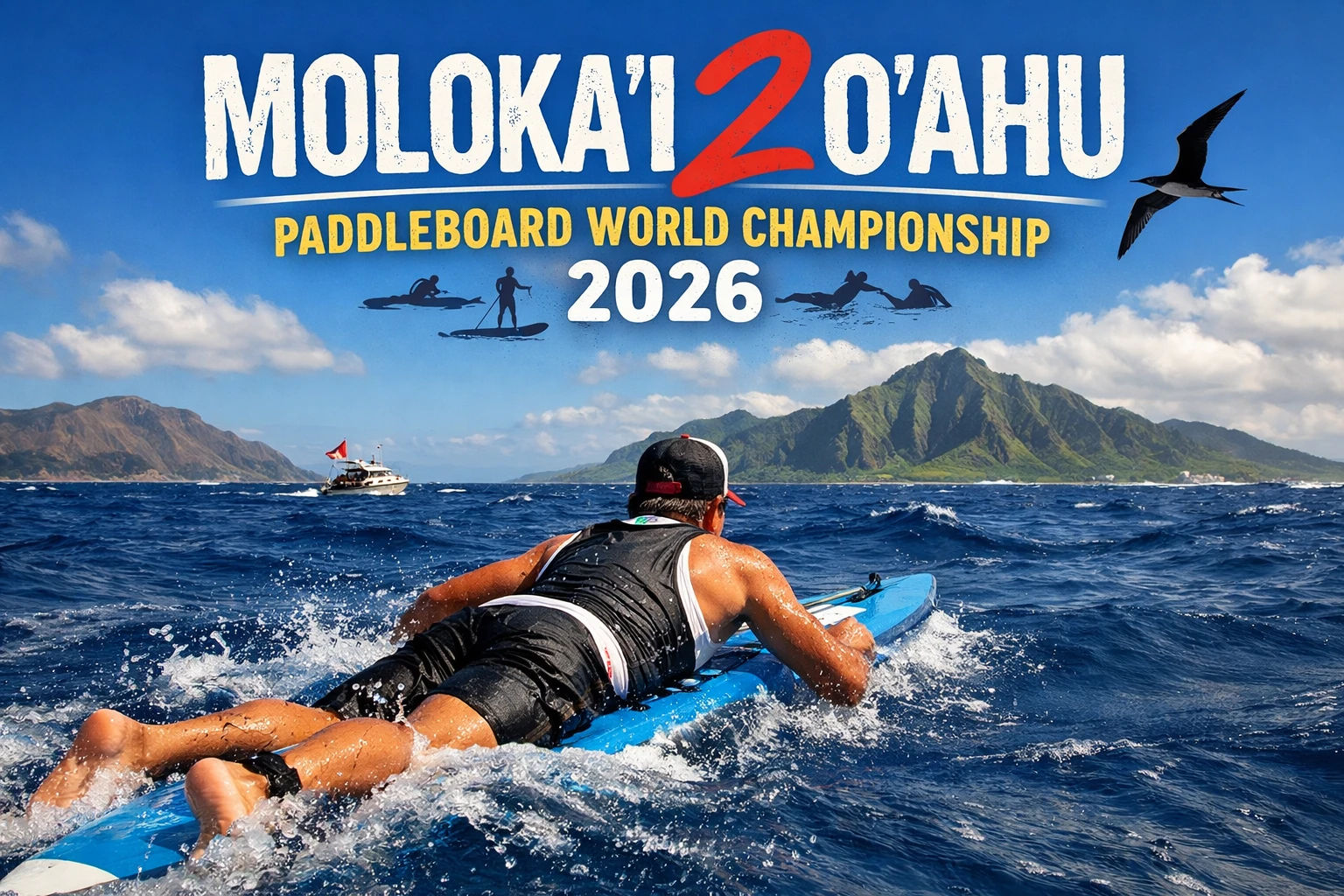
Thirty-two miles of open ocean. Trade winds that shove you sideways. Channel swells that can rise and disappear in seconds. No land in sight for most of the crossing. And at the end of it — Diamond Head rising above the Oʻahu coastline, the finish line at Kaimana Beach, and a result that every paddleboarder on earth recognizes as the ultimate benchmark of ocean athleticism. The 27th Annual Molokaʻi 2 Oʻahu Paddleboard World Championship 2026 takes place on Sunday, July 26, 2026 — and the 2026 field is completely sold out.
"The Molokaʻi 2 Oʻahu Paddleboard World Championship is not simply the most famous paddleboard race in the world. It is the defining challenge of the entire sport."
The Race That Defines Ocean Paddling
Molokaʻi to Oʻahu — The Ultimate Benchmark
Since its inaugural edition in 1997, the Molokaʻi 2 Oʻahu Paddleboard World Championship — known universally as M2O — has been the event that every prone paddler and SUP athlete measures themselves against. It is the crossing that separates the ocean riders from everyone else:
- 32 miles (51 km) of open ocean from the west coast of Molokaʻi to the south shore of Oʻahu
- Crossing the Kaiwi Channel — one of the most demanding stretches of open water in the Pacific, notorious for powerful Hawaiian trade winds, unpredictable swell lines, strong currents, and conditions that change faster than any weather forecast can track
- The race is widely considered the ultimate endurance test in paddleboard racing — athletes face wind, current, and fatigue across a relentless open-water crossing that has no equivalent in the sport
- Over half the 2026 field are new to the Kaiwi Channel — first-time M2O competitors taking on one of ocean sport's most formidable challenges
2026 Race Details: Everything Confirmed
M2O 27th Edition — Prone and SUP Championship
The 2026 edition of the M2O features both prone and stand-up paddleboard (SUP) disciplines, with a completely sold-out field:
- Date: Sunday, July 26, 2026
- Start: Kaluakoi Beach Area, west coast of Molokaʻi
- Finish: Maunalua Bay Beach Park / Kaimana Beach, Honolulu, Oʻahu
- Distance: 32 miles (51 km) across the Kaiwi Channel
- Disciplines: Prone paddleboard and stand-up paddleboard (SUP)
- Field status: Sold out — registration opened March 14 and closed April 5, 2026
- Entry fee: $400 solo / $800 two-person team / $1,200 three-person team
M2O Foil Edition
The Final Race of the Koa Kai Crown
The M2O Foil Edition serves as the final and highest-points race of the Koa Kai Crown — the 2026 inter-island foil racing series:
- Date: Monday, July 20, 2026
- Start: ʻIlio Point, Molokaʻi
- Finish: Kaimana Beach beneath Diamond Head, Honolulu, Oʻahu
- Distance: 40 miles — longer than the prone/SUP course
- Disciplines: SUP Foil and Wing Foil
- Significance: The M2O Foil Edition serves as the final and highest-points race of the Koa Kai Crown
Virtual M2O — V.7 Edition
A Global Paddling Community
The Virtual M2O is open to all paddlers worldwide, allowing participation from anywhere:
- Open to: All paddlers worldwide
- Format: Anywhere, Anytime, Anything — paddle any distance on any waterway and log it as part of the global M2O virtual community
- Award: Bragging rights only — no prizes, pure participation
The Kaiwi Channel: The Race's Soul
A Test of Endurance and Technique
The Kaiwi Channel between Molokaʻi and Oʻahu is the defining geographical fact of M2O:
- The channel stretches approximately 26 miles at its narrowest point between the two islands, with the M2O course covering 32 miles of actual paddling distance
- Hawaiian trade winds typically blow from the northeast — generating long, powerful downwind swells that experienced paddlers can surf across the channel in what is called downwinding
- The same conditions that create the opportunity for elite downwind riding also create the risk — wind shifts, cross-swells, and rogue conditions in the channel have challenged and humbled even the most experienced ocean athletes
- The crossing is considered the ocean paddling equivalent of an open-water marathon
The Koa Kai Crown 2026: An Inter-Island Foil Racing Series
A New Challenge for Foil Racers
The 2026 M2O introduces a significantly expanded context for the foil racing community through the Koa Kai Crown:
The Koa Kai Crown spans more than 80 miles of inter-island ocean racing across three Hawaiian islands in a single two-week window — making the full series one of the most demanding multi-race formats in all of ocean sports. The M2O Foil Edition on July 20 carries a 3x points multiplier — the race that determines the Koa Kai Crown champion.
RaceCourseDatePoints MultiplierVoyager X Wetfeet Downwind12 mi, OʻahuSunday, July 51xPaddle ImuaMaliko Gulch to Kanaha, MauiMid-July1xMaui to Molokaʻi26 mi, Maui → MolokaʻiFriday, July 172xKamalo Downwind10 mi, MolokaʻiSaturday, July 181xM2O Foil Edition40 mi, Molokaʻi → OʻahuMonday, July 203x Watching M2O 2026 as a Spectator
Experience the Thrill from Oʻahu
The M2O is a genuinely thrilling event to watch, especially at the finish line at Maunalua Bay Beach Park / Kaimana Beach:
- Kaimana Beach sits just east of Waikīkī at the base of Diamond Head — approximately 10 minutes from central Waikīkī by car or taxi
- Elite solo competitors typically finish in approximately 5 to 6 hours — for a 7:00 AM Molokaʻi start, the first finishers arrive at Kaimana Beach around midday
- The finish scene at Kaimana Beach is a full ocean sports festival atmosphere — supporters, crews, camera teams, and the gathering crowd of spectators
- The Foil Edition finish on July 20 also arrives at Kaimana Beach — the sight of foil boards lifting off the swells at speed is visually spectacular
- No tickets, no admission — watching from Kaimana Beach is free for all spectators
The M2O 2026 Start List: A Sold-Out International Field
Global Competitors Converge
The 2026 M2O start list was published on May 10, 2026, at molokai2oahu.com/2026-start-list:
- The field is completely sold out — all available solo and team entries filled during the March 14 to April 5 registration window
- Defending champions return to defend their titles alongside a strong wave of first-time M2O competitors
- The international composition of the field reflects M2O's status as a genuine world championship
- Over half the 2026 field are new to the Kaiwi Channel
The Start: Kaluakoi Beach, Molokaʻi
A Remote and Rugged Beginning
The race begins on the west coast of Molokaʻi at Kaluakoi Beach — a remote stretch of coastline on Hawaii's most rural and most deliberately undeveloped island:
- Molokaʻi is the most rural of the main Hawaiian islands — no traffic lights, no resort development, a population of approximately 7,000
- The start village at Kaluakoi on race morning is a gathering of the global paddleboarding community
- Getting to Molokaʻi for the race start: Direct flights from Honolulu's Molokaʻi Airport (MKK) via Mokulele Airlines (approximately 25 minutes); ferry service from Maui
The Finish: Maunalua Bay and Kaimana Beach, Oʻahu
An Iconic Finish Line
The M2O finish alternates between Maunalua Bay Beach Park in Hawaii Kai and Kaimana Beach at the base of Diamond Head:
- Maunalua Bay Beach Park address: Kalaniana'ole Highway, Hawaii Kai, Honolulu, HI 96825
- Kaimana Beach: At the east end of Kalākaua Avenue beneath Diamond Head
- The finish is unmissable — the moment a prone paddler or SUP athlete lifts their board from the Kaiwi Channel and walks onto the sand of Oʻahu is a human athletic moment that needs no commentary
Practical Information for M2O Spectators 2026
Key Dates and Logistics
- Foil Edition: Monday, July 20, 2026 | ʻIlio Point, Molokaʻi → Kaimana Beach, Oʻahu | 40 miles
- Prone and SUP Championship: Sunday, July 26, 2026 | Kaluakoi Beach, Molokaʻi → Maunalua Bay / Kaimana Beach, Oʻahu | 32 miles
- Start time: Typically 7:00 to 8:00 AM HST from Molokaʻi — confirm at molokai2oahu.com
- Elite finishers arrive: Approximately 5 to 6 hours after start — plan for a midday arrival at the Oʻahu finish line
Getting to the Finish Line
Accessibility and Transport Options
- Kaimana Beach: East end of Kalākaua Avenue, Honolulu; walk from Waikīkī hotels or take TheBus Route 2 along Kalākaua Avenue
- Maunalua Bay Beach Park: 20 to 25 minutes east of Waikīkī via Kalaniana'ole Highway; drive or rideshare recommended
- Parking: Maunalua Bay has surface parking along Kalaniana'ole Highway; arrive early on race day as the area fills quickly
Official Information
Stay Updated and Connected
- Official website: molokai2oahu.com
- 2026 Start List: molokai2oahu.com/2026-start-list (updated May 10, 2026)
- Registration: Closed April 5, 2026 — the 2026 field is sold out
- Facebook: facebook.com/molokai2oahu
- Instagram: @molokai2oahu
Frequently Asked Questions
The Things People Always Want to Know
When is the Molokaʻi 2 Oʻahu Paddleboard World Championship 2026?
The 27th Annual M2O Prone and SUP Championship is on Sunday, July 26, 2026. The Foil Edition runs on Monday, July 20, 2026.
Where does M2O start and finish?
Start: Kaluakoi Beach Area, west coast of Molokaʻi. Finish: Maunalua Bay Beach Park / Kaimana Beach, Honolulu, Oʻahu.
How long is the M2O race?
32 miles (51 km) for the Prone and SUP Championship across the Kaiwi Channel. The Foil Edition covers 40 miles.
Can I still enter the 2026 M2O?
No — the 2026 field is completely sold out. Registration opened March 14 and closed April 5, 2026.
Can I watch the race for free?
Yes — spectating from the Oʻahu finish line at Kaimana Beach or Maunalua Bay Beach Park is completely free.
What is the Koa Kai Crown?
A new 2026 five-race points-based foil racing series spanning Oʻahu, Maui, and Molokaʻi in July — the M2O Foil Edition on July 20 is the final race and carries a 3x points multiplier to determine the series champion.
What is the Virtual M2O?
An open global participation event — paddle any distance, anywhere in the world, log it as part of the M2O community; open to all paddlers, no registration required.
Verified Information at a Glance
- Event: 27th Annual Molokaʻi 2 Oʻahu Paddleboard World Championship 2026
- Category: World championship ocean paddleboard race
- Prone and SUP date: Sunday, July 26, 2026
- Foil Edition date: Monday, July 20, 2026
- Start: Kaluakoi Beach Area, Molokaʻi
- Finish: Maunalua Bay Beach Park / Kaimana Beach, Honolulu, Oʻahu
- Prone/SUP distance: 32 miles (51 km) across Kaiwi Channel
- Foil distance: 40 miles across Kaiwi Channel
- Competition disciplines: Prone paddleboard, SUP (July 26); SUP Foil and Wing Foil (July 20)
- Field status: Sold out
- Entry fee: $400 solo / $800 two-person team / $1,200 three-person team
- Spectator admission: Free at Oʻahu finish line
- Virtual edition: Open globally, free, no awards
- Koa Kai Crown: New 2026 five-race inter-island foil series; M2O Foil July 20 is the final race (3x points multiplier)
- Start list (updated May 10, 2026): molokai2oahu.com/2026-start-list
- Official website: molokai2oahu.com
- Nearest airport to finish: Honolulu International Airport (HNL) — approximately 25 to 30 minutes to Kaimana Beach
- Best for: Ocean sports enthusiasts, paddleboard competitors and fans, SUP and foil racing followers, Oʻahu July visitors, ocean endurance event spectators, Hawaiian waterman culture followers, island event content creators
```