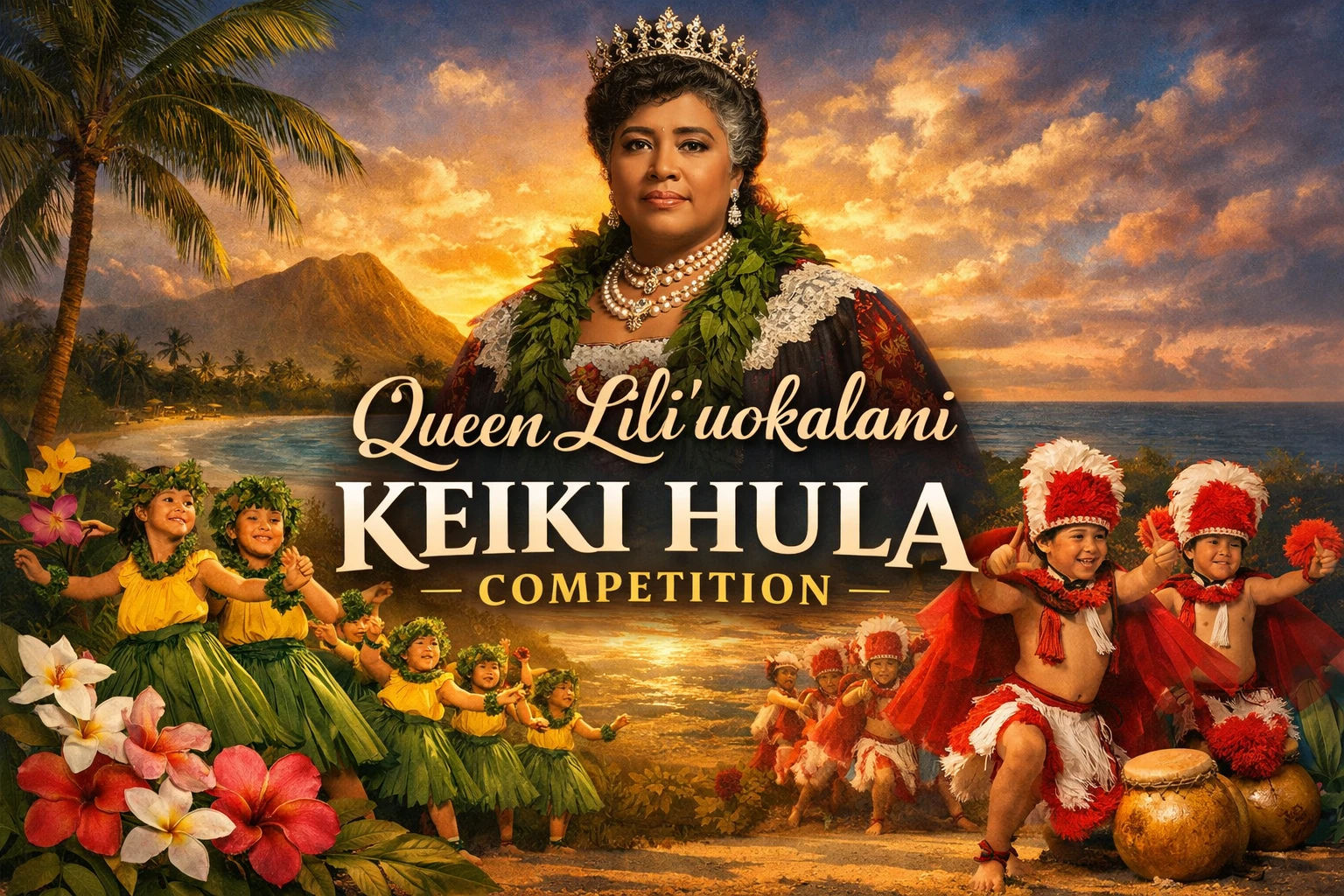
Queen Liliʻuokalani Keiki Hula Competition 2026 OahuQueen Liliʻuokalani Keiki Hula Competition 2026 Oahu: The World's Longest-Running Children's Hula Event Returns
There is a particular kind of stillness that falls over an arena when a child steps onto a competition stage alone. The lights settle, the audience quiets, and then the music begins. In the hands of a six-year-old who has been preparing for months under the watchful guidance of a kumu hula, the ancient movements of Hawaiian dance become something that stops time. Families lean forward. Kumu hold their breath. The air in the Neal S. Blaisdell Center Arena in Honolulu becomes charged with something older and more meaningful than competition.
That is the Queen Liliʻuokalani Keiki Hula Competition, and it has been happening on Oʻahu every single year since 1976.
The Queen Liliʻuokalani Keiki Hula Competition was established by the Kalihi-Pālama Culture and Arts Society in 1976 to honor the last Queen of Hawaii. Fifty years later, it has grown into one of the most beloved cultural institutions in the state, and the 2026 edition is expected to follow its established late-July schedule at the Neal S. Blaisdell Center Arena in Honolulu. More than 600 young dancers between the ages of 6 and 12 have competed in recent editions, making it the world's longest-running keiki hula event. For anyone on Oʻahu in late July, witnessing this competition is not simply attending an event. It is stepping into the living heart of Hawaiian cultural continuity.
The Roots of the Competition: Born During the Hawaiian Renaissance
How the Kalihi-Pālama Culture and Arts Society Sparked a Legacy
From its humble beginnings 45 years ago during the Second Hawaiian Renaissance of the 1970s, the Kalihi-Pālama Culture and Arts Society's annual event has become a world-class event that showcases and honors Hawaiian culture through hula, music, and fashion, with kumu and their hālau bringing their best in dance, costumes, and competition.
The Second Hawaiian Renaissance was a cultural and political awakening that swept through the islands beginning in the late 1960s and accelerating through the 1970s. Native Hawaiians reclaimed their language, their music, their navigation traditions, and their hula at a moment when all of those things had been suppressed and diminished by decades of colonial influence. It was in this context that Kalihi-Pālama's program coordinator, Kahu Wendell Silva, along with committee chairman and Kumu Hula legend, Uncle George Naʻope, envisioned a competition where children could share their achievements in hula while learning about Queen Liliʻuokalani, her ʻohana, and Hawaiʻi's historical past. Their mission was to create an organization to perpetuate Hawaiian culture through dance and by doing so teach a new generation to carry on the traditions of hula into the future.
That founding vision, teaching children to carry hula forward, has proven not just successful but transformative. The Kalihi-Pālama Culture and Arts Society proudly claims that it is one of the few culture-based organizations that can prove by the present generation of Kumu Hula today, that it has accomplished its mission of perpetuating authentic Hawaiian culture in one generation. Former competition winners who are now working kumu hula include Kumu Hula Keolalaulani Dalire, who won Miss Keiki Hula in 1990, Kumu Hula Kauʻionālani Kamanaʻo who received the first Master Keiki Hula Award in 1983, and Kumu Hula Kailihiwa Vaughn who took the Miss Keiki Hula title in 1985. The tree planted by Kahu Silva and Uncle George Naʻope half a century ago has produced extraordinary fruit.
Queen Liliʻuokalani and Why Her Name Belongs on This Competition
Naming this competition for Queen Liliʻuokalani was not incidental. She was the last reigning monarch of the Kingdom of Hawaiʻi, overthrown in 1893 in a politically complex and deeply unjust event that the United States government formally apologized for a century later. She was also a gifted musician and composer whose songs, including the beloved Aloha Oe, remain part of the living Hawaiian musical tradition to this day.
Asking young keiki to dance in her honor, to carry her legacy forward through the art form she loved, frames the competition as more than entertainment. It is an act of cultural remembrance and resistance, a way of saying to each generation of Hawaiian children that their traditions are worth keeping, their heritage is worth celebrating, and their queen is still honored on these islands.
What the Three-Day Competition Looks Like
Night One: Miss and Master Keiki Hula Solo Competition
Soloists will vie for the titles of Miss Keiki Hula and Master Keiki Hula on the first night of competition, followed by the award presentation. This opening night carries the highest individual stakes of the entire event. A single dancer steps out alone, performs before a panel of distinguished judges, and is evaluated on grace, technique, cultural authenticity, costuming, and the ineffable quality that experienced hula judges call feeling, the degree to which the dancer truly embodies the story they are telling.
It becomes a great honor to take home this title, with some Miss Keiki Hula winners going on to win the Miss Aloha Hula title at Merrie Monarch. That pathway from the keiki competition stage to the Merrie Monarch Festival, widely considered the most prestigious hula competition in the world, is one of the most meaningful measures of what the Queen Liliʻuokalani Keiki Hula Competition actually produces. It is not just a children's event. It is a training ground for the next generation of Hawaiian cultural leaders.
Night Two: Hula Kahiko Group Competition
The Kahiko, or traditional hula, group competition for kaikamāhine and keikikāne will take place on the second night. Hula kahiko is the ancient form of the art, performed to chant rather than Western music, with movements and rhythms that carry direct lines of connection to pre-contact Hawaiian practice. Watching groups of children perform kahiko together on the Blaisdell Arena stage is one of the most culturally powerful experiences available on Oʻahu, particularly for visitors who may never have encountered this form of hula outside of a tourism context.
The competition features Kahiko and ʻAuana competitions that award best keikikāne and kaimakahine in the top five places. Recognition is also given to the top hālau for Hawaiian Language ʻŌlelo Awards as well as for the overall winning hālau for their best in the overall keikikāne and kaikamāhine competitions. The ʻŌlelo awards are particularly meaningful because they recognize hālau that prioritize the Hawaiian language in their chants and instruction, a direct continuation of the competition's founding mission of cultural preservation through dance.
Night Three: Hula ʻAuana Group Competition and Grand Awards
The ʻAuana, or contemporary hula, group competition for kaikamāhine and keikikāne will take place on the third day, followed by the award presentation. Hula ʻAuana developed in the period following Western contact and is performed to modern Hawaiian music rather than ancient chant. It is typically more visually elaborate in costume and movement vocabulary, and the final night of the competition tends to be its most theatrical and celebratory.
The grand awards presentation that closes night three is one of the most emotional moments of the entire event calendar on Oʻahu. Kumu hula who have spent months preparing their students sit in the arena watching everything come together in real time, while children who began preparing for this moment in March or April finally reach the finish line. The tears are real. So is the pride.
The Competition as a Gathering of Hawaiʻi's Hula Community
Hālau From Across the Islands and Beyond
The competition brings together hula hālau from all of the Hawaiian Islands and Japan to perform and compete. The participation of Japanese hālau is one of the competition's most distinctive characteristics and reflects the deep affection for hula that has developed in Japan over generations. Japanese children who have trained in hula under teachers who may themselves have learned from Hawaiian kumu compete on the same stage as children from Kauaʻi and Maui and Hawaiʻi Island, a genuinely remarkable cross-cultural moment that speaks to hula's power as a universal language.
In recent editions, the dancers represent around 20 hula hālau from Oʻahu, Maui, Kauaʻi, and Hawaiʻi Island. Each hālau brings its own aesthetic sensibility shaped by its kumu's lineage and training, which means that over the three nights of competition, audiences experience a rich diversity of approaches to the same fundamental art form. No two hālau perform quite the same way, and that diversity is itself a testament to hula's depth and adaptability.
The Vendor Village and Exhibition Hall Experience
The competition is not confined to the arena floor. The Neal S. Blaisdell Center Arena features a variety of products from Hawaiʻi from well-known clothing designers as well as crafted items from local artisans such as Manaola, Ari South, Kini Zamora, and many others. Keiki Hula branded tees, totes, pareo and other products are also available. The Vendor Village does not require a ticket and is open to the public.
The public is also invited to visit the Exhibition Hall, which will be home to a variety of fun Keiki Hula Festival activities. The Pop-Up Mākeke will showcase local artisans and crafts. The Hawaiʻi State Archives will place on display treasures of Hawaiʻi's royal family as well as other historic memorabilia. A Hōʻike Stage will present hula and Hawaiian music throughout the day, and the Paikini Plaza will feature many of Hawaiʻi's renowned clothing designers.
That breadth of activity means that even attendees who are not focused on the competition itself will find the broader festival environment deeply engaging. The Vendor Village in particular offers an extraordinary window into contemporary Hawaiian fashion and craft, with designers whose work reflects the same values of cultural pride and artistic excellence that animate the hula on the arena stage.
The Broader Context: Kalihi-Pālama and Hawaiian Cultural Stewardship
The Kalihi-Pālama neighborhood where this organization is rooted sits in the urban core of Honolulu, a working-class community historically home to many of the Native Hawaiian families, Filipino immigrants, and Pacific Islander communities that built so much of this city. Since its Petition for Charter of Incorporation filed on January 5, 1972, the Kalihi-Pālama Culture and Arts Society has been and remains committed to providing education, training, services, and facilities to the public in furtherance of the maintenance, support, preservation, encouragement, and publicity of culture and arts, particularly the culture and arts of ancient Hawaii.
That commitment over more than fifty years, sustained through economic changes, a global pandemic, a venue renovation that displaced the competition temporarily, and every other challenge that a volunteer-led nonprofit faces, is itself a remarkable story. The children who compete have no idea, in most cases, how much organizational effort and community dedication has made their moment on that stage possible. But their kumu know, and the founders knew, and the community that fills the Blaisdell Arena each July knows.
The competition has also attracted many of Hawaiʻi's top musicians and entertainers to perform for the hālau and many of Hawaiʻi's celebrities to support the event, which means attending is also a genuine chance to experience live Hawaiian music performed by some of the island's finest artists in one of Honolulu's most beautiful indoor venues.
Practical Tips for Attending the 2026 Competition
The Blaisdell Arena is located at 777 Ward Avenue in Honolulu, sitting at the junction of the Kakaʻako arts district and the Ward Village corridor, approximately ten minutes from Waikiki by car and accessible via several TheBus routes along King Street and Beretania Street. Parking is available in the Blaisdell Center complex, though it fills quickly on competition evenings. Arriving at least 45 minutes before the scheduled start time is strongly recommended to secure parking and find good seats.
Ticket pricing for the competition has historically been modest and accessible to the broader community. Exact 2026 ticket pricing will be announced through the official Kalihi-Pālama Culture and Arts Society website at kpcas.org as the event date approaches. Tickets have typically been available for advance purchase online as well as at the door, though advance purchase is recommended for any of the three evenings you plan to attend.
As noted, the Vendor Village does not require a ticket, making the daytime festival activities a genuinely free and accessible experience for anyone visiting Honolulu during the competition week. Pairing a Vendor Village browse in the afternoon with a ticketed evening competition is a full and satisfying way to experience everything the event has to offer.
The event is broadcast live on Hawaiʻi's KFVE television and simultaneously streamed online for the international audience, which means friends and family who cannot make it to Honolulu can still watch in real time. If you are attending in person and want to share the experience with loved ones back home, pointing them to the live stream adds a meaningful communal dimension to your evening.
Children of all ages are warmly welcomed at the competition, and parents who bring their own keiki to watch other keiki dance often find it one of the most quietly powerful educational experiences they have given their children. Watching peers compete with this level of grace, discipline, and cultural knowledge has a way of making a deep impression on young minds that no classroom explanation of Hawaiian culture can quite replicate.
Fifty Years of Dancing, One Mission That Has Never Wavered
The Queen Liliʻuokalani Keiki Hula Competition turns fifty years old in 2026, and that anniversary gives the already emotionally rich event an additional layer of significance this year. Half a century of children learning to dance, learning to honor their queen, learning to carry their culture forward on the stage of the Blaisdell Arena, is a legacy of extraordinary proportions.
The children who compete in 2026 are the cultural grandchildren of those who competed in the earliest editions. Some of their kumu hula were themselves Miss and Master Keiki Hula winners in previous decades. The tradition has become self-sustaining in exactly the way that Kahu Wendell Silva and Uncle George Naʻope envisioned when they sat down together and imagined a competition where the next generation would learn to love what they had inherited.
If you are on Oʻahu in late July 2026 and you attend only one cultural event while you are here, let it be this one. Come for the hula. Stay for the music, the vendors, the royal archives, the laughter of families reuniting in the hallways, and the extraordinary sight of a six-year-old stepping into a spotlight and moving with a grace and intention that reaches all the way back to the beginning of Hawaiian history. You will leave the Blaisdell Arena understanding something about these islands that simply cannot be explained in words, only danced.
Verified Information at a Glance
Event Name: Annual Queen Liliʻuokalani Keiki Hula Competition 2026 (50th Anniversary Edition)
Event Category: Annual Competitive Hawaiian Cultural Event (Children's Hula Competition)
Organizer: Kalihi-Pālama Culture and Arts Society, Inc. (KPCAS)
Established: 1976 (honoring Queen Liliʻuokalani, last reigning monarch of the Kingdom of Hawaiʻi)
Expected 2026 Dates: Late July 2026, three consecutive days (exact 2026 dates not yet officially announced at time of publishing; the competition has consistently been held in the last week of July each year. The 2024 edition ran July 25 to 27. Check kpcas.org for the official 2026 announcement.)
Venue: Neal S. Blaisdell Center Arena
Address: 777 Ward Avenue, Honolulu, HI 96814
Three-Night Schedule Format: Night One: Solo Hula Competition for Miss and Master Keiki Hula titles with Award Presentation; Night Two: Hula Kahiko (Traditional) Group Competition for kaikamāhine and keikikāne; Night Three: Hula ʻAuana (Contemporary) Group Competition and Grand Awards Presentation
Competition Age Group: Keiki ages 6 to 12 years old
Typical Number of Competitors: 500 to 600+ young dancers
Hālau Represented: Approximately 20 hula hālau from Oʻahu, Maui, Kauaʻi, Hawaiʻi Island, and Japan
Awards: Miss Keiki Hula, Master Keiki Hula, Hula Kahiko top 5 kaikamāhine and keikikāne, Hula ʻAuana top 5 kaikamāhine and keikikāne, ʻŌlelo (Hawaiian Language) Awards, Overall Winning Hālau
Vendor Village: Free and open to the public, no ticket required
Exhibition Hall Activities: Pop-Up M