ʻUkulele Festival of Hawaiʻi 2026 Oahu: A Free Celebration the Whole World Comes to Hear
There is an instrument that fits in an overhead bin, can be learned in a weekend, and has the remarkable power to make virtually everyone who hears it smile. It is only four strings stretched across a body roughly the size of a cereal box, but on the island of Oʻahu, it carries the full weight of a cultural legacy stretching back more than a century. The ʻukulele is Hawaiʻi's most beloved instrument, and every July, Kapiʻolani Park in Honolulu becomes the place where the entire world comes to celebrate it.
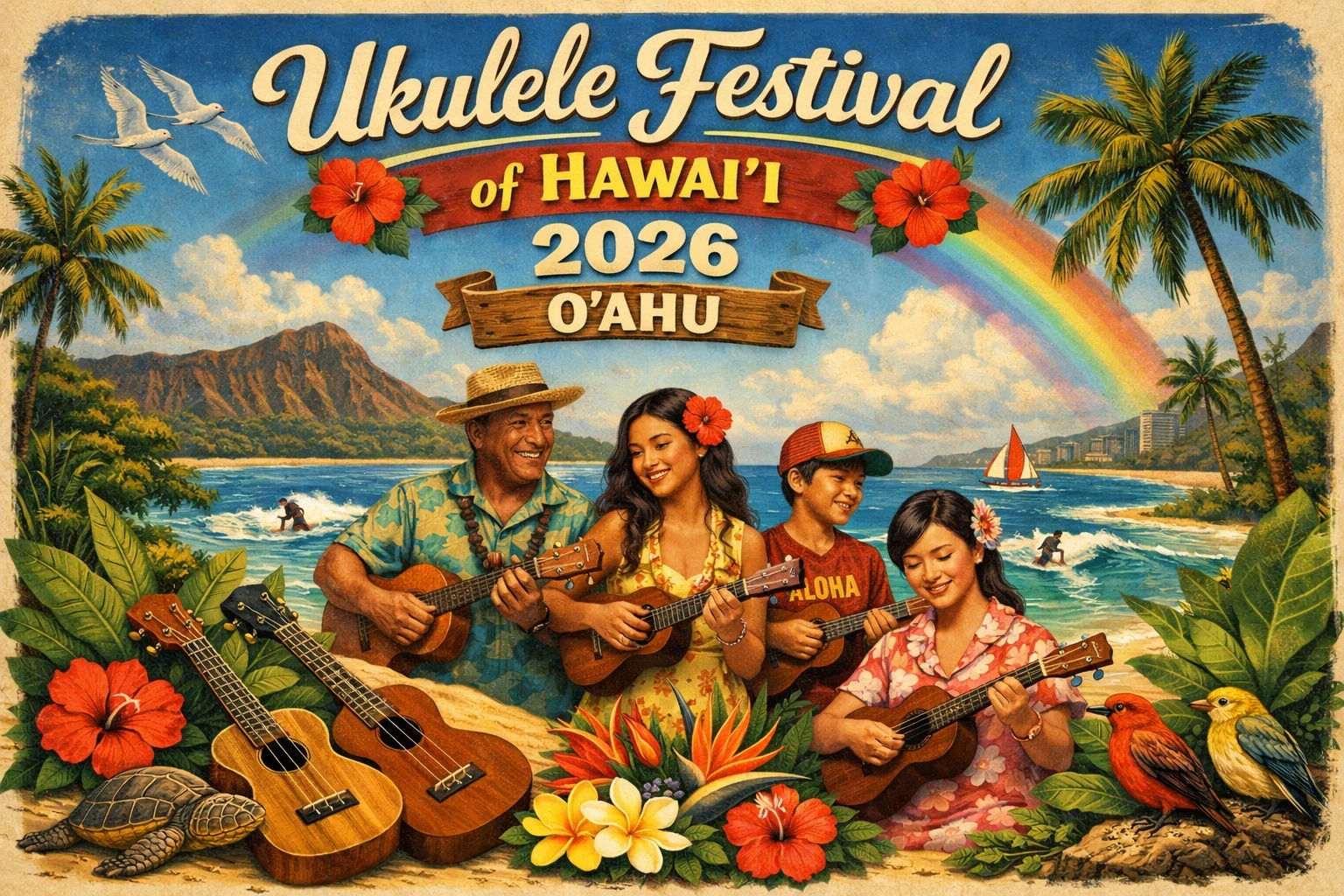
The 3rd International ʻUkulele Festival of Hawaiʻi will take place at Kapiʻolani Park on the island of Oʻahu, the beautiful park nestled on the east side of Waikīkī with a stunning view of Diamond Head, known as the "sacred home of the ukulele." The main festival day falls on Sunday, July 12, 2026, with a full surrounding program of events running from Friday, July 10, through Monday, July 13. Admission to the main outdoor festival is completely free, which means there is no barrier between you and one of the most genuinely joyful public events in the entire state.
Whether you play, have always wanted to learn, or simply love music and the feeling of being somewhere that makes you glad to be alive, the International ʻUkulele Festival of Hawaiʻi 2026 deserves a place on your calendar.
Over Fifty Years of ʻUkulele History at Kapiʻolani Park
How It All Began: Roy Sakuma and a Groundskeeper's Dream
The story of the ukulele festival in Hawaiʻi is one of the most quietly inspiring origin stories in American cultural life. In 1970, Roy Sakuma was working as a groundskeeper for the Waikiki Department of Parks. At lunch one day, Sakuma and his colleagues envisioned a ukulele concert. With the support of his supervisor, Sakuma worked with the department and the Hawaii International Ukulele Club to put together the first festival at the Kapiolani Park Bandstand in Waikiki in 1971.
Think about what that means. A groundskeeper who loved music looked at the park he tended every day and imagined it full of ukulele sound, then made it happen. That first event in 1971 was the world's first and original ukulele festival, and it launched an unbroken tradition that would run for more than five decades.
Roy and Kathy Sakuma are the founders of Ukulele Festival Hawaii, a nonprofit organization continuing their life's work of bringing laughter, love and hope to the world through the music of the ukulele. Over those fifty-plus years, the festival stage at Kapiʻolani Park welcomed legends from across every corner of the music world. Jack Johnson, Jake Shimabukuro, and Raiatea Helm have all graced the stage, alongside hundreds of other performers ranging from Grammy winners to elementary school students performing in front of a crowd for the very first time.
The Transition to the International ʻUkulele Festival of Hawaiʻi
When Roy Sakuma's decades of hosting finally came to a close, the question of who could carry that vision forward was answered by someone whose own life had been transformed by the festival. Inspired by Ohta's mastery, Sekiguchi traveled from Japan to Hawaiʻi to see Ukulele Festival Hawaii for the first time, setting the stage for his lifelong ʻukulele passion. It was there that he sought lessons from Sakuma, solidifying Sakuma's pivotal role as his mentor.
The event's transformation is made possible with the support and advice of Roy Sakuma, co-founder and host of Ukulele Festival Hawaii for 52 consecutive years. "On behalf of Ukulele Festival Hawaii, we congratulate Kazuyuki and the ʻUkulele Foundation of Hawaii on celebrating 15 years of sharing their love and passion for the 'ukulele with Hawaii and the world," said Roy and Kathy Sakuma.
That passing of the torch from mentor to student, from Hawaiian tradition to international community, captures exactly what makes the ukulele such a powerful instrument. It crosses every border it encounters.
What the 2026 Festival Looks Like: Four Days of Music, Community, and Aloha
The 2026 festival is not a single afternoon. It is a full four-day celebration that builds across the week, each day offering something distinct.
Friday, July 10: The International Ukulele Contest Final and Gala Night
The weekend opens on Friday with two of the most anticipated events on the calendar. The International Ukulele Contest Final brings together competitors from Hawaiʻi and around the world who have spent months preparing pieces that showcase the full technical and emotional range of the instrument. This is not amateur hour. The contest attracts players of genuine virtuoso quality, and watching the final round is a masterclass in how much can be done with four strings.
Friday evening also brings the Gala Party, officially titled the Kamaka Ukulele 110th Celebration: Generations of Tradition Concert, a ticketed event that celebrates one of Hawaiʻi's most storied ukulele makers in one of the most meaningful settings imaginable. Tickets for the Gala Party are available through Eventbrite. The evening also includes a silent auction featuring ukuleles and other items, making Friday night a collectors' dream alongside its musical offerings.
Saturday, July 11: Workshops and the Saturday Stage
Saturday brings a more participatory energy with the Saturday Stage performances running through the day and dedicated ukulele workshops that welcome players at every level. These workshops are where the festival's educational mission comes most alive, putting beginners in the same room as working professionals and letting the instrument do what it always does, which is close the distance between people remarkably quickly.
If you have ever picked up a ukulele and fumbled through a chord, or if you have always wanted to try and have not yet found the right moment, Saturday's workshops are designed precisely for you.
Sunday, July 12: The Main Festival at Kapiʻolani Park Bandstand
The centerpiece of the entire celebration arrives on Sunday morning. The International Ukulele Festival of Hawaii is held as a free-to-watch event that anyone can attend, beginning at 11 AM at the Kapiʻolani Park Bandstand with a full program running through the afternoon.
The event includes free giveaways, quick mini-lessons, manufacturers' exhibits and, of course, nonstop performances. The confirmed 2026 performer lineup already includes names like Kris Fuchigami, Benny Chong, Byron Yasui, Kalea Camarillo, and Kekoa, with additional announcements expected to continue rolling out in the months ahead.
Alongside passionate live performances, the festival features ukulele makers' booths, delicious local food vendors, and fun attractions for children, making it a beloved, family-friendly celebration for all ages. The ukulele makers' booths alone are worth a dedicated hour of exploration. Seeing the craftsmanship that goes into a handmade instrument, talking story with the people who build them, and occasionally playing one that costs more than a car payment is a genuinely revelatory experience for anyone who loves music.
Annually attracting over 5,000 attendees from around the world, the festival is a celebration to appreciate the beauty of the ʻukulele and express gratitude and respect for all Hawaiian music. That global reach, people flying in from Japan, Australia, Europe, and the US mainland specifically to attend, speaks to the festival's extraordinary gravitational pull. You will hear as many accents in the crowd as you will musical styles on the stage.
Following the main festival, Sunday closes with an afterparty that gives performers, attendees, and volunteers the chance to extend the day's warmth a little longer.
Monday, July 13: The Ukulele Factory Tour
For those who want to push the experience all the way to Monday, a curated ukulele factory tour rounds out the four-day program. Getting an inside look at where these instruments are actually made, ideally at one of Hawaiʻi's storied manufacturers, is the kind of behind-the-scenes access that a dedicated music lover simply does not pass up. Details on the specific manufacturer visit for 2026 are expected to be announced through the official festival website as the date approaches.
The Deeper Cultural Meaning of the ʻUkulele in Hawaiʻi
Understanding why this festival matters so much to the people of Oʻahu requires a short journey into the instrument's history and what it came to represent in Hawaiian life.
The ʻukulele arrived in Hawaiʻi in 1879, brought by Portuguese immigrants from the island of Madeira who carried a small guitar-like instrument called the braguinha. Hawaiian people took it in, adapted it, gave it a new name, and made it entirely their own. By the early twentieth century it had become an integral part of Hawaiian musical expression, woven into hula performances, family gatherings, community celebrations, and the professional music scene that would eventually reach the mainland and the world.
In the 1960s, as America's youth latched onto the larger, louder, more swaggering guitar, the little instrument from Hawaiʻi was relegated to the attic. Roy knew the instrument's true worth. And so for more than 50 years, with his wife Kathy, and their staff of instructors and supporters, his mission has been to spread the joy of the ukulele. That act of cultural stewardship, choosing to champion something precious at the exact moment it was being abandoned, is the spirit that still animates the festival today.
The ʻukulele's revival over the past two decades has been remarkable. It is now estimated that over 1.5 million ukuleles are sold annually in the United States alone, a figure that would have seemed unimaginable in the 1960s. The Kapiʻolani Park festival, the world's first and oldest of its kind, has been a continuous thread running through that entire story.
The Setting: Why Kapiʻolani Park Is the Only Possible Home for This Festival
Kapiʻolani Park, nestled on the east side of Waikīkī with a stunning view of Diamond Head, is known as the "sacred home of the ukulele." That phrase is not merely marketing language. It is a genuine acknowledgment that for over five decades, this park has been where the instrument's most important annual gathering has taken place.
The park is Oʻahu's oldest public park, established in 1877 and named for Queen Kapiʻolani. It sits at the eastern edge of Waikiki's famous strip, where Kalakaua Avenue gives way to the wide green expanse of grass shaded by tall trees, with Diamond Head rising behind it in the distance like a permanent exclamation point on the landscape. The park is surrounded by some of Honolulu's best running paths, cycling lanes, and picnic spots, making it a beloved community space on any given weekend even without a festival.
On festival Sunday, it transforms. Families arrive early with blankets and lawn chairs to claim spots with clear views of the Bandstand stage. The smell of food vendors drifts across the grass. Children dart between the keiki activity areas while their parents browse the ukulele makers' booths. And from the Bandstand, music flows continuously, carried on the trade winds that have always moved through this corner of Oʻahu.
Practical Tips for Visiting the Festival
Getting to Kapiʻolani Park from Waikiki is about as easy as getting anywhere gets on Oʻahu. The park sits at the end of Kalakaua Avenue, which means you can walk from most Waikiki hotels in fifteen to twenty minutes along one of the most scenic pedestrian corridors in the state. TheBus routes along Kalakaua Avenue also provide convenient access, and rideshare drop-offs are simple to arrange.
Parking along Kapahulu Avenue and in the park's surrounding streets fills quickly on festival day, so arriving early or using the transit options is a genuinely better experience than driving if you are coming from nearby. From elsewhere on the island, parking structures in Waikiki offer a reasonable landing point before the short walk to the park.
The festival also encourages amateur ukulele players to participate as performers, so they have prepared a special program for those who support the foundation's mission and make a donation, allowing them to perform at the festival or on stage the day before. If performing alongside professional artists in front of thousands of people at an internationally recognized festival is on your bucket list, this is genuinely your opportunity.
Bring sunscreen and a hat since July is Honolulu's warmest and sunniest time of year, and even the beautiful shade of Kapiʻolani Park is not entirely reliable during the afternoon hours. A blanket or portable chair will make the long Sunday program considerably more comfortable. Cash is helpful for the food vendors, though many vendors now accept cards as well. And if you are thinking about buying a ukulele from one of the makers' booths, bring a budget and an open mind. You may fall in love with something you were not expecting to.
The Festival That Reminds You Why Music Exists
Ukulele lovers gather from Hawaiʻi and far beyond, spanning countries, cultures, and generations. Watching everyone come together, smiling, moving to the rhythm, and feeling the music, is a true expression of peace. That sentence, written by the festival's organizers, reads like the kind of thing that might be exaggerated for promotional purposes, but anyone who has actually sat on the grass at Kapiʻolani Park on a July Sunday afternoon, surrounded by thousands of people from thirty different countries all listening to the same four strings, will tell you it lands exactly right.
This is a festival that started with one person's lunch break vision in 1970, grew into the world's largest international ukulele gathering over fifty years, survived transitions and transformations, and now enters 2026 with more energy and global reach than ever before. The ukulele did not need saving. But it needed someone to believe in it loudly enough, long enough, and consistently enough to remind the world of what it already knew in its heart.
July 12, 2026. Kapiʻolani Park. Free. That is really all you need to know, but everything else is worth knowing too.
Verified Information at a Glance
Event Name: International ʻUkulele Festival of Hawaiʻi 2026 (3rd Edition)
Event Category: Free International Music and Cultural Festival
Organizer: International ʻUkulele Festival of Hawaiʻi Executive Committee
Supporting Organization: ʻUkulele Foundation of Hawaiʻi (Kazuyuki Sekiguchi, Founder)
Main Festival Date: Sunday, July 12, 2026, beginning at 11:00 AM
Full Program Dates: Friday, July 10 through Monday, July 13, 2026
Venue: Kapiʻolani Regional Park, Bandstand Area, Honolulu, Oʻahu
Address: Kapiolani Park Bandstand, 2805 Monsarrat Avenue, Honolulu, HI 96815
Main Festival Admission: Free and open to the public
Friday, July 10: International Ukulele Contest Final / Gala Party: Kamaka Ukulele 110th Celebration: Generations of Tradition Concert (ticketed, available on Eventbrite) / Silent Auction
Saturday, July 11: Saturday Stage performances / Ukulele Workshops
Sunday, July 12: Main International ʻUkulele Festival of Hawaiʻi / Afterparty
Monday, July 13: Ukulele Factory Tour
Confirmed 2026 Performers (partial lineup): Kris Fuchigami, Benny Chong, Byron Yasui, Kalea Camarillo, Kekoa (additional lineup announcements ongoing)
Performer Participation Program: Amateur performers may apply to perform at the festival through a donation-based program; visit ukulelepicnicinhawaii.org for details
Annual Attendance: Over 5,000 attendees from around the world
Official Website: ukulelepicnicinhawaii.org
Legacy Organization Website: ukulelefestivalhawaii.org
All details verified from the official International ʻUkulele Festival of Hawaiʻi website at ukulelepicnicinhawaii.org. Full performer lineup and schedule details continue to be announced; confirm the latest information directly at the official website before attending.