Kalabukay Festival 2026 Palawan: Dumaran's Extraordinary Celebration of a Bird, a Forest, and a Community's Will to Protect Both
In the northern reaches of Palawan, on an island municipality that most travelers have never heard of, there is a bird whose survival story is one of the most remarkable conservation achievements in the Philippines. The Philippine cockatoo, known locally as katala or by its Cuyunon name kalabukay, once teetered so close to extinction that the Katala Foundation's founding director described the Rasa Island population in the program's early days as numbering no more than 25 to 30 individuals. Today, roughly 1,230 cockatoos are estimated to remain in the wild, with viable populations in four to six municipalities in the province of Palawan, and the municipality of Dumaran is among those where the bird has made its strongest comeback.
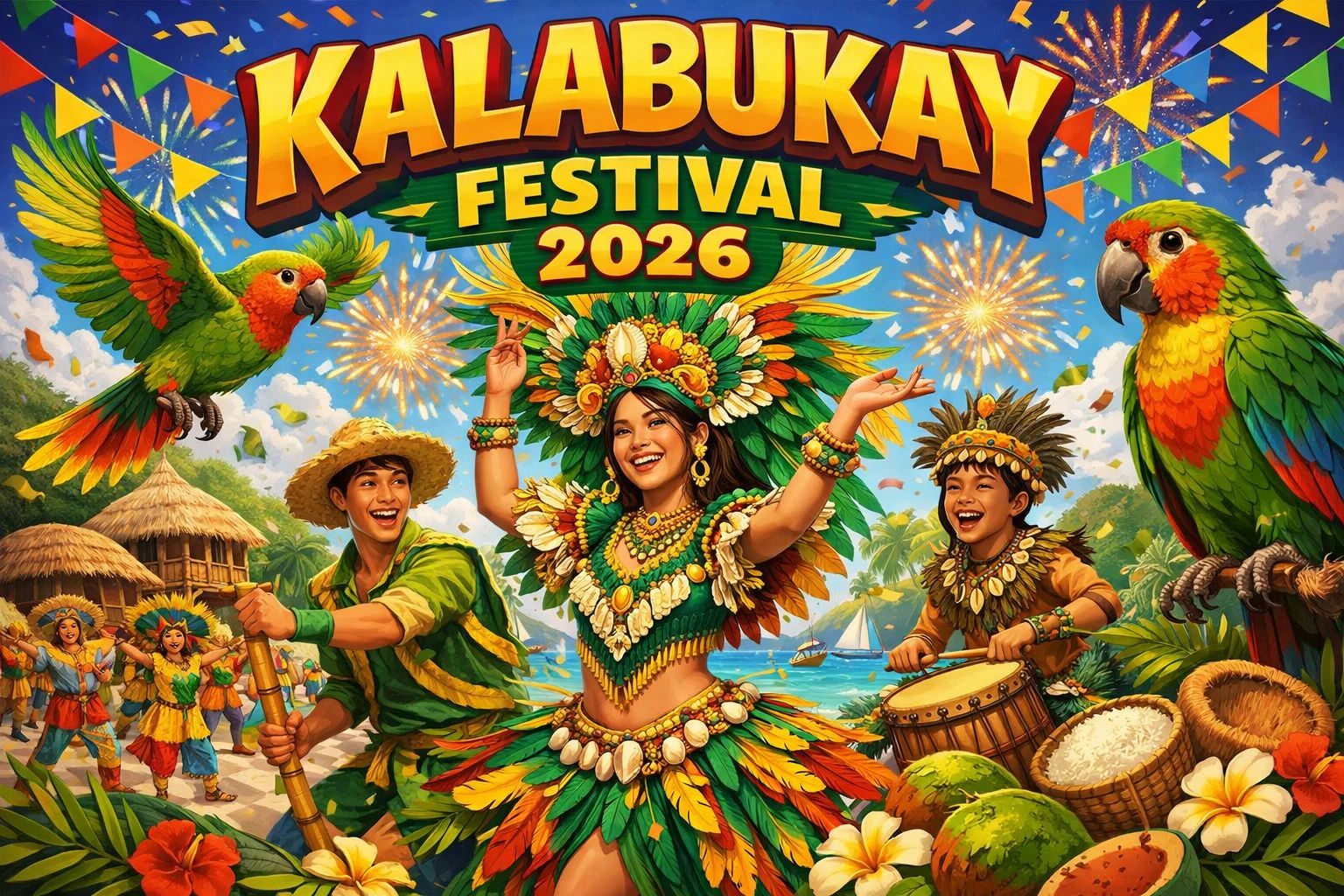
Every June, Dumaran throws a party to celebrate that comeback and everything it represents. The Kalabukay Festival is an annual celebration for the foundation day of the municipality of Dumaran, Palawan. It is also the celebration of the successful preservation of the endangered bird called katala or kalabukay and also for the preservation of natural resources of the island. In 2026, the festival returns for its 22nd edition from June 14 to 18, bringing five days of community celebration, environmental advocacy, cultural performance, and genuine aloha in the Filipino sense, the warmth of a community that opens itself to anyone who makes the journey to its shores.
For travelers who are tired of Palawan's well-worn tourist corridor and who want to experience the province in its fullest, most authentic expression, the Kalabukay Festival in Dumaran is one of the most compelling reasons to veer off the standard route and explore what northern Palawan actually looks like when it is celebrating itself.
The Bird That Inspired a Festival: Understanding the Philippine Cockatoo
A Species on the Edge and the People Who Pulled It Back
Before understanding what the Kalabukay Festival is, it is worth understanding why it exists, and that means understanding the bird at its center.
The Philippine cockatoo, known as katala, agay, kalabukay or abukay, continues to face grave threats from poaching, habitat loss and other destructive human activities. Roughly 70 percent of the remaining population of the red-vented cockatoo is in Palawan province, with the rest spread out in small concentrations on Polillo Island in Quezon province and in Sulu and possibly Tawi-Tawi in Mindanao.
Known for their ability to mimic humans, the Philippine cockatoo can talk, sing and even dance, making these amazing parrots a prized possession among pet lovers. That very quality, their intelligence and mimicry, made them targets for the illegal wildlife trade for decades. The combination of relentless poaching and rapid deforestation drove the species toward a crisis point that conservationists realized in the 1990s required an immediate and sustained response.
The Katala Foundation Incorporated stepped in with a conservation program that combined nest protection, habitat restoration, community engagement, and crucially, the recruitment of former poachers as paid wildlife wardens. Former poachers were recruited as wildlife wardens because of their profound knowledge of the species. They are indigenous people of Palawan: the Pala'wan from the south, the Tagbanua tribes and the Cuyunin from the northern part of the province. In return for their dedication and commitment to the project, KFI implements livelihood activities to augment their income. That approach, turning people who once threatened the species into its most committed defenders, is a model of conservation thinking that has been studied and replicated far beyond Palawan.
On Dumaran, the work has produced measurable results. Three critically endangered species occur in the same habitat on Dumaran: the Philippine Cockatoo, the Philippine Pangolin, and the Palawan Forest Turtle. Ornithological surveys have yielded 136 species from the island, many of which are threatened or endemic. Dumaran is not just a habitat for the kalabukay. It is a biodiversity hotspot of extraordinary importance, and the festival that celebrates the cockatoo is implicitly a celebration of all of that richness.
The Festival Itself: Twenty Years of Conservation Celebration
How the Kalabukay Festival Was Born
The Kalabukay festival started in 2005 with the effort of the Katala Foundation and the local government of Dumaran. The collaboration between a conservation nonprofit and a local government unit to launch a community festival was, at the time, a fairly novel approach to environmental advocacy in the Philippines. Rather than relying purely on legal enforcement or external pressure to protect the cockatoo and its habitat, the Katala Foundation recognized that genuine, lasting conservation requires community ownership, and that community ownership is best built through celebration.
The Katala Foundation believes that increased awareness and knowledge on biological conservation is vital to influence positive behavior towards protection and conservation. One of the most effective learning approaches that capture a wider audience is the celebration of nature festivals that promote environmental learning through fun activities. The Kalabukay Festival was designed from the beginning to be genuinely fun, not a lecture with costumes, but a real community celebration that happened to carry a conservation message woven through every activity.
That approach has worked. Two decades later, the festival is Dumaran's most anticipated annual event, anchoring the municipal Foundation Day celebrations with a program that brings together schools, barangays, community organizations, and visitors in a shared five-day experience.
The Five-Day Program: What Happens From June 14 to 18
The five-day celebration from June 14 to 18 includes an opening parade, booth exhibit, tree planting, coastal clean-up, basketball competition, and the highlight of the celebration: the Search for Miss Kalabukay.
But the full scope of the festival's activities goes considerably deeper than that list suggests. In these festivals, several activities are conducted:
- Billboard making contest
- Murals and conservation races for school children
- Environmental singing contest
- Arts contest and essay writing contest for school children
- Kite flying contest
- Beauty and talent search for adults
- Mascot appearances
- Puppet shows
- Street dancing competition participated in by barangay and community groups
- Face painting
What is immediately striking about that program is how purposefully it integrates conservation education into every activity. The billboard making contest is not simply a creative competition. It is an exercise in environmental communication, pushing students to think about how to translate complex ideas about habitat loss and species protection into visuals that move and persuade. The environmental singing contest does what music has always done in Filipino culture, carries important messages into the heart through melody and rhythm. The puppet shows bring the kalabukay to life in a form that even the youngest children can engage with, creating connections between kids and wildlife that research consistently shows translate into conservation attitudes in adulthood.
Puppet theater during the Kalabukay Festival on Dumaran is a notable attraction, with the Katala Foundation using this medium as part of its conservation education work alongside the reforestation effort within the critical habitat. Watching a puppet show about a cockatoo's journey through a threatened forest, performed by community members for an audience of schoolchildren who live adjacent to that actual forest, is conservation education at its most honest and its most effective.
The Street Dancing Competition: Community Pride in Motion
Among all the activities that fill the five-day Kalabukay Festival calendar, the street dancing competition draws the most participants and the largest crowds. Barangays and community groups from across Dumaran spend weeks, sometimes months, preparing choreography, assembling costumes, and rehearsing the sequences that they will perform on the municipal streets when festival week finally arrives.
The cockatoo theme runs through the street dancing in ways that range from the literal to the interpretive. Some groups design costumes that directly evoke the kalabukay's distinctive red vent and white plumage, incorporating bird-inspired movements into their choreography. Others take a more metaphorical approach, telling the story of the cockatoo's conservation through dance, depicting the threats the bird faces and the community's response. The result is street dancing that is not simply decorative but narrative, performances that carry genuine meaning for the people creating and watching them.
This is one of the hallmarks of a festival that grew from a real community need rather than a tourism marketing initiative. The creativity on display is not performed for outside audiences. It is generated by and for the people of Dumaran, which is precisely what gives it its vitality and authenticity.
Tree Planting and Coastal Clean-Up: When the Festival Becomes Action
The Kalabukay Festival does something that most festivals do not. It includes activities whose purpose is not celebration but direct environmental action, and it treats those activities as highlights rather than footnotes.
The tree planting component of the festival is one of the most meaningful expressions of the community's relationship with its own environment. An important component of the conservation work on Dumaran is the reforestation effort within the critical habitat. Native trees are propagated in one main and several satellite nurseries, and the corridor and buffer zone of the protected area is continuously replanted. The festival's tree planting activity connects directly to this ongoing effort, turning what could be an abstract conservation goal into something concrete and communal: hundreds of people going into the ground together, planting trees that will stand long after the festival banners have come down.
The coastal clean-up follows the same logic. Dumaran's coastline includes some of the most pristine marine environments in northern Palawan, including the Banawa Sand Bar and surrounding reef systems that support extraordinary marine biodiversity. Organizing a community-wide coastal clean-up as part of the festival program sends a clear signal about the community's values and its understanding of the connection between healthy forests, clean coastlines, and the wildlife that depends on both.
The Search for Miss Kalabukay: Beauty, Talent, and Conservation
The Search for Miss Kalabukay is the festival's most anticipated evening event, featuring sports, pageant, singing competition and other activities that promote conservation of the red-vented cockatoo as well as the attractions and culture of Dumaran.
Philippine beauty pageants carry enormous cultural weight, and the Miss Kalabukay competition channels that weight directly into the festival's conservation mission. Contestants are typically asked to demonstrate knowledge of the Philippine cockatoo, the conservation efforts underway in Dumaran, and the broader environmental issues facing Palawan. A beauty queen who can speak eloquently about the kalabukay's ecological significance and the threats to its habitat becomes an ambassador for the festival's values year-round, not just during the five-day celebration.
Dumaran Municipality: The Island Setting That Makes It All Real
An Island Archipelago with Extraordinary Natural Riches
Dumaran is one of the municipalities in the province of Palawan. The municipality has 7 islands including the town center and 16 barangays on the mainland. That archipelagic geography means that Dumaran is not simply a town with a bird conservation program. It is an island ecosystem where the relationship between healthy forests, clean coastlines, and thriving wildlife is visible and tangible in daily life.
The municipality's natural attractions offer travelers who arrive for the festival a rich extended experience beyond the celebration itself. Banawa Sand Bar is known in Dumaran for being a great site for snorkeling due to its beautiful beach, crystalline waters, and astounding coral reefs which serve as home to various kinds of fish, and is only ten minutes away from the town proper of Dumaran.
The Dumaran Spanish Fort ruins are an interesting historical site in the vicinity, with walls still intact despite the span of time that has passed. Oral tradition claims that the fort was never finished. Walking through these ruins while contemplating the centuries of history they have witnessed, from Spanish colonial presence through the Japanese occupation to the present-day conservation story playing out in the forests above, gives Dumaran a historical depth that most visitors never expect to find in such a small municipality.
Ilian Waterfalls is a hidden beauty located on the mainland of Dumaran, where visitors can enjoy cool fresh water in a relaxing ambiance surrounded by rich greenery. Isla Pugon is an island virtually surrounded by thick, lush mangrove forest, and climbing to the top reveals a breathtakingly beautiful view of the vast mangrove forest which extends to the beach.
Then there is the draw of the kalabukay itself. For birders and wildlife enthusiasts, the opportunity to observe the Philippine cockatoo in the wild in one of its remaining strongholds is a genuinely rare and meaningful experience. The Katala Foundation's wardens are knowledgeable guides to the bird's habitats and behaviors, and a guided visit to the cockatoo reserves during or around the festival period offers a perspective on what the entire celebration is protecting that no amount of festival programming alone can convey.
Getting to Dumaran: The Practical Side of a Meaningful Journey
Dumaran sits in the northern part of Palawan province, accessible from Puerto Princesa by a combination of road and sea transport. The most common route involves taking a bus or van north from Puerto Princesa along the national highway toward Roxas, then connecting to boat transport from Roxas port to Dumaran. The journey takes several hours and requires a bit of planning, particularly during festival week when transport options fill more quickly than usual.
The town is accessible via public transportation such as buses or shuttle vans, with arrival at the wharf in Barangay Sta. Teresita in Dumaran, from which boats can be boarded to reach the island barangays.
Roxas, the capital of the Municipality of Roxas in northern Palawan, serves as the main jumping-off point for Dumaran-bound travelers and is itself a pleasant town with basic accommodation and good seafood. Travelers who fly into Puerto Princesa can complete the entire overland and sea journey to Dumaran in a single day if they depart early in the morning.
Due to the fact that Dumaran is one of the less developed towns in Palawan, accommodation options are limited and it is highly recommended to arrange accommodation beforehand to avoid any complications. During festival week specifically, the small number of available rooms fills quickly, making advance planning essential. Travelers who prefer more accommodation options might consider staying in Roxas and making the daily boat crossing to Dumaran during festival activities, though this adds commute time to each day.
The festival is free and open to the public, with no entrance fees for any of the main activities. The informal economy of food stalls, community vendors, and local crafts sellers that springs up around the festival provides ample opportunity to eat, shop locally, and contribute to the municipal economy in a meaningful way.
June weather in northern Palawan sits at the beginning of the southwest monsoon season, with warm temperatures and occasional afternoon rain. The festival's outdoor activities are designed to be weather-resilient, and light rain in the tropics tends to dampen neither the mud nor the spirit of Philippine community celebrations. Pack light, breathable clothing, a rain layer, strong insect repellent, and the willingness to move slowly enough to appreciate everything around you.
Why the Kalabukay Festival Matters Beyond Dumaran
The Kalabukay Festival is one of the clearest examples in the Philippines of a festival that was created not to attract tourists but to build community. The fact that it is genuinely worth traveling to experience is almost a secondary consequence of how authentically it was designed.
The people of Dumaran celebrate their Kalabukay Festival to promote conservation of the forests where one of the last remaining populations of kalabukay or katala dwells. That stated purpose has held for twenty-one years and counting, and it shows in every activity the festival includes. The tree planting is real. The coastal clean-up has real environmental impact. The conservation education delivered through puppet shows and essay contests and billboard competitions reaches real children who will grow into the next generation of the community that decides whether the forests of Dumaran survive.
Palawan remains the stronghold of the Philippine cockatoo, where the campaign to save the species from extinction remains strong. The Kalabukay Festival in Dumaran is both a celebration of how far that campaign has come and a renewal each year of the community's commitment to seeing it through. For a visitor who attends, it offers something that is increasingly rare in Philippine tourism: the chance to witness a community in genuine relationship with its own natural environment, celebrating that relationship with music, dance, competition, and the unembarrassed joy of a people who know exactly what they have and exactly why it is worth protecting.
Come for the cockatoos. Stay for the street dancing, the puppet shows, the Miss Kalabukay pageant, the tree planting, and the moment when you realize that the bird everyone is celebrating is not a symbol but a living presence in the forest right above the festival grounds. The Kalabukay Festival 2026 runs June 14 to 18 in Dumaran, Palawan, and it is one of the finest things you can do with five days in the Philippines.
Verified Information at a Glance
Event Name: Kalabukay Festival 2026 (22nd Annual Edition)
Event Category: Annual Municipal Foundation Day Festival and Wildlife Conservation Celebration
Location: Dumaran, Northern Palawan, Philippines (Municipality of Dumaran)
Organizer: Local Government Unit of Dumaran in partnership with the Katala Foundation Incorporated (KFI)
Festival Dates: June 14 to 18, 2026 (five days, consistent annually)
Established: 2005 (founded by the Katala Foundation and LGU of Dumaran)
Festival Namesake: The kalabukay, the Cuyunon word for the Philippine cockatoo (Cacatua haematuropygia), also known as katala, an endangered species
Conservation Context