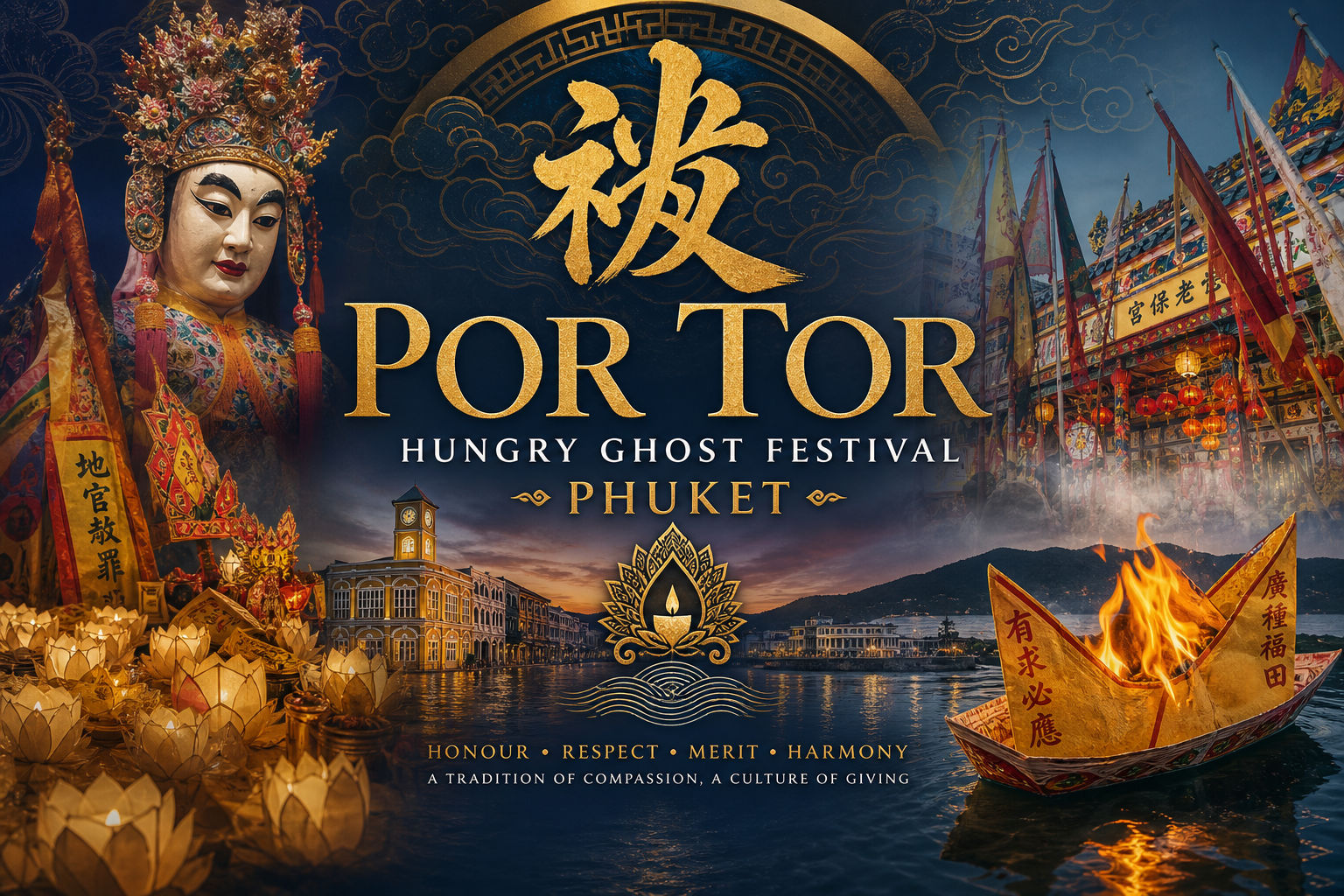
Every August, something shifts in the atmosphere of Phuket Town. The markets stay lit later than usual. The smell of incense hangs in the evening air at intersections and alleyways where small shrines have appeared overnight. Elaborate towers of red and gold food offerings rise outside shop fronts on streets that are usually all commerce and noise. And at the Seng Tek Bel Shrine on Phuket Road, the ceremonies have been running continuously for days. The Por Tor Festival 2026, Phuket's annual Hungry Ghost Festival, runs from Wednesday August 19 to Sunday September 6, 2026, with the peak ceremonial day, the 15th day of the 7th lunar month, falling on Thursday August 27, 2026. It is one of the most culturally distinctive and atmospherically extraordinary events in the entire Phuket calendar, and it is almost entirely off the tourist radar — which is precisely what makes it worth going to find.
"The Por Tor Festival is one of the most culturally distinctive and atmospherically extraordinary events in the entire Phuket calendar."
What Is Por Tor: Ghosts, Ancestors, and the Logic of a Festival
Exploring the Heart of Phuket's Chinese Heritage
Por Tor, also known in Phuket as Sart Chin, is the Thai-Chinese community's observance of the Ghost Month, the seventh lunar month in the Chinese calendar when, according to ancient Chinese folk belief, the gates of the underworld open and the spirits of the dead are temporarily released to wander among the living.
The Ghost Month 2026 runs from August 13 to September 10, with the gates of the underworld believed to open on August 13 and close again on September 10. The Ghost Day itself, when spirits are considered most active and most in need of appeasement, is August 27, 2026. The Por Tor Festival in Phuket runs from August 19 to September 6, bracketing the Ghost Day at its center and giving the community a full three weeks of ceremonial activity to ensure that both honored ancestors and unknown wandering spirits are properly fed and respected.
The philosophy behind Por Tor is both compassionate and pragmatic.
The philosophy behind Por Tor is both compassionate and pragmatic:
- Ancestor veneration: Families prepare food offerings at home altars and at shrines to honor their own ancestors, inviting the spirits of parents, grandparents, and earlier generations to return and receive the living family's love and gratitude.
- The hungry ghosts: These are the spirits without descendants to make offerings for them, those who died far from home, died young, died violently, or were simply forgotten. They are the most distressing category in the Hungry Ghost cosmology because their hunger is not their fault. The Por Tor Festival's community offerings at public altars feed these unclaimed spirits, an act of communal compassion that reflects the Buddhist and Taoist values woven through the festival's origins.
- Protection: Well-fed ghosts are appeased ghosts. The practical dimension of the festival is ensuring that spirits who might otherwise cause illness, accidents, or bad luck to the living are given enough that they have no reason to harm anyone.
The name "Por Tor" comes from the Hokkien dialect spoken by Phuket's ethnic Chinese community, whose ancestors arrived in Phuket primarily from the Fujian province of southern China in the 18th and 19th centuries to work in the tin mines. The festival is most intensely observed in communities where Hokkien culture remains strong: Phuket, Penang in Malaysia, Singapore, Hong Kong, and parts of Taiwan.
The 2026 Por Tor Dates: What Happens When
Mark Your Calendar for the Festival Highlights
The Por Tor Festival calendar is determined by the Chinese lunar calendar and varies year to year:
DateSignificance August 13, 2026Ghost Month begins, gates of underworld open August 19, 2026Por Tor Festival officially opens in Phuket August 22 to September 6Main seven-day-seven-night ceremony at Seng Tek Bel Shrine August 27, 2026Ghost Day — peak ceremonial day, spirits most active September 6, 2026Por Tor Festival closes in Phuket September 10, 2026Ghost Month ends, gates of underworld close The Two Centers of Por Tor in Phuket Town
Where the Heartbeat of the Festival Resonates
While offerings and ceremonies take place at Chinese shrines across the entire island, the Por Tor Festival in Phuket is concentrated in two locations that together form the heart of the event:
Seng Tek Bel Shrine (Por Tor Kong Shrine), Phuket Road
The Spiritual Core of the Festival
The Seng Tek Bel Shrine, also known as the Por Tor Kong Shrine, located on Phuket Road next to Bann Bang Neow School in Phuket Town, is the undisputed center of the festival on the entire island. Its primacy comes from its scale of commitment: while most shrines host Por Tor ceremonies for two to three days, Seng Tek Bel runs its ceremonies continuously for seven days and seven nights, from August 22 through to September 6. This sustained ceremonial intensity makes it the most immersive venue for visitors who want to experience the full depth of what the festival involves.
The shrine is a working Chinese Taoist temple with the particular atmosphere of a place that takes its spiritual responsibilities seriously.
During the festival, the shrine grounds fill with:
- Towering altar constructions laden with food offerings, fruit towers, and ritual objects
- Red and gold ceremonial decorations that transform the shrine's normal appearance into something far more elaborate
- Incense smoke rising continuously from the large incense burners at the entrance, the smell drifting across Phuket Road to alert the surrounding neighborhood that the ceremonies are in progress
- Priests and devotees performing the specific ritual sequences that the festival requires
- The distinctive Ang Ku cakes (red turtle-shaped sticky rice cakes filled with sweet mung bean paste) that are the Por Tor Festival's most recognizable and most symbolically significant food offering
The Ang Ku cake deserves particular mention because it is the single most distinctive culinary element of Por Tor and the one object that immediately communicates the festival's presence to anyone who recognizes it. The turtle shape represents longevity and good fortune, the red color represents happiness and luck, and the act of making and offering them is itself a form of merit-making that blesses both the maker and the ancestor to whom they are offered. At the Seng Tek Bel Shrine during Por Tor, locals prepare hundreds of Ang Ku cakes, and visitors who want to see the production process can watch the communal cake-making at the shrine in the days leading up to August 27.
Ranong Road Fresh Market Area
The Social and Entertainment Hub
The Phuket Town Fresh Market on Ranong Road and its surrounding streets provide the festival's most accessible and most lively public space. While the Seng Tek Bel Shrine is the spiritual center, the Ranong Road market is the social and entertainment center, running a programme from approximately noon until midnight that combines:
- Traditional merit-making ceremonies at the temporary altars erected throughout the market area
- Lion dances with the clanging cymbals and drums that announce the lion's progress through the market streets and bring good fortune wherever the lion pauses
- Magic shows performed by traditional Chinese folk entertainers
- Live concerts on the temporary stages erected for the festival period
- Cabaret shows reflecting the Thai performance tradition that sits alongside the Chinese ceremonial events
- Multiple stage shows throughout the evening programme
- Local food stands selling the full range of Phuket's Chinese-influenced cuisine at the accessible community prices that make festival street food one of the most genuinely value-for-money dining experiences in Phuket
The market atmosphere during Por Tor has a specific quality that distinguishes it from Phuket's regular night markets and walking streets: the combination of the ceremonial dimension, the traditional performance forms, the community gathering energy, and the food creates something that feels like a genuinely living cultural tradition rather than a curated tourism experience.
The Parades: Por Tor in the Streets
Where Tradition Meets Spectacle
Several major parades take place during the Por Tor Festival period, moving through the streets of Phuket Town and providing the festival's most visually spectacular public moments. The parade programme for 2026 had not been fully detailed at time of research. For confirmed parade times and routes, the Tourism Authority of Thailand (TAT) Phuket office is the most reliable source: call 076-212213 for the 2026 parade schedule.
The parades feature:
- School children and community members in traditional Chinese costumes, with many girls wearing the red cheongsam (Chinese-style fitted dress) and carrying flowers, Ang Ku turtle cakes, and fruits to the shrines
- Lion dance teams escorting the procession with their cymbal and drum accompaniment
- Community organizations from Phuket's various Chinese clan and dialect associations, whose distinctive banners and ceremonial robes reflect the specific social organization of the Hokkien and Teochew communities that have been the backbone of Phuket's Chinese heritage since the tin mining era
- Ritual objects and shrine palanquins carried by bearers in the same processional tradition that also characterizes the Phuket Vegetarian Festival, Por Tor's more famous and more extreme cousin event in October
The Food Offerings: Feeding the Ancestors and the Ghosts
Ceremonial and Culinary Delights
The food dimension of Por Tor is simultaneously ceremonial and culinary, and the two aspects are inseparable:
Ceremonial Offerings at the Altars
Honoring Spirits with Traditional Delicacies
The altars at Seng Tek Bel Shrine and at the Ranong Road market area carry an extraordinary variety of food offerings that reflect both Chinese culinary tradition and the specific symbolic requirements of the spirit world:
- Ang Ku cakes (red turtle sticky rice cakes): longevity and good fortune for the ancestors
- Fresh fruits: Pomelos, mandarins, apples, grapes, and pineapples arranged in elaborate tower constructions
- Roast pork and duck: The full animal presentation of roasted meat is a standard ancestral offering in Chinese tradition, representing abundance and respect
- Steamed buns (salapao): Both sweet and savory varieties in the Chinese Phuket style
- Rice dishes and noodle preparations: The everyday foods of the living community prepared for the ancestors who shared those same meals in life
- Incense, candles, and paper offerings: The burning of incense and paper money (joss paper) is the single most constant ritual act of the entire festival period, with the smoke carrying the offerings from the material world to the spirit world
Street Food for the Living
A Culinary Journey Through Phuket's Flavors
The food stalls at the Ranong Road market and around the Seng Tek Bel Shrine during Por Tor present the best and most concentrated opportunity of the year to eat Phuket's Chinese-influenced local cuisine at community prices:
- Mee Hokkien: Phuket's signature thick yellow noodle dish cooked in a dark soy and pork stock that is the Hokkien community's most emblematic daily food
- Bak kut teh: Pork rib soup with Chinese herbs, a dish carried directly from the Hokkien homeland in Fujian province
- O-tao: A Phuket Hokkien specialty of oyster and taro root in egg batter
- Sataw: Bitter beans stir-fried with shrimp paste and pork, one of the most intensely flavored dishes in the Phuket street food repertoire
- Khanom jeen: Fresh rice noodles with curry sauce
- Mango sticky rice and tropical fruit desserts: The sweet counterpoint to the savory street food that rounds out a Por Tor market evening
Other Shrines Across Phuket Observing Por Tor
Beyond the Main Centers
The festival extends well beyond its two main centers to Chinese shrines across the island:
- Hok Nguan Kong Shrine: One of the larger shrine celebrations with an early evening programme beginning the festival
- Cheng Ong Shrine: Full-day ceremonies in Phuket Town
- Thai Hua Museum, Thalang Road: The converted Chinese school building in the heart of Phuket Town's Old Town area hosts associated Por Tor programming and its heritage architecture provides a particularly atmospheric setting for the ceremonial dimension
- Community shrines in Kathu: Even in the more suburban areas of Phuket away from the Old Town, small community Chinese shrines observe Por Tor with household-scale offerings visible on the street
- Shrines in Patong, Karon, and Kata: The tourist beach communities have their own Chinese shrine networks whose Por Tor observances are smaller than the Phuket Town events but no less sincere
Por Tor and the Phuket Vegetarian Festival: Sister Events
A Cultural Continuum in Phuket's Calendar
Por Tor sits in the calendar approximately six weeks before the Phuket Vegetarian Festival, which in 2026 runs October 8 to 17 at Jui Tui Shrine, Bang Neow Shrine, and the streets of Phuket Town. The two festivals share deep roots in Phuket's Hokkien Chinese community and in the same network of Chinese Taoist shrines, and together they form the most concentrated period of Chinese cultural religious observance on the island's annual calendar.
The Vegetarian Festival is internationally far more famous, largely because its extreme piercing and fire-walking rituals generate dramatic imagery that travels widely on social media. Por Tor is quieter, more intimate, and arguably more genuinely representative of the everyday spiritual life of Phuket's Chinese community precisely because it is not designed for an audience. It is a family and community event that happens to be accessible to respectful visitors.
A visitor in Phuket for the last week of August through the first week of September 2026 experiences Por Tor at its peak around Ghost Day on August 27, then has time to explore the island before returning for the Vegetarian Festival opening on October 8 — or, if a return trip is not possible, leaves with the knowledge that Por Tor gave them a more authentic and less photographed glimpse of Phuket's Chinese heritage than the Vegetarian Festival's extraordinary but heavily documented ceremonies can now provide.
Practical Tips for Visiting Por Tor in Phuket Town
Your Guide to a Seamless Festival Experience
- Get to the Ranong Road market between 7:00 p.m. and 10:00 p.m. for the busiest and most atmospheric combination of ceremonies, performances, and food stalls.
- Visit Seng Tek Bel Shrine in the late afternoon before the market crowds build to see the altar offerings at their most elaborate and to watch the shrine ceremonies in a less crowded environment.
- Dress modestly at the shrines. Covered shoulders and knees are required at Chinese Taoist shrines during active ceremonies. The same basic modesty requirements as Buddhist temples apply.
- Do not touch the food offerings on altars. The offerings on shrine altars are sacred items placed for the spirits. Photographing them respectfully from a distance is appropriate; touching or moving them is not.
- Parking is difficult near the Seng Tek Bel Shrine and the Ranong Road market during the festival period. Walk from Phuket Old Town, take a motorbike taxi from your hotel, or use a ride-hailing app for the return journey.
- Try the Ang Ku cakes. Some vendors sell Ang Ku cakes for the living to eat as well as to offer at altars. The red turtle cakes filled with sweet mung bean paste are one of the most distinctive flavors of the entire festival and one of the most direct connections to the Hokkien culinary tradition that Por Tor celebrates.
- Go on August 27 (Ghost Day) if you can only attend one day. This is the most spiritually significant date of the entire festival and the ceremonies at both the shrine and the market are at their fullest and most intense.
- Call the TAT Phuket office at 076-212213 for the confirmed 2026 parade schedule as August 27 approaches.
Getting to Phuket Town for Por Tor
Navigating to the Heart of the Festival
The Seng Tek Bel Shrine and Ranong Road market are both in Phuket Town, the island's administrative and historical capital located approximately 35km northeast of Patong Beach and 15km southeast of Phuket International Airport:
- From Patong: 35 to 45 minutes by taxi or ride-hail via the main Patong to Phuket Town road.
- From the airport: 15 to 20 minutes south to Phuket Town by taxi.
- From Kata and Karon: 30 to 40 minutes north to Phuket Town.
- From Laguna and Bang Tao: 30 to 40 minutes south to Phuket Town.
The Old Town area of Phuket Town, with its Sino-Portuguese shophouse architecture, independent restaurants, heritage museums, and weekly Sunday Walking Street, is worth a full day visit at any time of year. The Por Tor Festival from August 19 to September 6 gives the Old Town an additional layer of cultural activity that makes it one of the most rewarding destinations in Phuket during this period.
Frequently Asked Questions
The Things People Always Want to Know
When is Por Tor Festival 2026?
Wednesday August 19 to Sunday September 6, 2026, with the peak Ghost Day on Thursday August 27, 2026.
What is the main venue?
The Seng Tek Bel Shrine (Por Tor Kong Shrine) on Phuket Road, Phuket Town, hosts the full seven-day-seven-night ceremony (August 22 to September 6). The Phuket Town Fresh Market on Ranong Road hosts the largest public programme of performances and food stalls (noon to midnight daily).
Is Por Tor Festival free?
Yes. All public ceremonies, parades, and performances are free to attend.
Is Por Tor Festival the same as the Phuket Vegetarian Festival?
No. They are distinct events from the same Chinese Hokkien religious tradition. Por Tor is the Hungry Ghost Festival in August and September. The Vegetarian Festival is in October (October 8 to 17 in 2026) and features more extreme physical rituals.
What is Ghost Month 2026?
The Ghost Month runs from August 13 to September 10, 2026, with the gates of the underworld believed to open on August 13 and close on September 10.
What is the best day to visit?
August 27, 2026 (Ghost Day) is the peak ceremonial day of the entire festival.
Verified Information at a Glance
- Festival Name: Por Tor Festival / Hungry Ghost Festival / Sart Chin
- 2026 Dates: August 19 to September 6, 2026
- Ghost Month: August 13 to September 10, 2026
- Ghost Day (Peak): August 27, 2026
- Primary Venue: Seng Tek Bel Shrine (Por Tor Kong Shrine), Phuket Road, Phuket Town
- Seven-Day-Seven-Night Shrine Ceremony: August 22 to September 6, Seng Tek Bel Shrine
- Market Programme: Ranong Road Fresh Market, noon to midnight daily
- Community: Hokkien Chinese community of Phuket
- Admission: Free
- TAT Phuket Office (Parade Schedule): 076-212213
- Related Event: Phuket Vegetarian Festival, October 8 to 17, 2026
- Nearest Airport: Phuket International Airport (HKT), 15 to 20 minutes from Phuket Town
- Best For: Cultural travelers, Chinese heritage visitors, food enthusiasts, photographers, visitors wanting an authentic off-tourist-track Phuket experience, travelers combining with the Phuket Vegetarian Festival