Parade of the Bands — Saint Lucia Carnival: The Greatest Street Party in the Caribbean
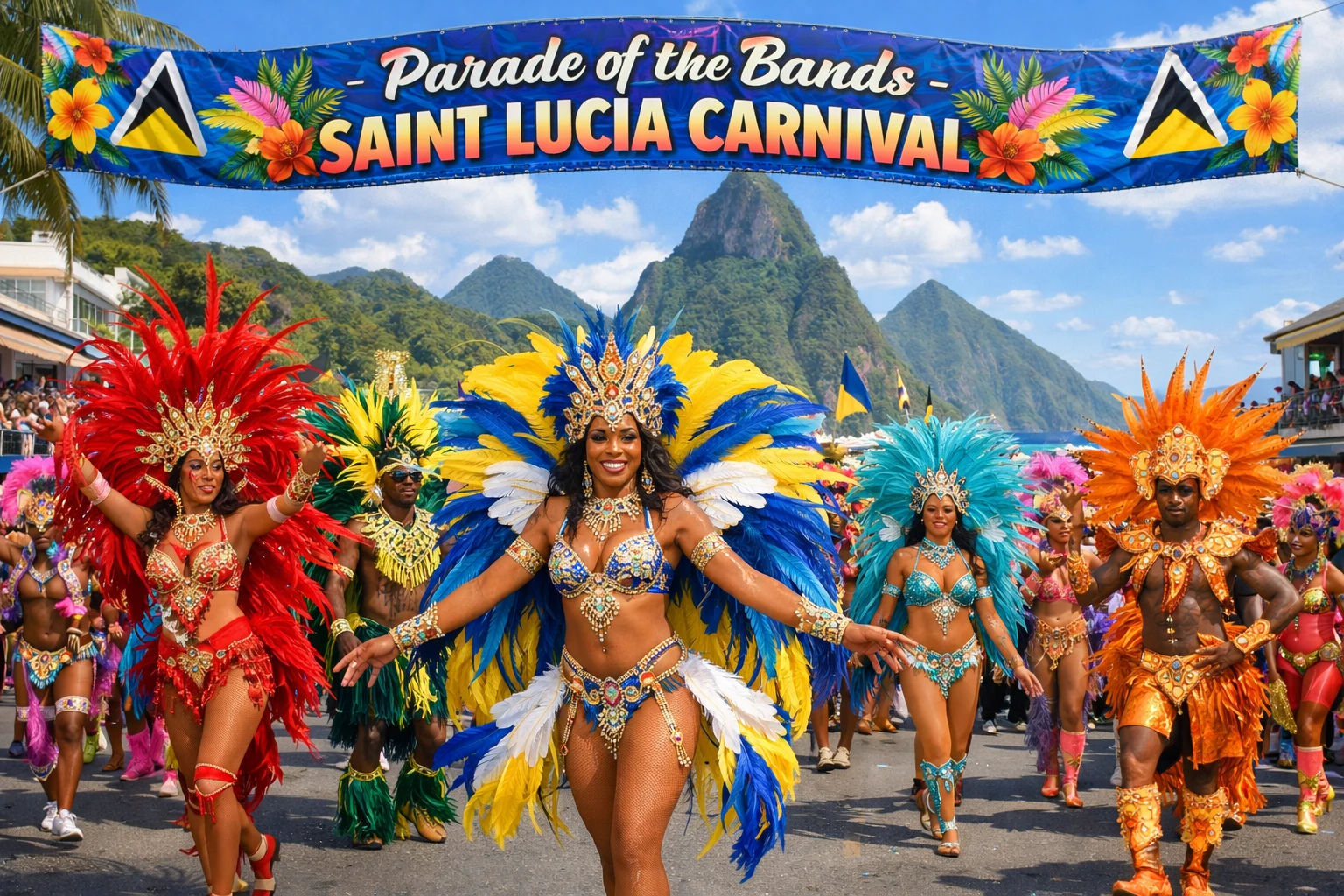
Picture this. You are standing on a sun-drenched street in Castries, the compact and colorful capital of Saint Lucia, and the bass from an approaching music truck is rolling through your chest before you can even see it coming. Then it rounds the bend, and behind it floods a river of human color so brilliant and so densely packed that your brain takes a second to process what your eyes are seeing. Towering feathered backpacks. Glittering bikini-style mas costumes draped in sequins the color of peacock wings. Headpieces so elaborate they look like wearable architecture. And every single person in that river is dancing, laughing, and absolutely living their best life on a Tuesday morning in July.
That is the Parade of the Bands at the Saint Lucia Carnival, and there is genuinely nothing else like it in the Caribbean.
The Parade of the Bands is the grand culmination of the Saint Lucia Carnival, where revelers adorned in dazzling costumes flood the streets of Castries in a kaleidoscope of colors and music, led by vibrant music trucks, with each band showcasing their intricately designed costumes dancing to the infectious rhythms of soca and calypso. It is the moment that everything else in the three-week carnival season builds toward, and for tens of thousands of participants and spectators, it delivers every single time.
A Festival Rooted in History: Where the Parade of the Bands Came From
From Shrove Tuesday to July: The Evolution of a Caribbean Icon
In Saint Lucia, carnivals became an organized festival after World War II. The first recorded celebration was in 1947 when a small group of people dressed in ragged clothes began to beat out rhythms on bottles and pieces of steel as they paraded through Castries. People soon joined the impromptu parade, which ended at the home of Derek and Roddy Walcott on Chaussee Road.
The Walcott home is a meaningful landmark in that origin story. Derek Walcott, who grew up watching this very tradition take root in the streets of Castries, went on to become Saint Lucia's first Nobel Laureate in Literature. His twin brother Roderick won the first Masquerade Band of the Year title in 1957. The carnival was literally born in the neighborhood of the family that would go on to define Saint Lucian artistic culture for the rest of the twentieth century.
In 1950, the Physical and Culture Club in Castries organized the first-ever King and Queen competition for the Saint Lucia Carnival. Steel bands first made their appearance at the carnival in 1948, and some anthropologists suggest that steel band music is directly related to the melodious xylophones of Africa, from tribes in Mozambique and Guinea.
The carnival grew through the 1950s and 1960s as a predominantly pre-Lenten celebration, but its most significant transformation came toward the end of the twentieth century. In 1999, the Saint Lucia Carnival Planning and Management Committee strategically moved it from February to July. The aim was to attract a larger international audience, avoid competing with Trinidad Carnival, and capitalize on the island's beautiful summer weather. Moving Saint Lucia Carnival to the summer transformed it from a pre-Lenten observance into a major tourism event with a growing international audience.
That decision changed everything. The July carnival now sits in its own lane in the Caribbean festival calendar, drawing visitors from North America, Europe, and across the Caribbean who previously would have chosen Trinidad or Barbados. Saint Lucia's carnival has its own identity, its own music, its own culture, and now its own undisputed place on the global party map.
What Actually Happens During the Parade of the Bands
Two Days of Road March, Music, and Mas
The Parade of the Bands is the crown jewel of Saint Lucia Carnival, featuring over 7,500 revelers who take to the streets for two days in a kaleidoscope of colors and creativity. On both days, the parade begins at the Choc Highway roundabout and winds its way through the City of Castries.
The two-day structure gives the parade a distinct personality on each day. Monday is the full costume day, when the bands come out in their most elaborate and carefully constructed finery. Monday is full-costume glory: feathers, gems, towering backpacks, the whole works. You grab your section's music truck and chip along the city circuit from early morning until sundown. This is the day that produces the images that end up on magazine covers and Instagram feeds, the day when months of costume design work finally gets its moment under the Caribbean sun.
Tuesday is lighter but just as fun. Most bands switch to Tuesday-wear, think monokini or swim-style pieces, so you can dance easier and keep cool. Tuesday has a looser, more intimate energy, a celebration among people who have already crossed the threshold of full-costume Monday together and now want to savour the last day of the season with a little less structure and a lot more joy.
The Route Through Castries
On Carnival Monday and Tuesday, carnival bands usually meet up at Union, which is about ten minutes or less from Castries by car. Revelers meet their bands at specific times and each band heads down the road at their allotted time with gaps in between to differentiate them.
The route moves through the heart of Castries, past the Basilica of the Immaculate Conception on Derek Walcott Square, through the busy commercial streets of the capital, and along a path that has been walked by Saint Lucians in carnival costume for more than seven decades. For spectators, lining the route near the start at the Choc Highway roundabout means fewer spectators and easier photography as the revelers pass. After some time you can head south to the center of Castries, overtaking the parade of bands heading to the end to see them cross the stage.
How the Judging Works
The Parade of the Bands is a competition as much as a celebration, and the judging system adds a layer of drama and craft to what might otherwise be simply a very spectacular procession.
There are two judging points along the route. The judges evaluate various aspects to award: Band of the Year, Best Portrayal of Theme, Mas on the Move, Spirit of Carnival, Section of the Year, and Individual of the Year.
The Band of the Year title is the most coveted award in Saint Lucia Carnival, and the competition for it is fierce. Bands spend months conceptualizing their theme, designing their sections, constructing costumes, and rehearsing the presentation they will deliver at the judging points. The difference between a band that wins and one that finishes second can come down to the coherence of the theme across every costume, the energy of the masqueraders when they cross the stage, and the ingenuity of the design that ties everything together. Tribe of Twell has been a particularly dominant force in recent editions, winning the Band of the Year title in consecutive years in 2024 and 2025.
Playing Mas: How to Join the Parade
Choosing Your Band
The carnival band you choose shapes your entire experience on the road. Whether you're looking for jaw-dropping costumes, premium drinks, a cultural experience, or a high-energy pump, each band offers something unique.
There are several established mas bands that participate in the National Parade of the Bands each year. Just4Fun and Xuvo are among the names that carnival travel packages frequently partner with, but the official carnival website lists all registered bands along with their themes, costume options, and what is included in each package. Reading the details carefully matters. Beyond the costumes, also consider what else is included in the carnival package, such as food, drinks, music, security, and toilets. These elements can significantly impact your carnival experience.
Picking Up Your Costume
Set aside at least half a day to grab your outfit at the band's mass camp. Your band will email or text the exact location and time window, usually a few days before the road parade. Arrive early, bring photo ID and your final payment receipt, and be ready to try everything on for quick tweaks. Lines can be long, but the vibe is festive and worth the wait.
The Ole Mas Tradition
Alongside the pretty mas costumes that dominate the visual coverage of the parade, there is a deeper and older tradition running through the Castries streets during carnival week. The ole mas competition features more traditional handmade mas costumes referencing stories of folklore, freedom, and strength, which tend to accompany old-school calypso music and reference the island's colonial past. Many of these tend to be huge, stilt-like structures with moving parts and intricate details.
These are the costumes that connect the modern carnival most directly to its African and Caribbean roots, the ones that carry the history and the memory of what this celebration was built on before sequins and feathers entered the picture. If you want to understand Saint Lucia Carnival at its deepest level, find a quiet spot along the route early on Monday morning and watch the ole mas pass by before the main parade builds.
The Events That Lead Up to the Parade
Three Weeks of Fetes, Competition, and Cultural Fire
The Parade of the Bands does not exist in isolation. It is the endpoint of a three-week season that begins in early July and builds relentlessly in energy and intensity. A variety of competitions including the ever-popular Power and Groovy Monarch, Senior and Junior Panoramas (Steel Pan Competitions), and the Inter-Commercial House Calypso competition, dozens of community events, and a continuous calendar of parties and fetes all precede the two-day street parade.
The Soca Monarch competition is where the songs of the season are crowned. The Power Monarch category rewards the most energetic and driving soca tracks, the ones that will be blasted from music trucks throughout the parade. The Groovy Monarch recognizes the more melodic, danceable end of the soca spectrum. Attending the Soca Monarch Finals, typically held on the Friday before the parade days, means you arrive on Monday already knowing the season's anthems and understanding why the crowd goes absolutely wild when a particular track drops from the truck.
Panorama, the steel band competition, is where Saint Lucia's musical heritage is most purely expressed. Steel bands compete with arrangements of carnival songs performed entirely on tuned steel pans, and the musicianship on display is genuinely extraordinary. Steel bands first made their appearance at the Saint Lucia carnival in 1948, and today the number has grown to sixteen, including junior orchestras and even female-only groups.
J'ouvert deserves its own paragraph entirely. J'ouvert at Castries is the official island-wide paint party that explodes around 2 AM on the relevant morning, with bands rolling out and streets staying drenched in color, mud, and soca until sunrise. It is chaotic, joyful, muddy, and entirely committed to the idea that the best way to greet carnival week is to cover yourself in paint in the middle of the night and dance in the streets with strangers until the sun comes up. Most people who do it once want to do it every year for the rest of their lives.
Getting There and Getting Around
Flying Into Saint Lucia
Saint Lucia has two airports: Hewanorra International Airport (UVF) in the south, which handles most long-haul international flights from North America and Europe, and George F.L. Charles Airport (SLU) near Castries, which mainly serves regional Caribbean routes.
Most travelers flying from the United States connect through Miami or New York, with the flight taking approximately four and a half hours from New York's JFK. From the UK, direct flights from London Gatwick with British Airways and Virgin Atlantic serve Hewanorra, with a flight time of around eight and a half hours. The drive from Hewanorra to Castries takes approximately one hour under normal conditions, but carnival traffic on parade days means building in extra time and confirming ground transport arrangements well in advance.
Staying in Castries for Carnival
The Sandals Halcyon Beach resort is situated at Choc Bay and the Saint Lucia Carnival Parade of Bands passes by the property on both days, which makes it one of the most conveniently located hotels in the city for spectators who want a guaranteed view without fighting for sidewalk space. For those who want to be closer to the action of the fetes and parties, hotels and guesthouses in and around Rodney Bay to the north of Castries offer easy access to the pre-parade party circuit.
Accommodation fills up months before the parade days. Although Lucian Mas falls in the island's low tourism season, flights can be surprisingly scarce and expensive once carnival fans snap them up. Book your seat and room in the same click. The recommendation to treat flights and accommodation as a single transaction rather than two separate decisions is well-earned advice from experienced carnival travelers.
Money and Getting Around
The local currency is the Eastern Caribbean Dollar (EC$), with US dollars widely accepted. Exchange rates hover around EC$2.7 to US$1. Carry small bills for street food and taxis. Official taxis have TX plates, confirm fares in advance. Parade days mean road closures around Castries and the northern highway, so arrange taxis early and confirm a pickup spot for after Las Lap.
Tips for Making the Most of Your Parade Experience
The carnival route is a marathon, not a sprint. From the moment you step onto the route it is nonstop vibes, dazzling costumes, and pure Lucian energy. The sun will be shining, the music will be pumping, and the drinks will be flowing. Lather up sunblock, stay hydrated with lots of water, wear comfortable shoes because you will be dancing for hours, and fuel up with a good meal before and during the parade to keep energy high.
For spectators who want the best free viewing experience, arriving at the Choc Highway roundabout starting point well before the first bands roll allows you to see each band as it launches in its full morning energy before the hours on the road have taken their toll. Bringing a cooler, as Saint Lucians do, and claiming a shaded spot along the route is the most comfortable and most communal way to experience the parade from the sidelines.
If you are playing mas for the first time, stay with your band's designated section throughout the day. The music trucks, the food and drinks, the security personnel, and the general organizational support all operate around the band's movement as a unit. Wandering too far ahead or falling too far behind means missing the infrastructure that makes the all-day parade physically manageable.
Why This Parade Belongs on Your Caribbean Bucket List
Saint Lucia is already one of the most beautiful islands in the Caribbean. The twin peaks of the Pitons rising dramatically from the southwest coast are among the most iconic natural landmarks in the entire region. The world's only drive-in volcano sits near Soufriere. Pigeon Island National Landmark to the north holds centuries of military and cultural history. The island's French and British colonial past has produced a cultural blend of Kweyol language, Creole cuisine, and Caribbean artistic tradition that is entirely its own.
The unique confluence of Caribbean, African, English, and French cultures creates an exquisite blend of food, music, and traditions that will inspire and enchant you.
The Parade of the Bands takes all of that heritage and puts it in motion for two days in July. It is not a performance for tourists. It is a community expressing itself at full volume, in full color, with every creative and cultural tool it has developed over more than seventy-five years of carnival tradition. Watching it from the sidewalk will move you. Being inside it, behind a music truck with feathers on your back and soca in your ears, will change you.
Pack your costume, charge your phone, break in your carnival shoes, and get yourself to Castries in July. The road is calling.
Verified Information at a Glance
Event Name: Parade of the Bands, Saint Lucia Carnival (officially known as Lucian Carnival)
Event Category: Annual National Carnival Street Parade and Cultural Celebration
Organizer: Carnival Planning and Management Committee (CPMC), under the Cultural Development Foundation (CDF), Government of Saint Lucia
Official Website: carnivalsaintlucia.com
Typical Months Held: July (full carnival season runs early July through the third week of July; exact dates vary by year)
Parade Days: Two consecutive days, traditionally the Monday and Tuesday of the final week of the carnival season (typically the third week of July)
Parade Start Location: Choc Highway Roundabout, northern Castries (near Massy Mega) / Union area, approximately 10 minutes from Castries city center
Parade End / Judging Stage: City of Castries (William Peter Boulevard area and Mindoo Phillip Park corridor)
Primary Venue City: Castries, Saint Lucia, Eastern Caribbean
Spectator Admission: Free (standing along the parade route is free and open to the public)
Mas Band Participation Cost: Varies by band, costume section, and inclusions (food, drinks, and amenities differ across packages). Costume costs have historically ranged from approximately USD $200 to $600 and above depending on the band and section. Always check directly with individual bands for current pricing at carnivalsaintlucia.com/carnival-bands
Fetes and Private Party Tickets: Range from approximately USD $20 to $100+ per event
Band of the Year Award: Most recent back-to-back holder: Tribe of Twell (2024 and 2025)
Nearest Airports: Hewanorra International Airport (UVF), Vieux Fort (major international gateway, approximately 1 hour from Castries) and George F.L. Charles Airport (SLU), Castries (regional Caribbean routes