Agioi Theodoroi Feast – Akrotiri, Santorini: Where Ancient Faith Meets the Island's Most Storied Village
Santorini is famous for many things: the sunsets, the caldera, the white-washed cliff-hanging architecture, and the volcanic wines. But there is an older, quieter, and in many ways more genuinely Greek Santorini that runs beneath the surface of every postcard, built from centuries of faith, community ritual, and the particular devotion that island people bring to honoring their saints. In that deeper Santorini, the feast day is not a tourist attraction. It is the heartbeat of village life.
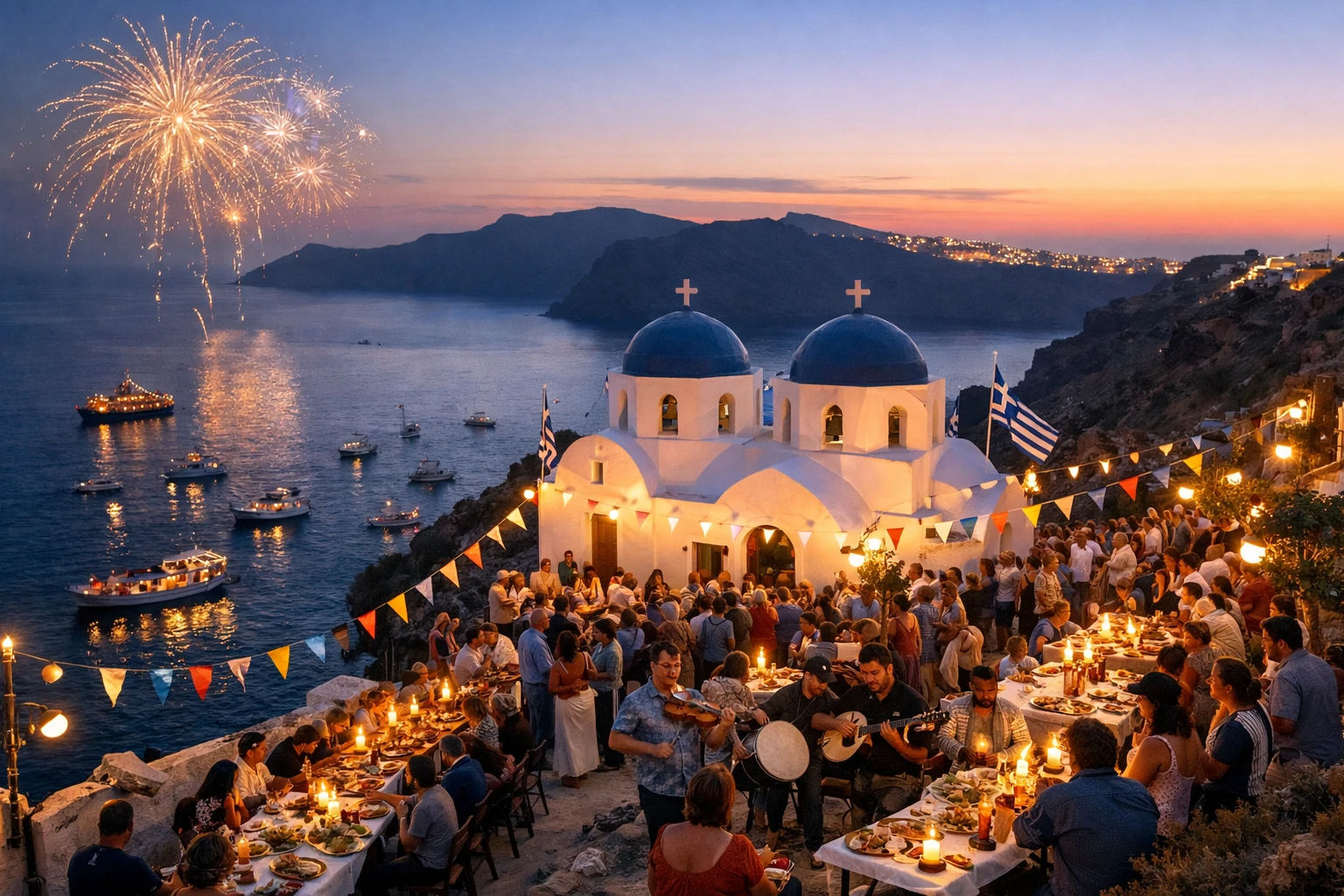
The Agioi Theodoroi feast in Akrotiri brings that heartbeat into full, audible expression. The traditional feasts of Santorini are related to the religious culture of the locals and are strictly connected with the churches and chapels built all over the island. These local feasts, which resemble village parties where all the inhabitants of a town or city are supposed to take part, are known as panigiri. The date of a panigiri depends on the name day of the Saint to which the corresponding church has been dedicated. In general, the feast consists of ecclesiastical ceremonies, common dinners at the yard of the church, and then singing and dancing.
For visitors fortunate enough to be on the island when a panigiri takes place in Akrotiri, one of Santorini's most culturally and historically layered villages, it is an experience that sits in an entirely different register from the caldera views and boat tours that define the standard tourist itinerary.
The Saints Theodore: Two Warriors, One Shared Legacy
Who Are the Agioi Theodoroi?
The name Agioi Theodoroi honors two of the Greek Orthodox Church's most venerated soldier-saints: Saint Theodore the Tyro and Saint Theodore Stratelates. Their stories are remarkably parallel, which is why the Greek Orthodox tradition has long honored them together under the single designation Agioi Theodoroi, meaning Saints Theodore, and why churches and chapels across Greece bear their shared name.
The Orthodox Church has long praised these two great saints and wonderworkers of Christ. It is likely that because they share the same name, similar circumstances from their lives, and feasts that are close to each other, they are often honored and depicted together in churches as Agioi Theodoroi, or Saints Theodore the Great Martyrs.
Theodore the Tyro was a Roman soldier from Pontus who, according to the tradition of the Church, slew a dragon in the forest near Euchaita and then voluntarily presented himself for martyrdom when ordered to sacrifice to the Roman gods. He had been a Christian since childhood but kept his faith secret, not out of cowardice but because he had not yet received a sign from God to present himself for martyrdom. When his moment arrived, he walked into the flames of his execution with a prayer on his lips and a composure that those watching could not explain in purely human terms.
Theodore Stratelates, meaning "the General," held a higher military rank and was martyred somewhat later. Both men chose death over apostasy, both bore the same name, and both became objects of devotion across the Greek-speaking Christian world, with particular strength in the Aegean island communities where soldiers, sailors, and fishermen looked to warrior-saints as protectors of those who faced danger in the service of others.
Why Soldier Saints Matter to Island Communities
The devotion to warrior saints in the Greek islands has deep practical roots. Island communities throughout the Cyclades lived for centuries under the constant threat of piracy, Ottoman taxation, and the unpredictable violence of the sea. The warrior saint, who had faced mortal threat with courage and faith and emerged victorious in the spiritual sense even in physical defeat, was a model and an intercessor simultaneously. Praying to Saints Theodore was not abstract theology; it was asking specifically for protection in a world where protection was genuinely and urgently needed.
That historical urgency has faded, but the devotion has not. The churches and chapels dedicated to the Agioi Theodoroi across the Cyclades continue to hold their feast days with the same communal energy that has characterized them for centuries, and the Santorini tradition is among the island world's most warmly observed.
Akrotiri Village: The Setting That Makes Every Celebration Extraordinary
A Medieval Castle Village at the Southern Tip of the Island
Akrotiri is one of the most famous villages of Santorini. The modern settlement stands out at the southern cap of the island. The village is characterized by Kastelli, the medieval castle at its highest point. It has about 500 permanent residents. Traditionally built around the old castle, the settlement itself does not disappoint visitors.
Akrotiri sits in a geographic position that makes it feel simultaneously remote and central on Santorini. It is at the end of the road heading south from Fira, past the island's most famous beaches and the extraordinary Bronze Age site that shares its name. The village is compact, genuine, and largely unaltered by the kind of boutique hotel development that has transformed other parts of the island. Its narrow cobbled lanes, whitewashed walls, and the medieval bulk of the Kastelli fortress at its crown give it a character that feels continuous with centuries of inhabited history.
Akrotiri village hosts panigiri on:
- May 12th at the Saint Epifanios church
- May 29th at the Saint Theodosia church
- August 6th at the Transfiguration church
- August 15th at the Assumption church
The village's calendar of feast days reflects its multiple church dedications, and the community approaches each one with the particular seriousness and warmth that distinguishes Santorinian panigiri from generic public celebrations.
The Church Landscape of Akrotiri
As in most of the islands of the Cyclades, countless churches and chapels adorn the residential environment. In Akrotiri, we find, among others, the churches of Agia Triada, Ypapanti, Agios Nikolaos, and others. However, the church of Agia Theodosia stands out, found near the castle's entrance, as the locals consider it the patron saint of Kastelia.
The density of religious architecture in Akrotiri reflects a broader truth about Santorini that the island's old saying captures perfectly. There is an old saying that Santorini has more churches than houses and more wine than water. This is not far from the literal truth. Santorini has over 350 churches and chapels, most of them small, private or semi-private foundations built by families as offerings of gratitude or petitions for divine protection. The chapels dedicated to the Agioi Theodoroi on the island are among the most consistently venerated of these, and the one in Firostefani with its iconic three-bell tower is the most visually recognized.
Panagia of Agioi Theodoroi, also known as the church with the three bells, is on the rim of the caldera at Firostefani village, one of the island's most photographed ecclesiastical landmarks. This church, whose distinctive triple bell tower has appeared in countless photographs of the caldera, holds its feast day with the same communal gatherings, traditional food, and evening music that characterize every Santorini panigiri, and its caldera-rim location makes it one of the most dramatically situated feast venues on the island.
What a Santorini Panigiri Actually Looks Like
The Day Before: Preparation and Anticipation
Understanding a panigiri in Santorini requires understanding that the celebration properly begins the evening before the feast day itself. For this reason, small rooms were built next to the churches, used for storing the staff needed for organizing the feast, such as tables and chairs and cooking equipment. These rooms, often invisible to the casual visitor who walks past a church on an ordinary day, become the operational heart of the panigiri as volunteers begin setting up tables in the church courtyard, lighting the outdoor ovens, and beginning the long cooking processes that will produce the communal meal.
Usually, preparations start days before the feast day. Those include cooking and the decoration of the church. Every village has its patron saint celebrated with various ceremonies and church services. The decoration of the church is itself a collective act of devotion: fresh flowers, oil lamps replenished and polished, the icons cleaned and adorned with special coverings. The church courtyard, which on ordinary days is a quiet whitewashed space with a few stone benches and a fig tree casting shade, is transformed into a communal dining room under the stars.
The Ecclesiastical Service: The Heart of the Feast
Attending one or more panigyria offers an excellent opportunity to experience how the Santorinians celebrate the Saints of the Orthodox Church. The evening service before the feast day, the Vespers, draws the village community into the church for chanting that has changed little in its essential form for a thousand years. The Byzantine musical tradition of the Greek Orthodox Church uses modes and melodic patterns that predate the Western musical system, and hearing them sung in a small whitewashed island church with a single oil lamp casting amber light on gilded icons is an experience of remarkable intimacy.
The feast day morning brings the Divine Liturgy, longer and more ceremonially elaborate than the Vespers, attended by a community dressed in its Sunday best. The procession of the icon, in which the icon of the saints being honored is carried around the church and often through the village lanes, is one of the most visually striking moments of any Greek Orthodox feast day. Accompanied by chanting and the ringing of the church bells, the procession makes the feast visible and audible to the entire village and to any visitor who happens to be in the lanes when it passes.
The Communal Feast: Traditional Food and Local Wine
The meal that follows the service is where the panigiri reveals its most fundamentally generous character. On Saint Epiphanius Day in Akrotiri, there are always fava beans, caper, sardines, and olives served. According to the traditional legend, someone once promised meat to the Saint, but a few days before the feast, all the calves died. That is why the feast menu strictly features fava accompanied by the above-mentioned foods.
Each panigiri on Santorini has its own traditional menu, shaped by the season, the local agricultural calendar, and sometimes by stories as vivid as the legend attached to the Akrotiri feast of Agios Epiphanios. The Agioi Theodoroi feast would bring similar seasonal abundance, with the volcanic landscape's particular bounty: capers from the cliff faces, fresh fish from the Aegean, the island's white wines made from Assyrtiko grapes grown in basket-trained vines, and the simple preparations that make Greek island food so deeply satisfying.
Foreigners are always welcome at those feasts and treated with generosity. That single sentence is among the most important practical pieces of information available about the Santorini panigiri tradition. You do not need an invitation. You do not need to be Greek or Orthodox. You need only show up with respect for the context you are entering, dress modestly for the church portions of the day, and be ready to accept the food and wine pressed upon you by locals who understand hospitality as a religious duty as much as a social grace.
The Evening Music and Dancing
As the afternoon deepens and the meal concludes, the panigiri transitions into its final phase: music, singing, and dancing that can continue well into the night. The music at traditional Santorinian feasts draws on the rebetiko and nisiotika traditions, the songs of the islands and the Greek working class that carry a particular emotional directness. Traditional instruments, including the bouzouki and the violin, carry the melody while the community gathers in a space that has been clear for dancing.
The dances of the Greek islands follow centuries-old patterns that are specific to regional traditions. The sirtaki that tourists learn at hotel activity sessions is a relatively recent invention. The dances that unfold at a Santorinian panigiri are older, more various, and more deeply connected to the social fabric of the communities that created them. Watching local families dance together, grandparents teaching grandchildren steps that were passed to them in the same courtyard by their own grandparents, is one of those travel experiences that no organized tour can replicate.
Akrotiri Beyond the Feast: A Village That Rewards Extended Exploration
The Bronze Age Excavation Site: History Beneath Your Feet
Akrotiri village gives its name to one of the most significant archaeological sites in the Mediterranean. The archaeological site of Akrotiri is one of Santorini's key attractions, where visitors can explore the remarkably well-preserved ruins of a Minoan settlement buried under volcanic ash from the catastrophic eruption of approximately 1600 BC. Walking through streets that were last walked by Bronze Age inhabitants roughly 3,600 years ago, beneath a modern roof that protects the excavated remains from the elements, connects the visitor to a layer of Santorini's history that makes the island's volcanic drama visible and tangible.
The excavation has been ongoing for decades and continues to yield extraordinary finds. The preserved frescoes recovered from the site, now displayed in the National Archaeological Museum in Athens and in Santorini's own Museum of Prehistoric Thira in Fira, are among the most beautiful surviving examples of Bronze Age painting anywhere in Europe. Pairing a visit to the site with a panigiri in the modern village of Akrotiri on the same day makes for one of the fullest and most temporally layered cultural experiences Santorini offers.
Red Beach and the Southern Coastline
A short walk from Akrotiri village brings you to the Red Beach, one of the most visually distinctive beaches in the Cyclades. The dramatic cliff of deep-red volcanic rock that towers above the narrow crescent of reddish-black pebbles and sand is a direct product of the same volcanic geology that shaped the entire island. The water is clear, the setting is extraordinary, and the walk from the village is short enough to feel like a natural extension of a morning spent in the lanes around the church.
The Aspri Paralia white beach and the Mesa Pigadia cove are nearby alternatives offering the kind of quiet coastal access that becomes increasingly rare on Santorini as the summer season fills the more accessible spots. Near Akrotiri, the southern cape is also where the famous lighthouse of Akrotiri stands, an 1892 structure that remains operational and offers panoramic views across the caldera from a perspective entirely different from the cliff-top viewpoints of Fira and Oia.
Wineries and the Volcanic Wine Tradition
The volcanic soil of Santorini produces wines of extraordinary character, and the area around Akrotiri and the southern part of the island is home to several of the island's most celebrated estates. The Assyrtiko grape, grown in the kouloura basket-training system that protects it from the meltemi wind, produces whites of remarkable minerality and longevity that have attracted international attention. The Santorini winemaking tradition is celebrated with its famous wines, and visitors can indulge in wine tastings, attend wine tours, and experience the winemaking process firsthand, all while enjoying live music and local delicacies.
Combining a panigiri visit with an afternoon winery tour is one of the most authentically Santorinian ways to spend a full day on the island. The wines you taste at a winery in the afternoon are the same wines that will be poured generously from large jugs at the panigiri tables in the evening, and understanding where they come from gives the communal meal a deeper pleasure.
Practical Information for Visitors
Getting to Akrotiri Village
The village of Akrotiri is accessible from Fira by the island's public bus service, which runs regular routes to the southern part of the island. The journey takes approximately 20 to 25 minutes from Fira's main bus station. By rental car, ATV, or quad bike, the drive from Fira follows the main road south through Megalochori and Emborio before reaching the turn-off for Akrotiri village. The archaeological site and the beaches are signposted separately from the village itself, so navigation to the village center requires attention to the signage.
For feast days, arriving in the afternoon gives you time to explore the village before the evening Vespers service begins. Most panigiri services start between 6 and 8 PM, with the communal meal and music following. Preparations start one day before with traditional food and local wine which is distributed to the people. The atmosphere in the village on the eve of a panigiri is noticeably different from ordinary days, and arriving the evening before a feast day means experiencing both the preparation and the celebration itself.
Dress modestly for the church service: covered shoulders and knees are required and universally appreciated. Most feast days have no entrance fee, and the food and wine served at the communal meal is offered freely, though a modest donation to the church maintenance collection is the appropriate gesture of respect.
When the Agioi Theodoroi Feast Occurs
The Greek Orthodox Church keeps one of the richest calendars in Christianity. Every day honors a saint, a feast, or a sacred event. For centuries, this calendar has shaped the rhythm of Greek faith and culture. In the Orthodox liturgical calendar, the feast days of the two Saints Theodore fall in the winter and early spring months: Theodore the Tyro is commemorated on February 17 and on the first Saturday of Great Lent, and Theodore Stratelates on February 8. However, local chapels across the Greek islands frequently hold their panigiri on dates set by the specific community tradition of that chapel, which can sometimes differ from the fixed liturgical calendar. The date of any specific Agioi Theodoroi panigiri in Akrotiri is best confirmed directly with the local community before traveling.
Visitors to Santorini during the summer months, which constitute the vast majority of island tourism, will find the Akrotiri feast calendar richly populated with other panigiri. Akrotiri celebrates panigiri on May 12th, May 29th, August 6th.
Verified Information at a Glance
Event Name: Agioi Theodoroi (Saints Theodore) Feast Day Panigiri, Akrotiri, Santorini
Event Category: Greek Orthodox Religious Feast Day (Panigiri), Community Celebration, and Cultural Tradition
Saints Honored: Agioi Theodoroi: Saint Theodore the Tyro (Great Martyr) and Saint Theodore Stratelates (Great Martyr and General)
Orthodox Calendar Dates: Theodore Stratelates: February 8 / Theodore the Tyro: February 17 / First Saturday of Great Lent (movable, also Theodore the Tyro)
Location: Akrotiri Village, Santorini (Thira), Cyclades, Greece
Village Setting: Southern tip of Santorini, approximately 15 km from Fira, near the Akrotiri Archaeological Site and Red Beach
Nearest Notable Church Dedicated to Saints: Panagia of Agioi Theodoroi (also called the Church with Three Bells), Firostefani village, on the caldera rim
Typical Format: Evening Vespers service on the eve of the feast / Divine Liturgy on the feast morning / Communal meal in the church courtyard (traditional Santorinian food and local wine) / Evening music and dancing
Other Akrotiri Feast Days: May 12 (Agios Epiphanios, Patron Saint of Akrotiri) / May 29 (Agia Theodosia) / August 6 (Transfiguration) / August 15 (Dormition of the Virgin Mary, a major celebration)
Admission: Free; donations to church maintenance are welcomed and appreciated
Dress Code: Modest attire required for church service: covered shoulders and knees
Food and Drink: Traditional Santorinian food and local wine served communally; offered freely to all attendees
Visitors Welcome: Yes; foreigners warmly welcomed and treated with generosity
How to Get There: Public bus from Fira bus station (approximately 20 to 25 minutes) / Rental car, ATV, or quad bike via the main road south through Megalochori
Best Sources for Confirming Annual Dates: Local churches and the Fira Municipal Authority; Santorini-islandguide.com panigiri calendar; Greeka.com Santorini festivals page
All details verified from Fira-Santorini.com, Greeka.com, Santorini-Islandguide.com, Santorini EasyRent, Golden Ibex Tours Santorini, and the Greek Orthodox Archdiocese liturgical calendar. Local panigiri dates at specific village chapels are determined by community tradition and should always be confirmed with local sources or hotel staff before traveling to attend.