Sardinia

    Sardinia

    Italy

    Costa Smeralda, pristine waters

    4.8
    Guest Rating
    11°C
    Partly Cloudy
    Humidity: 84%
    Wind: 14 km/h
    Live Temperature
    13
    Active Events

    About Sardinia

    Sardinia features the glamorous Costa Smeralda with its emerald waters and luxury resorts. Enjoy pristine beaches, charming villages, and some of the Mediterranean's clearest waters.

    The air in Sardinia smells of wild herbs, salt, and something ancient. It is an island of fierce beauty, where the sea is an impossible shade of blue and the rugged interior holds secrets in its granite hills. This is a part of Italy that feels like its own country, a place of proud traditions, unique flavors, and a landscape that keeps pulling you deeper. Sardinia travel is about discovery, whether you are finding a secluded cove, hiking to a stone tower, or sharing a meal at a farmhouse table.

    Sardinia is a place of two hearts. The coast is famous, especially the glamorous Costa Smeralda in the northeast with its emerald water and hidden bays. But the island’s soul lives inland, in the mountains where shepherds still move their flocks and ancient stone towers, called nuraghi, stand watch over the valleys. This contrast is what makes the island so compelling. You can spend a morning on a perfect beach and an afternoon exploring a Bronze Age settlement, all under the same wide, sunny sky.

    ...

    Climate & Weather

    Tropical climate with year-round warm temperatures and trade winds.

    Best Time to Visit

    May to September for warm weather and beach activities

    Top Highlights

    Costa Smeralda

    Emerald waters

    Luxury resorts

    Popular Activities

    Beach activities
    Sailing
    Luxury experiences
    Nature walks

    Quick Info

    Timezone
    UTC+2
    💰Currency
    Euro (EUR)
    🗣️Language
    Italian
    Temperature
    20°C

    Upcoming Events

    Mamoiada Carnival 2026
    Carnival/Tradition
    Free

    Mamoiada Carnival 2026

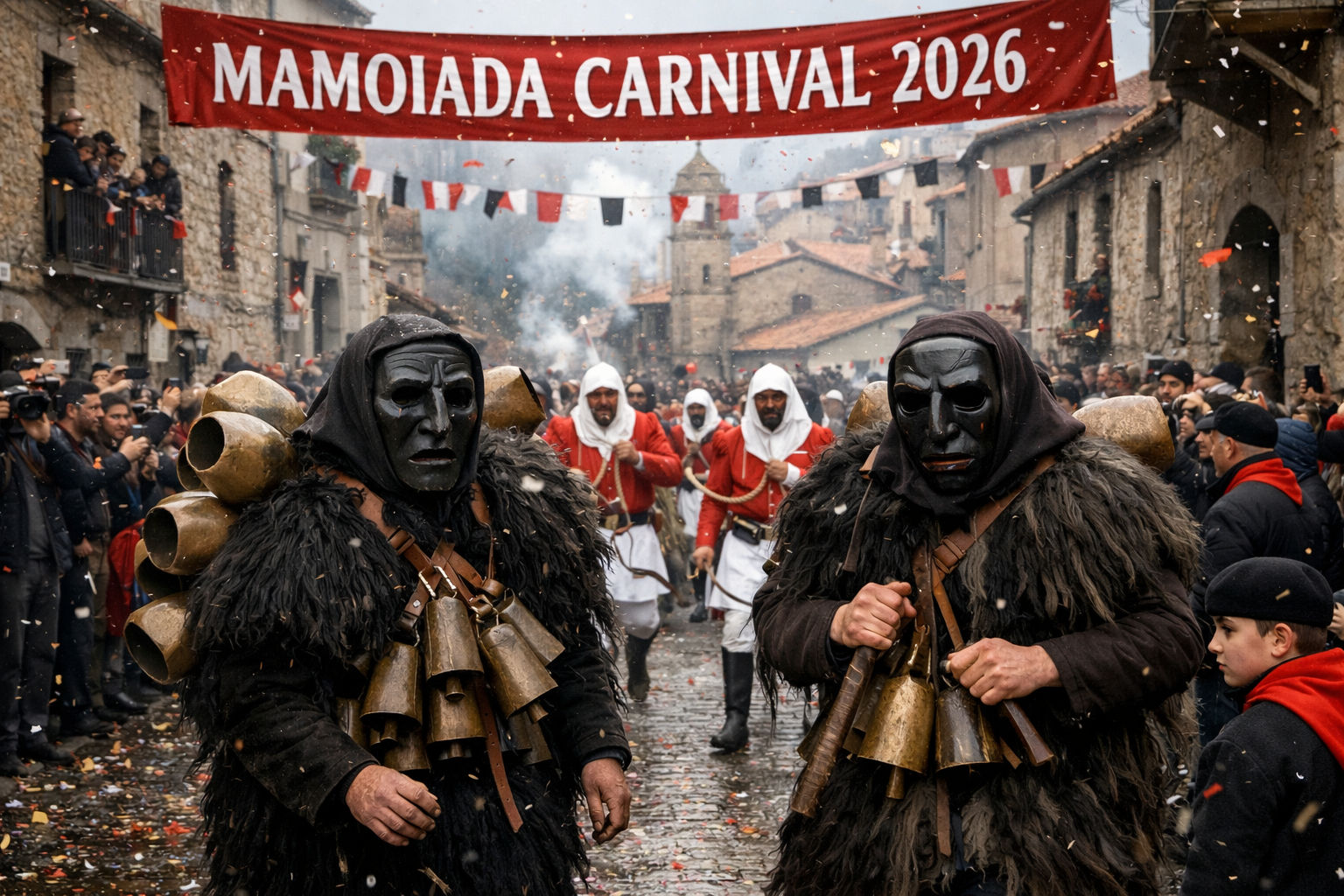
    Mamoiada Carnival 2026 in Sardinia is confirmed to include two key periods: the Sant’Antonio Abate bonfire nights on 16–17 January 2026 and the Carnevale Storico di Mamoiada dates on 15–16–17 February 2026 in the village of Mamoiada (Barbagia). This is one of the most powerful and visually unforgettable island Carnival traditions in Italy, centered on the ancient masked figures of the Mamuthones and Issohadores, whose silent, rhythmic procession is defined by heavy cowbells, carved wooden masks, and ritual movement.

    Mamoiada Carnival 2026 Sardinia: what it is

    Mamoiada Carnival is not a typical confetti-and-floats Carnival. It’s a ritual-rooted celebration in the heart of Sardinia, where the masked Mamuthones and Issohadores move through the streets in an ordered, almost hypnotic procession that locals treat as identity, heritage, and community pride. Mamoiada Turismo describes it as one of Sardinia’s most ancient traditional events, once little known beyond the region until the mid-20th century, later becoming famous thanks to these masks that are now a symbol for the entire island.

    For travelers, this is Sardinia at its most authentic. You’re not only watching a performance. You’re stepping into a living tradition where the village itself becomes the stage, and where local food, wine, and communal gatherings are part of the ritual experience.

    Confirmed 2026 dates and location

    Mamoiada Turismo explicitly lists “CARNEVALE STORICO DI MAMOIADA 2026” with:

    • 16–17 January 2026 for Sant’Antonio Abate.
    • 15–16–17 February 2026 for Carnevale.


    A separate Mamoiada.org page also confirms the 16–17 January 2026 Sant’Antoni “’e su ohu” dates, reinforcing the bonfire period as a key ritual start of the season. All events are located in Mamoiada, Sardinia, a village in the Barbagia region known for its deep cultural traditions and strong local identity.

    The Mamuthones and Issohadores: the heart of the Carnival

    The Mamuthones and Issohadores are the protagonists of Mamoiada’s Carnival, and understanding their roles makes the experience far more meaningful. Mamoiada Turismo describes how the procession becomes so intense that “the square stops” as the masks pass, with the defining sound being the campanacci (cowbells) that dominate everything else. Another Sardinia Carnival guide explains that Mamuthones wear black wool skins, carved masks, and carry almost 30 kg of cowbells, underlining how physically demanding and ritualized the role is.

    On the cultural side, Mamoiada Turismo links the festival’s social dimension to communal wine-sharing and older ritual concepts, describing the Carnival as both a moment of conviviality and a tradition that echoes ancient rites where disorder and celebration symbolically meet the sacred. For visitors, the respectful way to approach this is to observe quietly during the procession, then enjoy the village’s hospitality in the communal phases of the day.

    What happens during the January fires (Sant’Antonio Abate)

    Mamoiada’s Carnival season begins officially with Sant’Antonio Abate celebrations, when bonfires are lit and the Mamuthones and Issohadores make their first appearance for the year. Mamoiada Turismo confirms the 2026 Sant’Antonio Abate dates as 16–17 January 2026, framing this moment as the ritual opening of the broader Carnival season that continues for several weeks. Mamoiada.org also confirms these same dates, supporting the idea that mid-January is a core travel window if you want to witness the earliest, most symbolic appearance of the masks.

    If you’re planning a winter island trip to Sardinia focused on tradition rather than beaches, these January nights are a compelling reason to visit inland Barbagia.

    What to expect in February 2026 (Carnevale Storico)

    Mamoiada Turismo confirms the main Carnevale period for 2026 as 15–16–17 February 2026. While the site notes that the detailed program would be available later (“Il programma sarà disponibile…”), it also describes the classic structure of the celebration: processions culminating on Sunday and on Fat Tuesday (Martedì Grasso), plus village-wide participation through spontaneous masking and traditional costumes.

    A key atmosphere detail from Mamoiada Turismo is that during the procession everything becomes almost immobile, with movement limited to the Mamuthones and Issohadores and sound dominated by the bells. That “silence plus bells” contrast is one of the most memorable elements for first-time visitors, and it’s why Mamoiada feels less like a party and more like a ritual that happens to include celebration afterward.

    Food, wine, and the social side of the Carnival

    Mamoiada Turismo emphasizes that the Carnival is not only masks. It is also conviviality, union, and sharing, with typical Carnival sweets and local Cannonau wine offered as part of the festivities. The same page highlights wine as a long-standing ritual element in ceremonies and traditional festivals in Mamoiada, reinforcing that eating and drinking here is culturally meaningful, not just tourism.

    A practical travel tip: treat the food and wine offerings as a gift of hospitality. Enjoy it, but do so respectfully, especially around the solemn parts of the procession.

    Travel tips for visiting Mamoiada (Sardinia island planning)

    Mamoiada sits inland in Sardinia’s Barbagia region, so it’s best visited with a rental car or by arranging transport from larger hubs. Plan your timing carefully because the most important 2026 dates are concentrated around 16–17 January and 15–17 February.

    Suggestions for a smooth trip:

    • Arrive early on procession days to park outside the tight village core and walk in calmly.
    • Dress for winter inland Sardinia, which can be chilly, especially at night around bonfires.
    • Consider visiting the Museum of Mediterranean Masks in Mamoiada, which is highlighted as a unique place to understand the Mamuthones and Issohadores tradition in broader context.

    Pricing and what is (and is not) ticketed

    Mamoiada Turismo confirms the public festival character but does not list any paid admission requirement for attending the procession days. A separate Mamoiada Carnival guide explicitly states the event is free for all spectators, supporting the expectation that the street processions and village festivities are not ticketed.

    However, it’s important to separate the free festival from optional purchases. Mamoiada Turismo includes an online shop section offering Mamuthones and Issohadores mask items at listed euro prices, which are retail products, not event tickets. Budget primarily for transport, accommodation, meals, and optional museum entry or artisan purchases, rather than parade admission.

    Experience Mamoiada Carnival 2026 the right way

    Mamoiada Carnival 2026 is a rare chance to witness Sardinia’s ritual heritage in a living form, from the Sant’Antonio Abate fires on 16–17 January 2026 to the Carnevale Storico dates on 15–16–17 February 2026. Come ready to observe quietly when the bells begin, then join the village spirit afterward through food, wine, and the warmth of a community that carries its traditions proudly. If you want an island journey that feels deep, local, and unforgettable, Mamoiada in winter is waiting.

    Verified Information at glance

    Event Name: Carnevale Storico di Mamoiada (Mamoiada Carnival)

    Event Category: Traditional Carnival / folklore festival (ritual masks and processions)

    Island/Region: Sardinia, Italy (Barbagia)

    Confirmed Location: Mamoiada

    Confirmed Dates (Sant’Antonio Abate fires): 16–17 January 2026

    Confirmed Dates (Carnevale): 15–16–17 February 2026

    Key Figures (confirmed): Mamuthones and Issohadores

    Admission: Free for spectators (stated in a Mamoiada Carnival guide)

    Official program detail level: Full program stated to be released later (not fully published in the captured content

    Mamoiada (Nuoro province), Sardinia
    Feb 15, 2026 - Feb 17, 2026
    Trail del Marganai 2026
    Sport/Trail running
    TBA

    Trail del Marganai 2026

    Experience Trail del Marganai 2026: An Unforgettable Island Trail-Running Adventure

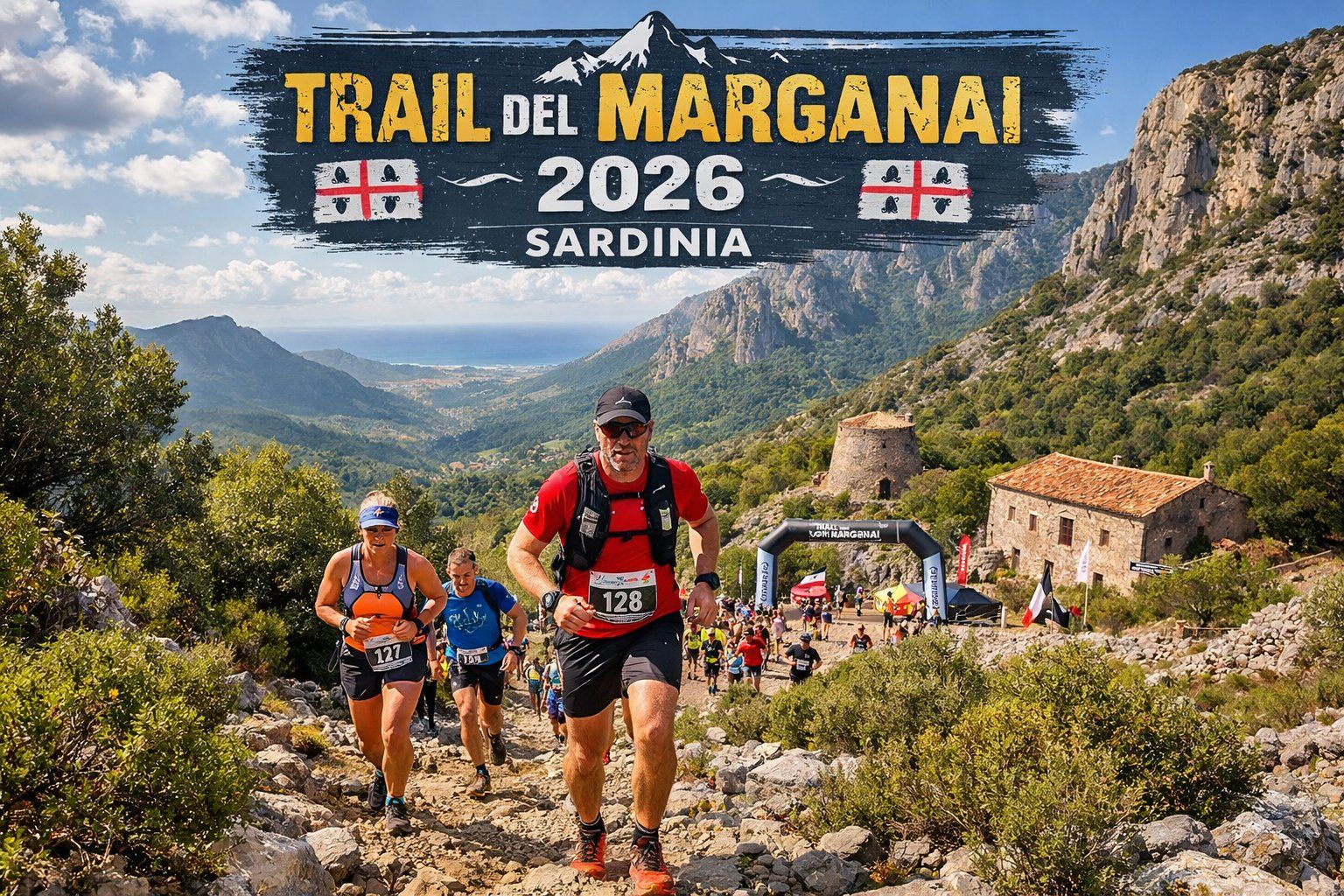
    Trail del Marganai 2026 is confirmed for March 14–15, 2026, set in southwest Sardinia. Races are hosted in and around Buggerru, with routes that traverse the Marganai forest and Sardinia’s extraordinary mining and archaeological landscapes. This is a true island trail-running experience where wild Mediterranean terrain, rich mining history, and breathtaking coastal mountain views converge into one unforgettable weekend.

    About Trail del Marganai 2026 in Sardinia

    Trail del Marganai is far from a typical “park trail” event. The official site describes it as trail running through ancient woods, intriguing archaeology, and significant mining history in the heart of the Marganai forest. With multiple race distances available, the event welcomes both seasoned ultra-runners and adventurous first-timers.

    This unique combination defines the event's identity: you're not just racing against the clock; you're running through layers of Sardinian heritage on a rugged island landscape shaped by both nature and industry.

    From a travel perspective, this race weekend offers a deeper immersion into Sardinia, showcasing more than just its beautiful beaches. While the coast is nearby, your miles will be earned in the island's interior terrain, where Sardinia’s quieter stories unfold.

    Verified Dates and Event Location: Buggerru, Sardinia

    Ahotu confirms Trail del Marganai 2026 for March 14–15, 2026 (Saturday to Sunday). The official Trail del Marganai site also reinforces these dates, highlighting it as a two-day weekend event rather than a single race morning. Multiple race listings identify Buggerru as the primary event location, and a Wedosport race leaflet page specifies Buggerru (SU) and details race start times across both days.

    For island travelers, Buggerru serves as a compelling base. It offers a charming, small-town Sardinian atmosphere, close to dramatic coastlines, while still providing easy access to the Marganai terrain that the race celebrates.

    Distances and Weekend Race Format (Confirmed)

    The official Trail del Marganai site advertises a weekend featuring multiple distances, including 100 km, 47 km, 25 km, and 17 km. All routes pass through the Marganai forest and its significant archaeological and mining heritage zones. Wedosport's leaflet further confirms a program that includes a 100K race on Saturday, with multiple distances, including a 47K and shorter trail races, scheduled for Sunday.

    This multi-distance structure makes it an excellent choice for a "group trip" event. One person can target an ultra-marathon while others opt for shorter challenges, all without missing out on the shared finish-line atmosphere and camaraderie.

    Registration Timeline and Participant Cap (Verified)

    The official registrations page confirms that registrations for Trail del Marganai 2026 open on November 3, 2025. Registration will close when the total number of participants reaches 500 or on March 6, 2026, whichever occurs first. This participant cap is important to note as the event can sell out, making early planning crucial, especially for those traveling from outside Sardinia.

    Entry Fees and Payment Deadline (Verified Examples)

    Pricing for Trail del Marganai varies by race distance and whether participants choose competitive or non-competitive categories. The official site provides at least one clearly verified fee example:

    • The official regulation page for the Trail del Marganai 2026 11 km Non-Competitive states a registration fee of 20 euros.
    • Payment for this category is due no later than March 6, 2026.

    If you are traveling with non-runners or newer runners, this shorter non-competitive option can be a welcoming way for everyone to participate in the lively island race weekend vibe.

    While the full regulations page available via the official site includes historical fee structures for earlier editions, it's best to rely only on the verified 2026 non-competitive 11 km fee mentioned above. For current fees for the 17K, 25K, 47K, and 100K races, please check the event’s registration portal directly.

    What Makes This Sardinia Trail Race Different: Mining Heritage and Caves

    Trail del Marganai distinguishes itself by treating the landscape as a layered story. The official site emphasizes “mining archaeology,” and the regulations detail an unusual and specific safety requirement: runners must carry a protective helmet to cross the Henry Mining Gallery after the initial kilometers.

    The regulations further state that athletes must use a light source when passing through “Galleria Henry,” confirming that parts of the course include tunnel or gallery passage rather than standard open trails.

    This is a rare feature in trail running and precisely what makes the race a uniquely Sardinian experience. It masterfully blends adventure travel with cultural landscape exploration in a way few island trail races can match.

    Race-Day Logistics: Safety Mindset and Kit Planning

    Trail del Marganai’s regulations underscore the importance of semi-autonomy and mountain readiness. They state that runners should be trained and capable of handling fatigue, sudden weather changes, and navigation challenges typical of mountainous environments. The regulations list several required safety items, including:

    • Windbreaker jacket
    • Survival blanket
    • Whistle
    • Mobile phone
    • Adequate water capacity

    It's important to note that random checks of mandatory material can occur both before and during the race. Even for experienced runners, this serves as a crucial reminder to approach the event as a serious mountain outing, not a simple road race, especially on an island where weather and terrain can change rapidly.

    Sardinia Travel Tips for a Trail del Marganai Weekend

    Given the event's location in southwest Sardinia, careful transport planning is advisable. Many travelers will opt to rent a car to reach Buggerru and to explore nearby coastal viewpoints and charming small villages after the race.

    Buggerru is also an excellent base for "recovery tourism," offering short beach walks, calm meals, and scenic drives that allow you to enjoy Sardinia without over-exhausting your legs.

    If you're extending your trip, consider staying an extra day or two. Sardinia truly rewards slow travel, and a race weekend provides the perfect excuse to experience the island beyond the classic summer beach season.

    Run Trail del Marganai 2026 in Sardinia!

    Trail del Marganai 2026 is confirmed for March 14–15, 2026, promising a powerful island trail-running weekend through the Marganai forest and Sardinia’s captivating mining and archaeological landscapes, with Buggerru serving as a central host location in the southwest.

    With a participant cap of 500 and registration closing by March 6, 2026 (or earlier if full), this event rewards early planning. If you seek a Sardinia trip that feels adventurous, deeply rooted in its location, and genuinely different from typical trail races, set your sights on Trail del Marganai. Come discover the island where history, forest paths, and bold running stories beautifully converge.

    Verified Information at a Glance

    • Event Name: Trail del Marganai 2026
    • Event Category: Trail running event / mountain trail races (multi-distance weekend)
    • Island/Region: Sardinia, Italy (southwest Sardinia)
    • Confirmed Dates (2026): March 14–15, 2026
    • Confirmed Host Location References: Buggerru (SU) listed on race leaflet sources
    • Distances (verified on official site): 100 km, 47 km, 25 km, 17 km
    • Registration Window (verified): Opens November 3, 2025; closes when participants reach 500 or on March 6, 2026, whichever comes first
    • Participant Cap (verified): 500 total participants
    • Verified Pricing (specific category): 11 km non-competitive registration fee is 20 euros; payment due by March 6, 2026
    • Unique Course Safety Note (verified): Regulations require a protective helmet to cross the Henry Mining Gallery and a light source for passing through the gallery
    Buggerru (SU) , Sardinia
    Mar 14, 2026 - Mar 15, 2026
    Sant’Efisio Festival (Cagliari) 2026
    Sport/Trail running
    Free

    Sant’Efisio Festival (Cagliari) 2026

    Sant’Efisio Festival 2026 in Sardinia: The Island Tradition That Stops Time

    Sant’Efisio Festival (Festa di Sant’Efisio) in Cagliari, Sardinia returns from May 1 to May 4, 2026, filling the island capital with one of the Mediterranean’s most moving religious and cultural processions. Over four days, thousands of participants in traditional Sardinian dress accompany the saint’s simulacrum from the historic Stampace district of Cagliari toward Nora, creating an unforgettable island journey of music, flowers, horses, and devotion.

    Sardinia has a strong identity that feels distinct from mainland Italy, and Sant’Efisio is one of the clearest expressions of that difference. For four days at the start of May, the streets of Cagliari become a living museum of Sardinian culture: embroidered costumes, gold filigree jewelry, decorated ox carts, and the haunting sound of launeddas (traditional woodwind instruments) echo through the city.

    For travelers, this is the kind of event that makes an island trip feel anchored in something real. You are not just sightseeing Roman ruins and beaches; you are witnessing a vow, repeated year after year, with the whole island watching.


    Key Dates and What They Mean for Your Trip

    The Sardegna Turismo (official tourism portal) states the Festival of Saint Ephysius is celebrated from May 1 to May 4. Multiple event listings for 2026 also specify Friday, May 1, 2026 through Monday, May 4, 2026, which matches the established annual pattern.

    If you want the biggest atmosphere in Cagliari, plan to arrive before May 1 and stay through at least May 2, because the opening procession day is when the city is most visually spectacular. If you want a deeper “follow the pilgrimage” feel, staying into May 3 and May 4 lets you experience the longer arc of the journey beyond the capital.


    The Story Behind Sant’Efisio: A Vow That Shaped Cagliari

    Many local summaries describe Sant’Efisio as a festival rooted in history and faith, associated with Cagliari’s devotion to its patron saint and a long-standing annual tradition. One Sardinia-focused explainer describes the festival as beginning on May 1 each year, with a procession that travels from Cagliari to Nora and back over four days.

    For visitors, understanding this “journey” aspect is important: this isn’t a single afternoon parade. It’s a moving event that connects city streets, coastal landscapes, and small towns on the route, which is why many Sardinians see it as a unifying island ritual.


    The Cagliari Highlight: Stampace, Petals, and the Great Procession

    Cagliari’s historic Stampace district is central to the festival’s identity, and the procession is widely described as starting from the church dedicated to Sant’Efisio in that neighborhood. You’ll want to be in Stampace early on May 1 to feel the build-up: bells, crowds, traditional groups assembling, and the first decorated carts rolling out.


    What You’ll See: Costumes, Carts, Horses, and “Is Goccius”

    Sardegna Turismo describes Cagliari being crossed by a procession of 2,500 people in traditional dress coming from all over Sardinia, followed by 270 horsemen, alongside devotional songs called is goccius and the sound of launeddas. Those numbers help explain why Sant’Efisio feels so grand: it’s not a small local pageant; it’s an island-scale cultural event with deep participation.

    A common visual symbol is the saint’s simulacrum transported on a richly decorated carriage, and accounts frequently mention the presence of flower-decorated carts and animals dressed for the occasion. Even if you’re not religious, the craftsmanship and pride on display is a masterclass in Sardinian tradition.


    The “Ramadura” Petal Tradition

    Many descriptions of the festival emphasize the flower-strewn streets and the way the route becomes a ceremonial path. As you follow the procession through Cagliari, the city itself feels transformed, with spectators leaning from balconies and streets turned into an island stage set for devotion and beauty.


    From Cagliari to Nora: The Island Pilgrimage Experience

    One of the most important travel-planning realities is that the festival is not confined to Cagliari. A Sardinian festival guide explains that the procession goes from Cagliari to Nora and back, marking a four-day journey.

    Nora is particularly significant because it’s a historic site near Pula, known for archaeological remains, and it’s also described in festival write-ups as the destination connected to the saint’s story and veneration. Following even part of the route gives you a richer Sardinia experience: you see how quickly the island shifts from urban Cagliari to open landscapes and coastal scenery.


    Cultural Atmosphere: What Makes Sant’Efisio Feel Uniquely Sardinian

    Sant’Efisio is often described as a powerful combination of religion, folk culture, and island identity. The traditional costumes alone are worth planning around, because groups arrive representing towns across Sardinia, bringing different colors, textiles, and jewelry styles.

    Sound is another defining element. Sardegna Turismo explicitly highlights launeddas and devotional singing as part of the festival’s atmosphere, and those sounds give the day a timeless feel that’s hard to find in more modernized events. If you want to experience “Sardinia beyond the beach,” this festival is one of the best possible entry points.


    Practical Travel Tips for Sant’Efisio Festival 2026

    Where to Stay in Cagliari

    For easy access on May 1, consider staying near central Cagliari or within walking distance of Stampace, since street closures and crowds can make driving inconvenient. Being able to walk also lets you shift viewpoints as the procession moves, instead of committing to one spot.


    Best Viewing Strategy

    • Arrive early on May 1 to see groups assemble and to secure a comfortable viewing position.
    • Choose a spot with open sightlines, since the procession includes carts, horses, and many participants.
    • Plan for slow movement: this is not a quick parade, and the best moments are often the unhurried ones.

    What to Wear and Bring

    Early May in Sardinia can feel warm in the sun and cooler in shade or evenings, so light layers help. Bring water, sunscreen, and a phone power bank, because you’ll likely spend hours outside. (Also, keep footwear comfortable since old-town streets can be uneven.)


    Pricing: What It Costs to Attend

    Sant’Efisio is fundamentally a public religious procession and street celebration, so the standard experience is typically free to watch from public spaces. Costs for travelers usually come from accommodation, transport (especially if following the route toward Pula and Nora), meals, and optional guided cultural experiences rather than entry tickets.

    If you want a premium view, the most common “paid upgrade” is booking accommodation with balconies on the route or choosing restaurant seating with procession sightlines, but those are optional comforts rather than required festival tickets.


    Verified Information at a Glance

    Event Name: Sant’Efisio Festival (Festival of Saint Ephysius / Festa di Sant’Efisio)

    Event Category: Religious and cultural festival with a major multi-day procession

    Confirmed Dates (Annual Festival Period): May 1 to May 4

    Confirmed 2026 Date Range: Friday, May 1, 2026 to Monday, May 4, 2026

    Main City: Cagliari (Sardinia), especially the historic district of Stampace

    Key Route Theme: Procession journeys from Cagliari toward Nora and back (four-day pilgrimage)

    Notable Participation Scale: About 2,500 people in traditional dress and 270 horsemen

    Traditional Cultural Elements: Launeddas music and is goccius devotional songs

    Pricing: Public procession viewing is generally free; main costs are travel logistics and optional upgrades


    • If you want to see Sardinia at its most authentic, plan to be in Cagliari for May 1, step into Stampace early, and follow the sound of launeddas through flower-strewn streets as the island’s most beloved procession begins, because Sant’Efisio is the kind of festival that makes you feel like you’re not just visiting Sardinia, you’re sharing it.
    Buggerru (SU) , Sardinia
    May 1, 2026 - May 4, 2026

    Past Events

    Maxim Vengerov Recital - Isaac Stern Memorial Concert 2026
    Music/Classical
    Free

    Maxim Vengerov Recital - Isaac Stern Memorial Concert 2026

    In January 2026, the island of Sardinia welcomes one of the world’s greatest violinists for a rare Mediterranean recital. Maxim Vengerov, celebrated for his powerful sound and deep musicality, is scheduled to perform in Cagliari at the Teatro Lirico on Saturday, January 24, 2026, from 7:00 PM to 9:00 PM. While the official Annual Isaac Stern Memorial Concert in 2026 takes place later that season at Carnegie Hall’s Stern Auditorium in New York, this Italian island recital carries the same spirit of honoring Stern’s legacy through uncompromising artistry and intimate chamber music. For music lovers and island travelers alike, the Maxim Vengerov Recital 2026 in Sardinia offers a unique chance to pair world‑class performance with the cultural richness of Cagliari and the wider Sardinian landscape.​

    Maxim Vengerov and the Isaac Stern Legacy

    Maxim Vengerov’s relationship to the Isaac Stern tradition runs through his leadership role in Carnegie Hall’s multi‑season Perspectives series, where he curates programs including the Annual Isaac Stern Memorial Concert in New York. The Stern Memorial concert is a flagship event at Carnegie Hall, designed to honor the legendary violinist and cultural ambassador Isaac Stern through performances by major artists who share his commitment to musical excellence and outreach.​

    In the 2025–2026 Carnegie Hall season, Vengerov’s Perspectives includes the 2026 Annual Isaac Stern Memorial Concert at Stern Auditorium / Perelman Stage. This positioning underscores how closely his artistry is now associated with Stern’s legacy of deep musical engagement and chamber collaboration. When Vengerov brings a recital program to Sardinia just weeks before his New York Stern Memorial appearance, audiences on the island can expect the same level of interpretive depth and technical command he brings to Carnegie’s most important commemorative stage.​

    Though the Cagliari event is billed simply as “Recital Italy” on Vengerov’s official schedule, its placement during this Perspectives season links it conceptually with his Stern Memorial work and makes it an attractive destination for fans who want to experience his 2026 programs in a more intimate, Mediterranean setting.​

    The 2026 Sardinia Recital: Date, Time, and Venue

    According to Maxim Vengerov’s official events calendar, the Sardinian recital details are:

    • Date: Saturday, January 24, 2026
    • Time: 7:00 PM to 9:00 PM (evening recital)
    • City: Cagliari, Sardinia, Italy
    • Venue: Teatro Lirico di Cagliari, Via Sant’Alenixedda, 09128 Cagliari​

    Teatro Lirico di Cagliari is the island’s principal opera house and symphonic venue, home to the Cagliari Opera and a hub for classical music on Sardinia. Its modern acoustics and generous stage provide an ideal setting for a violin‑piano recital, while its location just inland from the historic center makes it convenient for visitors staying in downtown Cagliari.​

    The 7 PM start time allows concertgoers to enjoy a relaxed pre‑performance aperitivo in Cagliari’s cafés or a leisurely post‑concert dinner in the Marina or Stampace neighborhoods, making the evening a complete cultural experience on the island.

    Program Style and Musical Expectations

    While the exact program for the Cagliari recital has not yet been fully published, Vengerov’s 2025–2026 Perspectives series at Carnegie Hall indicates the kind of repertoire he favors in this period. At Stern Auditorium, his recital programming features major sonatas by Shostakovich, Schubert, and Brahms, often in partnership with pianist Polina Osetinskaya.​

    In the Belgrade BEMUS Festival, for example, his recital program includes:

    • Shostakovich Violin Sonata
    • Schubert Violin Sonata No. 3
    • Brahms Violin Sonata No. 3
    • With Polina Osetinskaya at the piano​

    Given the close timing between the Italian recital and his New York Perspectives engagements, Sardinia audiences can reasonably expect a comparable mix of late‑Romantic and 20th‑century sonatas, with emphasis on:

    • Deep emotional narratives (Brahms and Shostakovich).
    • Lyrical Viennese charm (Schubert).
    • Virtuosic passages that highlight Vengerov’s legendary bow control and tonal range.

    These sonatas demand the exact qualities that made Isaac Stern’s own playing so admired: structural understanding, singing tone, and the ability to shape long lines with dramatic insight. Hearing them in Sardinia, within the context of Vengerov’s Stern‑linked season, gives the recital a memorial resonance even outside the official Carnegie Hall framework.

    Why Sardinia Is a Special Setting for a World‑Class Recital

    Cagliari, the capital of Sardinia, combines a rich cultural life with the relaxed atmosphere of an island city overlooking the Mediterranean. Attending the Maxim Vengerov Recital here offers an experience very different from hearing him in large metropolitan centers.

    • Historic neighborhoods: Castello, Villanova, Stampace, and Marina offer medieval streets, views over the Gulf of Cagliari, and traditional Sardinian restaurants within walking distance of Teatro Lirico.
    • Island character: Even in winter, Sardinia’s mild climate and slower rhythm create a distinct island feel. Visitors can explore archaeological sites like the Roman Amphitheatre or nearby Nuragic ruins during the day, then immerse themselves in high classical art at night.
    • Local audience: The crowd at Teatro Lirico will include Sardinians for whom this is a major cultural event of the season, creating a focused, appreciative listening environment that many touring artists treasure.

    Pairing a world‑class recital with Sardinia’s coastal light, seafood cuisine, and layered history makes this date particularly attractive for music travelers who prefer destinations off the typical mainland circuit.

    Practical Travel Tips for the 2026 Cagliari Recital

    Getting to Cagliari

    Cagliari Elmas Airport (CAG) connects Sardinia to major Italian and European hubs, with regular flights from cities like Rome, Milan, and Barcelona even in winter. From the airport, it is a short train or taxi ride to Cagliari city center and onward to hotels near the Marina, Via Roma, or the historic Castello district.

    Where to Stay

    For easy access to Teatro Lirico and Cagliari’s cultural sites, consider:

    • Marina / Via Roma: Close to the harbor, cafés, and restaurants, with straightforward routes up to the theatre.
    • Villanova: A quieter residential quarter with characteristic streets and proximity to both the center and the concert hall.
    • Castello: Perched above the city, offering panoramic views and a historic atmosphere, though with steeper walks back after the concert.

    Staying in central Cagliari means you can walk to the theatre and avoid parking challenges on recital night.

    What to Wear and Expect

    January evenings in Cagliari can be cool and occasionally rainy, so bring a warm coat and perhaps a scarf, though average temperatures remain milder than most of mainland Europe in winter. Teatro Lirico audiences typically favor smart casual to semi‑formal dress for international recital events, with many locals choosing elegant outfits for such a distinguished guest.

    Arrive at least 30 minutes before the 7 PM start time to find your seat comfortably, read the program notes, and absorb the atmosphere as the hall fills. Most recitals of this length include one intermission, offering time to stretch, discuss the first half, and enjoy a drink in the foyer.

    Tickets and Pricing

    Ticketing for the 2026 Maxim Vengerov Cagliari recital is managed via standard Italian concert channels and the artist’s own event links. While exact prices for Sardinia have not yet been posted in the international tour summaries, similar European recital events by Vengerov typically use tiered pricing based on seat category, with more affordable options in upper tiers and premium pricing for stalls and front rows.​

    To secure seats:

    • Monitor Maxim Vengerov’s official events page, where the Cagliari recital is already listed with date, time, and venue.​
    • Check Teatro Lirico di Cagliari’s box office or website closer to the event for local pricing and subscription options.
    • Consider booking early, as island audiences and mainland visitors may quickly fill the best sections for a star of Vengerov’s stature.

    Combining the Recital with a Sardinian Island Itinerary

    If you are traveling from abroad, attending the Maxim Vengerov Recital can anchor a broader exploration of Sardinia in winter. Consider:

    • Day trips from Cagliari: Visit Poetto Beach, the Molentargius wetlands with their winter flamingos, or archaeological sites around the city.
    • Extended island travel: Use the recital as the starting point for a multi‑day journey north toward Oristano, Alghero, or the rugged central mountains, experiencing Sardinian culture away from summer crowds.
    • Food and wine: Pair the concert with tastings of local Cannonau and Vermentino wines, traditional dishes like fregula with seafood, and Sardinian pecorino cheeses in city trattorias.

    This approach turns a single evening of high art into a full island experience, aligning with growing trends in cultural tourism that seek depth rather than speed.

    Why This 2026 Sardinia Recital Matters

    For Sardinia, hosting Maxim Vengerov at Teatro Lirico in January 2026 positions the island on the international classical calendar alongside major capitals. For Vengerov, it offers an opportunity to bring the same standard of performance associated with his Isaac Stern Memorial work at Carnegie Hall into a Mediterranean context, sharing his artistry with audiences who may rarely have access to such stars.

    For listeners, it is a chance to encounter a violinist whose career includes:

    • Grammy Award recognition and major international prizes.
    • Collaborations with leading orchestras and conductors around the world.
    • A multi‑season Perspectives series at Carnegie Hall, including the Annual Isaac Stern Memorial Concert.​

    Experiencing that level of artistry within the acoustics of Teatro Lirico and the embrace of Sardinia’s island culture is the kind of musical pilgrimage that lingers in memory long after the final applause.

    Mark Saturday, January 24, 2026 on your calendar. Plan your journey to Cagliari. Reserve your seat at Teatro Lirico and let Maxim Vengerov’s violin fill the hall as the Sardinian night settles over the city. Then step out into the island air, carrying the echoes of Brahms, Schubert, or Shostakovich through Cagliari’s streets.

    If you love both great music and distinctive island destinations, this is your invitation. Sardinia is ready. The stage is set. All that remains is for you to be there when the first note sounds.

    Verified Information at glance

    Event Category: Classical music / Violin‑piano recital / International concert tour​

    Event Name: Maxim Vengerov Recital – Italy (Cagliari, Sardinia)

    Linked Memorial Context: Part of Maxim Vengerov’s 2025–2026 Perspectives season at Carnegie Hall, which includes the Annual Isaac Stern Memorial Concert in New York​

    Island: Sardinia (Sardegna), Italy

    City: Cagliari

    Confirmed Date: Saturday, January 24, 2026​

    Time: 7:00 PM – 9:00 PM​

    Venue: Teatro Lirico di Cagliari, Via Sant’Alenixedda, 09128 Cagliari, Sardinia, Italy​

    Artist: Maxim Vengerov, violin​

    Season Context: Part of Vengerov’s international tour schedule for 2025–2026, which includes European dates and major Carnegie Hall appearances​

    Carnegie Hall Link: Perspectives series at Stern Auditorium / Perelman Stage featuring Maxim Vengerov and the Annual Isaac Stern Memorial Concert in 2026​

    Program Style (in season): Major violin sonatas by Shostakovich, Schubert, and Brahms, often with pianist Polina Osetinskaya​

    Ticketing: To be sold via artist event links and Teatro Lirico box office; pricing tiers based on seat category (exact 2026 Cagliari prices not yet posted in tour summaries)​

    Typical Dress Code: Smart casual to semi‑formal for evening recitals at major Italian theatres

    Travel Notes:

    • Cagliari Elmas Airport (CAG) connects Sardinia to mainland Europe year‑round.
    • Teatro Lirico located near Cagliari’s central districts, accessible by taxi, bus, or on foot from many hotels.


    Teatro Lirico, Via Sant'Alenixedda, Cagliari, Sardinia
    Jan 24, 2026 - Jan 24, 2026
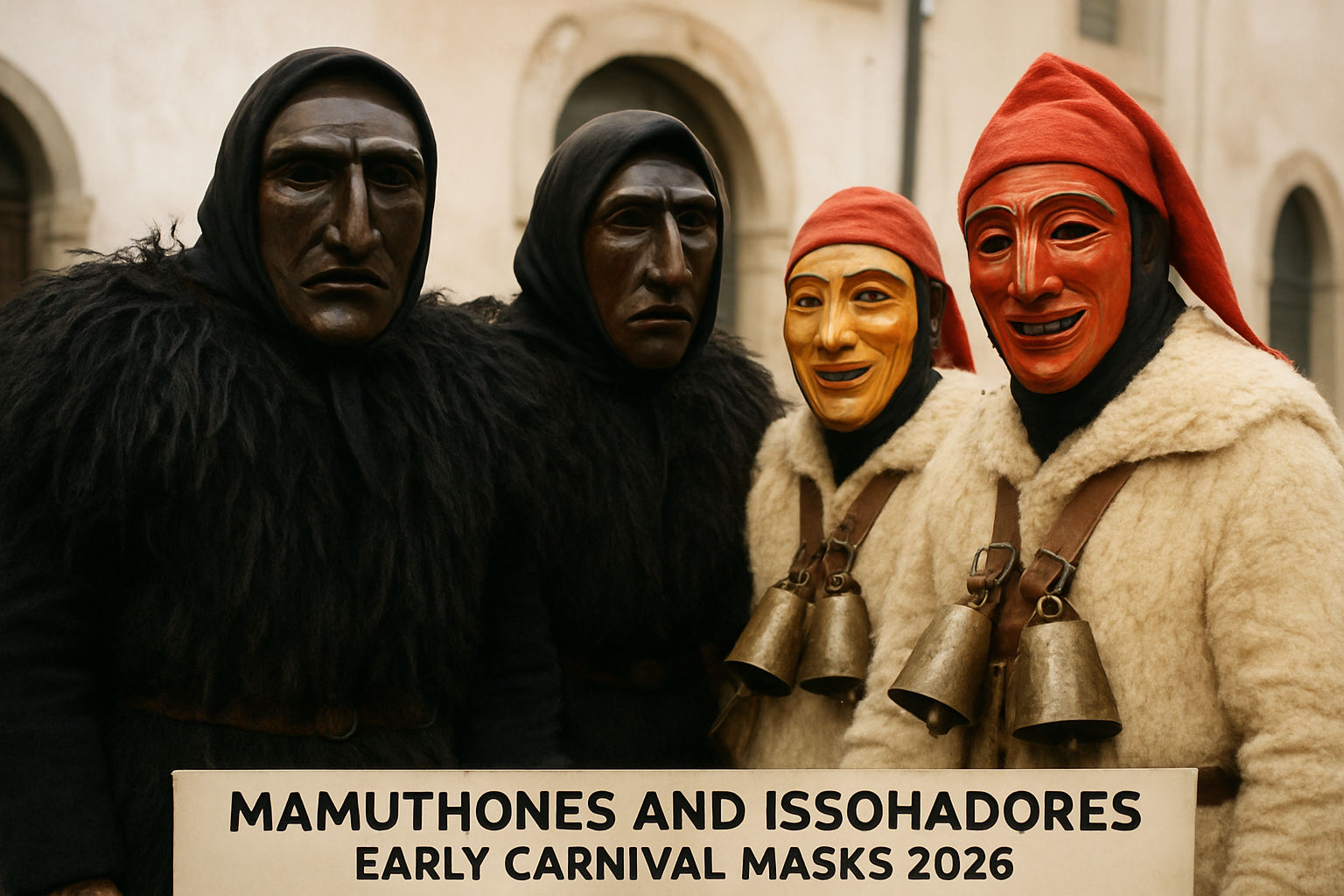
    Mamuthones and Issohadores - Early Carnival Masks 2026
    Cultural/Folklore
    Free

    Mamuthones and Issohadores - Early Carnival Masks 2026

    On a cold January night in the mountains of Barbagia, in the village of Mamoiada, Sardinia’s most haunting Carnival masks come to life. The Mamuthones, bent under the weight of 30 kilograms of bells and black sheepskins, move in a slow, rhythmic march, while the brightly dressed Issohadores leap and lasso spectators in a choreography that feels half pagan rite, half living theatre. In 2026, these early Carnival figures will once again open Sardinia’s Apokreo season with appearances for Sant’Antonio Abate on 16–17 January and then return on Carnival Sunday and Shrove Tuesday in February. For island travelers, witnessing Mamuthones and Issohadores in their home village is one of the most powerful cultural experiences in the Mediterranean.​

    Origins of Mamuthones and Issohadores in Mamoiada

    The masked figures of Mamuthones and Issohadores belong specifically to Mamoiada, a village in the Barbagia region of central Sardinia. Their exact origins are lost in the mists of time. Some scholars trace the ritual back to the Nuragic age as a propitiatory ceremony for crops and protection from evil spirits, others see echoes of Dionysian rites, and still others connect it to later Christian processions.​

    What is undisputed is that this ceremony has been performed for centuries, possibly for around 2,000 years, as a pre‑Christian masquerade later absorbed into the Christian calendar. Today’s Mamuthones and Issohadores embody the layered history of the island, blending pagan symbolism, rural memory, and Christian feast days into a single, deeply felt ritual.​

    Key 2026 Dates: Early Carnival in Mamoiada

    The Mamuthones and Issohadores do not appear only on Carnival weekend. Their first outing each year coincides with the Feast of Sant’Antonio Abate (Saint Anthony the Great), the protector of animals and fire.​

    For 2026, visitors can plan around:

    • Night of 16–17 January 2026: First appearance of Mamuthones and Issohadores during the bonfires of Sant’Antonio Abate, marking the symbolic start of Carnival season in Mamoiada.​
    • Carnival Sunday 2026: Afternoon and evening procession through Mamoiada’s streets as part of Sardinia’s wider Apokreo celebrations.​
    • Shrove Tuesday 2026: Final major parade of the season in Mamoiada, closing the Carnival period for these masks.​

    These dates sit slightly ahead of the main Italian and Greek Carnival peaks and make Mamoiada’s ritual one of the earliest and most distinctive Carnival events in the Mediterranean.

    The Look of the Masks: Dark Mamuthones, Bright Issohadores

    The two masks always appear together and form a single living tableau, but their appearance and roles are dramatically different.

    Mamuthones: The Burdened, Ancestral Figures

    Mamuthones are the dark, heavy figures that tend to capture most visitors’ imagination. They wear:

    • A black wooden mask carved from fig, elm, chestnut, or walnut and blackened to create a ghostly presence.​
    • Black sheepskins that cover the body, giving them a beast‑like silhouette.​
    • On their backs, a cluster of large copper or iron cowbells called “sa carriga,” weighing around 30 kilograms, strapped in layers.​

    Their faces are expressionless and often menacing, their posture slightly bent from the bells’ weight. With every synchronized step, the bells crash in unison, creating a deep, metallic roar that vibrates through the narrow village streets. Many interpretations see the Mamuthones as ancestral spirits, old men of the village, or symbolic animals tied to agriculture and pastoral life.​

    Issohadores: Rope Carriers and Guardians

    The Issohadores, by contrast, are bright, agile figures who bring movement and color to the procession. They typically wear:

    • White mask or sometimes no mask, depending on the tradition of the group.
    • Red bodice (curittu) over a white shirt and white trousers.
    • A black embroidered shawl at the hips and coarse wool gaiters (cartzas).​
    • A leather bandolier of small bronze bells (sonajolos) across the chest.​
    • A rope lasso called “soha,” from which their name Issohadores, “rope carriers,” is derived.​

    Their role is to guard and “command” the Mamuthones, keeping them in formation and setting the rhythm of their dance. They move lightly around the group, at times breaking off to lasso spectators in the crowd, traditionally choosing women or respected community members as a symbolic gesture of good fortune, fertility, and social prestige.​

    Symbolism and Possible Meanings

    Interpretations of Mamuthones and Issohadores are numerous, reflecting the ritual’s ancient roots and shifting historical layers. Some of the main theories suggest that:

    • The masks represent a propitiatory rite for good harvests and protection from evil forces in a harsh mountain environment.​
    • The Mamuthones may symbolize subjugated animals or even defeated enemies, while Issohadores represent their masters or victors, dramatizing the relationship between humans, nature, and power.​
    • Another reading places them in a social context: Mamuthones as old men of the village or agricultural workers, Issohadores as younger men guiding and honoring them as they “retire” from physical labor.​
    • Some scholars have suggested political interpretations, with Mamuthones embodying oppressed Sardinian peasants and Issohadores evoking foreign or Spanish rulers, though this is debated.​

    Modern Sardinian cultural writers often emphasize a broader symbolic frame: the dance of Mamuthones and Issohadores stages an eternal clash and reconciliation between darkness and light, winter and spring, death and rebirth, with the end of the ritual affirming continuity and hope for the new agricultural year.​

    The Procession: Sound, Movement, and Choreography

    Watching Mamuthones and Issohadores in motion is very different from seeing their photographs. The procession follows a strict choreographic structure:

    • Mamuthones advance in two parallel lines of six or more, heads slightly bowed, moving slowly and in perfect synchrony, each heavy step making the cowbells thunder as one.​
    • Issohadores walk and dart around them, keeping time, adjusting formations, and occasionally giving the signal for the Mamuthones to perform a specific turn or jump so their bells crash in a precise pattern.​

    The result is a kind of living drum ensemble. The sound reverberates through Mamoiada’s stone houses and narrow streets, creating an atmosphere that many visitors describe as both unsettling and mesmerizing. Children often watch half‑afraid, half‑fascinated, while adults respond with a mix of pride and reverence, recognizing the ritual as a cornerstone of their identity.​

    When Issohadores lasso someone from the crowd with their soha, it is considered an honor, not an aggression. Traditionally, those “captured” offer a drink in return, turning the act into a playful exchange of hospitality and good wishes.​

    Dressing Ceremony: The Private Heart of the Ritual

    Behind the public parade lies a more intimate moment that visitors rarely see: the dressing of the Mamuthones and Issohadores. Photographers and writers who have documented this backstage ritual describe it as a private, almost sacred process taking several hours, where:

    • Each Mamuthone is helped into layers of leather, sheepskin, and finally the heavy set of bells.
    • Straps are tightened to distribute the weight across the back and shoulders, turning each man into a living instrument.​
    • The leaders run a final rehearsal without masks in a courtyard, ensuring the group’s steps and bell rhythms are perfectly synchronized before facing the public.​

    Only when they are deemed ready do the performers put on their black masks and leave the yard to become Mamuthones in full, no longer just individual villagers but part of a collective ancestral entity. For locals, this transformation is the emotional core of the ritual, symbolizing connection to those who performed the same dance generations before.​

    Practical Travel Tips for Experiencing Mamuthones and Issohadores in 2026

    Getting to Mamoiada

    Mamoiada lies in central Sardinia, in the province of Nuoro, roughly:

    • 15–20 km from Nuoro city (about 20–30 minutes by car).
    • 2–2.5 hours’ drive from Cagliari or Olbia, depending on route and conditions.

    Renting a car is the most convenient way to reach the village, especially in winter when public transport is limited. Roads into Barbagia are winding but scenic, passing through rugged hills and traditional rural landscapes.

    When to Go

    For the full early Carnival experience in 2026, plan around:

    • 16–17 January 2026 (Sant’Antonio Abate): Evening bonfires, first entrance of Mamuthones and Issohadores for the year, strong local participation.
    • Carnival Sunday and Shrove Tuesday (February 2026): Afternoon and evening parades as part of Sardinia’s broader Carnival calendar.​

    Arriving by early afternoon on parade days allows time to park, explore the village, visit local bars or the Museum of Mediterranean Masks (if open), and secure a good vantage point along the streets.

    What to Expect and How to Behave

    • The event is free, with no ticketed access to the streets or public spaces.
    • Crowds can be dense in key squares and narrow alleys, so wear comfortable shoes and warm clothing suitable for standing outside in January or February evenings.
    • Respect the performers’ space; do not block their route or interfere with the bells and ropes.
    • If an Issohadore lassos you, take it as an honor and enjoy the playful moment. Local custom suggests offering a drink or at least a smile and a handshake in return.​

    Photography is generally tolerated, but be discreet during more intimate parts of the ritual, and always ask before taking close portraits of individuals without masks.

    Combining with Other Sardinian Carnival Masks

    If you are exploring Carnival across Sardinia, Mamuthones and Issohadores in Mamoiada can anchor a route that also includes:

    • Boes and Merdules in Ottana.
    • Thurpos in Orotelli.
    • Other Barbagia villages with unique pagan‑Christian Carnival masks.​

    Each community’s masks express different aspects of Sardinian identity, but Mamoiada’s figures are among the most iconic and internationally recognized.

    Why Early Carnival in Sardinia Belongs on Your 2026 Island Itinerary

    Experiencing Mamuthones and Issohadores in 2026 reveals Sardinia as much more than a summer beach destination. In the cold months, away from crowded coasts, the island’s inner mountains preserve rituals that predate modern tourism and even Christianity. In Mamoiada, Carnival Season begins not with glitter and floats but with fire, bells, and ancient rhythms that speak to humanity’s oldest concerns: survival, renewal, and the balance between darkness and light.

    If you are planning an island‑focused year of travel, make space in your calendar for mid‑January or Carnival 2026 in Sardinia. Stand in Mamoiada’s streets as the first Mamuthone turns a corner, bells roaring, black mask glinting in the firelight. Watch Issohadores leap and lasso, guiding the line of masked figures through the village as they have for centuries.

    Let this early Carnival mark the start of your own year of journeys. Sardinia’s mountains are calling, the bells are ready to sound, and the Mamuthones and Issohadores will soon step into the streets again. Will you be there when they do?

    Verified Information at glance

    Event Category: Traditional Carnival ritual / Early Carnival masks / Cultural and folkloric parade​

    Event Name: Mamuthones and Issohadores – Early Carnival Masks of Mamoiada

    Island / Region: Sardinia (Sardegna), Barbagia region, village of Mamoiada​

    Core 2026 Dates:

    • First annual appearance: Night between 16 and 17 January 2026 during Sant’Antonio Abate bonfires​
    • Further appearances: Carnival Sunday and Shrove Tuesday in February 2026 (exact civil dates follow the 2026 Carnival calendar)​

    Location of Ritual: Streets and squares of Mamoiada, Nuoro province, central Sardinia​

    Mamuthones Costume Details:

    • Black wooden mask from fig, elm, chestnut, or walnut, blackened for ghostly effect​
    • Black sheepskin garments covering body​
    • 30+ kg of large copper or iron bells (“sa carriga”) strapped on the back​

    Issohadores Costume Details:

    • White mask (in many variants), red bodice (curittu), white shirt and trousers​
    • Embroidered shawl at hips, wool gaiters (cartzas), bandolier of bronze bells (sonajolos)​
    • Rope lasso called soha used to “catch” spectators​

    Symbolism:

    • Linked to pre‑Christian or Nuragic propitiatory rites, Dionysian cults, and later Christian practice​
    • Embody ancestral spirits, rural life, conflict between dark/old and light/young, or mythic struggle between good and evil​

    Procession Structure:

    • Mamuthones march in two lines at slow, synchronized pace, bells sounding with each step​
    • Issohadores move around them, controlling rhythm, guarding group, lassoing chosen spectators as a sign of good fortune​

    Dressing Ritual:

    • Multi‑hour private ceremony where performers are dressed in sheepskins and heavy bells before donning masks and entering streets​

    Access and Pricing:

    • Public parades and village events are free; no ticket required to watch in streets​

    Travel Notes:

    • Mamoiada located in Nuoro province, roughly 20–30 minutes by car from Nuoro and around 2–2.5 hours from Cagliari or Olbia​
    • Best reached by rental car due to limited winter public transport in Barbagia region.


    Mamoiada, Ottana, Orotelli, Orani, Gavoi, Sarule, Sardinia
    Jan 16, 2026 - Jan 17, 2026
    Sant'Antonio Abate Festival 2026
    Religious, Traditional
    Free

    Sant'Antonio Abate Festival 2026

    Experience the most mystical and ancient celebration in Sardinia as the Sant'Antonio Abate Festival 2026 transforms the island into a spectacular display of sacred fire and carnival magic on January 16-17, 2026. This profound religious and cultural festival marks the beginning of Sardinian Carnival season, featuring legendary bonfires, mysterious masked processions, and ancient rituals that connect visitors to over 2,000 years of island heritage in villages throughout this enchanting Mediterranean paradise.

    The Sacred Legend of Sant'Antonio Abate: The Fire Saint

    The Christian Prometheus of Sardinian Tradition

    Sant'Antonio Abate (Saint Anthony the Abbot), known throughout Sardinia as "Sant'Antoni 'e su fogu" (Saint Anthony of Fire), holds legendary status as the "Christian Prometheus" who descended into the underworld to steal fire from Lucifer. According to ancient Sardinian tradition, this 4th-century Egyptian hermit captured the sacred flame using his ferula stick (a herbaceous plant that blackens but doesn't burn when touched by fire) and gifted it to humanity, enabling people to survive harsh winter conditions.

    This powerful legend explains why Sant'Antonio Abate serves as the patron saint of animals, farmers, and countryside communities throughout Sardinia, where his feast day represents one of the island's most deeply felt religious celebrations. The saint's connection to fire, agriculture, and animal protection resonates profoundly with Sardinian communities whose livelihoods have depended on these elements for millennia.

    The Patron Saint of Animals and Farmers

    January 17th traditionally brings the blessing of animals throughout Sardinia, where pets and livestock receive divine protection for the coming year. According to ancient Italian folklore, animals gain the ability to speak on the night of Sant'Antonio Abate, making this a magical time when the natural and supernatural worlds interconnect.

    This tradition reflects Sant'Antonio's role as protector of domestic animals, stemming from his association with the Antonians monastic order who raised pigs to produce medicinal fat for treating skin diseases. The saint's iconography consistently features a pig companion, symbolizing his deep connection to animal husbandry and rural life.

    The Sacred Fire Rituals: Su Pesperu and Ancient Customs

    The Evening of January 16th: Su Pesperu Preparation

    "Su Pesperu" (The Vespers) on January 16, 2026 marks the beginning of sacred fire preparations throughout Sardinian villages. Communities gather to construct massive bonfires using carefully selected wood, creating imposing structures that often reach eight meters in height and thirty meters in width. This collective effort involves entire villages working together to transport materials, often using traditional oxen-drawn carts accompanied by Launeddas music (ancient triple-pipe wind instruments).

    The ritual preparation involves hollowing out ancient oak trunks called "sa tuva" in Gallura region, where these sacred containers are believed to host spirits that judge human actions. Laurel branches are inserted into holes of cut branches for both symbolic purposes and practical fire-lighting assistance.

    The Sacred Fire Lighting Ceremony

    Evening of January 17, 2026 brings the solemn blessing and lighting of bonfires conducted by local priests who lead processions through village streets. The ceremony begins with three clockwise laps around the fire followed by three counterclockwise circuits, symbolizing purification and protection while driving away evil spirits.

    After the priest blesses the wood with holy water and recites prayers, the fire is lit using specially prepared torches, transforming village squares into sacred spaces illuminated by dancing flames. Participants make three additional laps around the blazing bonfire, offering silent prayers for protection and prosperity throughout the coming year.

    Mamoiada: The Epicenter of Mysterious Carnival Traditions

    The First Release of Mamuthones and Issohadores

    Mamoiada hosts the most spectacular Sant'Antonio Abate celebration, where the legendary Mamuthones and Issohadores make their first annual appearance on the night of January 16-17, 2026. These mysterious masked figures represent 2,000-year-old pre-Christian traditions that have evolved into one of Europe's most authentic and powerful carnival rituals.

    Mamuthones wear black wooden masks with suffering expressions, dark sheepskin costumes, and carry heavy belts of cowbells (sa carriga) that create rhythmic soundscapes as they move through village streets. Their silent, curved procession under the weight of bronze bells creates haunting atmospheres that connect participants to ancient agricultural and pastoral rituals.

    The Solemn Dressing Ceremony

    The ritualistic dressing of Mamuthones requires two assistants and follows sacred protocols passed down through generations. Twelve Mamuthones parade together, symbolically representing the months of the year, while eight Issohadores provide guidance and protection. This precise organization reflects deep symbolic meaning connected to seasonal cycles and cosmic order.

    Issohadores wear white anthropomorphic masks, red jackets (curittu), white shirts and trousers, and carry brass rattles while wielding special ropes called "sa soha". Their agile movements and rope-throwing skills create interactive elements that engage spectators in the ancient ritual.

    Traditional Foods and Culinary Celebrations

    Sacred Breads and Ritual Sweets

    Sant'Antonio Abate festivities feature distinctive ritual breads and traditional sweets that carry deep symbolic meaning. "Su pane de saba" (bread made with grape must) receives special blessing during fire ceremonies and is shared among participants with glasses of Cannonau wine. "Sas rughittas" (cross-shaped breads) symbolize divine protection, while "su capidu e s'annu" (oval breads with twelve holes) represent the months of the year.

    Traditional Sardinian sweets including "su popassinu nigheddu," "sas caschettas," "su popassinu biancu," and "su coccone 'in mele" are prepared specifically for festival celebrations. These artisanal delicacies showcase centuries-old recipes that connect contemporary celebrations to ancestral culinary traditions.

    Pabassinas: The Festival's Signature Treats

    Pabassinas (also called Papassini) represent the festival's most iconic sweets, featuring diamond-shaped cookies with white icing and colorful sprinkles. These traditional treats combine sultana raisins, walnuts, almonds, anise flavoring, and sweet wine in recipes that require 60 minutes preparation and 50 minutes baking time.

    Originally prepared for All Saints' Day celebrations, these 320-calorie delicacies have become essential elements of Sant'Antonio festivities throughout Sardinia. The white royal icing and decorative sprinkles create visually appealing treats that complement the festival's joyful community atmosphere.

    Village Celebrations Across Sardinia

    Fonni: The Mountain Celebration

    Fonni presents one of Sardinia's most atmospheric Sant'Antonio celebrations, where "su pispiru" (vespers) culminates with a massive bonfire in Piazza Santa Croce. Following the priest's three blessed laps around the fire, traditional masks S'Urthu and Sos Buttudos perform dramatic battles between good and evil. The celebration combines sacred blessing of bread with wine sharing while traditional characters animate the evening with folkloric performances.

    Multiple Village Festivities

    January 16, 2026 brings simultaneous celebrations in Limpiddu (Via Taro, Church Square), San Gavino/Solità (Via Tucconi/Via Montanaru), Tanaunella (Via Telamone, Centro Culturale Valerio Zucchitta), Agrustos (Via Colombo), and Berruiles (Via Nazionale/Via San Francesco). Each location features bonfire blessing, traditional sweet tasting, and community dining accompanied by music and storytelling about ancient customs.

    Saturday, January 18, 2026 continues celebrations in Birgalavò hamlet, extending the festival period and providing additional opportunities for cultural immersion.

    The Cultural Significance of Sa Soha Rope Throwing

    Ancient Fertility and Fortune Rituals

    Issohadores' rope-throwing ceremony using "sa soha" represents one of Sardinia's most distinctive cultural traditions. These exceptionally lightweight ropes made from special materials require considerable skill to maneuver, making successful captures demonstrations of dexterity and prowess. Issohadores typically target women and girls, symbolically bestowing good fortune and fertility blessings on chosen participants.

    Captured individuals must offer drinks to their captors to gain release, creating social interactions that strengthen community bonds while honoring ancient customs. This playful ritual transforms sacred ceremonies into joyful community celebrations that welcome visitor participation.

    The Silent Mamuthones and Talkative Issohadores

    The contrast between silent Mamuthones and communicative Issohadores creates powerful symbolic dynamics representing different aspects of human nature. Mamuthones maintain complete silence throughout processions, their presence conveying solemnity and connection to ancestral spirits. Issohadores engage in constant dialogue with spectators, joking and creating festive atmospheres that balance sacred and celebratory elements.

    Regional Variations and Local Customs

    Different Bonfire Traditions Across Sardinia

    Sardinian fire traditions use various regional names that reflect linguistic diversity: "Sas tuvas" in Oristano area, "Sos focos" in Nuorese region, "Sas frascas" in Ogliastra, "Su romasinu" in Dorgali, and "Is foghidonis" in Sadali and Sant'Andrea Frius. Each region maintains distinctive construction methods and ritual elements that preserve local cultural identity.

    Gallura's "sa tuva" tradition uses hollow centuries-old oak trunks believed to host judging spirits, while other areas create elaborate wooden structures using community-donated materials. These variations demonstrate how fundamental traditions adapt to local resources and beliefs while maintaining core spiritual significance.

    Planning Your Sant'Antonio Abate Experience

    Festival Schedule and Timing

    January 16, 2026 features afternoon bonfire preparation (4:00 PM onward) followed by evening Su Pesperu ceremonies beginning around 6:00 PM. January 17, 2026 includes morning masses, animal blessings, and evening fire lighting ceremonies starting at 7:00 PM. Celebrations continue until late night with community dining, traditional music, and folk performances.

    Mamoiada's Mamuthones first release typically occurs after midnight on January 17th, creating magical nighttime processions around village bonfires. This timing provides opportunities for photography and cultural immersion under starlit Sardinian skies.

    Transportation and Accessibility

    Mamoiada sits in Sardinia's central Barbagia region, approximately 45 minutes from Nuoro and accessible by car via well-maintained mountain roads. Public transportation connects major cities to Nuoro, with local buses providing access to Mamoiada and other festival villages.

    Multiple celebration sites throughout Sardinia ensure visitors can experience Sant'Antonio traditions regardless of accommodation location, with Fonni, Ottana, and Sadali offering alternative venues for those seeking authentic cultural experiences.

    Accommodation and Local Services

    Early booking proves essential for January accommodations, as Sant'Antonio Abate attracts visitors from throughout Europe seeking authentic Sardinian cultural experiences. Agriturismo establishments throughout Barbagia provide traditional hospitality while hotels in Nuoro offer urban conveniences with easy access to festival villages.

    Local restaurants prepare special Sant'Antonio menus featuring traditional foods, while village celebrations include community dining where visitors can taste authentic Sardinian specialties alongside local families.

    The Spiritual and Cultural Legacy

    Ancient Purification and Protection Rituals

    Sant'Antonio Abate Festival represents thousands of years of purification and protection rituals that connect contemporary Sardinians to their pre-Christian ancestors. The fire's healing and regenerating power transcends religious boundaries, incorporating pagan beliefs alongside Christian spirituality. These celebrations serve as living heritage where ancient customs continue strengthening community bonds while welcoming international visitors.

    The Beginning of Carnival Season

    January 17th officially launches Sardinian Carnival season, making Sant'Antonio Abate the gateway to months of mask festivals throughout the island. The appearance of Mamuthones, Issohadores, Boes, Merdules, and other traditional masks creates anticipation for upcoming carnival celebrations that continue through Ash Wednesday.

    This timing connects winter fire festivals to spring renewal celebrations, demonstrating how Sardinian traditions create continuous cultural narratives that span entire seasonal cycles.

    Witness the most mystical and ancient celebration in the Mediterranean by joining the Sant'Antonio Abate Festival 2026 in Sardinia's mountain villages. From sacred fire ceremonies and mysterious masked processions to traditional sweet tastings and community blessings, this extraordinary festival offers authentic cultural immersion that connects visitors to over 2,000 years of island heritage. Experience the magic of dancing flames illuminating ancient masks while participating in rituals that have remained unchanged for millennia, creating memories that capture the true soul of Sardinian tradition and community spirit.

    Verified Information at a Glance

    Event: Sant'Antonio Abate Festival 2026 Sardinia

    Main Dates: January 16-17, 2026

    Saint's Feast Day: Friday, January 17, 2026

    Su Pesperu: Thursday, January 16, 2026 (preparation evening)

    Extended Celebrations: Through January 18, 2026 (Birgalavò hamlet)

    Primary Locations:

    Mamoiada: Mamuthones & Issohadores first release, bonfires around village

    Fonni: Piazza Santa Croce bonfire, S'Urthu and Sos Buttudos masks

    Multiple Villages: Limpiddu, San Gavino, Tanaunella, Agrustos, Berruiles

    January 16 Schedule:

    • 4:00 PM: Bonfire preparation begins
    • 6:00 PM: Su Pesperu ceremonies start
    • Evening: Community wood gathering, cart processions

    January 17 Schedule:

    • Morning: Holy masses and animal blessings
    • 7:00 PM: Fire lighting ceremonies
    • After midnight: First Mamuthones release (Mamoiada)

    Cultural Elements:

    • Sacred fire rituals: Three clockwise/counterclockwise laps
    • Traditional masks: Mamuthones (silent), Issohadores (rope throwers)
    • Sa Soha ceremony: Rope throwing for good fortune
    • Ritual foods: Pabassinas, ritual breads, Cannonau wine

    Regional Fire Names:

    • Sas tuvas (Oristano), Sos focos (Nuorese), Sas frascas (Ogliastra)

    Transportation: Central Barbagia location, 45 minutes from Nuoro

    Entry: Free public celebrations, community participation welcome

    Significance: Beginning of Sardinian Carnival season, 2000-year-old traditions


    Villages island-wide (notably Mamoiada, Ottana), Sardinia
    Jan 16, 2026 - Jan 17, 2026
    Epiphany (Befana) 2026
    Holiday/Cultural
    Free

    Epiphany (Befana) 2026

    On Tuesday, January 6, 2026, Sardinia closes its Christmas season with one of Italy’s most beloved winter holidays: Epiphany, known locally as Sa pasca nuntza and across the country as La Befana. As in the rest of Italy, Epiphany in Sardinia marks the visit of the Magi to the infant Jesus and the last day of the festive season, but here it also carries distinctive island flavors, combining the national folklore of the Befana “good witch” with Sardinian sweets, village customs, and family gatherings. For travelers, Epiphany (Befana) 2026 offers a unique chance to experience winter life on the island beyond summer beaches and coastal resorts.​

    What Epiphany (Befana) Means in Italy and Sardinia

    Epiphany is a major Christian feast commemorating the revelation of Christ to the Gentiles through the visit of the Three Wise Men, celebrated in Italy on January 6 as a national public holiday. In the Italian calendar, it officially ends the Christmas period that begins with the Immaculate Conception on December 8, giving rise to the saying “L’Epifania tutte le feste porta via” – Epiphany takes all the holidays away.​

    In popular culture, the religious Epiphany is intertwined with the folklore of La Befana, a witch‑like old woman who brings gifts and sweets to children on the night of January 5, leaving treats in stockings for the good and coal for the naughty. She travels house to house, much like Santa, but arrives on Epiphany Eve rather than Christmas Eve.​

    On Sardinia, Epiphany is both Epifania and Befana, but island traditions give the figure a slightly different nuance. Travel writers note that “according to Sardinian tradition, the Befana, a Santa‑like figure, visits children to leave them sweets if they have been good (or coal if they have not been so good), and it is common to see special events for children on this date”. The holiday is known locally as Sa pasca nuntza, the “wedding feast” or “feast of announcement,” reflecting older Sardinian names for Epiphany that emphasize completion and transition.​

    Epiphany 2026: A National Holiday on January 6

    For 2026, holiday calendars confirm:

    • Date: Epiphany 2026 in Italy falls on Tuesday, January 6, 2026.​
    • Holiday Type: National public holiday (Epifania / La Befana) across Italy, including Sardinia.​

    This means schools, public offices, and many businesses on the island will be closed, while city centers and villages host children’s events, church services, and family gatherings. It also marks the last day of Christmas decorations and markets in many Sardinian towns, after which daily life gradually returns to its non‑festive rhythm.​

    Sardinian Befana Traditions: Sweets, Coal, and Children’s Events

    While large urban spectacles like Venice’s Befana Regatta or Rome’s Piazza Navona flights get national attention, Sardinia celebrates Epiphany in a more intimate, community‑oriented way. The core customs remain centered on children:​

    • On the night of January 5, Sardinian children hang stockings or leave small shoes out, hoping the Befana will fill them with sweets, chocolate, and tangerines if they have behaved, or dark sugar “coal” if they have misbehaved.​
    • Families often tell stories of the Befana as a kind, slightly scruffy old woman who travels the island, visiting houses and village squares to check on children and close the holidays with a smile.

    Contemporary travel descriptions highlight that in Sardinia “special events for children” are common on Epiphany, with local councils and cultural associations organizing performances, games, and gift distributions to make the day memorable. In many towns, a woman dressed as the Befana appears in the main piazza, often arriving in a humorous or acrobatic way before handing out candy and small presents.​

    Cagliari’s Acrobatic Befana

    National tourism sources single out Cagliari, Sardinia’s capital, as hosting one of the island’s most anticipated Epiphany events. According to VisitItaly’s Epiphany guide, “in Sardinia, the most anticipated celebration is in Cagliari. Befana is eagerly awaited by children all over Italy, but the one in Cagliari has a peculiarity: she is a particularly fit old lady. The delivery of gifts takes place in a super acrobatic way: the Befana will use skates to please the little ones. There is also a show on stilts and a descent from the flying trapeze”.​

    This description suggests that for Epiphany 2026, families in Cagliari can expect:

    • A Befana figure arriving on roller skates in a central square.
    • Street performances, stilt walkers, and circus‑style aerial descent.
    • Public hand‑outs of sweets and small gifts to children.

    For island visitors based in Cagliari, checking the municipality’s event listings in late December 2025 and early January 2026 will provide exact locations and times.

    Sa pasca nuntza: Epiphany in Sardinian Culture

    Sardinian cultural sources emphasize that Epiphany, Sa pasca nuntza, has long been a significant festival on the island, not only for children but also as a marker in the rural calendar. Traditionally, it signaled:​

    • The official end of Christmas and New Year festivities.
    • A moment to look ahead to the agricultural cycle and the coming Carnival (Apokreo) season.
    • A time for blessings, family visits, and modest feasts before winter’s leaner months.

    Older Sardinian customs included village‑level rituals, carols, and door‑to‑door visits reminiscent of Befana songs in other Italian regions, though many of these practices have faded or been absorbed into modern children’s events. Still, the phrase Sa pasca nuntza survives in local parlance, connecting contemporary celebrations to island history.​

    Church Services and Religious Observance

    While the Befana folklore dominates children’s imaginations, Epiphany remains a liturgical feast in the Catholic Church. Across Sardinia, parishes celebrate Mass on January 6, commemorating the visit of the Magi and the revelation of Christ to the nations.​

    In Cagliari and other major towns such as Sassari and Nuoro, you can expect:

    • Morning or late‑morning solemn Masses in cathedral churches.
    • Children attending with families, sometimes bringing symbolic gifts or offerings.
    • Nativity scenes still in place, often with the Magi figurines finally placed near the manger on this day.

    Visitors who want to experience the religious side of Epiphany (Befana) 2026 in Sardinia can attend a parish Mass, dress modestly, and follow local customs of standing, kneeling, and silence during liturgy.

    What to Do on Epiphany 2026 in Sardinia

    Morning: Join a Local Mass and Walk the Historic Centers

    Start your Epiphany in a city like Cagliari, Alghero, Oristano, or a smaller coastal town. Attend an Epiphany Mass in a central church, then stroll through the historic center while decorations are still up. January light on Sardinia can be crisp and bright, and the streets are quieter than in summer, with more locals than tourists.

    In Cagliari, you might:

    • Visit the Cathedral of Santa Maria in Castello after Mass.
    • Walk down to Via Roma and the Marina district for coffee and a pastry.
    • Watch families heading toward the main square where afternoon Befana events will unfold.

    Afternoon: Follow the Befana

    Midday or early afternoon often brings children’s Epiphany shows. In Cagliari, look for the acrobatic Befana on skates and stilts described by national tourism guides. In smaller towns and villages, local cultural associations may:​

    • Stage small plays or puppet shows about the Befana.
    • Organize face‑painting, games, and candy distribution in community halls or piazzas.
    • Invite a Befana character to “fly in” from a balcony or descend via rope, echoing mainland traditions where firefighters or climbers assist.​

    Check local event calendars and municipal websites in late December to find exact schedules for Epiphany 2026 events in your chosen Sardinian area.

    Evening: Family Dinners and Sweet Farewell to Christmas

    Epiphany evening tends to be quieter, as families gather at home for the last festive meal of the season. Typical Sardinian treats may include:

    • Local pastries and Christmas biscuits left over from the holidays.
    • Regional panettone or pandoro variants.
    • Hot chocolate or liqueurs served to adults as stockings are checked and stories told.

    As a visitor, you can book dinner in a trattoria or agriturismo that stays open on holidays, savoring dishes such as malloreddus alla campidanese (Sardinian pasta with sausage and tomato sauce) or roasted meats, paired with Cannonau or Vermentino wines. This slow, convivial evening is the perfect way to say goodbye to the Christmas lights before they come down.

    Travel Tips for Epiphany (Befana) 2026 in Sardinia

    Weather and Packing

    January in Sardinia is winter, though milder than much of mainland Europe. Expect:

    • Daytime temperatures often between 8 and 14°C on the coasts, colder inland.
    • Possible rain and wind, especially in Cagliari and along the western shores.

    Pack layers, a waterproof jacket, and comfortable shoes for walking cobbled city streets and village alleys. Bring something warm for evening children’s events, which may be outdoors.

    Transport and Public Services

    Because Epiphany is a national holiday, public transport runs on limited schedules, and some shops close or reduce hours. Plan:​

    • Airport transfers or intercity trains/buses ahead of time.
    • Grocery shopping on January 5 if you are staying in a self‑catering apartment.
    • Museum visits either side of the holiday, as some cultural sites may close on January 6.

    Tourist infrastructure in large cities like Cagliari generally stays functional, but small town services can be more restricted.

    Where to Base Yourself

    For an Epiphany‑focused trip, consider:

    • Cagliari: Best choice for larger‑scale Befana performances, children’s shows, and a lively urban atmosphere.​
    • Alghero or Sassari: Offer charming old towns and likely local Befana events, plus access to coastal scenery.
    • Rural or inland villages: Provide more intimate experiences of Sardinian family life, though you may need a car and Italian language skills to fully navigate local customs.

    Why Epiphany (Befana) 2026 Belongs on Your Sardinian Calendar

    Choosing Sardinia for Epiphany (Befana) 2026 allows you to experience the island at its most authentic. There are no cruise ship crowds, no August heat, just a mix of soft winter light, local families enjoying a day off, and children’s laughter as they chase a witch on skates through a Cagliari square.

    You will see how a national Italian tradition — La Befana — takes on island shape through Sa pasca nuntza, blending Catholic feast, folklore, and Sardinian hospitality. You will taste seasonal sweets, hear stories of coal and candy, and, if you wish, stand in church as the Magi approach the nativity scene one last time.​

    Mark Tuesday, January 6, 2026, in your travel plans. Book a few winter days in Cagliari or another Sardinian town. Let Epiphany (Befana) 2026 be your introduction to Sardinia’s quieter, deeper side — an island where even the closing of the holidays carries magic, community, and the promise of new beginnings.

    Verified Information at glance

    Event Category: Religious and folkloric holiday / Family and children’s festival / National public holiday

    Event Name: Epiphany (Epifania / La Befana, locally Sa pasca nuntza) 2026 – Sardinia

    Island / Country: Sardinia (Sardegna), Italy

    Confirmed Date: Tuesday, January 6, 2026​

    Holiday Type: National public holiday in Italy (Epiphany)​

    Religious Meaning:

    • Commemorates visit of the Magi to baby Jesus and revelation of Christ to the Gentiles​
    • Marks end of the Christmas period in Italy​

    Befana Tradition (Italy‑wide and Sardinia):

    • La Befana, a witch‑like old woman, brings sweets and small gifts to good children and coal to naughty ones on the night of January 5​
    • According to Sardinian tradition, the Befana (a Santa‑like figure) visits children with sweets or coal, and special events for children are common on this date​

    Sardinia‑Specific Note:

    • Epiphany in Sardinia also known as Sa pasca nuntza, an ancient festival marking the day that “takes all holidays away”​

    Highlight Event in Sardinia:

    • In Cagliari, Epiphany Befana celebration described as featuring an acrobatic Befana who arrives on skates, with a show on stilts and a flying trapeze descent, handing out gifts to children​

    Typical Activities:

    • Children hang stockings or leave shoes for Befana on January 5​
    • Morning Epiphany Mass in churches, including cathedrals​
    • Afternoon children’s shows, Befana appearances, and candy distribution in town squares​
    • Families share final festive meals in the evening, closing Christmas season​

    Weather / Travel Notes (January Italy):

    • Winter conditions, with cool temperatures and possible rain; layering recommended​
    • Holiday schedules may reduce public transport and shop opening hours on January 6


    Island-wide, Sardinia, Sardinia
    Jan 6, 2026 - Jan 6, 2026
    Capodanno Sardo (Sardinian New Year) 2026
    Holiday, Traditional
    Free

    Capodanno Sardo (Sardinian New Year) 2026

    Experience the fascinating world of Capodanno Sardo (Sardinian New Year) 2026, where the ancient traditions of this Mediterranean island create multiple meaningful celebrations throughout the year. From the traditional Cabudanni in September marking the agricultural new year to the modern Capodanno festivities on December 31st, Sardinia offers visitors unique opportunities to witness authentic island culture that blends millennia-old customs with contemporary celebrations.

    The Ancient Origins of Sardinian New Year Traditions

    Cabudanni: September's Agricultural New Year

    The traditional Sardinian New Year, known as "Cabudanni" (from Latin "caput anni" meaning "head of the year"), historically occurred in September rather than January, reflecting the island's deep agricultural heritage. This ancient timing aligned with the Byzantine calendar and the agro-pastoral cycle that governed Sardinian life for millennia, marking the end of harvest season and the beginning of new agricultural activities.

    September in Sardinian dialect is still called "Cabudanni" today, preserving this connection to ancient traditions even as modern celebrations have shifted to December. This linguistic preservation demonstrates how deeply rooted these customs remain in Sardinian cultural identity, connecting contemporary islanders to their ancestral heritage.

    The Sacred Agricultural Calendar

    The September new year coincided with the completion of the grape harvest (vendemmia) and other crucial agricultural activities that defined the island's economic and social rhythms. Santa Vittoria di Serri, an ancient Nuragic sanctuary, celebrated its patron saint during this agricultural season, demonstrating the continuity between pre-Christian and Christian celebrations.

    This timing reflected the agro-pastoral communities' life cycles, when marriages were sanctioned, events celebrated, and the most important phases of community life took place during the abundant months of May through September.

    Sa Die de Sa Sardigna: April 28th, 2026

    The Sardinian People's Day Celebration

    April 28, 2026 marks Sa Die de Sa Sardigna (Sardinian People's Day), celebrating the 1794 uprising against Savoy rule that represents a defining moment in Sardinian identity and resistance. This regional holiday, officially recognized since 1993, combines historical commemoration with cultural celebration throughout the island.

    Cagliari, Alghero, and Bono serve as the three capitals for this celebration, with special events including readings, music, torchlight processions, and flash mobs that honor the memory of the Sardinian uprising. The day emphasizes Sardinian autonomy, cultural identity, and the ongoing aspiration for self-determination.

    Educational and Cultural Programming

    Sa Die de Sa Sardigna 2026 includes comprehensive educational initiatives where school children are welcomed into the Regional Council for official celebrations. Piazza del Carmine hosts evening celebrations from 8:00 PM featuring readings and music by Andrea Porcu, Claudia Aru, Franca Masu, and Andrea Andrillo.

    The celebration serves as "a day of the Sardinian people" that emphasizes the importance of making Sa Die de Sa Sardigna walk on the legs and heads of our boys and girls, ensuring cultural transmission to new generations.

    Modern Capodanno Celebrations: December 31, 2025 - January 1, 2026

    Island-Wide New Year Festivities

    December 31, 2025 brings spectacular modern Capodanno celebrations across Sardinia, with major cities hosting world-class concerts and festivities under the regional theme "New Year's Eve 2025 in Sardinia, a whole other music!". Seventeen municipalities participate in this coordinated celebration that combines international artists with breathtaking Sardinian scenery.

    Cagliari's New Year celebration features Stewart Copeland, founder of The Police, performing with a 29-piece orchestra at Largo Carlo Felice. The city transforms into a festival zone with celebrations in four main squares: Largo Carlo Felice, Piazza San Giacomo, Piazza Garibaldi, and Piazza Santa Croce.

    Premier Entertainment Across the Island

    Major Sardinian cities host spectacular New Year's events including Le Vibrazioni in Iglesias, Giusy Ferreri in Nuoro, and Max Gazzè in Dorgali. Alghero celebrates the 29th edition of "Cap d'Any" with historic DJs Albertino, Fargetta, Molella, and Prezioso performing on December 30th.

    Olbia features Pinguini Tattici Nucleari at Molo Brin, while Castelsardo and Sassari provide additional entertainment options that showcase both international talent and local Sardinian culture.

    Traditional Sardinian New Year Customs and Rituals

    Cenone di Capodanno: The Great Feast

    New Year's Eve dinner (Cenone di Capodanno) represents the centerpiece of Sardinian celebrations, featuring traditional dishes that symbolize abundance and prosperity. Sardinian families gather for lavish dinners featuring specialties like porceddu (roasted suckling pig) and malloreddus (Sardinian pasta), creating meals that honor both Italian traditions and distinctive island flavors.

    Lentils (lenticchie) play crucial symbolic roles, representing wealth and prosperity due to their coin-like appearance. These legumes are paired with cotechino or zampone (rich pork sausages) that symbolize abundance and indulgence perfect for welcoming the new year.

    Midnight Traditions and Community Celebrations

    Sardinian New Year customs include the symbolic smashing of old pottery at midnight, representing the casting away of the old year and welcoming the new. Families step outside to listen to chiming church bells while participating in this ancient ritual that connects contemporary celebrations to centuries-old customs.

    Fireworks displays illuminate the Mediterranean night sky above Sardinian cities, creating spectacular visual celebrations that complement the island's dramatic coastal landscapes.

    Regional Celebrations and Local Variations

    Ancient Winter Customs: Is Candeberis and Su Candelarzu

    Traditional Sardinian New Year celebrations include ancient customs like "de su Candelarzu" in Nuoro and "Is Candeberis" in northern regions. Children gather in groups on December 31st carrying white pillowcases (sacchettas) to collect offerings including chestnuts, dried figs, almonds, and traditional ritual breads.

    Traditional breads include "sas rughittas" (cross-shaped), "su capidu e s'annu" (oval with twelve holes symbolizing months), and "s'accheddu" (spiral bread sticks) that represent good fortune and renewal. These customs preserve pre-Christian agricultural traditions while incorporating Catholic symbolism.

    Loguodoro's Ritual Bread Traditions

    Loguodoro region maintains unique "cabude" bread traditions with pre-Christian origins dating to the September agricultural new year. These ritual breads prepared with sourdough, semolina, salt, and water feature different shapes according to recipients' crafts and occupations, preserving ancient community connections.

    Wheat preparation begins December 31st morning, with grain cleaned and soaked for twelve hours before evening boiling. New Year's morning features communal breakfast where everyone partakes of cooked wheat with warm sheep's milk to ensure prosperous coming year.

    Contemporary Cultural Festivals and Events

    Autumn in Barbagia: September Harvest Celebrations

    September 2026 brings Autunno in Barbagia (Autumn in Barbagia), a series of festivals held in different villages throughout the Barbagia region. These celebrations provide glimpses into traditional Sardinian life with ancient crafts, homemade delicacies, and folk performances passed down through generations.

    Grape harvest celebrations (vendemmia) occur throughout September, allowing visitors to participate in harvesting and learn winemaking processes from vine to bottle. These festivals create festive atmospheres with traditional music, dancing, and abundant local wine.

    Traditional Wedding Celebrations

    Antico Sposalizio Selargino takes place each September in Selargius, where ancient wedding ceremonies are reenacted with couples in traditional costumes participating in age-old rituals. This festival celebrates Sardinian culture through vibrant community processions that offer authentic cultural experiences for visitors.

    Planning Your Sardinian New Year Experience

    December 31st Celebration Schedule

    New Year's Eve programming follows identical formats across celebration squares with diffuse music (9:00 PM), live concerts (10:30 PM), midnight countdown and toast (11:55 PM), closing performances (12:15 AM), DJ sets (12:20 AM), and final conclusion (1:30 AM).

    January 1, 2026 continues celebrations with Anima e Cuore puppet shows by Is Mascareddas in Piazza Garibaldi at 5:00 PM, providing family-friendly entertainment that bridges traditional and contemporary culture.

    Transportation and Accommodation

    Early booking proves essential for New Year's period accommodation, as Sardinian cities attract visitors from throughout Europe seeking Mediterranean holiday experiences. Major cities offer diverse lodging options from historic center luxury hotels to family-friendly establishments in surrounding neighborhoods.

    Public transportation connects celebration venues while walking remains preferred for navigating between festival locations in historic city centers. Free parking areas operate during festival periods, though early arrival is recommended due to high visitor volumes.

    Cultural Etiquette and Participation

    Visitors are welcomed to participate in public celebrations and traditional customs including community meals and midnight rituals. Learning basic Sardinian greetings and understanding symbolic food significance enhances cultural engagement while demonstrating respect for local traditions.

    Traditional costume appreciation and participation in communal activities like bread sharing and midnight pottery breaking provide authentic cultural immersion opportunities.

    The Cultural Significance of Multiple New Years

    Living Heritage and Community Identity

    Sardinia's multiple New Year celebrations demonstrate how the island successfully preserves ancient traditions while embracing contemporary culture. The coexistence of September Cabudanni, April Sa Die de Sa Sardigna, and December Capodanno reflects the complex layers of Sardinian identity that include Nuragic, Byzantine, Italian, and modern Mediterranean influences.

    These celebrations serve as "living heritage" where centuries-old customs continue strengthening community bonds while welcoming international visitors to experience authentic Sardinian culture. Each celebration emphasizes different aspects of island identity: agricultural heritage (September), political autonomy (April), and contemporary community (December).

    Preserving Island Traditions for Future Generations

    Educational programming associated with these celebrations ensures cultural transmission to new generations while adapting traditions to contemporary expectations. School participation in Sa Die de Sa Sardigna and family involvement in traditional New Year customs create comprehensive cultural experiences that appeal to diverse audiences.

    Experience the rich tapestry of Sardinian culture by participating in Capodanno Sardo 2026, where ancient agricultural traditions meet modern Mediterranean celebrations. From September's harvest festivals honoring the traditional Cabudanni to April's Sa Die de Sa Sardigna commemorating island identity, and culminating in spectacular December 31st festivities featuring world-class entertainment, Sardinia offers unparalleled opportunities to witness living cultural heritage. Join locals in traditional bread-sharing ceremonies, participate in midnight pottery-breaking rituals, and enjoy spectacular fireworks over pristine Mediterranean coastlines while discovering why Sardinian New Year celebrations represent some of Europe's most authentic and meaningful cultural experiences.

    Verified Information at a Glance

    Capodanno Sardo (Sardinian New Year) 2026 Key Dates:

    Traditional Cabudanni: September 2026 (agricultural new year, harvest festivals)

    Sa Die de Sa Sardigna: Tuesday, April 28, 2026 (Sardinian People's Day)

    Modern Capodanno: December 31, 2025 - January 1, 2026 (contemporary New Year)

    December 31, 2025 Major Events:

    • Cagliari: Stewart Copeland & 29-piece orchestra at Largo Carlo Felice (10:30 PM)
    • Alghero: "Cap d'Any" 29th edition with historic DJs (December 30th)
    • Nuoro: Giusy Ferreri concert in Piazza Vittorio Emanuele (10:00 PM)
    • Iglesias: Le Vibrazioni concert in Piazza Sella (10:00 PM)
    • Dorgali: Max Gazzè with Jazz Orchestra of Sardinia (11:00 PM)

    Traditional Elements:

    • Cenone di Capodanno: Traditional feast with lentils, porceddu, malloreddus
    • Su Candelarzu: Children's offerings tradition in Nuoro
    • Cabude bread: Ritual breads in Loguodoro region
    • Pottery breaking: Midnight ritual for casting away old year

    September Celebrations:

    • Autunno in Barbagia: Village festivals throughout Barbagia region
    • Vendemmia: Grape harvest celebrations island-wide
    • Antico Sposalizio Selargino: Traditional wedding reenactment in Selargius

    Cultural Significance: Agricultural heritage, political autonomy, community identity

    Entry: Most public celebrations free admission

    Languages: Italian, Sardinian (traditional events often bilingual)


    Various villages (notably Tonara, Aritzo), Sardinia
    Dec 31, 2025 - Jan 1, 2026
    Christmas Markets Cagliari 2025
    Market, Holiday
    Free

    Christmas Markets Cagliari 2025

    Experience the enchanting blend of ancient traditions and Mediterranean warmth at the Christmas Markets Cagliari 2025, where Italy's captivating island of Sardinia transforms into a festive wonderland from November 29, 2025, through January 6, 2026. This beloved 12-day Christmas celebration brings together authentic Sardinian crafts, traditional island cuisine, and holiday magic in the historic heart of Cagliari's cobblestone streets and sun-kissed piazzas.

    The Unique Charm of Sardinian Christmas Traditions

    Mediterranean Christmas Under Palm Trees

    Cagliari's Christmas Markets offer a distinctly unique holiday experience where festive traditions are enjoyed under the glow of palm trees strung with lights and the crisp sea breeze carries the scent of citrus and myrtle. This Mediterranean setting creates an extraordinary Christmas atmosphere where visitors can enjoy warm coastal air carrying citrus scents while exploring traditional holiday markets in comfortable December temperatures averaging 15°C (59°F).

    The island's Christmas celebrations beautifully blend Italian holiday customs with Sardinia's proud and ancient cultural heritage, incorporating unique island crafts and traditions that merge ancient Nuragic, Catalan, and Italian holiday customs. This fusion creates an authentic experience that cannot be found anywhere else in Italy.

    Sardinia's 12-Day Christmas Celebration

    Following traditional Italian Christmas customs, Cagliari's Christmas fair lasts for 12 magical days, attracting visitors from across Europe who come to experience this vibrant showcase of Sardinian identity. The extended celebration period allows visitors ample time to explore the markets while enjoying the island's unique blend of local food, wine, toys, and handmade crafts.

    Prime Market Locations in Historic Cagliari

    Piazza Yenne: The Heart of Christmas Magic

    Piazza Yenne serves as the primary hub for Cagliari's Christmas celebrations, featuring approximately 40 wooden stalls arranged in charming Christmas village formations. This historic square transforms into a magical winter wonderland with traditional wooden huts populated with handmade products, gift ideas, decorations, and opportunities to taste excellent flavors typical of this season.

    The square comes alive with entertainment featuring jugglers, street artists, choir performances, creating festive atmospheres that blend seamlessly with the cobbled streets and squares lit up with bright decorations.

    Corso Vittorio Emanuele II: Shopping and Cultural Immersion

    Corso Vittorio Emanuele II, Cagliari's main shopping thoroughfare, extends the Christmas market experience with additional stalls and festive decorations. This elegant street provides perfect settings for leisurely strolls between market vendors while enjoying views of traditional Sardinian architecture adorned with holiday lights and decorations.

    The combination of historic architecture and festive market stalls creates Instagram-worthy backdrops where visitors can capture the essence of Mediterranean Christmas celebrations.

    Piazza del Carmine: Traditional Crafts Center

    Piazza del Carmine rounds out the trio of primary market locations, focusing on authentic Sardinian handicrafts and traditional products. This charming square provides intimate settings where visitors can interact directly with local artisans while discovering unique island crafts that cannot be found anywhere else.

    Authentic Sardinian Christmas Specialties and Cuisine

    Traditional Pabassinas: Island Christmas Cookies

    No visit to Cagliari's Christmas markets is complete without tasting Pabassinas, Sardinia's distinctive Christmas cookies that combine nuts, raisins, and honey in a spiced shortbread format. These traditional treats are often decorated with white glaze, making them visually appealing and symbolically festive while representing centuries of island baking traditions.

    Pabassinas hold deep cultural significance, originally made to commemorate ancestors during Is Animas (All Saints' Day) and later becoming essential Christmas treats throughout the island. Market visitors can watch local bakers prepare these treats using traditional methods while learning about their cultural importance.

    Malloreddus: Sardinia's Golden Pasta

    Malloreddus, known as "gnochetti Sardi" throughout Italy, represents Sardinia's signature pasta shape and appears frequently in Christmas market food stalls. These small, ridged shells are traditionally colored with precious saffron, creating golden hues and exotic aromas that reflect Sardinia's historical spice trade connections.

    Market food vendors serve Malloreddus alla Campidanese with traditional sauce made with tomatoes, Sardinian sausage, and more saffron, creating harmony of flavors that represents centuries of culinary evolution.

    Seadas and Traditional Sweets

    Seadas, Sardinia's unique Christmas dessert, combines savory cheese with sweet honey in a fried pastry format. Made with fresh pecorino cheese and drizzled with local honey, these treats represent perfect balance between sweet and savory flavors that's uniquely Sardinian.

    Additional Christmas specialties available at market stalls include torrone, pan'e saba, and other delicacies that invite visitors to discover authentic Sardinian flavors.

    Authentic Island Crafts and Artisan Products

    Filigree Jewelry and Traditional Textiles

    Cagliari's Christmas markets showcase distinctive island crafts, featuring intricate filigree jewelry that represents one of Sardinia's most celebrated artisan traditions. Local silversmiths demonstrate their craft while creating delicate pieces that reflect centuries of Sardinian metalworking expertise.

    Hand-woven textiles display vibrant colors and traditional patterns that tell stories of island heritage, with artisans offering pottery and traditional textiles alongside unique Christmas decorations that capture Sardinian cultural identity.

    Ceramics and Traditional Pottery

    Market stalls feature local crafts including pottery that showcases Sardinian ceramic traditions passed down through generations. Visitors can observe artisans at work while purchasing authentic pieces that serve as meaningful souvenirs representing the island's rich craft heritage.

    Handmade toys and unique Christmas decorations crafted by local artisans provide opportunities to acquire gifts that cannot be found elsewhere, ensuring visitors take home truly authentic Sardinian products.

    Family-Friendly Activities and Entertainment

    Interactive Workshops and Children's Programs

    The Christmas markets include workshops where children can learn how to make Christmas decorations or participate in letter-writing sessions to Father Christmas. These interactive experiences create memorable family moments while introducing young visitors to Sardinian cultural traditions.

    Live performances by local musicians and choirs performing Christmas carols provide entertainment throughout the market areas, creating festive atmospheres that appeal to visitors of all ages.

    Ice Skating and Winter Activities

    Piazza Yenne transforms into a magical winter wonderland with a large ice skating rink that provides unique experiences in Mediterranean settings. The combination of ice skating under palm trees creates extraordinary holiday memories that epitomize the unique character of Sardinian Christmas celebrations.

    Exploring Cagliari's Historic Districts During Christmas

    Castello: Medieval Quarter Magic

    Cagliari's historic Castello district provides stunning backdrops for Christmas market visits, with narrow lanes and medieval architecture creating atmospheric settings enhanced by holiday decorations. Visitors can explore Santa Croce church, built on top of a synagogue in an area that was historically known as Cagliari's Jewish Ghetto until 1492.

    The Bastione di Saint Remy offers stunning panoramic views of Cagliari while providing elevated perspectives of Christmas market activities below. The Umberto I terrace affords sweeping views over Marina and the newer parts of the city, creating perfect viewpoints for Christmas photography.

    Marina District: Nightlife and Dining

    La Marina district provides the best nightlife in town during Christmas celebrations, with restaurants and bars offering special holiday menus featuring traditional Sardinian Christmas dishes. The area's merchants and fishermen heritage creates authentic atmospheres where visitors can experience local hospitality.

    Via Roma features Palazzo Civico, Cagliari's beautiful City Hall built between 1899 and 1913, which offers guided tours on Saturday (advance booking required).

    Complementary Holiday Experiences

    Wonderland Amusement Park

    Sardinia's largest amusement park operates from December 8th through February 2025 with 30 total attractions including skating rinks, entertainment with mascots, panoramic wheels, and street food. This family-friendly addition complements Christmas market visits while providing modern entertainment options.

    New Year's Eve Celebrations with Stewart Copeland

    New Year's Eve 2025 in Cagliari features Stewart Copeland, founder of The Police, with an extraordinary concert at Largo Carlo Felice accompanied by a 29-piece orchestra. The city celebrates from December 30th to January 1st in four squares: Largo Carlo Felice, Piazza San Giacomo, Piazza Garibaldi, and Piazza Santa Croce.

    Planning Your Christmas Market Experience

    Best Times to Visit and Duration

    Markets typically operate daily from 10 AM to 10 PM throughout the December holiday period, with peak visiting times occurring during evening hours when holiday lights create magical atmospheres. Weekend visits offer enhanced entertainment programming with special performances and extended activities.

    The 12-day duration allows flexible scheduling, enabling visitors to explore markets at leisure while combining visits with other Sardinian attractions and cultural experiences.

    Transportation and Accessibility

    Cagliari's compact historic center makes walking the preferred method for navigating between market locations, with Piazza Yenne, Corso Vittorio Emanuele II, and Piazza del Carmine all within easy walking distance. Public transportation connects the historic center with modern Cagliari and surrounding areas.

    The city's four historic districts (Castello, Stampace, Villanova, and Marina) provide comprehensive exploration opportunities that complement Christmas market visits.

    Accommodation and Local Services

    Early booking proves essential during Christmas season as Cagliari attracts visitors from throughout Europe seeking authentic Mediterranean Christmas experiences. The city offers diverse accommodation options from luxury hotels in the historic center to family-friendly establishments in surrounding neighborhoods.

    Regional Christmas Market Network

    Island-Wide Christmas Celebrations

    Christmas markets populate towns, cities, and villages across Sardinia throughout December and January, providing opportunities for comprehensive island exploration. Oristano province offers Christmas experiences in Narbolia, Uras, Terralba, with wooden huts populating central Piazza Roma.

    Northern Sardinia features colorful Christmas villages in Golfo Aranci while Alghero hosts vibrant Christmas villages with rich event calendars. Southern Sardinia includes Senorbì's Christmas village in the "town-museum" of artist Pino Sciola.

    Cultural Context and Significance

    Christmas markets throughout Sardinia serve as collective rituals that celebrate the deep bond between community, land, and tradition while preserving authentic island cultures. These celebrations provide opportunities to discover rural Sardinia, with its mountains, forests, and charming villages off the beaten track.

    Immerse yourself in the magical Mediterranean Christmas experience by visiting Cagliari's Christmas Markets 2025 from November 29th through January 6th. This extraordinary celebration combines ancient Sardinian traditions with festive holiday magic, offering authentic island crafts, traditional cuisine, and unforgettable cultural experiences under the warm Sardinian sun. From tasting traditional Pabassinas cookies and watching artisans create filigree jewelry to ice skating under palm trees and enjoying world-class entertainment, these markets provide the perfect blend of authentic culture and holiday celebration. Plan your visit to discover why Cagliari's Christmas markets represent one of Europe's most unique and enchanting holiday destinations.

    Verified Information at a Glance

    Event: Christmas Markets Cagliari 2025 Sardinia

    Expected Dates: November 29, 2025 - January 6, 2026 (unconfirmed, based on previous years)

    Main Locations: Piazza Yenne, Corso Vittorio Emanuele II, Piazza del Carmine

    Market Stalls: Approximately 40-43 traditional wooden huts

    Operating Hours: Daily 10:00 AM - 10:00 PM

    Entry: Free admission to all market areas and basic entertainment

    Featured Activities:

    • Traditional Sardinian crafts and textiles shopping
    • Local food specialties including Pabassinas and Malloreddus
    • Ice skating rink in Piazza Yenne
    • Live entertainment: jugglers, street artists, choir performances
    • Children's workshops and Christmas decoration making
    • Letter writing to Father Christmas activities

    Special Events:

    • New Year's Eve 2025: Stewart Copeland & Band concert at Largo Carlo Felice
    • Wonderland Amusement Park: December 8, 2025 - February 2026 (30 attractions)

    Local Specialties: Filigree jewelry, traditional ceramics, Sardinian textiles, Christmas sweets

    Historic Districts: Castello (medieval quarter), Marina (nightlife), Stampace, Villanova

    Climate: Mild Mediterranean, average 15°C (59°F) in December

    Transportation: Walking recommended in historic center, public transport available

    Social Media: Follow @mercatinidinatalecagliari for updates


    Cagliari historic center (Via Roma, Bastione area), Sardinia
    Nov 29, 2025 - Jan 6, 2026
    Rassegna del Vino Novello (New Wine Festival) 2025
    Food & Wine, Traditional
    TBA

    Rassegna del Vino Novello (New Wine Festival) 2025

    Discover the enchanting world of Rassegna del Vino Novello 2025 in Sardinia, where the ancient town of Milis transforms into the island's premier celebration of new wine from November 7-9, 2025 (dates to be confirmed). This beloved festival marks the 36th edition of Sardinia's most anticipated wine event, bringing together over 50 Sardinian wineries in the historic center of Milis to showcase the season's first wines alongside the island's rich cultural traditions.

    The Essence of Vino Novello: Italy's Young Wine Tradition

    Understanding Sardinia's New Wine Heritage

    Vino Novello, literally meaning "new wine," represents Italy's answer to France's Beaujolais Nouveau, offering wine enthusiasts the first taste of each year's harvest. Since 2012, Italian regulations permit the release of Vino Novello starting October 30th, creating anticipation among wine lovers across Italy and beyond. This light, fruity wine typically contains no more than 11% alcohol and features minimal tannins, making it perfect for immediate consumption and celebration.

    The tradition holds deep significance in Italian wine culture, where San Martino Day (November 11th) historically marked when farmers would open their first bottles to celebrate the completion of their agricultural cycle. In Sardinia, this ancient custom blends seamlessly with the island's unique winemaking heritage, featuring indigenous grape varieties like Cannonau, Vermentino, and Carignano that create distinctly Sardinian expressions of novello wine.

    The Charm of Carbonic Fermentation

    What makes Vino Novello special lies in its unique production method called carbonic fermentation, where whole grapes are placed in sealed containers, allowing fermentation to occur within each individual berry. This process preserves the wine's fresh, fruity characteristics while creating the light, easy-drinking style that defines novello wines. The result is a celebration in a bottle that captures the essence of the harvest season in every sip.

    Milis: The Perfect Island Setting

    A Historic Town with Agricultural Roots

    Milis, located in the Province of Oristano in central-western Sardinia, provides the perfect backdrop for this celebration of new wine. This charming agricultural center benefits from its strategic position between two rivers, creating fertile lands that have supported winemaking and citrus cultivation since the 13th century when Camaldolese monks first planted the famous citrus groves.

    The town's rich history dating back over 1,000 years creates an atmospheric setting where ancient traditions meet modern winemaking excellence. During the festival, Milis' narrow streets fill with the sounds of celebration, creating an intimate island experience that connects visitors to authentic Sardinian culture.

    Palazzo Boyl: An Architectural Gem

    The festival's crown jewel venue, Palazzo Boyl, represents one of Sardinia's finest examples of 18th-century Piedmontese neoclassical architecture. Built on the site of a 14th-century monastery, this magnificent red-ochre palazzo with its English gardens and towering palm trees has hosted royalty, including the Piedmontese sovereigns of Sardinia.

    Today, Palazzo Boyl houses the Museum of Sardinian Jewelry and Costume while serving as the festival's primary venue for conferences, exhibitions, and elegant wine tastings. The Boyl Amphitheater provides an stunning outdoor setting for cooking demonstrations and cultural performances, creating magical evening atmospheres under Sardinian stars.

    Festival Highlights and Cultural Experiences

    Comprehensive Wine Tasting Program

    The Rassegna del Vino Novello 2025 welcomes approximately 50 Sardinian wineries showcasing their novello wines alongside organic selections and traditional Vernaccia di Oristano. Visitors can explore the diverse expressions of Sardinian winemaking, from the bold Cannonau novello to crisp Vermentino interpretations, all while strolling through Milis' picturesque historic center.

    Professional sommelier-led tastings take place in elegant settings within Palazzo Boyl, providing educational opportunities to understand the nuances of different novello styles and Sardinian terroir. The festival format allows visitors to obtain tasting glasses and guidebooks, creating self-directed exploration opportunities throughout the town's designated wine areas.

    Culinary Excellence and Show Cooking

    Renowned Sardinian chefs present live cooking demonstrations featuring traditional island cuisine paired with novello wines. The festival traditionally features celebrated chefs like Pierluigi Fais, Claudio Enna, and Ivan Matarese preparing authentic Sardinian dishes that complement the young wine's fresh characteristics.

    These show cooking events take place at venues including Casa Bagnolo and the Boyl Amphitheater, where audiences can learn traditional recipes while enjoying wine pairings that highlight the harmony between Sardinian food and wine traditions.

    Educational Programming and Cultural Immersion

    Wine Industry Conferences and Technical Sessions

    The festival includes comprehensive educational programming with technical conferences exploring Sardinian wine's future. Topics include "Sardinia: Artisan Wine Between Present and Future" and "Biodiversity: What Opportunities for Sardinian Wine?" - sessions that examine lesser-known native grape varieties and potential market developments.

    These expert-led discussions at Villa Pernis provide wine professionals and enthusiasts with insights into Sardinian viticulture's evolution while highlighting the island's unique position in Italian winemaking. The conferences emphasize organic wine production and sustainable practices that preserve Sardinia's distinctive terroir.

    Vernaccia di Oristano Celebrations

    Special programming honors Vernaccia di Oristano, Sardinia's unique fortified wine that represents one of Italy's most distinctive wine styles. "Vernaccia at the Palace" events in the Beniamino Bagnolo Amphitheater showcase this ancient wine alongside educational tastings that explore its complex production methods and cultural significance.

    The partnership with the Ecomuseum of Vernaccia in Oristano adds depth to these presentations, connecting festival visitors to the broader context of Sardinian wine heritage.

    Traditional Crafts and Local Artisan Exhibitions

    Sardinian Handicraft Showcases

    The festival extends beyond wine to celebrate Sardinia's rich artisan traditions through craft exhibitions in Palazzo Boyl. These displays feature traditional textiles, filigree jewelry, Sardinian masks, and leather goods that represent centuries of island craftsmanship.

    Live demonstrations allow visitors to observe skilled artisans creating carpets, pottery, and traditional Sardinian knives while learning about techniques passed down through generations. The collaboration with Confartigianato ensures authentic representation of Sardinia's artisan heritage.

    Cultural Performances and Folk Traditions

    Evening entertainment includes traditional Sardinian folk performances featuring the distinctive Canto a Tenore polyphonic singing that UNESCO recognizes as a Masterpiece of Oral and Intangible Heritage. These performances, often accompanied by Launeddas concerts (traditional triple-pipe instruments), create atmospheric backdrops for wine tasting experiences.

    Traditional costume displays and folk dancing provide visual celebrations of Sardinian culture while enhancing the festival's authentic island character.

    Exploring Milis and Surrounding Attractions

    Historic Architecture and Religious Sites

    Festival visitors can participate in guided tours of Milis' historic sites including the Church of San Paolo, Chiesa San Sebastiano, and Casa del Vescovo. These architectural gems showcase different periods of Sardinian history while providing peaceful respites between wine tastings.

    The ancient bell tower and Ortus de Is Paras (traditional garden) offer insights into Milis' agricultural heritage, while the Gothic-Catalan perspective of Chiesa San Sebastiano demonstrates the island's diverse architectural influences.

    Archaeological Discoveries and Ancient Heritage

    Special programming includes visits to Nuraghe Cobulas, one of Sardinia's mysterious Bronze Age stone structures that dot the island landscape. These guided excursions, organized in collaboration with Associazione Tocoele, provide context for understanding Sardinia's ancient civilizations and their connection to modern winemaking traditions.

    Planning Your Novello Festival Experience

    Festival Schedule and Timing

    While specific 2025 dates await official confirmation, the festival traditionally occurs during the second weekend of November, following the pattern of previous years. Daily programming typically begins at 10:00 AM with conferences and educational sessions, while wine tastings and cultural activities commence at 4:30 PM.

    Evening entertainment including show cooking and live performances continues until late evening, creating comprehensive daily experiences that balance education, tasting, and cultural immersion.

    Transportation and Accessibility

    Milis sits conveniently along the SS131 highway, making it easily accessible by car from major Sardinian cities. The journey from Cagliari takes approximately one hour, while Oristano is only 30 minutes away. Public transportation options include trains to Oristano followed by local bus connections or taxi service to Milis.

    The festival's compact layout within Milis' historic center makes walking the primary mode of transportation between venues, though organizers provide designated parking areas and shuttle services during peak attendance periods.

    Accommodation Recommendations

    While Milis offers limited accommodation options, nearby Oristano provides numerous hotels, bed & breakfasts, and agriturismi that cater to festival visitors. Early booking proves essential as the festival attracts thousands of participants, including wine professionals from throughout Italy and beyond.

    Agriturismo stays in the surrounding countryside offer authentic Sardinian hospitality while providing easy access to festival activities, often including traditional meals featuring local specialties.

    Sardinian Wine Varieties and Tasting Notes

    Indigenous Grape Treasures

    Cannonau, Sardinia's flagship red grape variety (known elsewhere as Grenache), produces novello wines with bright fruit flavors and spicy notes that reflect the island's Mediterranean terroir. These wines showcase intense colors and aromatic complexity while maintaining the light, approachable style characteristic of novello wines.

    Vermentino creates exceptional white novello expressions with crisp acidity and citrus flavors enhanced by sea breezes that influence vineyards across the island. Carignano adds depth and structure to red novello blends, contributing tannic backbone and dark fruit characteristics that distinguish Sardinian expressions.

    Organic Wine Focus

    The festival emphasizes organic wine production, showcasing Sardinia's commitment to sustainable viticulture practices. Many participating wineries present certified organic novello wines that demonstrate how traditional farming methods enhance wine quality while protecting the island's unique ecosystems.

    These organic offerings often feature native yeast fermentations and minimal intervention techniques that allow Sardinian terroir to express itself authentically in every bottle.

    Economic Impact and Cultural Significance

    Supporting Local Wine Communities

    With approximately 50 wineries participating but only five currently producing novello wine, the festival provides crucial exposure for small producers exploring this specialized market segment. The event creates networking opportunities between producers, distributors, and wine enthusiasts while promoting Sardinian wine culture internationally.

    Preserving Island Traditions

    Since its inception in 1988, the festival has grown from a local celebration to a significant cultural event that attracts tens of thousands of visitors annually. This growth demonstrates the festival's success in preserving and promoting Sardinian wine traditions while adapting to contemporary wine tourism expectations.

    The festival's emphasis on education, culture, and community ensures that traditional knowledge passes to new generations while welcoming international visitors to experience authentic Sardinian hospitality.

    Immerse yourself in the authentic flavors and traditions of Sardinia by attending the Rassegna del Vino Novello 2025 in the enchanting town of Milis. This extraordinary celebration offers the perfect opportunity to taste the island's newest wines while experiencing centuries-old cultural traditions in one of Italy's most beautiful settings. From intimate wine tastings in historic palaces to traditional craft demonstrations and cooking shows, this festival creates unforgettable memories that capture the true essence of Sardinian island life. Reserve your place at this remarkable celebration of new wine and ancient culture by contacting Pro Loco Milis at [email protected] for the latest updates and information.

    Verified Information at a Glance

    Event: 36th Rassegna del Vino Novello (New Wine Festival) 2025

    Expected Dates: November 7-9, 2025 (awaiting official confirmation)

    Location: Historic Center of Milis, Province of Oristano, Sardinia

    Main Venues: Palazzo Boyl, Boyl Amphitheater, Villa Pernis, Casa Bagnolo

    Participating Wineries: Approximately 50 Sardinian producers

    Organizer: Pro Loco Milis

    Contact: [email protected]

    Festival Features: Wine tastings, cooking demonstrations, cultural conferences, craft exhibitions

    Key Wine Varieties: Cannonau, Vermentino, Carignano, Vernaccia di Oristano

    Cultural Activities: Traditional folk performances, artisan workshops, guided historic tours

    Transportation: SS131 highway, 1 hour from Cagliari, 30 minutes from Oristano

    Accommodation: Nearby Oristano and local agriturismi

    Vino Novello Release Date: October 30th annually (Italian regulation)

    Festival History: Running since 1988, celebrating island winemaking heritage

    Special Features: Organic wine focus, archaeological site visits, traditional costume displays


    Serdiana, various vineyards, Sardinia
    Nov 7, 2025 - Nov 9, 2025
    Discovery Sardinia Festival 2025
    Music, Festival
    TBA

    Discovery Sardinia Festival 2025

    Discovery Sardinia Festival 2025 is confirmed for Thursday to Sunday, October 2–5, in Sassari as an intimate, free‑entry weekender built around beach days, outdoor excursions, wellness, heavenly Sardinian food, and a deep, feel‑good music program spanning funk, disco, boogie, and house. The official festival site and organizer pages list Sassari as the base and highlight a three day/night flow with daytime trips to paradisiacal beaches and unspoilt surroundings, followed by laid‑back selectors in small, welcoming spaces each evening; capacity is intentionally limited, with a waitlist live for updates and access. Social channels echo the dates and “musical trip” concept, with first‑wave lineup teases already rolling out as summer ends.

    Dates, place, and format

    • Dates: October 2–5, 2025; the organizer’s pages present the “Weekender” across four days, positioning arrivals on Thursday and a full long weekend of day and night programming through Sunday.
    • Base: Sassari, in northern Sardinia, with daytime forays to beaches and nature spots and evening parties in intimate city venues and pop‑up spaces; the festival emphasizes exploration and community over mega‑stages.
    • Free entry, limited capacity: All events are free entry, but places are limited; the festival uses a waitlist for capacity management and to release details first to subscribers.

    What to expect in 2025

    • A musical trip: The curation leans soul‑rooted and groove‑forward — funk, disco, boogie, house — with selectors known for warm, timeless sets rather than peak‑EDM theatrics. The vibe is intimate and local, attracting a crowd of music lovers and welcoming Sardinians.
    • Day to night cadence:
    • Day: Blissful beach time and excursions in northern Sardinia’s coastline and countryside, plus wellness activities that set an easy tone.
    • Night: Small‑room parties and terrace sessions where DJs play long, connective sets; the festival foregrounds “laid‑back music selections” over big‑room drops.
    • Community ethos: The goal is a unique experience in an intimate space, with respectful tourism and discovery of local food and landscapes embedded in the program.

    How it differs from big Sardinian festivals

    Discovery Sardinia sits alongside the island’s renowned jazz and electronic fixtures, but on a boutique scale. It is positioned for travelers who prefer crate‑digger selections and daytime exploration over stadium shows and heavy production. Organizer pages list broader Sardinia festival context — from Sunandbass to Cala Gonone jazz — reinforcing that Discovery Sardinia targets a different, soulful corner of the island’s scene.

    Early lineup signals

    • First wave live: The festival’s Instagram confirms “FIRST WAVE LINE UP OUT NOW” for the October 2–5 window, with posts tagged to Sassari venues and partners; full artist lists cascade closer to show week.
    • Resident flavor: Organizer profiles highlight DJs tied to soul, funk, and house lineages, underscoring a selector‑driven identity for the weekender.

    Travel planning

    • Getting there: Fly into Alghero–Fertilia (AHO; ~30–35 minutes by car) or Olbia Costa Smeralda (OLB; ~90 minutes) and rent a car or use regional trains and buses to Sassari. Ferries arrive to Porto Torres, 20 minutes from Sassari.
    • Where to stay: Base in central Sassari for night access and walkability; rent a car or arrange carpools for daytime beach runs to Platamona, Stintino/La Pelosa, Argentiera, or Castelsardo.
    • What to pack: Beach kit, comfortable shoes for walking the historic center, a light jacket for cooler nights, and a reusable bottle; October evenings can be crisp inland even if beach days are warm.

    Daytime ideas between sessions

    • Stintino and La Pelosa: Famous white‑sand spit and shallow turquoise water; arrive early and respect local booking/boardwalk rules in protected areas.
    • Argentiera: Wild, cinematic coastline around a former mining village; great for photos and sunset strolls.
    • Castelsardo: Medieval sea town for lunch, basket‑weaving workshops, and cathedral views before returning to Sassari nights.

    Food and drink to seek out

    • Gallura and Sassari flavors:
    • Culurgiones and ravioli alla gallurese for pasta lovers.
    • Porceddu (suckling pig) and seadas with honey for classic mains and desserts.
    • Vermentino di Gallura and Cannonau as go‑to wines; try mirto as a nightcap.
    • Cafés and aperitivo: Sassari’s piazzas are perfect for a mid‑afternoon espresso or a pre‑party spritz before diving into evening sets.

    Sustainability and etiquette

    • Respect the beaches: Use boardwalks where required, carry out all waste, and avoid trampling dunes and Posidonia wrack.
    • Sound and space: Intimate rooms mean big courtesy — give dancers space, avoid flash while DJs work, and support the bar teams and venues that host the free events.
    • Local support: Dine at family‑run trattorie, buy from small producers, and tip crews and drivers; the weekender’s energy depends on local partners feeling the love.

    Sample 3‑day plan

    • Friday (Oct 3): Morning in Sassari’s historic center; afternoon at Stintino; sunset return, dinner in town; opening‑night selector session.
    • Saturday (Oct 4): Brunch, slow beach at Argentiera; nap; terrace warm‑up and late‑night vinyl‑heavy party.
    • Sunday (Oct 5): Castelsardo half‑day; closing beach hang if weather holds; farewell sets and a final Cannonau toast.

    Verified details at a glance

    • Name and format: Discovery Sardinia Festival — Weekender; “A musical trip through funkdiscoboogiehouse.”
    • Dates: October 2–5, 2025 (long weekend).
    • Location: Sassari, northern Sardinia, with beach excursions by day and intimate parties by night; all events free entry with limited capacity.
    • Access and info: Waiting list live on the festival site; travel and accommodation pointers published by the organizer network.
    • Social confirmations: Festival Instagram carries first‑wave lineup notices and date locks for 2025.

    Mark the dates, join the waitlist, and plan a long weekend that pairs Sardinia’s most beautiful beaches with selectors who play from the heart. With free entry, limited capacity, and a community‑first ethos, Discovery Sardinia Festival 2025 is the perfect way to meet the island through music, food, and friends — from sun‑washed afternoons to soulful Sassari nights.


    , Sardinia
    Oct 2, 2025 - Oct 5, 2025
    Grape Festival & Open Cellars 2025
    Cultural, Wine
    TBA

    Grape Festival & Open Cellars 2025

    Sardinia’s Grape Festival & Open Cellars 2025 is not a single venue event but a seasonal arc of wine happenings that stretch from August star‑gazing tastings through September–October harvest open days across the island. Anchored by nationally coordinated formats from Italy’s Movimento Turismo del Vino, Sardinia’s calendar blends village wine feasts, “Calici di Stelle” nights under Perseids skies, and “Cantine Aperte in Vendemmia” harvest weekends when wineries open gates for tours, tastings, grape‑stomping, and vineyard walks. For travelers, it means planning a late‑summer to autumn route that pairs coastal swims with cellar doors in Cannonau, Vermentino, Carignano, Monica, and Bovale country, guided by local tourism pages and winery listings released as dates approach.

    Season overview 2025

    • August: Calici di Stelle events bring night‑time tastings, music, and astronomy to piazzas and coastal towns around August 10, the Night of San Lorenzo, with producers pouring under the stars. Sardinian municipalities such as Sorso and Sant’Antioco have already posted 2025 programs and “save the date” notices for August 9–10 activities.
    • September–October: Cantine Aperte in Vendemmia weekends see wineries open during harvest with guided visits, tastings, sensory workshops, picnics among the rows, and family activities. The format runs nationally from early September through October, with regional calendars published by participating wineries and local media.
    • May reference: Earlier in the year, Sardinia participates in Cantine Aperte (spring open cellars) which sets the tone for summer and harvest seasons; in 2025, 13 Sardinian wineries joined the May edition, indicating strong cellar‑door momentum heading into autumn.

    Spotlight: August starlit tastings

    • Sorso (Sassari): The city announced “Calici di Stelle 2025” programming culminating Saturday, August 9, with a diffuse route of tastings, local producers, cultural animation, and live music across renovated piazzas Marginesu and Garibaldi. The municipality previewed a July pre‑program and the August headline night, confirming the islandwide tradition’s vitality.
    • Sant’Antioco (Sulcis): “Calici di Stelle” returns August 10 with Carignano del Sulcis as the star, plus street food, live music, folklore, artisan stalls, and coordinated star‑gazing at the Su Pisu fort with a mobile planetarium. Tickets are purchased in town during the event for tasting circuits.

    Harvest open days: what to expect in September–October

    • Format: Wineries welcome visitors during crush with guided cellar tours, vineyard walks, themed tastings, kids’ corners, live music, and food pairings. The national framework describes Vendemmia open days as a family‑friendly window into the most important time of the year for producers.
    • Activities: Expect barrel‑room tastings, vertical flights of Sardinian varieties, grape‑stomping photo ops at select estates, picnic tables between rows, and short lessons on pairing local cheeses and salumi with Vermentino, Cannonau, Monica, or Carignano.
    • How to plan: Regional winery lists go live as harvest nears; Sardinian wine blogs and local media aggregate participating cellars, with some events requiring RSVP or small tasting fees on arrival.

    August wine villages that feed into harvest

    • Jerzu Wine Festival (Ogliastra): The week leading up to August 10 blends cellar tastings, folklore, parades, and music in Cannonau country; the finale coincides with Calici di Stelle, with paid tasting passes (glass, holder, multiple food‑and‑wine stops) and a headliner concert. This festival primes cellars for autumn visits and offers a north‑east inland base ahead of Vendemmia weekends.


    How Sardinia maps the season

    • National framework: Visit Tuscany’s official overview of Movimento Turismo del Vino explains the sequence — Cantine Aperte (spring), Calici di Stelle (August), Cantine Aperte in Vendemmia (Sept–Oct), with Vigneti Aperti spanning March to October 27 in 2025 — a model Sardinia follows with local flavor.
    • Sardinian participation: Regional pages reported 13 Sardinian wineries for the May 2025 Cantine Aperte, with tastings, sensory paths, music, and cultural add‑ons; expect a similar, winery‑led approach for Vendemmia in September–October.

    Cultural flavor in the glass

    • Varieties to find:
    • Cannonau (Grenache): Spicy reds from Ogliastra/Jerzu and Nuoro hills.
    • Vermentino di Gallura: Mineral whites from the island’s sole DOCG.
    • Carignano del Sulcis: Plush reds from Sant’Antioco and Sulcis sands.
    • Monica, Bovale, Nasco, Malvasia di Bosa: Indigenous styles to seek in open cellars.
    • Pairings: Pecorino sardo, pane carasau, bottarga, cured mullet roe, and seadas with honey are frequent tasting companions at cellar counters and festival stalls.

    Practical planning

    • When to come:
    • Star‑lit August (around Aug 9–10) for “Calici di Stelle” nights.
    • September–October weekends for Vendemmia open cellars; expect listings to publish late August and early September.
    • Where to base:
    • North and northeast (Alghero/Sassari–Gallura) for Sorso, Vermentino routes, and coastal cellars.
    • Southwest (Sant’Antioco–Sulcis) for Carignano and the August 10 Sant’Antioco tasting route.
    • Ogliastra/Nuoro for Jerzu Cannonau festival in early August leading toward harvest tours inland.
    • How to book: Many tastings are pay‑as‑you‑go in piazzas; some wineries require reservations for guided visits during Vendemmia. Follow local municipal pages and winery feeds as dates approach.
    • Getting around: A car is best for rural cellar routes; appoint a designated driver for tasting days. Coastal towns often host central ticket points for Calici di Stelle routes.

    Responsible tasting and access

    • Sustainability: Respect vineyard paths, avoid trampling vineyard cover crops, and separate waste at events. Producers increasingly request reusable glasses or provide glass‑holders with tasting kits in August festivals.
    • Accessibility: Piazza‑based tastings offer flat routes and seating. Vineyard and cellar tours may involve uneven surfaces; alert wineries when booking if mobility support is needed.

    Sample 6‑day plan

    • Days 1–2 (Aug 9–10 window): Base in Sorso or Alghero; attend Calici di Stelle Sorso on Aug 9; drive to Sant’Antioco Aug 10 for Carignano night with star‑gazing at Su Pisu.
    • Days 3–4: Head to Ogliastra for Jerzu cellars and coastal detours; if visiting earlier in August, align with Jerzu Wine Festival week and Calici di Stelle finale.
    • Days 5–6 (Sept/Oct swap): Return in September for a Vendemmia weekend; pick a Vermentino route in Gallura or a mixed red route in Sulcis, booking guided tours where required.

    Verified details at a glance

    • Framework: Calici di Stelle (around Aug 10), Cantine Aperte in Vendemmia (Sept–Oct), with Vigneti Aperti running March–Oct 27, 2025; formats include guided visits, tastings, family activities under a national coordination.
    • Sardinia August examples: Sorso confirmed Aug 9 “Calici di Stelle 2025” night with tastings and music in renovated piazzas; Sant’Antioco on Aug 10 focuses on Carignano, with live music, folklore, and star‑gazing at Su Pisu.
    • Wine village tie‑in: Jerzu’s August wine festival and Calici di Stelle finale link Cannonau cellars to the broader seasonal arc that continues with open cellars in harvest months.
    • Sardinian participation: 13 island wineries took part in Cantine Aperte (May 24–25, 2025), a strong indicator of active cellar‑door culture that extends to Vendemmia.

    Mark the calendar for starlit August tastings and return for the fragrance of crush in September and October. Build a Sardinian route that starts with Calici di Stelle in Sorso or Sant’Antioco, then follows the vines into Vendemmia weekends when cellar doors open and grapes turn to stories in the glass. Book a few guided visits, pace the pours, and let Sardinia’s landscapes — from Gallura granite to Sulcis sands — shape a harvest season to remember.

    , Sardinia
    Sep 11, 2025 - Sep 14, 2025
    Autunno in Barbagia 2025
    Cultural, Food, Craft
    Free

    Autunno in Barbagia 2025

    Autunno in Barbagia 2025 is Sardinia’s long-running village-to-village fall festival that opens the heart of the island from early September to mid‑December, inviting visitors into historic homes, artisan workshops, wine cellars, and cobbled squares across 30‑plus Barbagia towns. The 25th edition runs from the weekend of September 6–7 in Bitti through December 13–14 in Orune and Ortueri, with every weekend dedicated to a different cluster of villages that stage Cortes Apertas, or “open courtyards,” featuring crafts, food, music, costumes, and living traditions unique to each place. The official tourism listing confirms 2025 dates and the town‑by‑town arc, while the Chamber of Commerce of Nuoro notes the program launch and partners behind this cornerstone of Sardinian culture.

    What it is and how it works

    Autunno in Barbagia is a decentralized festival: each weekend, a new set of mountain or inland villages opens private courtyards and historic houses to showcase artisans at work, from filigree goldsmiths and textile weavers to woodcarvers and knife makers, alongside bakers, cheesemakers, and winemakers offering tastings and workshops. Streets and squares fill with folk music, tenore choirs, dance, and seasonal dishes, turning each town into a walkable open‑air museum and kitchen. The format is known locally as Cortes Apertas and has become an essential way to experience the island’s inner regions beyond the coast.

    2025 calendar at a glance

    • Opening weekend: Bitti, September 6–7, 2025, renews the tradition of starting the circuit with its tenore singing heritage and nuragic sites like Romanzesu.
    • September highlights: Oliena (Sep 13–14); Lodine and Sarule (Sep 20–21); Austis, Dorgali, and Orani (Sep 27–28). Each village brings different strengths, from Oliena’s breads and oils to Dorgali’s jewelry, honey, and wines.
    • October highlights: Lula, Meana Sardo, Orotelli (Oct 4–5); Gavoi, Lollove, Onanì, Tonara (Oct 11–12); Belvì, Orgosolo, Sorgono (Oct 18–19); Olzai and Ottana (Oct 25–26). Winemaking towns like Sorgono integrate vendemmia traditions and chestnut season in nearby Belvì.
    • November highlights: Desulo (Nov 1–2); Mamoiada (from Nov 7) and Ovodda (Nov 8–9); Nuoro and Tiana (Nov 15–16); Atzara and Ollolai (Nov 22–23); Gadoni and Oniferi (Nov 29–30). Mamoiada is famed for its masks (Mamuthones and Issohadores) and strong Cannonau culture.
    • December finale: Fonni (Dec 6–8) and closing weekend in Orune and Ortueri (Dec 13–14). Mountain towns lean into winter dishes, pastoral heritage, and Christmas crafts as the circuit ends.

    Who organizes it and why it matters

    The festival is promoted and organized by the Camera di Commercio di Nuoro and its special agency ASPEN, which convene municipalities and associations across Barbagia to present artisan economies, foodways, and folk traditions to residents and travelers. The 25th‑edition press briefing in late July underlines institutional backing and the goals for artisan and agri‑food valorization in 2025, reinforcing why Autunno in Barbagia is central to the island’s cultural calendar.

    What to expect in each village

    • Open courtyards: Private homes and old manor houses open rooms and inner patios to display looms, embroidery frames, knives, filigree benches, cork craft, and traditional clothing, often demonstrated by masters at work.
    • Food and wine: Tastings of carasau flatbread, seadas with honey, culurgiones, sheep and goat cheeses, cured meats, sweets like papassinos, and pours of Cannonau, Vernaccia, or local vinos; in Sorgono and nearby villages, vendemmia flavors and grape rituals animate mid‑October.
    • Music and ritual: Tenore choirs, launeddas, folk dance, and seasonal rites specific to towns such as Mamoiada’s masks mark weekends with sound and pageantry in the streets.

    Sample weekend plans

    • Bitti (Sep 6–7): Visit artisan cortes, taste shepherd cheeses, attend a tenore performance, and detour to Romanzesu nuragic village in the woods above town.
    • Oliena (Sep 13–14): Walk historic lanes for olive oils and pane carasau, then hike Su Gologone spring or Monte Corrasi for limestone panoramas after the cortes.
    • Orgosolo + Sorgono (Oct 18–19): See Orgosolo’s murals and folk music, then continue to Sorgono for wine‑and‑harvest themed courtyards and chestnut season flavors.
    • Mamoiada (from Nov 7): Explore mask culture at the Mamo Museum, taste Cannonau in open tasting rooms, and watch Mamuthones demonstrations woven into the weekend.

    Travel logistics

    • When to go: Any weekend from Sep 6 to Dec 14, 2025, following the official schedule by village clusters; arrive early Saturday to beat traffic and secure parking at town edges.
    • Getting around: A car is essential to link villages; within towns, everything unfolds on foot. Expect narrow streets, pedestrian‑only zones, and signs leading to cortes trails.
    • Where to base: Nuoro makes a central base for many weekends; alternative bases include Dorgali/Oliena for eastern dates, Gavoi/Fonni for mountain weekends, and Mamoiada/Orgosolo during mask and wine time.

    Practical tips

    • Timing: Peak hours are late morning to mid‑afternoon; plan tastings before 1 pm and again after 3 pm when kitchens and counters reset.
    • Cash and cards: Many cortes are family‑run; carry small bills, though larger food courts and official stands often accept cards.
    • Dress: Comfortable shoes for cobbles and sloped alleys; bring a light rain layer in October–December and a tote for purchases.
    • Etiquette: Ask before photographing people inside private homes, be mindful of queues in small rooms, and dispose of cups and plates in designated eco‑islands to support village efforts.

    Culture deep‑dives

    • Origins and growth: Cortes Apertas began in Oliena in 1996, later folding into Autunno in Barbagia in 2001; today more than 30 villages participate, drawing visitors from across Sardinia and beyond to sustain artisans and family kitchens.
    • UNESCO‑listed singing: Towns like Bitti keep the canto a tenore tradition alive; catching a live set in a stone courtyard is one of the circuit’s most moving experiences.
    • Masks and memory: Mamoiada’s masks embody seasonal rituals and community identity; demonstrations and museum visits contextualize the figures often seen in winter festivals.

    2025 village list and weekends (official)

    • September: Bitti (6–7); Oliena (13–14); Lodine and Sarule (20–21); Austis, Dorgali, Orani (27–28).
    • October: Lula, Meana Sardo, Orotelli (4–5); Gavoi, Lollove, Onanì, Tonara (11–12); Belvì, Orgosolo, Sorgono (18–19); Olzai, Ottana (25–26).
    • November: Desulo (1–2); Mamoiada (from 7) and Ovodda (8–9); Nuoro, Tiana (15–16); Atzara, Ollolai (22–23); Gadoni, Oniferi (29–30).
    • December: Fonni (6–8); Orune, Ortueri (13–14).

    Verified details at a glance

    • Dates: Sep 6 – Dec 14, 2025, weekends rotating by village clusters.
    • Opening and closing: Opens in Bitti (Sep 6–7), closes in Orune and Ortueri (Dec 13–14).
    • Organizer: Camera di Commercio di Nuoro with ASPEN; 25th edition press presentation July 31, 2025.
    • Format: Cortes Apertas — open courtyards, artisan demos, tastings, folk music and dance, house museums, and guided trails through historic centers.

    Map a weekend, choose a village, and step through an open courtyard into Sardinia’s living heritage. Autunno in Barbagia 2025 turns September to December into a feast of voices, crafts, and flavors — plan a route across two or three weekends, book a mountain stay, and savor the island’s most authentic season from doorway to doorway.

    , Sardinia
    Sep 6, 2025 - Oct 26, 2025

    Photo Gallery

    Sardinia gallery 1
    Sardinia gallery 2
    Sardinia gallery 3
    Sardinia gallery 4
    Sardinia gallery 5

    Popular Events at Sardinia

    Redentore Festival (Nuoro)

    Redentore Festival (Nuoro)

    <p>Redentore Festival (Nuoro) - Event DescriptionRedentore Festival (Nuoro) is one of Sardinia’s most powerful late-summer traditions, blending deep faith with unforgettable folklore as thousands gather for processions, parades in traditional dress, and a pilgrimage to Mount Ortobene. Held at the end of August, it transforms Nuoro, the heart of Barbagia, into a living showcase of Sardinian identity, music, and community pride.</p><h2>Redentore Festival (Nuoro) in Sardinia: What It Is</h2><p>The Redentore Festival, known locally as <em>Festa del Redentore</em>, is a major Nuoro event that combines a solemn religious celebration with one of Sardinia’s most vibrant folkloric displays. Sardegna Turismo describes it as an important island event that began as a tribute to the statue overlooking Nuoro from Mount Ortobene since 1901, and that over time gained a strong folkloric dimension.</p><p>This is not a small-town street party. Sardegna Turismo notes that tens of thousands of people take part, turning the final days of August into a peak moment for culture travel in central Sardinia.</p><h2>When the Redentore Festival is Typically Held</h2><p>Redentore celebrations take place every year at the end of August, with the most symbolic and solemn day tied to <strong>August 29</strong>. Sardegna Turismo describes the gathering on August 29 in front of Nuoro’s Cathedral of Santa Maria della Neve, followed by the pilgrimage to Mount Ortobene.</p><p>For trip planning, the key idea is to treat Redentore as a multi-day travel experience, not just a single evening. Program-style guides commonly outline several days of religious events, parades, and performances leading into the August 29 pilgrimage and Mass on the mountain.</p><h2>The Story Behind Redentore: Faith, History, and Mount Ortobene</h2><p>At the heart of the celebration is the statue of Christ the Redeemer on Mount Ortobene, a symbol that shapes both the festival narrative and the geography of the event. Sardegna Turismo explains that the festival was born as a tribute to this statue and that the summit commemoration recalls the blessing and consecration of the mountain.</p><p>Redentore also connects to a wider Italian tradition. Sardegna Turismo notes that homage to the statue began with the Jubilee of 1900, when Pope Leo XIII called for monuments to Christ the Redeemer to be placed on Italian summits, including Ortobene for Sardinia.</p><h2>The Must-See Highlights in Nuoro</h2><h3>The Pilgrimage from the Cathedral to Mount Ortobene</h3><p>One of the most moving moments happens at dawn on August 29, when the faithful gather at the Cathedral of Santa Maria della Neve and begin the pilgrimage toward the summit. Sardegna Turismo describes a route of about six kilometres on foot to Mount Ortobene, accompanied by <em>gosos</em>, religious chants in the local language.</p><p>If you want to experience Redentore beyond photos, this is the moment to plan for. It’s physical, emotional, and deeply local, and it connects you directly to Nuoro’s spiritual heartbeat.</p><h3>Folk Costumes, Masks, and “Living Museum” Parades</h3><p>Redentore is equally famous for its folkloric celebrations that fill the streets of Nuoro. Sardegna Turismo emphasizes that the festival increasingly acquired a folkloristic note over the years, becoming a celebration of folklore with roots in deeply held faith.</p><p>Local program guides describe major parades featuring traditional masks from across Sardinia and processions of groups in traditional clothing, often moving through central streets and gathering near the Cathedral area. For visitors, it’s a rare chance to see how diverse Sardinian traditions are from village to village, all converging in one mountain city.</p><h3>Mass at the Statue on the Mountain</h3><p>The religious peak of the festival is the Mass celebrated at Mount Ortobene near the statue of Christ the Redeemer. Sardegna Turismo notes that the summit is where the memory of the statue’s blessing and the mountain’s consecration is renewed.</p><p>Expect a different atmosphere up there than in town. It feels quieter, more reverent, and intensely connected to place, with views and pine forests that frame the experience as both pilgrimage and landscape encounter.</p><h2>Cultural Aspects Travelers Should Know</h2><p>Redentore is a festival where respect opens doors. It’s rooted in faith and community identity, so visitors who treat religious moments as sacred and folklore moments as living tradition tend to have the most rewarding experience.</p><p>A few cultural notes that help you blend in:</p><ul><li>During the pilgrimage and Mass, keep voices low and dress modestly.</li><li>Ask before taking close-up portraits of participants in traditional clothing, especially during solemn moments.</li><li>Stay curious about local songs and chants, since <em>gosos</em> are specifically referenced as part of the pilgrimage tradition.</li></ul><h2>Practical Travel Tips for Nuoro and Barbagia</h2><h3>Getting Around During Festival Days</h3><p>Nuoro becomes busy during the Redentore period because it draws crowds from across Sardinia. Plan to arrive early for the biggest moments, and expect slower movement in central streets during parades and gatherings.</p><h3>Where to Base Yourself</h3><p>Staying in Nuoro makes it easy to attend late-night cultural events and early-morning religious moments without stressful commutes. If accommodations are limited, consider nearby Barbagia villages for a quieter stay, then travel into Nuoro for the main days and evenings.</p><h3>What to Pack</h3><p>End-of-August days can still feel summery, while evenings in the interior can cool down. Bring comfortable walking shoes for town cobblestones and the Mount Ortobene pilgrimage route.</p><h2>Pricing and Tickets: What It Costs to Attend</h2><p>Redentore is primarily a public religious and cultural celebration, so many core experiences, such as watching parades in town and attending public religious services, typically do not require an admission ticket. Visitor costs are mainly practical, including lodging, transport, and meals during one of Nuoro’s busiest periods.</p><p>Because programming can include organized performances alongside public ceremonies, it’s still smart to check the latest official schedule closer to your travel dates for any reserved seating or special events.</p><h2>Verified Information at a Glance</h2><ul><li>Event name: Redentore Festival (Festa del Redentore), Nuoro, Sardinia</li><li>Event category: Religious and cultural festival (pilgrimage, Mass, folklore parades).</li><li>Typically held: End of August, with key rites associated with August 29.</li><li>Primary venues / locations: Nuoro city center and the Cathedral of Santa Maria della Neve, plus Mount Ortobene and the statue of Christ the Redeemer.</li><li>Core traditions: Pilgrimage on foot from the Cathedral to Mount Ortobene (about six kilometres) with <em>gosos</em> chants, and summit celebrations linked to the Redeemer statue placed on Ortobene since 1901.</li><li>Attendance: Described as drawing tens of thousands of participants.</li><li>Pricing: Many central ceremonies and street-viewing experiences are public; typical visitor costs are travel-related, with any paid add-ons depending on specific programmed events.</li></ul><p>Plan your Sardinia island journey for the end of August, step into Nuoro’s streets as folklore fills the air, and follow the pilgrimage path to Mount Ortobene to feel why Redentore is more than an event: it’s Barbagia welcoming the world into its most meaningful traditions.</p>

    Typically in August
    Time in Jazz Festival

    Time in Jazz Festival

    <h2>Experience the Magic of Time in Jazz Festival Sardinia</h2><p>Time in Jazz Festival Sardinia turns the small mountain town of Berchidda into one of the island’s most original summer cultural journeys, where jazz spills from the main square into forests, rural churches, and nearby villages. Held in <strong>August</strong>, this long-running festival invites travelers to experience northern Sardinia as more than beaches, pairing world-class music with landscapes that feel intensely local and beautifully wild.</p><h2>Time in Jazz Festival Sardinia: What It Is</h2><p>Time in Jazz is an international jazz festival founded in <strong>1988</strong> in Berchidda, Sardinia, and it has grown into one of the island’s most important cultural events. The official festival description credits trumpeter <strong>Paolo Fresu</strong> with creating the festival in Berchidda and emphasizes its evolution into an internationally respected event that draws about <strong>40,000 spectators</strong> each summer.</p><p>What makes Time in Jazz stand out is how it treats the island itself as part of the stage. The festival program is described as having over <strong>fifty events</strong> across about <strong>ten consecutive days</strong>, using venues ranging from the open-air theater in Berchidda’s main square to Mount Limbara woods and rural countryside churches.</p><p><br></p><h2>Where the Festival Happens: Berchidda and Beyond</h2><p>Berchidda is the heart of Time in Jazz, with major evening concerts staged in the town’s main square in a large open-air setup. The official festival description highlights how events spread through multiple locations, including natural settings like the woods of <strong>Mount Limbara</strong> and historically significant rural churches around Berchidda and surrounding villages.</p><p>For an island audience, this is the dream combination. You can spend your day at the coast near Olbia or exploring Gallura landscapes, then head inland for a night concert that feels intimate, community-driven, and unmistakably Sardinian.</p><p><br></p><h2>When Time in Jazz is Typically Held</h2><p>Time in Jazz takes place every year in <strong>August</strong>, and it is commonly scheduled in the first half of the month. Wikipedia’s overview notes it is held annually in August, generally around <strong>August 9 to 16</strong>, which matches the festival’s typical early-to-mid August positioning.</p><p>The official festival page also frames Time in Jazz as an annual summer appointment that unfolds across ten consecutive days with a dense schedule from morning until late at night. For trip planning, that means you can attend for a weekend and still catch multiple concert styles, or stay longer to experience the full rhythm of the festival across different venues.</p><p><br></p><h2>The Festival Atmosphere: Why It Feels Like Sardinia</h2><p>Time in Jazz is designed around originality and creativity, but with deep roots in the local territory, including traditions, people, nature, and culture. The official festival text describes an “utterly unique atmosphere” that blends music and art with the colors, aromas, and flavors of northern Sardinia, creating an experience that is as much about place as it is about performance.</p><p>That sense of place is especially strong because many events happen outside typical concert halls. When jazz is performed in forests, rural chapels, or village spaces, it naturally slows you down and invites you to travel like a local, not like a checklist tourist.</p><p><br></p><h2>What to Do at Time in Jazz: Highlights and Experiences</h2><p>Time in Jazz is more than headline concerts. The festival’s identity is built around variety, with events running from morning to late at night and spread across multiple locations.</p><p><br></p><h3>Evening Concerts in Berchidda’s Main Square</h3><p>The festival’s main square concerts are a signature experience, staged in a large open-air theater setup in the center of Berchidda. This is where the big communal feeling comes alive, with the whole town moving toward the music as the day cools and the piazza lights up.</p><p><br></p><h3>Nature and Heritage Venues That Feel Unforgettable</h3><p>The official festival description specifically mentions performances in Mount Limbara woods and in rural countryside churches near Berchidda. These venues are not just scenic backdrops; they shape the sound, the mood, and the memory of the performance.</p><p><br></p><h3>A Multi-Art Cultural Program</h3><p>Time in Jazz is presented as a broad cultural appointment rather than a pure jazz-only schedule. The official festival page describes a program filled with events across ten days, emphasizing originality and creativity across contemporary languages, and mentions how the festival experience includes more than music through an atmosphere of art, flavors, and shared humanity.</p><p><br></p><h2>Cultural Travel Tips: How to Enjoy Berchidda Like a Local</h2><p>Berchidda is small, and that’s the point. The festival’s scale and volunteer-driven spirit help it feel welcoming, so visitors who take time to explore slowly tend to get more out of it.</p><p>Simple ways to make it feel personal:</p><ul><li>Arrive early in the afternoon to walk the town before the evening crowds gather.</li><li>Treat one festival day as a “venue-hopping” day, following the program into countryside settings like rural churches or natural areas mentioned by the festival.</li><li>Pair concerts with local food experiences, since the festival explicitly ties its atmosphere to Sardinian flavors and aromas.</li></ul><p><br></p><h2>Practical Travel Planning for Time in Jazz Festival Sardinia</h2><h3>How to Get There</h3><p>Berchidda is in northern Sardinia, within an easy travel zone from Olbia and the Gallura area. Event guides commonly describe the festival as taking place in Berchidda and surrounding towns in the north of the island, making it ideal for travelers who want to combine coast and interior.</p><p><br></p><h3>Where to Stay</h3><p>Staying in or near Berchidda gives you the easiest access to night concerts and morning events without long drives. If you prefer a split stay, you can base part of your trip near the coast, then move inland for a few festival nights to experience the full atmosphere.</p><p><br></p><h3>What to Pack</h3><p>Pack for variety: summer heat during the day and cooler air at night in the interior. Comfortable shoes matter because events can take place in different venues, including countryside locations referenced in the festival’s own description.</p><p><br></p><h2>Tickets and Pricing: What It Usually Costs</h2><p>Time in Jazz includes a mix of paid and free programming depending on the event and venue. Italy By Events notes that many events are free while others are paid, which is typical for festivals that combine major concerts with community-access cultural programming.</p><p>Because pricing varies by artist and seating, the best approach is to budget for at least one paid headline concert and then build the rest of your schedule around the free or lower-cost events. If you’re traveling with friends, consider prioritizing one “big night” in the main square and one countryside venue night for contrast.</p><p><br></p><h2>Verified Information at a Glance</h2><ul><li>Event name: <strong>Time in Jazz Festival (Time in Jazz), Sardinia</strong></li><li>Event category: <strong>Music and culture festival</strong> (international jazz festival with multi-venue programming).</li><li>Typically held: <strong>August</strong> (often early to mid-August).</li><li>Main location: <strong>Berchidda, northern Sardinia.</strong></li><li>Venues mentioned by the festival: <strong>Open-air theater in Berchidda’s main square, Mount Limbara woods, rural churches</strong> and other locations around Berchidda and nearby villages.</li><li>Founded: <strong>1988</strong>, created in Berchidda and associated with Paolo Fresu.</li><li>Scale: <strong>The festival is described as drawing about 40,000 spectators each summer.</strong></li><li>Programming size: <strong>Described as over fifty events across about ten consecutive days.</strong></li><li>Pricing: <strong>Mix of free and paid events</strong> depending on the concert and program.</li></ul><p>If you want a Sardinia island trip that blends music with landscapes and local culture, put Time in Jazz Festival at the center of your route, spend a night in Berchidda’s piazza, follow the program into forests and countryside chapels, and let northern Sardinia show you how unforgettable a jazz festival can feel when the island itself becomes part of the performance.</p>

    Typically in August
    Cavalcata Sarda (Sassari)

    Cavalcata Sarda (Sassari)

    <h2>Cavalcata Sarda (Sassari) Sardinia: What It Is</h2><p>Cavalcata Sarda, often described as “the festival of beauty,” is a major folkloric celebration in Sassari featuring a long procession of participants in traditional dress, both on foot and on horseback. SardegnaTurismo explains that the high point is a Sunday morning procession covering about two kilometres along roads in Sassari’s historic center, with groups arriving from all over Sardinia.</p><p>This is not a religious procession like many Italian feast days. Travel guides frequently describe Cavalcata Sarda as a secular folkloric event that showcases the diversity of costumes, customs, and horse traditions from different Sardinian communities.</p><p><br></p><h2>When Cavalcata Sarda Is Typically Held</h2><p>Cavalcata Sarda is traditionally held in May, commonly referenced as taking place on the third Sunday of May in Sassari. Sassari tourism materials also frame the event as a major Sunday celebration, with morning parades and additional programming continuing later in the day.</p><p>For travelers planning a Sardinia island itinerary, May is ideal because you can combine festival energy with springtime road trips through the northwest, including Alghero’s coastline and the Nuragic and countryside landscapes inland from Sassari.</p><p><br></p><h2>Where It Happens in Sassari: Key Venues and Neighborhoods</h2><p>Cavalcata Sarda is centered in Sassari’s historic streets and squares, with the parade route running through the city center. The evening cultural shows are often associated with <strong>Piazza d’Italia</strong>, one of Sassari’s main gathering points and a natural place to experience the festival’s after-dark atmosphere.</p><p>The event also extends beyond the city streets. Some guides note that the afternoon features <em>pariglie</em>, acrobatic horse performances held at the <strong>Pinna Hippodrome</strong>, adding a thrilling equestrian chapter after the morning parade.</p><p><br></p><h2>The Highlights: What You’ll See and Feel</h2><h3>The Costume Parade: Sardinia on Display</h3><p>The most unforgettable element is the parade of traditional dress, where each group represents its place of origin with distinct fabrics, embroidery, and jewelry. SardegnaTurismo emphasizes that costumes are typical of each community and often enriched with finely finished embroidery and gold and silver jewelry, turning the city center into a moving “gallery” of Sardinian craft.</p><p>Expect a sensory overload in the best way. SardegnaTurismo describes the rhythm of singers alternating with the thundering sound of horses, creating a unique atmosphere that feels both ceremonial and celebratory.</p><p><br></p><h3>Horse Riders, Amazons, and Local Offerings</h3><p>Cavalcata Sarda is also about the bond between Sardinians and horses. SardegnaTurismo notes that horsemen and Amazons offer breads, pastries, and the first fruits of the season to spectators and authorities, a detail that captures the festival’s spirit of generosity and pride.</p><p><br></p><h3>Traditional Masks and Folklore Moments</h3><p>Some editions include appearances from Sardinian mask traditions that many visitors only know from Carnival imagery. Event listings and local guides mention mask groups such as the Mamuthones of Mamoiada and Boes e Merdules of Ottana as part of the broader folklore presence around Cavalcata Sarda programming.</p><p><br></p><h3>Pariglie: Acrobatic Horsemanship</h3><p>If you stay for the afternoon, the <em>pariglie</em> show is a must for adrenaline lovers. Guides describe <em>pariglie</em> as horseback acrobatics at the Pinna Hippodrome, where riders perform daring formations and feats that showcase training, teamwork, and nerve.</p><p><br></p><h2>Cultural Meaning: Why the Festival Matters to the Island</h2><p>Cavalcata Sarda is often called a “festival of beauty,” but its deeper value is cultural preservation. SardegnaTurismo highlights the craft and symbolism embedded in traditional clothing and jewelry, and the event’s structure brings together communities from across the island in one shared stage.</p><p>It’s also one of the best ways to understand Sardinia’s internal diversity. The island is not culturally uniform, and the parade makes that visible through distinct costume styles, local music, and different equestrian traditions arriving in Sassari as one collective celebration.</p><p><br></p><h2>Travel Tips for Visiting Cavalcata Sarda in Sassari</h2><h3>Arrive Early for the Parade Route</h3><p>The parade is a major draw, and good viewing spots fill quickly. Since the procession covers a long route through the city center, arriving early gives you the chance to choose a comfortable spot and still have room to move.</p><p><br></p><h3>Plan Your Day in “Chapters”</h3><p>Cavalcata Sarda works best as a full-day plan:</p><ul><li>Morning: City-center parade through Sassari’s historic streets.</li><li>Afternoon: <em>Pariglie</em> acrobatics at the Pinna Hippodrome (if scheduled).</li><li>Evening: Traditional song and dance showcases often linked to Piazza d’Italia programming.</li></ul><p><br></p><h2>Where to Stay and How to Move</h2><p>Staying in central Sassari keeps logistics easy, especially if you want to attend evening performances. If you’re based on the coast in Alghero or Stintino, plan transportation in advance because festival day traffic and parking can be challenging.</p><p><br></p><h2>Pricing and Tickets: What It Costs</h2><p>Many parts of Cavalcata Sarda, especially the street parade viewing, are commonly described as <strong>free</strong> to attend from public spots along the route. However, some associated events can be ticketed, particularly reserved seating for evening shows or special performances.</p><p>If you see conflicting ticket messaging while planning, treat it this way: street viewing is usually open-access, while comfort upgrades like covered seating or certain evening events may require tickets depending on the program setup.</p><p><br></p><h2>Verified Information at a Glance</h2><ul><li>Event name: <strong>Cavalcata Sarda (Sassari), Sardinia</strong></li><li>Event category: <strong>Cultural and folkloric festival</strong> (traditional costume parade, horse riders, music, dance).</li><li>Typically held: <strong>May</strong>, commonly referenced as the third Sunday of May.</li><li>Main venues / locations: <strong>Sassari historic center</strong> parade route (about two kilometres), with related performances often linked to <strong>Piazza d’Italia</strong> and <em>pariglie</em> shows referenced at the <strong>Pinna Hippodrome</strong>.</li><li>Signature highlights: <strong>Traditional costumes</strong> with embroidery and gold or silver jewelry, groups from across Sardinia, and horses creating a strong rhythmic presence during the procession.</li><li>Pricing: <strong>Public street viewing</strong> is commonly described as free, while some reserved seating or additional programmed events may require tickets.</li></ul><p>If you’ve been dreaming of a Sardinia island trip that goes beyond beaches and into living tradition, plan for Cavalcata Sarda in Sassari, claim your spot along the parade route, stay for the songs, the horses, and the craftsmanship on display, and let the island’s “festival of beauty” become the highlight your travel story has been waiting for.</p>

    Typically in May
    Sant’Efisio Festival (Cagliari)

    Sant’Efisio Festival (Cagliari)

    <h2>Experience the Sant’Efisio Festival in Cagliari, Sardinia</h2><p>Sant’Efisio Festival in Cagliari is Sardinia’s most important religious procession and one of the island’s most spectacular cultural experiences, with traditional costumes, ox-drawn carts, and devotional songs filling the streets from May 1 to May 4. Over four days, the celebration follows the saint’s route from Cagliari to Nora and back, turning the capital into the beating heart of Sardinia island tradition.​</p><h2>What is the Sant’Efisio Festival?</h2><p>The Festa di Sant’Efisio is a four-day celebration that combines faith, folklore, and community pride, centered on a long procession carrying the saint’s simulacrum from Cagliari toward Nora. SardegnaTurismo describes it as a blend of colors, costumes, the sound of the <em>launeddas</em> (traditional reed instrument), and devotional songs, celebrated from May 1 to May 4.​</p><p>It is also a living vow. The National Museums of Cagliari explain that during the prolonged plague of 1652 to 1656, the Municipality of Cagliari made a vow to bring the statue of the saint from Cagliari to Nora, creating the tradition of processions and prayers linked to Sant’Efisio’s veneration.</p><h2>When is Sant’Efisio Typically Held?</h2><p>Sant’Efisio Festival is held every year from May 1 to May 4, making it one of the most recognizable early-May events on the Sardinia island calendar. A hotel guide focused on Nora and Pula notes that the festival has been held every year from May 1 to May 4 since 1657, emphasizing how established this tradition is.​</p><p>For travelers, this fixed timing is a gift. You can plan your Sardinia island trip around it well in advance, knowing the city will be dressed in tradition and the atmosphere will be unlike any “regular” spring weekend in Cagliari.</p><h2>Where Does It Happen?</h2><p>Sant’Efisio is a moving festival with key stages rather than a single venue. The procession begins in Cagliari, traditionally linked with the district of Stampace, and continues south-west toward Pula and Nora, with multiple stops along the way.</p><h2>Cagliari’s Stampace District: The Emotional Starting Point</h2><p>Stampace is central to the festival story because it’s associated with the church from which the procession starts and the place where traditions around the saint are rooted in the city. Forte Village Magazine notes that the route connects important places associated with Efisio, including the site in Stampace where the church stands and from where the procession begins.</p><p>Arrive early in the morning if you want to feel the anticipation build. This part of Cagliari feels intensely local, with residents treating the day as sacred, communal, and deeply personal.</p><h2>The Long Pilgrimage Route: Cagliari to Nora</h2><p>A travel guide describes the celebration as a four-day pilgrimage covering about 65 kilometers, following the chariot pulled by oxen carrying the statue of the saint from the capital toward Pula and the ancient site of Nora, with stops including Capoterra, Sarroch, and Villa San Pietro. The same source highlights the “golden chariot pulled by oxen” as a central symbol of the procession.</p><p>If your goal is to see Sant’Efisio as more than a parade, consider following at least one segment outside the city. The shift from urban streets to open landscapes gives you a clearer sense of Sardinia’s devotional geography and why the route matters.</p><h2>Nora and Pula: The Sacred Destination</h2><p>Nora is the destination tied to the saint’s martyrdom tradition and the location of the church of Sant’Efisio near the coast. The Nora Club Hotel guide explains that the procession heads toward Pula and the small church of Sant’Efisio on Nora beach.​</p><p>This is where the festival’s spiritual tone becomes even stronger. According to a travel guide outlining the route and schedule, masses are celebrated in Nora, and processions may also move along paths that connect to the area’s archaeological setting and the beach.</p><h2>The Most Unforgettable Highlights</h2><p>Sant’Efisio is packed with moments that feel cinematic, but they are also deeply real because the community is not performing for tourists.</p><h3>Traditional Costumes and Jewelry from Across Sardinia</h3><p>One of the festival’s most famous elements is the sea of traditional Sardinian dress. The Nora Club Hotel guide describes the procession as featuring authentic Sardinian costumes enriched with ancient jewelry, turning the streets into an incredible display of craftsmanship and regional identity.</p><h3>Traccas, Oxen, and the Chariot of the Saint</h3><p>The procession includes decorated carts and ceremonial movement that feels ancient and powerful. A route guide describes the statue traveling in a chariot pulled by oxen, with groups following on foot from the center of Cagliari.</p><h3>Soundscape: Launeddas and Devotional Songs</h3><p>Sant’Efisio is as much heard as it is seen. SardegnaTurismo specifically calls out the sound of the <em>launeddas</em> and devotional songs as part of the festival’s defining atmosphere.</p><h2>Cultural Etiquette: How to Experience It Respectfully</h2><p>Sant’Efisio is a religious vow expressed in public space, so the most important “travel tip” is respectful participation. The origin of the festival is connected to a civic vow during the plague years, which helps explain why locals treat key moments with reverence and emotion.</p><p>Good visitor habits:</p><ul><li>Dress modestly if you plan to attend Mass or stand near religious focal points.</li><li>Avoid stepping into the procession route for photos, especially in narrow streets where movement is slow and ceremonial.</li><li>Use a quiet tone during devotional moments, since music and chants are part of the religious character of the event.</li></ul><h2>Practical Travel Tips for Sant’Efisio in Cagliari</h2><h3>Book Accommodation Early</h3><p>This is one of Sardinia’s biggest events, and Cagliari becomes busy. Staying centrally helps you experience the early morning departure and return moments without transport stress.</p><h3>Best Places to Watch in Cagliari</h3><p>Choose a viewing area where you can see the procession clearly and still have room to step aside. Central streets and major squares can be packed, so arrive early and be patient.</p><h3>Combine Festival Days with Cagliari Sightseeing</h3><p>If you’re traveling for the festival, build in time for Cagliari’s everyday pleasures between processions: waterfront strolls, cafés, and historic districts. You’ll appreciate the contrast between festival intensity and the city’s slower spring rhythm.</p><h2>Pricing: What It Costs to Attend</h2><p>Sant’Efisio is primarily a public religious celebration, so watching the procession from public streets is generally free, with costs mainly related to transport, accommodation, and food during peak festival days. If you want extra comfort, some travelers choose paid options such as guided viewing experiences or private terraces, but the core festival experience is designed for the public.</p><h2>Verified Information at a Glance</h2><ul><li><strong>Event name:</strong> Sant’Efisio Festival (Festa di Sant’Efisio), Cagliari, Sardinia</li><li><strong>Event category:</strong> Religious and cultural festival (procession, devotion, folklore, music).</li><li><strong>Typically held:</strong> May 1 to May 4​</li><li><strong>Key locations / route:</strong> Begins in Cagliari (linked with the Stampace area and church), continues toward Pula and Nora, with stops along the route described in sources as including Capoterra, Sarroch, and Villa San Pietro.​</li><li><strong>Signature elements:</strong> Traditional costumes, <em>launeddas</em> music, devotional songs, and an ox-drawn chariot carrying the saint’s simulacrum.​</li><li><strong>Historical origin:</strong> Connected to a civic vow during the plague years 1652 to 1656 to bring the saint’s statue from Cagliari to Nora.</li><li><strong>Pricing:</strong> Public street viewing is generally free; visitor costs are mostly travel-related.</li></ul><p>If you want to feel Sardinia island culture at its most powerful, plan your Cagliari stay for early May, find your place along the Sant’Efisio route, follow the colors and songs as the procession moves toward Nora, and let this four-day celebration show you why Sardinians call it a tradition worth keeping forever.​</p>

    Typically in May 1 to May 4

    Fall in Love with Sardinia

    Discover the magic of this tropical paradise. From stunning beaches to vibrant culture,Sardinia offers unforgettable experiences for every traveler.