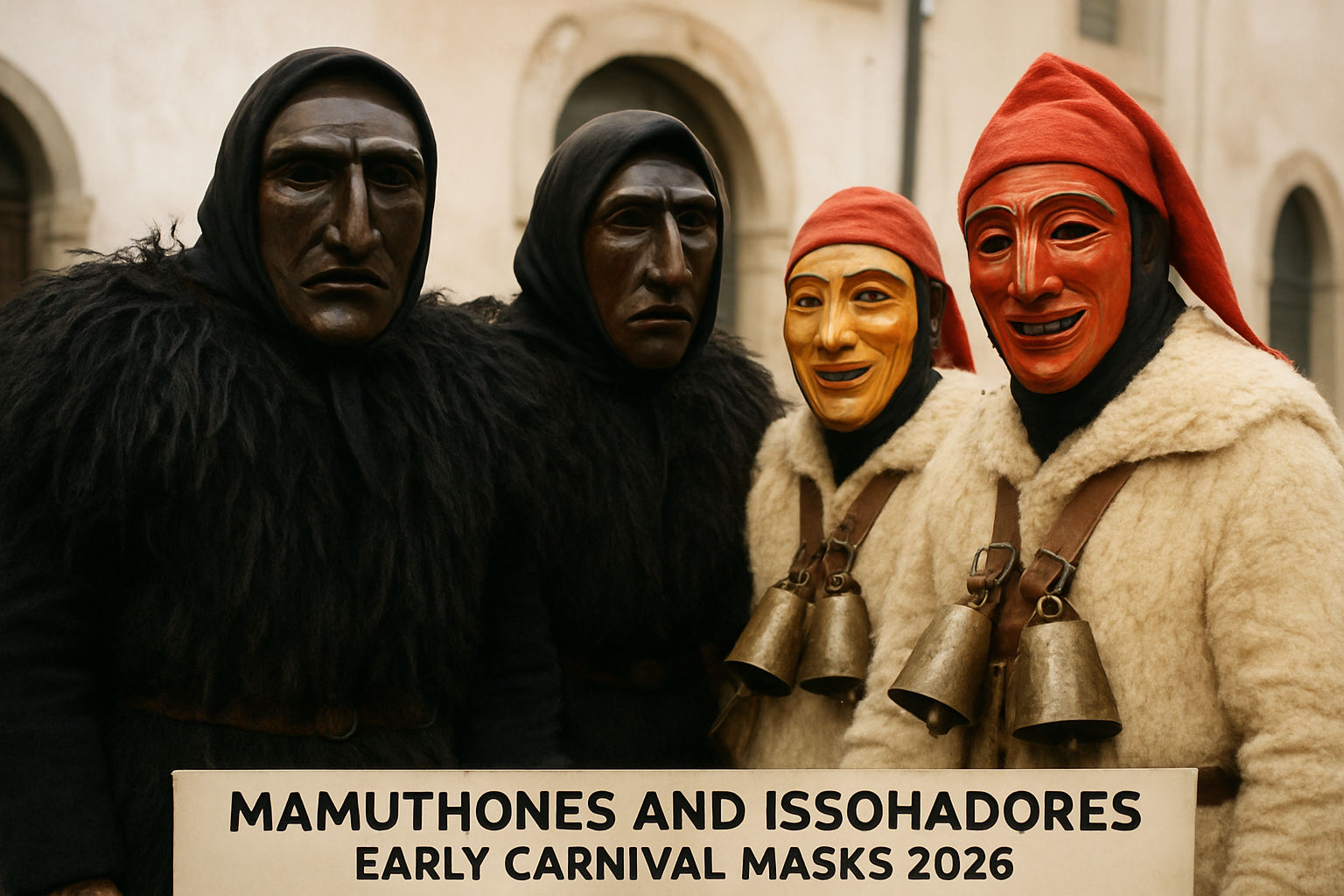
On a cold January night in the mountains of Barbagia, in the village of Mamoiada, Sardinia’s most haunting Carnival masks come to life. The Mamuthones, bent under the weight of 30 kilograms of bells and black sheepskins, move in a slow, rhythmic march, while the brightly dressed Issohadores leap and lasso spectators in a choreography that feels half pagan rite, half living theatre. In 2026, these early Carnival figures will once again open Sardinia’s Apokreo season with appearances for Sant’Antonio Abate on 16–17 January and then return on Carnival Sunday and Shrove Tuesday in February. For island travelers, witnessing Mamuthones and Issohadores in their home village is one of the most powerful cultural experiences in the Mediterranean.
Origins of Mamuthones and Issohadores in Mamoiada
The masked figures of Mamuthones and Issohadores belong specifically to Mamoiada, a village in the Barbagia region of central Sardinia. Their exact origins are lost in the mists of time. Some scholars trace the ritual back to the Nuragic age as a propitiatory ceremony for crops and protection from evil spirits, others see echoes of Dionysian rites, and still others connect it to later Christian processions.
What is undisputed is that this ceremony has been performed for centuries, possibly for around 2,000 years, as a pre‑Christian masquerade later absorbed into the Christian calendar. Today’s Mamuthones and Issohadores embody the layered history of the island, blending pagan symbolism, rural memory, and Christian feast days into a single, deeply felt ritual.
Key 2026 Dates: Early Carnival in Mamoiada
The Mamuthones and Issohadores do not appear only on Carnival weekend. Their first outing each year coincides with the Feast of Sant’Antonio Abate (Saint Anthony the Great), the protector of animals and fire.
For 2026, visitors can plan around:
- Night of 16–17 January 2026: First appearance of Mamuthones and Issohadores during the bonfires of Sant’Antonio Abate, marking the symbolic start of Carnival season in Mamoiada.
- Carnival Sunday 2026: Afternoon and evening procession through Mamoiada’s streets as part of Sardinia’s wider Apokreo celebrations.
- Shrove Tuesday 2026: Final major parade of the season in Mamoiada, closing the Carnival period for these masks.
These dates sit slightly ahead of the main Italian and Greek Carnival peaks and make Mamoiada’s ritual one of the earliest and most distinctive Carnival events in the Mediterranean.
The Look of the Masks: Dark Mamuthones, Bright Issohadores
The two masks always appear together and form a single living tableau, but their appearance and roles are dramatically different.
Mamuthones: The Burdened, Ancestral Figures
Mamuthones are the dark, heavy figures that tend to capture most visitors’ imagination. They wear:
- A black wooden mask carved from fig, elm, chestnut, or walnut and blackened to create a ghostly presence.
- Black sheepskins that cover the body, giving them a beast‑like silhouette.
- On their backs, a cluster of large copper or iron cowbells called “sa carriga,” weighing around 30 kilograms, strapped in layers.
Their faces are expressionless and often menacing, their posture slightly bent from the bells’ weight. With every synchronized step, the bells crash in unison, creating a deep, metallic roar that vibrates through the narrow village streets. Many interpretations see the Mamuthones as ancestral spirits, old men of the village, or symbolic animals tied to agriculture and pastoral life.
Issohadores: Rope Carriers and Guardians
The Issohadores, by contrast, are bright, agile figures who bring movement and color to the procession. They typically wear:
- White mask or sometimes no mask, depending on the tradition of the group.
- Red bodice (curittu) over a white shirt and white trousers.
- A black embroidered shawl at the hips and coarse wool gaiters (cartzas).
- A leather bandolier of small bronze bells (sonajolos) across the chest.
- A rope lasso called “soha,” from which their name Issohadores, “rope carriers,” is derived.
Their role is to guard and “command” the Mamuthones, keeping them in formation and setting the rhythm of their dance. They move lightly around the group, at times breaking off to lasso spectators in the crowd, traditionally choosing women or respected community members as a symbolic gesture of good fortune, fertility, and social prestige.
Symbolism and Possible Meanings
Interpretations of Mamuthones and Issohadores are numerous, reflecting the ritual’s ancient roots and shifting historical layers. Some of the main theories suggest that:
- The masks represent a propitiatory rite for good harvests and protection from evil forces in a harsh mountain environment.
- The Mamuthones may symbolize subjugated animals or even defeated enemies, while Issohadores represent their masters or victors, dramatizing the relationship between humans, nature, and power.
- Another reading places them in a social context: Mamuthones as old men of the village or agricultural workers, Issohadores as younger men guiding and honoring them as they “retire” from physical labor.
- Some scholars have suggested political interpretations, with Mamuthones embodying oppressed Sardinian peasants and Issohadores evoking foreign or Spanish rulers, though this is debated.
Modern Sardinian cultural writers often emphasize a broader symbolic frame: the dance of Mamuthones and Issohadores stages an eternal clash and reconciliation between darkness and light, winter and spring, death and rebirth, with the end of the ritual affirming continuity and hope for the new agricultural year.
The Procession: Sound, Movement, and Choreography
Watching Mamuthones and Issohadores in motion is very different from seeing their photographs. The procession follows a strict choreographic structure:
- Mamuthones advance in two parallel lines of six or more, heads slightly bowed, moving slowly and in perfect synchrony, each heavy step making the cowbells thunder as one.
- Issohadores walk and dart around them, keeping time, adjusting formations, and occasionally giving the signal for the Mamuthones to perform a specific turn or jump so their bells crash in a precise pattern.
The result is a kind of living drum ensemble. The sound reverberates through Mamoiada’s stone houses and narrow streets, creating an atmosphere that many visitors describe as both unsettling and mesmerizing. Children often watch half‑afraid, half‑fascinated, while adults respond with a mix of pride and reverence, recognizing the ritual as a cornerstone of their identity.
When Issohadores lasso someone from the crowd with their soha, it is considered an honor, not an aggression. Traditionally, those “captured” offer a drink in return, turning the act into a playful exchange of hospitality and good wishes.
Dressing Ceremony: The Private Heart of the Ritual
Behind the public parade lies a more intimate moment that visitors rarely see: the dressing of the Mamuthones and Issohadores. Photographers and writers who have documented this backstage ritual describe it as a private, almost sacred process taking several hours, where:
- Each Mamuthone is helped into layers of leather, sheepskin, and finally the heavy set of bells.
- Straps are tightened to distribute the weight across the back and shoulders, turning each man into a living instrument.
- The leaders run a final rehearsal without masks in a courtyard, ensuring the group’s steps and bell rhythms are perfectly synchronized before facing the public.
Only when they are deemed ready do the performers put on their black masks and leave the yard to become Mamuthones in full, no longer just individual villagers but part of a collective ancestral entity. For locals, this transformation is the emotional core of the ritual, symbolizing connection to those who performed the same dance generations before.
Practical Travel Tips for Experiencing Mamuthones and Issohadores in 2026
Getting to Mamoiada
Mamoiada lies in central Sardinia, in the province of Nuoro, roughly:
- 15–20 km from Nuoro city (about 20–30 minutes by car).
- 2–2.5 hours’ drive from Cagliari or Olbia, depending on route and conditions.
Renting a car is the most convenient way to reach the village, especially in winter when public transport is limited. Roads into Barbagia are winding but scenic, passing through rugged hills and traditional rural landscapes.
When to Go
For the full early Carnival experience in 2026, plan around:
- 16–17 January 2026 (Sant’Antonio Abate): Evening bonfires, first entrance of Mamuthones and Issohadores for the year, strong local participation.
- Carnival Sunday and Shrove Tuesday (February 2026): Afternoon and evening parades as part of Sardinia’s broader Carnival calendar.
Arriving by early afternoon on parade days allows time to park, explore the village, visit local bars or the Museum of Mediterranean Masks (if open), and secure a good vantage point along the streets.
What to Expect and How to Behave
- The event is free, with no ticketed access to the streets or public spaces.
- Crowds can be dense in key squares and narrow alleys, so wear comfortable shoes and warm clothing suitable for standing outside in January or February evenings.
- Respect the performers’ space; do not block their route or interfere with the bells and ropes.
- If an Issohadore lassos you, take it as an honor and enjoy the playful moment. Local custom suggests offering a drink or at least a smile and a handshake in return.
Photography is generally tolerated, but be discreet during more intimate parts of the ritual, and always ask before taking close portraits of individuals without masks.
Combining with Other Sardinian Carnival Masks
If you are exploring Carnival across Sardinia, Mamuthones and Issohadores in Mamoiada can anchor a route that also includes:
- Boes and Merdules in Ottana.
- Thurpos in Orotelli.
- Other Barbagia villages with unique pagan‑Christian Carnival masks.
Each community’s masks express different aspects of Sardinian identity, but Mamoiada’s figures are among the most iconic and internationally recognized.
Why Early Carnival in Sardinia Belongs on Your 2026 Island Itinerary
Experiencing Mamuthones and Issohadores in 2026 reveals Sardinia as much more than a summer beach destination. In the cold months, away from crowded coasts, the island’s inner mountains preserve rituals that predate modern tourism and even Christianity. In Mamoiada, Carnival Season begins not with glitter and floats but with fire, bells, and ancient rhythms that speak to humanity’s oldest concerns: survival, renewal, and the balance between darkness and light.
If you are planning an island‑focused year of travel, make space in your calendar for mid‑January or Carnival 2026 in Sardinia. Stand in Mamoiada’s streets as the first Mamuthone turns a corner, bells roaring, black mask glinting in the firelight. Watch Issohadores leap and lasso, guiding the line of masked figures through the village as they have for centuries.
Let this early Carnival mark the start of your own year of journeys. Sardinia’s mountains are calling, the bells are ready to sound, and the Mamuthones and Issohadores will soon step into the streets again. Will you be there when they do?
Verified Information at glance
Event Category: Traditional Carnival ritual / Early Carnival masks / Cultural and folkloric parade
Event Name: Mamuthones and Issohadores – Early Carnival Masks of Mamoiada
Island / Region: Sardinia (Sardegna), Barbagia region, village of Mamoiada
Core 2026 Dates:
- First annual appearance: Night between 16 and 17 January 2026 during Sant’Antonio Abate bonfires
- Further appearances: Carnival Sunday and Shrove Tuesday in February 2026 (exact civil dates follow the 2026 Carnival calendar)
Location of Ritual: Streets and squares of Mamoiada, Nuoro province, central Sardinia
Mamuthones Costume Details:
- Black wooden mask from fig, elm, chestnut, or walnut, blackened for ghostly effect
- Black sheepskin garments covering body
- 30+ kg of large copper or iron bells (“sa carriga”) strapped on the back
Issohadores Costume Details:
- White mask (in many variants), red bodice (curittu), white shirt and trousers
- Embroidered shawl at hips, wool gaiters (cartzas), bandolier of bronze bells (sonajolos)
- Rope lasso called soha used to “catch” spectators
Symbolism:
- Linked to pre‑Christian or Nuragic propitiatory rites, Dionysian cults, and later Christian practice
- Embody ancestral spirits, rural life, conflict between dark/old and light/young, or mythic struggle between good and evil
Procession Structure:
- Mamuthones march in two lines at slow, synchronized pace, bells sounding with each step
- Issohadores move around them, controlling rhythm, guarding group, lassoing chosen spectators as a sign of good fortune
Dressing Ritual:
- Multi‑hour private ceremony where performers are dressed in sheepskins and heavy bells before donning masks and entering streets
Access and Pricing:
- Public parades and village events are free; no ticket required to watch in streets
Travel Notes:
- Mamoiada located in Nuoro province, roughly 20–30 minutes by car from Nuoro and around 2–2.5 hours from Cagliari or Olbia
- Best reached by rental car due to limited winter public transport in Barbagia region.