L'Ardia di San Costantino – Sedilo 2026: Sardinia's Most Dangerous and Deeply Sacred Festival
There are events in the world that no travel writer can adequately prepare you for. The kind of thing you read about, think you understand, and then arrive at to discover that the reality exceeds every expectation in a way that leaves you slightly breathless and completely unable to explain it to friends back home. L'Ardia di San Costantino in Sedilo, Sardinia, is one of those events.
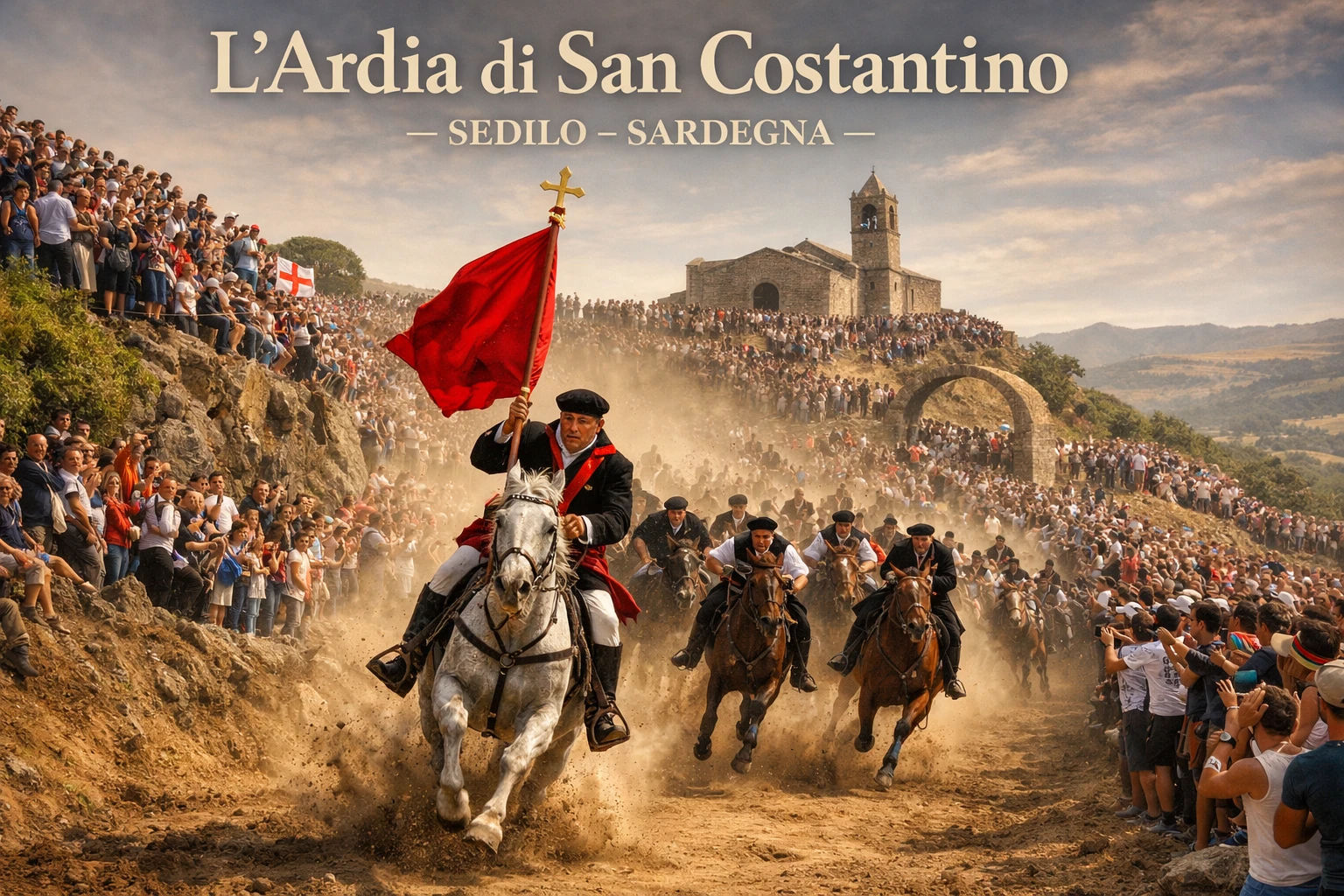
At the beginning of every July in the small village of Sedilo in northern Sardinia, you'll discover L'Ardia di San Costantino: the protection of Saint Constantine, a frantic, traditional celebration seemingly totally untouched by the twenty-first century. On July 6 and 7, 2026, roughly one hundred horsemen will thunder down a dusty hillside at breakneck speed, through an impossibly narrow arch, and around the Sanctuary of San Costantino in a ritual that has been enacted in this form since at least 1806. Between the 5th and 7th of July each year, the 3,000 inhabitants of Sedilo are joined by as many as 50,000 pilgrims who come to give thanks to the Saint and renew their Christian vows.
If you are within reach of central Sardinia this July, there is no better reason to be here.
The History That Built This Race: Constantine, a Battle, and a Vision in the Sky
The Battle of Milvian Bridge and the Birth of a Festival
To understand the Ardia, you need to go back to Rome in 312 AD and one of the most consequential battles in the history of the Western world.
Despite the fact that he was outnumbered, on 28 October 312 AD, Constantine won the battle of Ponte Milva, defeating the pagans of the imposter Maxentius, who with the support of the Senate had proclaimed himself Emperor of Italy and Africa. A year later in Milan, Constantine issued the edict that ended the persecution early Christians had been subject to.
Before that battle, according to tradition, Constantine saw a flaming cross in the sky with the words inscribed upon it: "in this sign thou shall conquer." He went into the battle outnumbered and came out victorious, and the consequence for the trajectory of European civilization was enormous. Christianity moved from a persecuted minority religion to the faith of the Roman state.
At Sedilo, a small town in the centre of Sardinia, the Roman emperor is known as Santu Antine and is by far the island's most venerated saint. Worship of him dates to Byzantine times.
The specific tradition of the Ardia as it exists today grew from a second layer of local mythology. The origin of this popular festival comes from far away and should be sought in a mystical vision Don Giommaria Ledda had: while a prisoner of the Moors, he dreamt of meeting a young man dressed as a Roman warrior who promised him freedom in exchange for a dedicated church on Mount Ise. Ledda built the Sanctuary of Santu Antine, and around that sanctuary the Ardia has gathered its community and its ritual structure ever since.
S'Ardia has been held every year in July since 1806 in Sedilo, a small town of 2,000 inhabitants in the province of Oristano. Since 1806, S'Ardia has been held in Sedilo and only its inhabitants can take part in the horse race.
What the Name Means and How the Race Actually Works
Sa Prima Pandela: The Role That Changes a Life
Ardia comes from the verb bardiare, that is, to protect or keep safe. Pandelas and iscortas, brave knights who carry the standards, protect the leader and his chosen men from the frenzied horde of pagans. Sa prima pandela must never be overtaken; it would mean the defeat of Christianity.
The honor of becoming sa prima pandela is not simply applied for. The name of the "first pandela," or head of the race, is chosen from a list of names enrolled years earlier in a secret register kept by the parish priest and communicated to the entire village on January 16th, the day of the feast of St. Anthony. A rider might wait a decade or more for his name to come to the top of that list. When it does, and when the parish priest pronounces his name in the village square on a January morning, it is one of the most significant moments of his life.
The Feast consists of two phases. First are the celebrations that take place in the main square of Sedilo, where the parish priest officially appoints the three riders who will receive the pandelas, which are the small flags. One is yellow and is the most important, one is red and the other is white. The riders are dressed in dark jackets, in contrast to their escorts and opposition. The three riders, together with their small army of escorts, will have the task of defending the pandelas.
The second phase is the race itself.
It begins when the riders head towards Su Frontigheddu, the promontory that overlooks the entrance arch of the sanctuary. The Ardia takes off without much warning as the riflemen who led the procession shoot into the air and the excited crowd frantically incites its heroes. The riders hurdle down the winding route between su Frontigheddu and the sanctuary, their horses galloping at breakneck speed over dirt tracks.
Every year in July, participants in L'Ardia di San Costantino Festival include riders representing Constantine and Maxentius, costumed flag men and a fairly believable army doing their best to thwart the efforts of Maxentius. The roles are played by villagers who wait years, even decades, for the privilege. The end is still always a surprise. The faithful make pilgrimages to Sedilo from all over Sardinia. Constantine's victory means Christianity's survival for another year.
July 6 and 7: What Happens on Each Day
Saturday Evening: The Main Race
The race takes place every year on the evening of July 6th and repeats on the morning of July 7th. In the central square of the village, the parish priest officially names the three riders as representatives of Christianity.
At 6:00 PM in Piazza S. Giovanni the parish priest Don Maurizio Demartis delivers Sas Pandelas. At 7:00 PM at the Sanctuary of San Costantino the Ardia begins, accompanied by the gunmen of Sedilo and the Monastir band. Following the race, the evening continues with live music in the sanctuary area.
The advice from everyone who has attended is to arrive well before the 5:00 PM mark. The advice to those who have to attend the Ardia is to arrive at 5:00 PM at the latest. When the car areas are full you will only be able to park in the village and walk down. The natural amphitheater around the sanctuary fills as the afternoon progresses, and the best viewing positions go to those who commit to arriving early.
Sunday Morning: The Race Repeats
On Sunday morning July 7th at 7:00 AM the Ardia repeats itself with the same rituals. At the end, mass in the sanctuary with the flags and in the afternoon at 6:30 PM in the parish, vespers and solemn procession of San Costantino.
From 6:00 AM and then every hour, masses are held in the Sanctuary, followed by a Solemn Holy Mass at 11:00 AM. The Sunday morning edition of the race carries a different energy from Saturday evening. The crowd is slightly different in composition, with more local pilgrims who have spent the night near the sanctuary, and the early morning light over the central Sardinian plateau gives the entire setting an atmospheric quality that the more crowded Saturday evening cannot replicate. After the race everyone trudges down to the priest's house for a few sips of vernaccia, the local wine, and a mouthful of pastry. Then it's on to the houses of the flag bearers for more of the same.
The Setting: Sedilo and Central Sardinia's Ancient Landscape
A Village in the Heart of the Island
Nowadays, the event has crossed regional borders and attracts tourists from all over Italy and abroad, also bewitched by the surrounding nuragic complex of Iloi and the domus de janas of Ispiluncas.
Sedilo sits in the Oristano province of central Sardinia, in a landscape shaped by the twin forces of volcanic geology and thousands of years of human habitation. The nuraghe Iloi complex, visible from the area of the sanctuary, is among the most significant Bronze Age sites in the region, with towers and structures dating to the period between 1600 and 900 BC when Sardinia's mysterious nuragic civilization was at its height. The domus de janas, the "fairy houses" cut into the rock face at Ispiluncas nearby, are Neolithic burial chambers whose name reflects the folk traditions that grew up around their mysterious carved openings.
The Omodeo Lake, the largest artificial lake in Italy, was created in the 1920s by the damming of the Tirso River and today dominates the landscape around Sedilo with a surface area of 20 square kilometers. The contrast between the ancient hillside sanctuary of San Costantino and the vast mirror of the lake below it is one of the most visually striking backdrops of any festival setting in the Mediterranean.
For three hundred and sixty days of the year, as one observer memorably put it, Sedilo is a quiet village where the sheep outnumber the people. For two days in July, it becomes one of the most intensely alive places in all of Italy.
The Food and Wine That Accompany the Celebration
Traditional food favourites include wonderful suckling pigs which have been roasted in wood-fired ovens and delicious freshwater eels. Most people will be drinking a few glasses of the local vernaccia, which is itself strong enough. The hardiest, however, will quickly move on to filu e ferru, which is Sardinia's answer to poteen and normally 100 percent proof.
The food culture surrounding the Ardia is entirely consistent with the Sardinian tradition of communal feasting that has accompanied every major religious celebration on this island since before recorded history. Porceddu, the whole roasted suckling pig cooked over aromatic wood, is the defining dish of Sardinian festive cooking. The roasting takes place over several hours over myrtle and lentisk wood that infuse the meat with a perfume specific to the island's macchia vegetation. Eating it in the open air near the sanctuary, surrounded by the crowd and the smoke of the cooking fires, is a sensory experience of considerable intensity.
Vernaccia di Oristano, the amber-colored oxidative wine of the province, is the drink most closely associated with the Ardia celebration and with Sardinian religious feasts more broadly. After the race everyone trudges down to the priest's house for a few sips of vernaccia. This wine, produced exclusively in the Oristano area from the Vernaccia grape, has been made on Sardinia for at least three thousand years and carries a flavor profile unlike anything produced elsewhere in Italy: nutty, saline, deeply aromatic, and completely individual in its character.
How to Get to Sedilo and Where to Stay
The Road North From Cagliari
The best bet to experience this festival is to rent a car in Cagliari and drive north to Sedilo. It's unlikely you'll find lodging in Sedilo for the festival.
The closest major cities are Oristano, about 47 km away, and Nuoro, about 48 km away. By car, to reach Sedilo, take the SS 131 dcn. The drive from Cagliari takes approximately two hours and thirty minutes via the SS 131, Sardinia's main north-south artery, passing through the agricultural flatlands of the Campidano plain before climbing into the central plateau landscape of the Oristano province.
For those arriving in Sedilo it is important to remember that from the 131 bis Abbasanta-Nuoro they must enter at the Sedilo Sud crossroads, arrive in the town and follow the stretch of road that leads to the parking area and then on foot to the natural amphitheater of San Costantino. The same applies to people arriving from Olbia-Nuoro who enter the Sedilo Nord junction.
Because accommodation within Sedilo itself is extremely limited, most visitors base themselves in Oristano or Nuoro and drive in for the event. Both cities have a reasonable range of hotels and B&Bs, and the distances of approximately 47 and 48 kilometers respectively from Sedilo make them practical bases. Nuoro, as Sardinia's cultural capital and the city most closely associated with the island's literary tradition through figures like Grazia Deledda, who won the Nobel Prize for Literature in 1926, is worth at least an extra day of exploration for visitors who are not familiar with inland Sardinia.
Hotel Su Gologone, set in the Valley of Lanaittu near Oliena east of Nuoro, is among the most celebrated agriturismo-style hotels in all of Italy and is consistently recommended by visitors to the Ardia as one of the finest places to stay in the region. Its location approximately 45 kilometers from Sedilo makes it a comfortable base, and its deep immersion in Sardinian culture through its food, its art collection, and its surrounding landscape makes a stay there an extension of the same cultural experience that the Ardia itself provides.
By Ferry and By Air
Take a flight to Cagliari from Rome or Milan, or a Tirrenia Ferry from Civitavecchia to Cagliari, or Sardinia Ferries from Civitavecchia to Cagliari. Cagliari Elmas Airport receives direct domestic connections from Rome and Milan year-round, and direct international connections from London, Paris, Frankfurt, Amsterdam, and other European cities throughout the summer. Alghero Airport in the northwest and Olbia Costa Smeralda Airport in the northeast provide alternative entry points, each approximately two hours from Sedilo by car.
The ferry crossing from Civitavecchia, Rome's port, to Cagliari overnight is a genuinely enjoyable way to arrive on the island and eliminates the need to navigate an early morning airport departure for a summer festival. Tirrenia operates comfortable overnight crossings with cabin berths and dining facilities that arrive in Cagliari in the early morning, leaving a full day for the drive north and the afternoon arrival at Sedilo.
Why No Other Festival in Italy Compares to This One
Along with the parade of Sant'Efisio, I Candelieri or Sa Faradda, and the Carnival, S'Ardia of Sedilo is one of the most popular festivals in Sardinia. If you haven't yet seen it with your own eyes, it is an experience not to be missed: dust, horses, delirious crowds mix with the religious experience, but keep intact the feverish participation of the people of Sedilo in honor of the warrior emperor who later became a saint.
What sets the Ardia apart from virtually every other festival in Italy, and indeed from most festivals anywhere in Europe, is the genuine stakes it carries. This is not a historical recreation performed for tourists by costumed actors. It is a religious obligation fulfilled by community members who have waited years for the privilege, in front of fifty thousand pilgrims who have traveled to be there and who understand everything that is happening and why it matters. The horses are real. The speed is real. The faith is real. And the outcome, as Atlas Obscura observed, is still always a surprise.
Ardia is a ritual horse race held in honor of a saint. The best known is the one that takes place on 6 and 7 July at the sanctuary not far from Sedilo dedicated to the emperor Constantine.
Come early on Saturday July 6, find your place in the natural amphitheater before the afternoon crowds arrive, watch the three pandela riders receive their banners from the parish priest in the village square, follow the procession to the rocky promontory of Su Frontigheddu, and wait. When the riflemen raise their weapons and the crowd draws its collective breath before the race begins, you will understand immediately why people walk for days across Sardinia to be in exactly this place at exactly this moment.
Verified Information at a Glance
Event Name: L'Ardia di San Costantino (S'Ardia di Sedilo)
Event Category: Annual Religious Festival, Traditional Ritual Horse Race, and Community Pilgrimage
Dates: Saturday, July 6, 2026 (main evening race) and Sunday, July 7, 2026 (morning repeat race)
Venue: Sanctuary of San Costantino (Santuario di Santu Antine), Sedilo, Province of Oristano, Sardinia, Italy
Race Route: Su Frontigheddu promontory to the Arch of the Sanctuary of San Costantino
Saturday July 6 Schedule: Masses in the Sanctuary from morning / 6:00 PM: Sa Pandela ceremony, Piazza S. Giovanni, Sedilo town center / 7:00 PM: Ardia race, Sanctuary of San Costantino, accompanied by Sedilo gunmen and Monastir band / Evening: Live concert after the race
Sunday July 7 Schedule: Masses from 6:00 AM onward / 7:00 AM: Ardia repeats with same rituals / 11:00 AM: Solemn Holy Mass in the Sanctuary / 6:30 PM: Vespers and solemn procession of San Costantino
Attendance: Approximately 50,000 pilgrims and spectators across the two days
Admission: Free; no ticket required to attend as a spectator
Organizer: Santu Antinu Association (President Annarita Nanu), in partnership with the Municipality of Sedilo and Civil Protection