61st INDA Classical Performances at the Greek Theatre of Syracuse, Sicily: Where Ancient Drama Speaks Directly to the Present
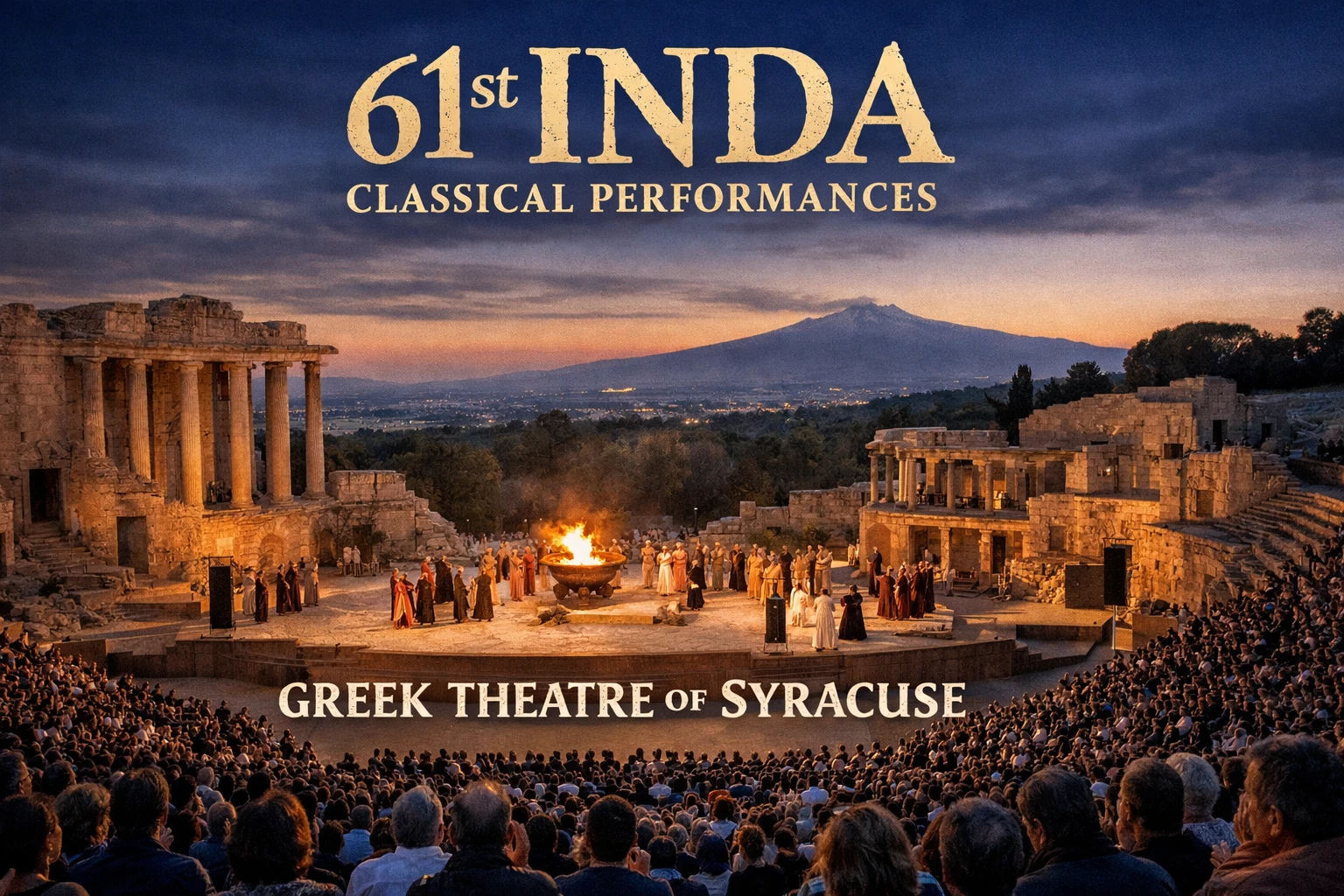
There is no theatre experience quite like sitting in the cavea of the Greek Theatre of Syracuse as the light fails behind the city and the Sicilian evening air begins to cool. You are in a stone amphitheatre carved into the Temenite hill more than two and a half thousand years ago. The seat beneath you is ancient limestone. The stage before you is the same stage on which Aeschylus himself almost certainly supervised performances of his own tragedies. And the words being spoken are the same words, give or take a translator's interpretation, that an Athenian audience heard in the fifth century BC.
This is the context in which the 61st Season of INDA Classical Performances unfolds, running from May 8 to June 28, 2026, bringing Sophocles, Euripides, Aeschylus, and Homer to one of the greatest open-air stages in the world. At the Greek Theatre of Syracuse, the 61st Season of Classical Performances, "Sconfinamenti," unfolds as an intense journey into the great themes of ancient drama, with masterpieces that explore the meaning of limits and human choice.
After the new record of spectators in 2025 with over 172,000 presences, the season, whose manifesto is signed by Michelangelo Pistoletto, brings extraordinary new surprises. The 2026 season is already shaping up as one of the most ambitious in the festival's 111-year history, and for anyone with even a passing interest in classical literature, world-class theatre direction, or the extraordinary experience of watching ancient drama performed in an ancient theatre under a Sicilian sky, this is a journey worth making.
One Hundred and Eleven Years of Bringing the Ancients Back to Life
INDA and the Theatre That Started It All
Founded in 1914 by the National Institute of Ancient Drama, INDA, the festival aims to revive the grandeur of classical Greek tragedies and comedies. Performances are staged in the historic Greek Theatre, a majestic amphitheater dating back to the 5th century BC. The venue itself is a marvel, carved into the rocky hillside and overlooking the shimmering Mediterranean Sea, offering an ambiance that transports audiences back to ancient times.
The Greek Theatre of Syracuse was first built in the 5th century BC, rebuilt in the 3rd century BC, and renovated again in the Roman period. Today it is a part of the UNESCO World Heritage Site of "Syracuse and the Rocky Necropolis of Pantalica." Since 1914 with the birth of INDA, the scenic space of the Greek theater has been used mainly for classical representations of Greek tragedies and comedies, following the dictates of tradition.
The numbers that describe the theatre's physical scale give some sense of what it means to see a performance there. The cavea is about 138 meters in diameter, accommodating up to 15,000 spectators. Seating is divided into the ima cavea with 27 rows and the summa cavea with 40 rows, each with 9 sectors. The acoustics are renowned for their clarity, enabling performances to be heard from any seat. Those acoustics, the same phenomenon of carved hillside geometry that allowed Aeschylus's choruses to be heard by every one of those 15,000 spectators without amplification, still function today. The sound of a Greek chorus at the Syracuse theatre in a quiet evening carries an almost physical quality that modern theatre technology can approach but never quite replicate.
The festival's 2026 season manifesto is signed by Michelangelo Pistoletto, one of the most significant figures in twentieth-century Italian art and a co-founder of the Arte Povera movement. His involvement as the visual artist behind the season's identity connects the ancient world to contemporary artistic consciousness in a way that confirms INDA's understanding of classical drama not as archaeology but as ongoing conversation.
"Sconfinamenti": The Unifying Theme of the 2026 Season
When Power Overreaches and Conscience Must Choose
This year's season threads a single question through all four works: what happens when power overreaches, when law hardens against conscience, and when the boundary between life and death is stretched too far?
Sconfinamenti translates roughly as "crossings of boundaries" or "transgressions," and the theme threads through all four productions with remarkable coherence. Power and hubris in I Persiani, where Xerxes tries to command land and sea and pays the price. Law and conscience in Antigone, where a young woman decides that state decrees cannot overrule unwritten moral law. Life and death in Alcesti, where a king is allowed to escape his fate if someone else will die in his place. Genres and languages in Iliade, which blends theatre, dance, and music to retell Homer for a modern audience.
The political resonance of that thematic framework is not coincidental. The conflict between morality and state authority is at the center of the work, explains Robert Carsen, director of Antigone: we continue to encounter weak and dictatorial politicians like Creon, politicians who try to govern through fear. Obsessed with themselves and their own interests, without any plan for the good of others.
That the stories of Sophocles, Euripides, and Aeschylus should feel immediately applicable to contemporary politics is not a reflection of the cleverness of the 2026 season's curators. It is a reflection of the extraordinary permanence of what these playwrights understood about human nature and political power two and a half thousand years ago.
The Four Productions: An Evening-by-Evening Guide
Alcestis by Euripides – May 8 to June 6
The season opens on May 8 with Alcestis by Euripides, translated from the Greek by Elena Fabbro and staged in co-production with the Teatro Stabile del Veneto by its director, Filippo Dini, who will also play the role of Ferete. The music is written by Paolo Fresu, who will perform it live for the premiere of the show. Deniz Ozdogan will play the title role.
King Admetus has struck a strange bargain with the gods: he may escape death if someone else agrees to die in his place. Only his wife Alcesti steps forward. She walks towards death on the condition that Admetus will never remarry. The play lives exactly on that boundary between heroic devotion and unbearable emotional debt.
The participation of jazz musician Paolo Fresu performing his score live during the premiere makes this opening night a particularly singular cultural event. Fresu, one of the most celebrated Italian jazz musicians of his generation, composing and performing alongside a Euripidean tragedy in the world's oldest functioning theatre is exactly the kind of unexpected creative synthesis that keeps a 111-year-old festival feeling genuinely alive.
Antigone by Sophocles – May 9 to June 5
Sophocles' Antigone debuts on May 9. After the great successes with Oedipus Rex and Oedipus at Colonus, Robert Carsen closes his personal journey in Thebes. The translation is by Francesco Morosi. Camilla Semino Favro plays Antigone while Paolo Mazzarelli plays Creon.
Thebes has torn itself apart in civil war. Eteocles and Polyneices, sons of Oedipus, have killed each other in battle. Creon, now king, decrees that one brother will be honored with full burial, while the "traitor" must be left unburied outside the city walls. Their sister Antigone refuses to accept that a royal edict can outrank divine law or family duty.
Siracusa has returned to Antigone many times since the 1920s; each generation uses it to ask slightly different questions. Carsen is known for his clear, uncluttered staging and strong use of light and space, which usually works beautifully in the Greek Theatre's wide, open setting.
The Persians by Aeschylus – June 13 to June 28
On June 13, Àlex Ollé, a Catalan director among the founders of the Fura dels Baus, will make his debut at the Greek Theater and will direct Aeschylus's Persians in the translation by Walter Lapini.
In "The Persians" by Aeschylus, the reflection focuses on hybris and the downfall of power that dared to cross human limits. This is perhaps the most politically charged production of the season. The tragedy stages the first visible conflict between the West, the Greeks, and the East, the Persians, delineating boundaries that even today seem impossible to heal, pacify, or quell.
Àlex Ollé's association with the Fura dels Baus, the Catalan performance collective famous for its visually spectacular, often physically overwhelming theatre productions, promises a Persians of considerable visual ambition. In a theatre that has watched empires rise and fall, I Persiani tends to feel disturbingly close to present-day news.
The Iliad by Homer – June 14 to June 26
The "Iliad" by Homer, directed by Giuliano Peparini, transforms epic poetry into physical movement and visual storytelling. For the first time in its more than one hundred-year history, INDA presented a preview of Homer's Iliad, directed by Giuliano Peparini, reserved for schools with four performances from April 13th to 16th. The show is performed by students and former students of the INDA theater school and by performers and students of the Peparini Academy.
After its debut in 2025, Iliade returns as a cross-over project that mixes spoken text, music, and dance. Verses from Homer, in Francesco Morosi's modern Italian, are woven into a visual and choreographic score performed by actors from the INDA Academy and dancers from the Peparini Academy. If the tragedies form the intellectual backbone of the season, Iliade is its emotional finale, an accessible way in for teenagers, reluctant theatregoers, or anyone who has always bounced off epic poetry on the page. It is also the piece least reliant on language: you can follow the emotional arc through movement, light, and music even with modest Italian.
The Theatre and Its Setting: A UNESCO World Within a World
Neapolis, Ortigia, and the Full Archaeological Richness of Syracuse
You are sitting in a vast stone cavea carved into the Temenite hill, inside the Archaeological Park of Neapolis, part of the UNESCO site "Siracusa and the Rocky Necropolis of Pantalica." On a good evening there is a warm breeze from the harbour, the light drops behind the city, and a few thousand people fall silent together as stories more than two thousand years old start to sound alarmingly current.
The Neapolis Archaeological Park that surrounds the Greek Theatre contains two other major ancient monuments that reward the pre-performance hours. To the east of the Greek Theatre, the Latomie del Paradiso, the stone quarries, comprise the ancient caves of the Orecchio di Dionisio, the Ear of Dionysius, and the Grotta dei Cordari. Once used to house prisoners of war captured by Dionysius I, the quarries are now filled with the scent of lemon groves. A Roman amphitheatre, now overgrown, stands just outside the main park but visits are included in the main entry ticket to the Archaeological Park.
The island of Ortigia, the ancient original city of Syracuse connected to the mainland by two short bridges, is where most visitors base themselves for a festival stay and where the evening atmosphere before and after performances is most concentrated. The Piazza del Duomo, built on the foundations of the Temple of Athena whose ancient columns are still visible within the cathedral walls, is one of the most layered public spaces in the world: Greek temple, Roman civic building, Byzantine church, Norman cathedral, and Baroque facade all occupying the same footprint across three thousand years of continuous religious and civic use.
Practical Information for Attending the 2026 Season
Performance Schedule, Timing, and Ticket Access
The confirmed performance schedule is: Alcesti by Euripide, May 8 to June 6; Antigone by Sophocles directed by Robert Carsen, May 9 to June 5; Persiani by Aeschylus directed by Àlex Ollé, June 13 to June 28; Iliade by Homer directed by Giuliano Peparini, June 14 to June 26.
Shows in the May period are scheduled at 7:00 PM, while in the June period the start is at 7:30 PM. The duration of the shows is about 2 hours, except in special events or special performances. Those performance times are chosen to take advantage of the Sicilian evening light: beginning while the sun is still above the western horizon and watching the sky change color behind the stage as the first act unfolds before full darkness brings the floodlit cavea to its most spectacular.
Tickets are available through the official INDA foundation box office and online. The Foundation Ticket Office is at Corso Matteotti 29, Syracuse, open Monday to Friday from 10:00 AM to 1:00 PM and Monday to Thursday from 3:00 PM to 5:00 PM. Tel: +39 0931 487248. An assistance service is available to accompany people with disabilities to their designated seating area, without the need for prior arrangements. This assistance service is provided free of charge by volunteers from the Syracuse Delegation of the Knights of Malta, who wear recognizable uniforms and identification cards, and is available at the entrance on Via Agnello. Car parking is available 150 metres from the beginning of Via Giuseppe Agnello.
Ticket price categories vary by seating zone, with the best-positioned seats in the central ima cavea commanding higher prices and the outer zones offering more accessible pricing for visitors who want the experience without the premium positioning. The official website at indafondazione.org/en is the most reliable source for current pricing and availability.
Getting to Syracuse
Syracuse sits on the southeastern coast of Sicily, accessible by train from Catania in approximately 1 hour and 20 minutes and from Palermo in approximately 3 hours and 30 minutes. The closest airport is Catania Fontanarossa Airport, with extensive international and domestic connections throughout the spring and early summer season. The train journey from Catania airport to Syracuse central station is straightforward and the most environmentally responsible option for most visitors.
The Greek Theatre is open-air, within the Parco Archeologico della Neapolis, about 15 to 20 minutes by taxi or bus from Ortigia. The Ortigia island neighborhood provides the richest and most atmospheric base for a festival stay, with the concentrated weight of three thousand years of urban history visible in every street corner and the best restaurants and bars of the city within easy walking distance of each other and of the bridges that connect the island to the mainland and the route to Neapolis.
What to Wear, Bring, and Expect
The performances take place outdoors in a stone amphitheatre carved into a hillside, which means that while May and June in Sicily are warm, the evening air once the sun drops and the sea breeze comes in from the harbor can require a light jacket or layer. Bringing one, particularly for May and early June performances, is advice that reviews of previous seasons consistently reinforce.
The stone seating of the ancient cavea is supplemented during the festival by cushions and temporary seating units that improve comfort considerably but cannot fully substitute for a seat pad if you are planning to stay for a full two-hour performance. Most experienced festival-goers bring their own light cushion. Arriving 30 to 45 minutes before the stated start time is recommended, both to find your allocated seats and to appreciate the theatre itself in the golden light of the early evening before the performance begins.
Why the 61st Season Is Worth Crossing an Ocean For
The 61st season of the INDA at the Greek Theater in Syracuse, from April 13 to June 28, presents many surprises. The season confirms Syracuse as a symbolic place of the Mediterranean, where myth continues to speak to the present.
There are theatres that are historically significant and theatres that produce great work. Very rarely are those two qualities found in the same stone bowl at the same moment. The Greek Theatre of Syracuse is one of the places on earth where a 2,500-year-old building designed by people who believed that watching tragedy performed in public was a civic duty continues to function as exactly that: a space for a community to gather and examine the most difficult questions that human beings face.
The 2026 season's four productions, Alcestis, Antigone, The Persians, and the Iliad, address questions about sacrifice, political authority, imperial hubris, and the human cost of war that no contemporary news service makes feel distant or resolved. The writers who posed those questions in the fifth century BC wrote them to be asked again, by every generation, in every language, in every theatre that was willing to ask them honestly.
The Greek Theatre of Syracuse has been asking them, every season since 1914, in the oldest outdoor theatre in the Mediterranean world. May and June 2026 are the next chapters of that conversation, and they are fully open to anyone who makes the journey to southeastern Sicily and takes a seat in the stone cavea as the Sicilian evening light begins to fade.
Verified Information at a Glance
Event Name: 61st Season of INDA Classical Performances at the Greek Theatre of Syracuse
Full Italian Name: 61° Stagione di Rappresentazioni Classiche al Teatro Greco di Siracusa
Season Theme: "Sconfinamenti" (Crossings of Boundaries / Transgressions)
Event Category: Annual Classical Theatre Festival; open-air Greek drama performed at a UNESCO World Heritage Site
Organizer: Fondazione INDA (Istituto Nazionale Dramma Antico), Siracusa, Italy
Season Manifesto Artist: Michelangelo Pistoletto
%202026.webp)