Sicily Feast of Saints Peter and Paul 2026: Island-Wide Celebrations on June 29
There is a particular quality of religious celebration in Sicily that you simply do not find anywhere else in the Catholic world. It combines genuine spiritual devotion with a theatrical exuberance that reflects centuries of layered cultural identity: Greek, Roman, Byzantine, Arab, Norman, Spanish, and finally Italian, all compressed into communities that have been marking these feast days in essentially the same way since the early medieval period. The Feast of Saints Peter and Paul, observed across the island on June 29, 2026, is one of the finest expressions of that tradition, and in certain Sicilian towns, particularly Modica in the southeast, it reaches a level of communal intensity that ranks among the most remarkable religious festivals in the entire Mediterranean world.
June 29 marks Sts. Peter and Paul Day, most fervently celebrated in Sicily with a three-day festival in Modica. But the celebration is not confined to one town. From the fishing villages of the Sicilian coast to the baroque hilltop cities of the interior, June 29 is a day when the island marks two of the most significant figures in the Christian tradition with the particular Sicilian combination of solemn ceremony and uninhibited communal joy.
The History Behind the Feast: Two Apostles, One Ancient Celebration
From the Roman Catacombs to a Universal Christian Commemoration
The Feast of Saints Peter and Paul is a liturgical feast recognizing the martyrdom of Saints Peter and Paul in Rome. This feast is observed on June 29, the anniversary of either their death or that of the translation of their relics. Saint Peter was martyred in the year 64 under the Roman Emperor Nero. According to the customs of Rome at the time, Peter was crucified upside down, as he claimed he was not worthy of being crucified in the same manner as Jesus Christ.
The specific history connecting the two saints is remarkable. As Peter and Paul are generally regarded as the two main Apostles responsible for the spread of Christianity in the early years of the First Century, their being honoured on the same day is, in effect, a short-hand way of remembering the whole of the Christian faith. Peter, the fisherman from Galilee who became the first pope, and Paul, the intellectual convert who wrote much of the New Testament and carried the gospel into the Gentile world, represent between them the two great streams of early Christian energy: the witness of direct experience and the transmission of reasoned faith.
Feast Day of Saints Peter and Paul are likely one of the oldest feast days celebrated in the Christian calendar. Paintings of Peter and Paul were discovered on the wall of catacombs in 2010. The images on the walls date back to the fourth century A.D. The longevity of this feast day, continuous from the early centuries of Christianity to the present, gives it a weight that more recently established religious celebrations cannot claim. When Sicilian communities gather on June 29, they are participating in a commemoration that Christians have maintained, in essentially the same form, for seventeen hundred years.
In honor and praise of St. Peter, who was the patron saint of fishermen, coastal and island communities may decorate their boats. This fishing community dimension of the feast carries particular resonance in Sicily, where the sea has defined the economic and cultural life of coastal towns since antiquity, and where the figure of Peter the fisherman-apostle connects the religious celebration directly to the lived experience of communities whose grandparents and great-grandparents fished the same waters described in the Gospel stories.
Modica: Where the Feast Becomes a Three-Day Festival
The Baroque Chocolate Capital's Greatest Religious Celebration
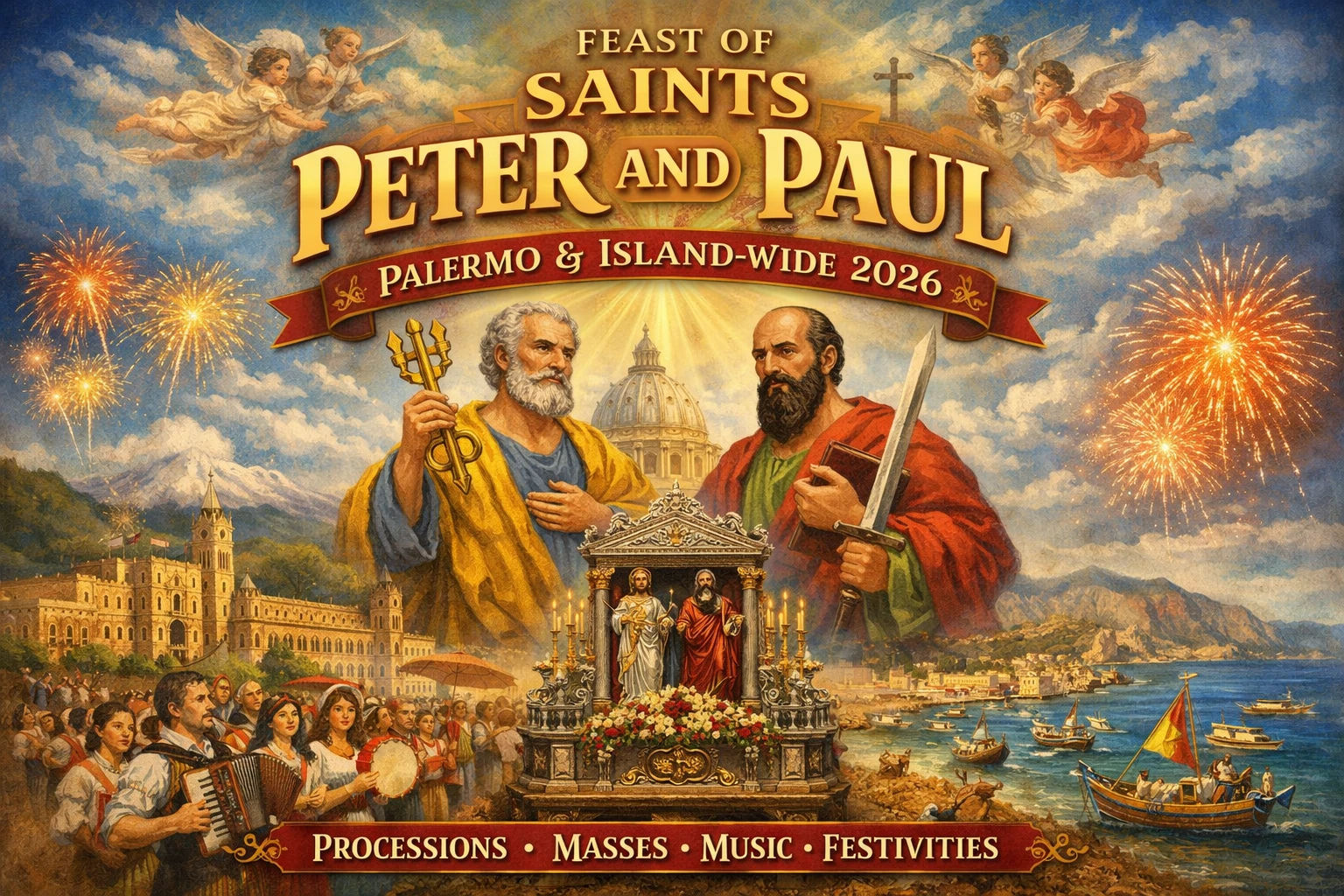
On June 29 in Modica, the Feast of St. Peter and Paul, patron of the city, is held. The procession of the holy relics of St. Peter and Paul are brought in a silver arm and make procession to the 12 holy statue saints in front of the church. The feast of St. Peter's is synonymous with market stalls, live concerts, and food stands. It is celebrated in the last three days of June, with a traditional variety of stalls invading the city's historic center, attracting in addition to residents people from neighboring towns or rural areas.
Modica is the perfect town for understanding what a Sicilian patron saint festival actually means to the community that produces it. The city is already one of the most architecturally extraordinary places in Sicily, its baroque churches and palaces built into a deep limestone gorge in the Ragusa province after the catastrophic earthquake of 1693 destroyed the medieval settlement. The UNESCO-listed baroque town center, with its two competing high streets running along the ridges above the gorge and its extraordinary concentration of 18th-century religious architecture, provides a setting for the June 29 celebrations that would be hard to improve upon aesthetically.
The festival builds across the last three days of June, with market stalls appearing in the historic center from June 27 onward. These are not the tourist-oriented artisan markets that characterize many Italian festa days. They are genuine commercial and communal gatherings where residents of Modica and the surrounding Ibleo plateau communities come to eat, to shop for seasonal goods, to encounter each other in the particular informal but important way that market culture provides, and to participate in the shared energy that accumulates in a community building toward its major annual celebration.
The procession of the silver arm containing the holy relics, moved through the streets and past the twelve sacred statues of the saints outside the church, is the ceremonial heart of the celebration and the moment when the religious dimension most fully asserts itself over the festive. The most important moment of the festival, at 13:00 on the 29th, is when the statue of the Saint is carried out of the church, to the sound of pealing bells and firecrackers and the throwing of the "nzareddi," long strips of colored paper prepared by the women in the days leading up to the festival. The saint is then carried around the streets on the shoulders of local men and followed by the faithful, mostly barefoot women. A firework display concludes the procession, in front of the church.
The detail of the barefoot women following the procession is particularly significant. Barefoot participation in religious processions is one of the most ancient and most physically demanding expressions of devotional commitment in Mediterranean Catholic culture. It signals a willingness to surrender comfort in acknowledgment of the sacred, and in the heat of a late June afternoon in the Sicilian interior, the commitment it represents is both literal and profound.
The Feast Across Sicily: Island-Wide Celebrations and Local Traditions
From Coastal Fishing Villages to Interior Baroque Cities
Beyond Modica, the Feast of Saints Peter and Paul is observed with varying degrees of public celebration across the island, shaped by each community's particular relationship to the two apostles and to the season in which the feast falls.
The coastal fishing communities of Sicily, from the tuna fishing towns of the western coast to the swordfish-hunting villages of the Strait of Messina, mark June 29 with particular devotion to Saint Peter as the patron of their profession. On June 29, Christians in coastal and island communities adorn their boats and docks to honor St. Peter, who was the patron saint of fishermen. Boats decorated with ribbons and flowers, brief ceremonies at the water's edge, and the blessing of fishing vessels by local priests are traditions found in coastal Sicilian communities from Trapani on the western tip to Messina on the northeastern point of the island.
In Palermo, the island's capital and largest city, June 29 carries the additional weight of falling at the threshold of the city's own greatest celebration: the Feast of Santa Rosalia, which begins on July 10 and reaches its spectacular culmination on July 14 and 15. The proximity of the feast of Saints Peter and Paul to Palermo's most emotionally charged religious event of the year gives the June 29 celebrations in the capital city a particular energy, as the city's communal religious attention begins to build toward the extraordinary spectacle of U Fistinu.
The churches of Palermo dedicated to Saints Peter and Paul observe the feast with solemn masses and the particular ceremonial elaboration that characterizes Palermitan church culture: elaborate floral decorations, the exposition of relics and devotional objects, and the communal singing of traditional lauds that reflect the city's deep tradition of religious confraternity life. The Oratorio dei Santi Pietro e Paolo in the historic center, and the various churches bearing the names of the two apostles throughout the city's historic neighborhoods of Kalsa, Capo, and Ballarò, become focal points of community gathering that offer visitors an unobstructed view of Sicilian Catholic devotion at its most genuine and most visually striking.
The Culinary Dimension: Saint Peter's Day Food Traditions in Sicily
Eating the Season in the Shadow of Two Apostles
The Feast of Saints Peter and Paul falls at one of the most abundant moments in the Sicilian agricultural calendar. Late June in Sicily is the peak of the stone fruit season, the height of tomato production, and the period when the waters around the island are at their most generous with the swordfish, tuna, and smaller fish that define the island's coastal cooking tradition.
The market culture that surrounds the Modica celebration in particular reflects this seasonal abundance: arancini, caponata, grilled swordfish, and the varieties of fresh ricotta and aged pecorino that the Ibleo plateau produces are all central to the communal eating that accompanies the three-day festival. The evening concerts and the daytime market stalls operate in an atmosphere heavy with cooking smells that tell you as much about Sicilian cultural identity as any museum exhibit.
And then there is the chocolate. Modica's famous Modica chocolate, made according to a pre-Columbian cold-process technique that produces a grainy, intensely flavored bar without any emulsification, is the town's most internationally recognized product and one of the few Sicilian food traditions with a credible claim to Aztec origin. The festival period is when the chocolate shops along Corso Umberto and Corso Vittorio Emanuele extend their hours, their displays spill onto the streets, and the international visitors who have heard about the chocolate but never tasted it make their first encounters with a confectionery tradition that operates by rules entirely different from the smooth-melting bars they know from home.
Practical Information for Attending the Feast in Sicily
Getting to Modica and Planning the Long Weekend
For visitors planning to attend the June 29 celebrations in Modica specifically, the town is approximately 80 kilometers from Catania and 120 kilometers from Palermo, accessible by train on the scenic Ragusa-Syracuse line or by car via the A19 motorway south toward Catania and then east toward the Ragusa province.
The three-day festival means that arriving in Modica on June 27 or 28 allows you to experience the full build-up, including the market stalls appearing in the historic center and the increasing energy of community preparation, before the main procession and ceremonies of June 29 itself. Accommodation in Modica spans excellent B&Bs and small hotels in the historic center, many of them occupying converted baroque buildings whose architectural character is itself part of the experience, to agriturismo properties in the surrounding Ibleo countryside that offer the particular Sicilian pleasure of eating breakfast on a terrace overlooking olive groves and almond trees in the early morning light.
The feast is fervently celebrated in Sicily with a three-day festival in Modica. The recommendation to treat it as a long-weekend event rather than a single-day excursion reflects the reality that the festival's best qualities, the market culture, the communal accumulation of festive energy, the evening concerts, and the full sensory richness of a Sicilian baroque town in celebration mode, cannot be absorbed in the few hours of a day trip.
For visitors based in Palermo who want to experience the June 29 celebrations without traveling to Modica, the coastal town of Palermo itself offers the particular Sicilian combination of devotional ceremony and communal festivity that makes these celebrations so rewarding for curious visitors who approach them with respect and genuine interest.
The feast is free to attend in all its public manifestations: the processions, the market areas, and the evening concerts and fireworks that conclude the celebration in Modica and in other Sicilian towns that observe June 29 with public programming. Individual church services are open to all attendees regardless of religious affiliation, provided visitors dress modestly and observe the silence and decorum that the liturgical context requires.
A Festival Worth Building Your Sicily Trip Around
The Feast of Saints Peter and Paul arrives at a perfect moment in the Sicilian year. The island's summer season has fully established itself, the light is at its most intense and most golden in the hours before sunset, and the agricultural abundance of late June fills every market and every kitchen with the flavors that define this island's particular genius for connecting food to season and season to celebration.
For travelers who time their Sicily visit to coincide with June 29, the reward is entry into a layer of island life that tourist itineraries focused on monuments and beaches rarely reach. The Sicilian festa is not a tourist attraction. It is the community's most authentic self-expression, and June 29 is one of the island's most earnest expressions of the religious and communal values that have held these extraordinary communities together through centuries of conquest, earthquake, poverty, and transformation.
A spectacular festival dedicated to Saint Paul, in which the statue of the Saint is carried triumphantly around the town. The most important moment of the festival is when the statue of the Saint is carried out of the church, to the sound of pealing bells and firecrackers and the throwing of the nzareddi, long strips of colored paper prepared by the women in the days leading up to the festival.
Come for the baroque architecture and the chocolate. Stay for the procession, the market, the fireworks, and the barefoot women following the silver arm through the streets of Modica in the June afternoon heat. Leave understanding something about Sicily that the guidebooks, however thorough, can never quite communicate.
Verified Information at a Glance
Event Name: Feast of Saints Peter and Paul (Festa dei Santi Pietro e Paolo)
Event Category: Annual Catholic Religious Feast Day with Public Celebrations; Patron Saint Festival
Date: Monday, June 29, 2026 (fixed annual feast day in the Catholic liturgical calendar)
Primary Sicilian Celebration: Modica, Province of Ragusa, Sicily (patron saint festival; three-day festival in the last days of June, culminating June 29)
Festival Duration in Modica: Three days, approximately June 27 to 29, 2026
Key Modica Events:
- Market stalls and food stands throughout historic center (from June 27)
- Live concerts during festival period
- Procession of silver arm containing holy relics of Saints Peter and Paul
- Processing past 12 sacred statues in front of the church
- Main procession at 1:00 PM on June 29: statue of the Saint carried on the shoulders of men, accompanied by pealing bells, firecrackers, and the throwing of "nzareddi" (colored paper strips)
- Barefoot women's procession following the saint
- Evening fireworks display in front of the church
Admission: Free and open to all (all public processions, market areas, concerts, and fireworks)
Additional Sicilian Celebrations: Coastal fishing community boat blessings and decorations throughout the island; church celebrations in Palermo and across Sicily with solemn masses and devotional ceremonies
Getting to Modica: Approximately 80 km from Catania (via A19 and SS514); approximately 120 km from Palermo; train service on the Ragusa-Syracuse line; nearest large airport is Catania Fontanarossa (CTA)
Also Celebrated on June 29: Rome (solemn mass at St. Peter's Basilica and St. Paul Outside the Walls; traditional public holiday); Malta (public holiday, known as L-Imnarja, celebrated with festivities at Buskett Gardens, Rabat, and Nadur on Gozo)
Modica's Additional Cultural Context: UNESCO-listed baroque city; internationally known for cold-process Modica chocolate
Nearby Modica Attractions: Ragusa Ibla (UNESCO baroque city, 12 km), Scicli (UNESCO baroque city, 16 km), Noto (UNESCO baroque city and infiorata site, 30 km)
All details verified from Rick Steves' Italy Festivals Guide, Villa Modica event listing at villamodica.com, SicilyEvents at dicasainsicilia.com, ItalyHeritage.com feast day reference, NationalToday.com, and Wikipedia's Feast of Saints Peter and Paul article. The June 29 date is fixed in the Catholic liturgical calendar. Specific Modica 2026 program details will be announced through the Municipality of Modica's official channels. Confirm the latest schedule at the Modica tourist office before traveling.
%202026.webp)