Bastille Day Celebrations – Tahiti 2026: When France's National Day Becomes the World's Most Beautiful Party
On the morning of Tuesday, July 14, 2026, the Pomare Boulevard waterfront in Papeete will be packed before 8 AM. Not because the people of French Polynesia wake early by habit, though they do, and not because there is nowhere else to be on the most beautiful islands in the Pacific, though there essentially is not. They will be there because July 14 in Tahiti is not what July 14 is anywhere else in the world.
National Day, as Bastille Day is known in the islands, falls amid the weeks-long Heiva i Tahiti festival, a cultural showcase that kicks off with the June 29 celebration of French Polynesia's autonomy. What happens on and around July 14 in Papeete is genuinely unlike anything you can experience in Paris, in the French overseas territories of the Caribbean, or anywhere else that France's national holiday is observed. It is the intersection of two very different kinds of freedom, the French revolutionary tradition and the Polynesian cultural revival, and the result is a celebration that has been building and deepening and intensifying since 1881 without ever losing the urgency that gives it its particular power.
A Holiday With a Complicated and Deeply Interesting History
How a Colonial Festival Became a Cultural Declaration
Things started to change when Tahiti was annexed by France in 1881. To further erase any Protestant influence, the French permitted Tahitians to celebrate their culture through song, dance, and sporting competitions but only during one day of the year, the July 14 Bastille Day celebration, so that there wouldn't be any mistake with regards to who needed to be thanked for this act of generosity. The Tiurai Festival was born, the early version of the Heiva.
The story behind that single permitted day of cultural celebration is the story behind everything that July 14 means in Tahiti today. The Protestant missionaries who had preceded French colonial authority had suppressed traditional Polynesian dance, music, and ceremony as incompatible with Christian observance. When the French arrived and permitted these practices again, the permission was calculated and condescending: you may dance, but only for us, only on our day, only as evidence of our generosity. The Tahitians took that single day and over the following century transformed it, slowly and then rapidly, into the month-long cultural explosion of the Heiva i Tahiti.
In 1985, the festival was renamed Heiva, meaning gathering or assembly in Tahitian, reclaiming Indigenous identity and asserting cultural sovereignty. This history demonstrates that colonized peoples find ways to maintain culture within imposed frameworks, that cultural revival requires reclaiming names and meanings, and that festivals can be sites of resistance and decolonization.
The single day of celebration evolved into the major Heiva i Tahiti festival in Papeete Tahiti, where traditional events such as canoe races, tattooing, and fire walks are held. The singing and dancing competitions continue with music composed with traditional instruments such as the nasal flute and ukulele.
Understanding that history does not diminish the July 14 celebrations. It amplifies them. When the military parade moves through Papeete on the morning of July 14 and the French High Commissioner hosts a reception in the gardens of the Republic, and then in the evening a sixty-person Tahitian dance company performs an 'ote'a that has been rehearsed for six months, telling stories drawn from Polynesian mythology in the ancient hip-movement language of the islands, the two traditions are in direct conversation with each other. France is present. Polynesia is present. And the celebration belongs to both and to neither.
July 14 in Papeete: The Official Program and the Cultural Festival Backdrop
A Military Parade, a Reception, and Then the Real Celebration Begins
July 14 is marked with a military parade followed by a reception in the residential gardens of the French Republic High Commissioner.
The official French National Day ceremony in Papeete follows the standard protocol observed in French territories around the world: a military parade displaying the pride and discipline of the French Republic's armed forces, attended by the High Commissioner, local officials, invited guests, and the public who line the parade route along Pomare Boulevard. The ceremony is genuinely impressive, with the particular quality that colonial-era ceremonial protocols acquire in tropical settings, the formal French military bearing somehow more striking against a backdrop of Pacific mountains and lagoon water than it would be in any European capital.
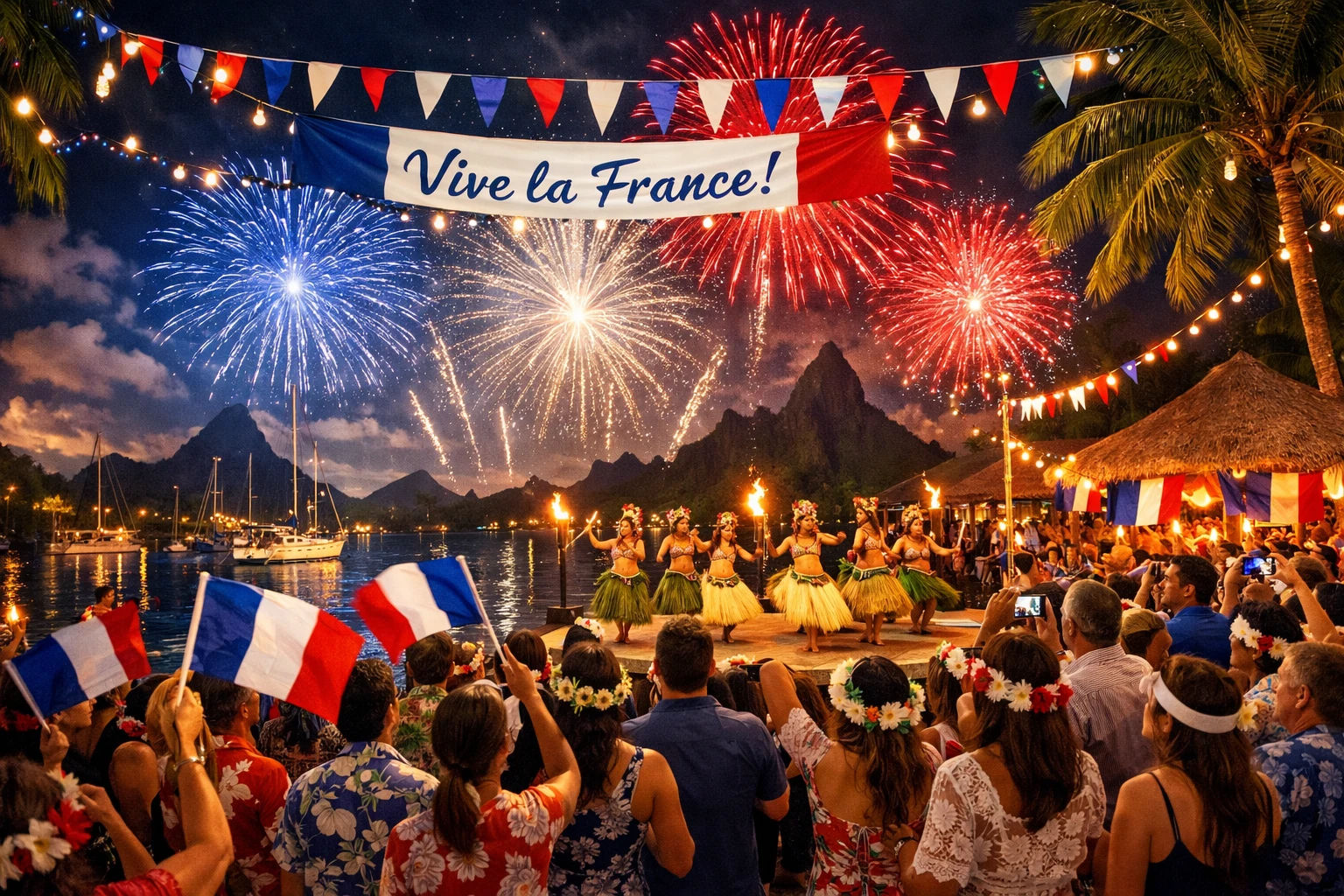
Bastille Day on July 14th is celebrated in French Polynesia with parades, fireworks, and various public events that showcase French culture. Colorful parades take place in major towns, featuring floats, dancers, and musicians. As night falls, spectacular fireworks light up the sky, creating a magical atmosphere. Community involvement means locals and visitors alike participate, making it a fun experience for everyone. Cultural performances of traditional Tahitian dances are performed, showcasing the rich heritage of the islands.
The fireworks that close the official July 14 celebrations in Papeete deserve particular mention. The harbor at Papeete, with the mountains of Tahiti rising steeply behind the waterfront and the calm lagoon water providing a perfect reflective surface, is among the finest fireworks settings available anywhere in the Pacific. The combination of the display above and its mirror image below in the water creates the kind of visual spectacle that photographs only partially capture and that memory holds with unusual clarity for years afterward.
The Heiva i Tahiti: The Festival That Gives July 14 Its Full Context
Seventeen Days of Cultural Celebration With July 14 at Its Heart
The Heiva i Tahiti is one of the most important cultural events on The Islands of Tahiti. It was created in 1881, and it is one of the oldest festivals in the world. From July 3 to 19, 2026, it will feature several artists in song and dance with colorful performances and costumes. Visitors are invited to join in with events, shows, rituals, and contests. The events calendar offers dance shows, songs, but also amazing traditional sports including Heiva Tuaro and Heiva va'a. The communities representing the different archipelagos of the islands of French Polynesia gather in Papeete at this time of the year to present their arts, techniques, and know-how during contests and craft exhibitions.
July 14 sits at the structural center of the Heiva i Tahiti's seventeen-day program, arriving eleven days into the festival and five days before its close. By July 14, the most important dance and song competitions of the season have either just concluded or are approaching their final nights, the traditional sports competitions at the Museum of Tahiti are in full swing, and the city of Papeete is at maximum cultural saturation: every restaurant is full, every hotel is full, every vendor stall along the To'ata waterfront is operating at capacity, and the atmosphere of the Polynesian city in full celebration mode is something that rewards the visitor who simply walks through it without any particular agenda.
People from across French Polynesia's five archipelagos take part in Heiva i Tahiti's countless sporting competitions, beauty pageants, parades, and food tastings. There are also competitions in stone weight lifting, palm tree climbing, and coconut cracking. Colorfully dressed Tahitian dance troupes perform to traditional music on To'ata Square's open amphitheater and stage as vendors sell their handicrafts nearby.
The To'ata amphitheatre, the lagoon-side outdoor performance venue that serves as the primary stage for the Heiva's evening dance competitions, is at its most concentrated energy in the days immediately before and after July 14. The troupes that have been preparing for the better part of a year to perform here bring their absolute best to these nights, and the audience that fills the amphitheatre is one of the most engaged and most knowledgeable you will find anywhere in the Pacific. These are not tourists being introduced to a cultural practice for the first time. These are Tahitian families who know every troupe's history, every choreographer's style, and every competitive result going back decades. Their response to what happens on stage tells you as much as the performance itself.
Beyond Papeete: Bastille Day Across the Outer Islands
From Bora Bora to Moorea, the Islands All Celebrate
One of the most appealing aspects of Bastille Day in French Polynesia is its island-wide character. The celebration is not confined to the capital, and for visitors based in Bora Bora, Moorea, Huahine, or any of the outer island resorts during July, the July 14 celebrations are part of the local community's own program.
Although the main Tahiti Pearl Regatta race is open to sailing boats of all sizes, and Heiva extends across all five archipelagos of French Polynesia. Each island and archipelago puts on its own version of Heiva during the month of July.
Bora Bora, whose incomparable lagoon setting and dramatic volcanic peaks make it perhaps the most visually celebrated island in the entire Pacific, observes Bastille Day with its own community celebrations that connect the national holiday to the local Heiva i Bora Bora program. The smaller scale of the outer island celebrations relative to the grand spectacle of Papeete gives them a different quality: more intimate, more neighborhood-focused, and in some ways more genuinely communal precisely because everyone knows everyone else in attendance.
Moorea, just thirty minutes by ferry from Papeete, offers the option of crossing from the capital for the Bastille Day parade and fireworks in the evening and returning to one of the most dramatically beautiful bays in the Pacific for the night. The mountain profiles of Moorea, visible from Papeete across the Sea of the Moon, provide the constant visual backdrop for the Papeete celebrations, and seeing them illuminated in the glow of fireworks reflections on the harbor water on the night of July 14 is a specifically Tahitian visual experience that does not exist anywhere else.
The Food, the Music, and the Evening Light of a Tahitian July 14
Where to Eat, What to Listen For, and How to Find Your Best Memory
The food of the Heiva and Bastille Day season in Papeete is one of the most complete expressions of French Polynesian culinary identity available to any visitor. The vendor stalls along the To'ata waterfront and in the Paofai Gardens serve ma'a Tahiti, traditional Polynesian food, including poisson cru, the national dish of raw fish marinated in lime juice and coconut milk that is simultaneously the simplest and most satisfying thing the island produces; the pork, spinach, and fafaru combination that represents the ancient feast food tradition; and the freshly baked bread and pastry that reflect the French culinary inheritance. Alongside these, the Chinese and French food traditions that are equally part of Papeete's multicultural food landscape fill the restaurants around the market and along the boulevard.
The traditional music that accompanies every Heiva event is the to'ere, the struck hardwood slit drum that produces the distinctive hollow staccato sound that everyone who has spent time in Tahiti identifies immediately and indelibly with the place. The singing and dancing competitions continue with music composed with traditional instruments such as the nasal flute and ukulele, and the combination of these instruments, plus the full drum orchestra driving the dance competitions, creates a sonic environment for July 14 evenings in Papeete that is unlike any other national day celebration anywhere in the world.
The July evening light in Papeete begins its most beautiful phase around 6 PM, when the sun moves toward the western horizon across the lagoon and the mountains behind the city shift from the harsher brightness of midday to the warm amber and gold of a Pacific sunset. Finding a table on the terrace of one of the waterfront restaurants or bars in the hour before the evening Heiva performances begin, watching the light change over the water while the drums from the rehearsal at To'ata drift across, and eating poisson cru with a cold Hinano beer: this is what July 14 in Tahiti actually feels like when you have found your way into it properly.
Practical Information: Being in Tahiti for July 14, 2026
Flights, Accommodation, and What to Book in Advance
Airline and hotel reservations are difficult to come by during July, so book early and take your written confirmation with you.
That advice from a long-established Tahiti travel guide is as true for July 14 weekend as for any point in the Heiva season. July is the most popular travel month to French Polynesia, driven directly by the Heiva and Bastille Day celebrations, and accommodation from Papeete to Bora Bora fills months in advance. The combination of the Heiva's international reputation and the French national holiday creates demand from both international visitors and French nationals traveling to the territory for the national celebration that exceeds the islands' total accommodation capacity at many property categories.
Flying into Fa'a'ā International Airport in Papeete on or before July 12 gives you the best chance of experiencing the full July 14 program from the military parade through the evening fireworks. Direct connections operate from Los Angeles on Air Tahiti Nui and United, from Paris on Air Tahiti Nui and Air France, from Auckland on Air New Zealand, from Sydney on Air Tahiti Nui, and from Tokyo on Air Tahiti Nui.
July weather in Tahiti is in the heart of the dry, cooler austral winter season, with temperatures in the low to mid-twenties Celsius, lower humidity than the summer months, and predominantly clear skies that make both the daytime parade and the evening fireworks visually spectacular. The trade winds blow reliably from the southeast, providing the gentle cooling breeze that makes outdoor evening events on the waterfront thoroughly comfortable even for visitors from temperate climates.
The July 14 public holiday means that most government offices and many businesses are closed, but the tourist infrastructure of hotels, restaurants, and transport runs at full capacity. The Papeete market, which normally operates every morning, observes shortened hours on the national holiday but does not close entirely, and the evening vendor scene along the waterfront is at its most extensive precisely because of the holiday crowd.
For a visitor arriving in Tahiti with no prior experience of the Heiva or the Bastille Day celebrations, the single most rewarding investment of time is arriving at the To'ata waterfront early enough on the evening of July 14 to find a good position for the fireworks, then walking the full length of the festival area along the boulevard while the vendors are in full operation, before settling in for whatever cultural performance the evening program brings. The fireworks will be spectacular. The food will be extraordinary. The music will follow you home.
Verified Information at a Glance
Event Name: Bastille Day (le 14 juillet) / National Day Celebrations in Tahiti, French Polynesia
Event Category: French National Public Holiday with Military Parade, Fireworks, and Community Celebrations, coinciding with the Heiva i Tahiti cultural festival
Date: Tuesday, July 14, 2026
Official Ceremony: Military parade in Papeete followed by a reception in the residential gardens of the French Republic High Commissioner
Primary Location: Papeete, Tahiti, French Polynesia (main celebrations along Pomare Boulevard waterfront and To'ata Square amphitheatre area)
Heiva i Tahiti Festival Dates (surrounding context): July 3 to 19, 2026 (July 14 falls at the center of this 17-day program)
French Polynesia Autonomy Day (festival opening): June 29, 2026 (the Heiva i Tahiti traditionally begins around this date)
Key July 14 Activities:
- Official military parade along Pomare Boulevard, Papeete (morning)
- French Republic High Commissioner reception (afternoon)
- Evening fireworks display over Papeete harbour
- Heiva evening dance and song competitions at To'ata Amphitheatre
- Vendor stalls, handicraft market, and food festival along the waterfront
- Community celebrations across the outer islands including Bora Bora, Moorea, and beyond
To'ata Amphitheatre Heiva Ticket Prices: Typically 1,500 to 3,000 XPF per evening performance (approximately $13 to $27 USD); tickets available from May 2026 via tahititourisme.pf
Admission to Bastille Day Public Celebrations: Free
Nearest Airport: Fa'a'ā International Airport (PPT), Papeete (approximately 5 km from city center)
International Flight Connections: Los Angeles (direct), Paris (direct), Auckland, Sydney, Tokyo, and connections through other Pacific hubs via Air Tahiti Nui, Air France, Air New Zealand, and United Airlines
Booking Note: July is the highest-demand month of the year for French Polynesia; flights and accommodation should be booked several months in advance
Official Tourism Information: tahititourisme.pf
All details verified from the official Tahiti Tourisme website at tahititourisme.pf, National Geographic's Bastille Day global celebrations guide, Wikipedia's Bastille Day article, xdaysiny.com's comprehensive Heiva Festival guide, Frommer's French Polynesia Calendar of Events, Exoticca.com's French Polynesia events guide, and dresslerdetours.com's Heiva i Tahiti 2026 article. The July 14, 2026 date is fixed in both the French and French Polynesian public holiday calendars. Specific July 14 ceremony timing and programming details will be announced by the French Republic High Commission and the Collectivity of French Polynesia closer to the date.