Heiva i Tahiti 2026: The World's Oldest Island FestivalHeiva i Tahiti 2026: The World's Oldest Island Festival Returns to the Heart of Polynesia
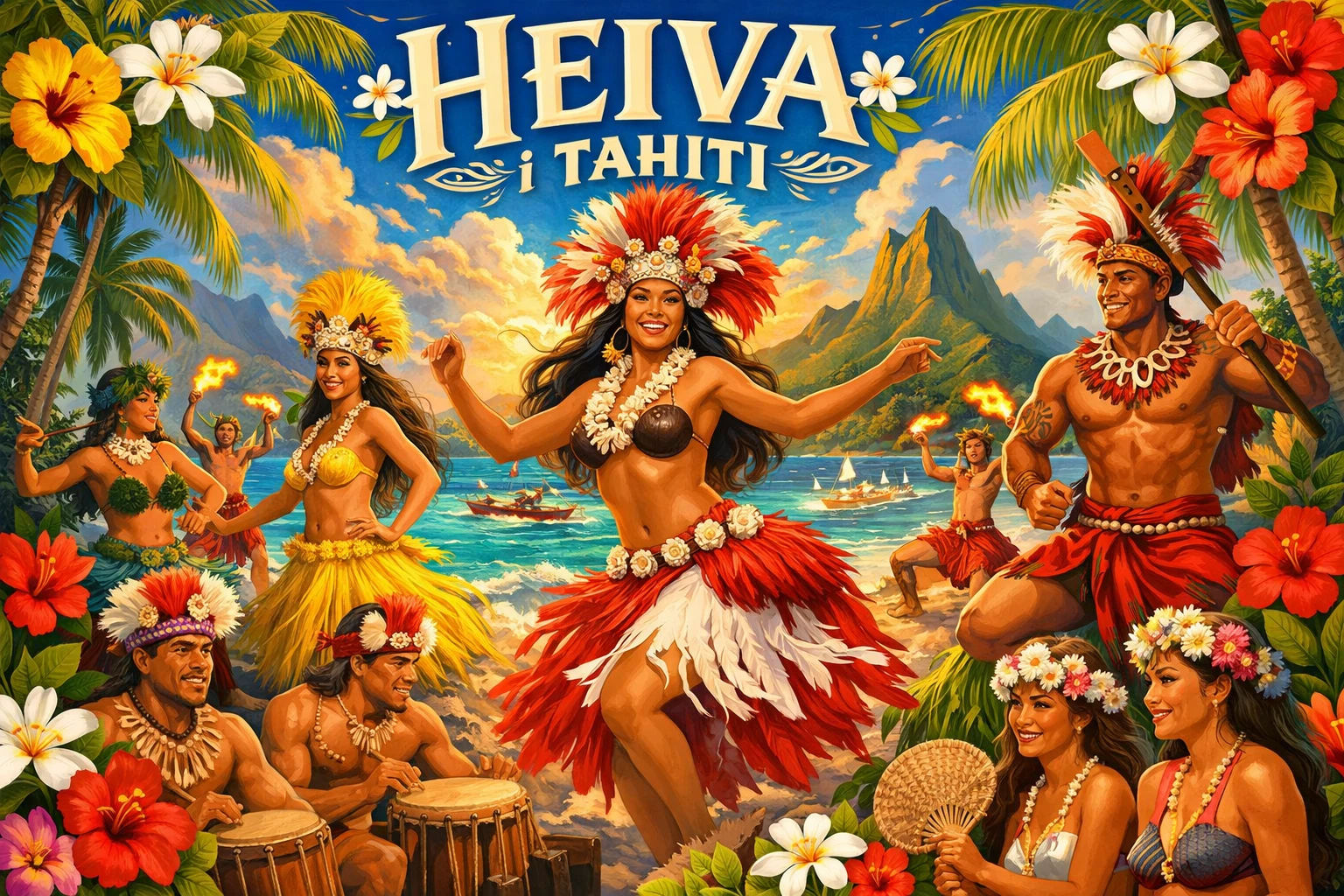
There is a moment during the Heiva i Tahiti that no photograph can prepare you for, no travel documentary can replicate, and no description in any language can fully communicate. A company of sixty or more dancers moves across the To'ata amphitheatre stage in absolute synchrony. The women's hips trace the stories of ocean voyages and sacred ceremonies in the 'ote'a, the most demanding of all Polynesian dances. The drummers drive everything with the to'ere and the fa'atete, the hand-carved hardwood percussion instruments that have been directing Tahitian ceremony for centuries. And somewhere in the crowd of thousands of people who have gathered in the warm July night to watch, something catches in the throat that has nothing to do with sentimentality and everything to do with the genuine experience of watching a civilization celebrate itself with absolute mastery and absolute joy.
This is the Heiva i Tahiti, one of the most important cultural events on The Islands of Tahiti, a popular community festival that has been one of the annual must-see events for almost 140 years.
From July 3 to 19, 2026, the Heiva i Tahiti will feature several artists in song and dance with colorful performances and costumes. Visitors are invited to join in with events, shows, rituals and contests. The events calendar offers dance shows, songs but also amazing traditional sports including Heiva Tuaro and Heiva va'a I Mataiea. The communities representing the different archipelagos of the islands of French Polynesia gather in Papeete at this time of the year to present their arts, techniques and know-how during contests and craft exhibitions.
Seventeen days. One island capital. The fullest expression of Polynesian cultural identity available anywhere on earth. If there is a single event that belongs on every serious traveler's lifetime list, this is it.
145 Years of Unbroken Celebration: Understanding the Heiva's Depth
From Colonial-Era Celebration to UNESCO-Level Cultural Treasure
The Heiva i Tahiti is the most popular and important event in the cultural calendar of The Islands of Tahiti. A colorful celebration of traditional chants, music and dancing, in a competition which brings together dance troupes from every corner of French Polynesia. The evening performances are a rapturous explosion of color and movement.
The festival's founding in 1881 places it among the oldest continuously running cultural festivals in the world. It began as a celebration around July 14, the French national holiday, but the specifically Polynesian content, the traditional dances, the sacred chants, the ancient sports, the craft competitions, was always the living heart of the event rather than any colonial occasion. Over the decades, that living heart has only grown stronger. The Heiva has survived the full arc of French Polynesia's political history, from colonial subordination through the nuclear testing era to the current status of an Overseas Collectivity with meaningful cultural autonomy, and it has emerged from that history as one of the most powerful acts of cultural self-determination available to any Pacific island community.
The name Heiva itself contains its own significance. In Tahitian, heiva denotes a gathering for the purpose of festivity and cultural expression, a concept that encompasses the competitive dimension alongside the celebratory one. You come to the Heiva to show what you know, what you have kept alive, what your community has preserved and developed and refined across generations. And you come to be seen doing it, by your neighbors, by your ancestors in spirit, and by the world.
The Dance: Why the 'Ote'a Is the Heart of Everything
A Competition Standard That Has No Equal in the Pacific
The Heiva is Tahiti's most emphatic statement of their deep history and rich culture. It's a non-stop, month-long celebration of joy through dance, song, and other cultural events giving an understanding of Polynesian culture, history and life.
The dance competitions at the Heiva are organized across two primary categories that represent the two fundamental streams of Polynesian performing arts. The 'ote'a is the most spectacular and most demanding, a fast-paced and highly choreographed group dance where performers in elaborate costumes of tapa bark cloth, natural fibers, and feathers execute synchronized hip movements, stomping rhythms, and formations that tell stories drawn from Polynesian mythology, history, and cosmology. The more than thirty muscles required to execute proper 'ote'a hip technique correctly cannot be trained overnight. The best dancers in the top competing groups have spent years or decades developing the precision and power that the competition demands.
The 'aparima is the contrasting form: slower, more gestural, more explicitly narrative. Performed primarily with the hands and upper body to express stories, prayers, and emotional states through specific codified movements, the 'aparima is often described as the more intimate of the two major dance forms and the more accessible to non-Polynesian audiences trying to read the meaning in the performance. Watching a master 'aparima performer tell the story of a sea voyage or a divine encounter entirely through the movement of their hands and the expression of their face is one of the most quietly astonishing things available to any audience anywhere in the world.
The Heiva dance troupes, or groups, spend twelve months preparing each year's program. Choreographers devise new arrangements, costume designers create new outfits, and every dancer commits to an intensive rehearsal schedule that reflects the genuine competitive stakes involved. The top groups in the professional division are competing for prizes, prestige, and the honor of being recognized as the finest expression of living Polynesian dance culture by a panel of knowledgeable judges. The stakes are real, and the performances reflect that.
The Music: When the Drums of Polynesia Fill the Night
To'ere, Fa'atete, and the Ancient Orchestra Tradition
The drum orchestra that accompanies every Heiva dance performance is not simply rhythmic support for what the dancers are doing. It is co-equal with the dance, shaping its dynamics and emotional register as fully as the choreography itself. The Traditional Tahitian Orchestra has a long and rich history dating back centuries. The orchestras are essentially percussion based utilizing a series of drums developed over time and made by hand from local materials.
The to'ere is the traditional drum that is the most challenging to play and the true director of ceremonies. Its role is of paramount importance in all Tahitian compositions. It's the to'ere that gives the distinctive hollowed wooden, high-pitched sound that most people associate with the Heiva, indeed with Traditional Tahitian Orchestras. The to'ere is most often made by the hands of its player, hollowed from a log of one of several native hardwood trees like the tou, the poro'ati, or the highly regarded miro.
Hearing a full traditional orchestra driving a sixty-person dance company at the To'ata amphitheatre is a physical experience as much as an auditory one. The sound enters through the ears and through the chest simultaneously. The rhythm is complex enough to reward careful listening but immediate enough that anyone who has never heard Tahitian percussion before finds their body responding to it instinctively. This is music that was made over centuries for exactly this purpose: to move people, in every sense of the word.
The Traditional Sports: Heiva Tuaro and the Ancient Athletic Tradition
When Warriors' Games Become Competition
In July, visitors are invited to join in with events, shows, rituals and contests. The events calendar offers dance shows, songs and also amazing traditional sports.
The Tuaro Maohi, the traditional Polynesian sports competitions, are among the most distinctive and most visually extraordinary components of the entire Heiva program. These are not archaeological re-enactments of sports nobody practices anymore. They are living athletic traditions maintained by communities of genuine competitors, and the skills on display represent physical capabilities developed over generations of practice.
Coconut husking at speed, the Pa'aro Ha'ari, is one of the most astonishing things you will ever see a human being do with a sharpened stick and the conviction that time matters. The best competitors can reduce an entire coconut to its inner shell in seconds, using a blade fixed in the ground and the momentum of the whole body to force the husk away from the inner nut in a process that looks dangerous but is executed with complete mastery. Stone lifting, the Amoraa Ofai, challenges competitors to raise stones of specific weights in specific ways, and the athletes who train for this event represent a physical tradition of strength and technique unique to the Pacific.
The javelin throwing at a coconut target, Patia Fa, takes the upper body skills of stone lifting and directs them at a target suspended above the competition area. The Heu Uru, the climbing of the coconut palm, is exactly what it sounds like and consistently draws some of the loudest crowd response of any traditional sports event in the Heiva calendar.
Va'a paddling, the outrigger canoe races that occur as part of the broader Heiva season, connect the competitions directly to the voyaging tradition that brought Polynesian ancestors across ten million square kilometers of open Pacific to settle every habitable island in the world's largest ocean. Watching sprint races between outrigger canoes in the harbor at Papeete, with the mountains of Tahiti behind the finish line and the crews digging their paddles into the water with everything they have, is a reminder that the Polynesian relationship with the ocean is not metaphorical. It is the founding fact of the civilization that the Heiva celebrates.
Papeete and the To'ata Amphitheatre: The Stage That Belongs to This Festival
A Capital City That Transforms in July
Papeete, the capital of French Polynesia and the urban heart of Tahiti, is a city that wears its Polynesian identity most visibly during the Heiva season. The To'ata amphitheatre, the city's premier outdoor performance venue situated on the Pomare Boulevard waterfront, hosts the major evening competitions and draws crowds that fill its open-air seating and spill onto the surrounding areas in the warm July nights.
The city of Papeete goes through a makeover for the event with illuminations of Pomare Boulevard, on the waterfront, and the city hall at dusk. Those illuminations transform the boulevard into something genuinely festive, and walking along the Papeete waterfront in the early evening during the Heiva, with the lights reflecting off the harbor and the drums audible from the direction of To'ata, is one of the finest urban evening experiences available in the entire Pacific.
Beyond To'ata, the festival extends into the surrounding spaces of Papeete with craft exhibitions, traditional food stalls, and the informal cultural exchange that accompanies any great island festival. The Marché de Papeete, the city's famous covered market, is at its most vibrant during July as the Heiva brings additional visitors into the city and the vendors who sell everything from vanilla and black pearls to pareo fabrics and monoi oil extend their hours to meet the demand.
Practical Information: Attending the Heiva i Tahiti 2026
Tickets, Timing, and How to Experience It Fully
Tickets open on May 2026. The typical ticket pricing for the Heiva dance competitions at the To'ata amphitheatre has historically ranged from approximately 1,500 to 3,000 XPF (roughly $13 to $27 USD) per evening performance, depending on the category of competition and the seating area. The evening performances, which are the festival's most spectacular events, typically begin at 7:00 or 7:30 PM and run for three to four hours. Arriving early, as the seats are un-numbered in most sections, is essential for securing a good view.
There is no fee payable to witness any of the other events, including Va'a, Coprah, Tressage and Pandanus, Patia Fa, Tuaro Maohi, and Porteurs de Fruits. The traditional sports competitions, craft demonstrations, and many of the daytime cultural events are free to attend, making it entirely possible to experience the Heiva's full breadth across seventeen days while paying only for the ticketed evening performances that form the competitive heart of the dance competition.
Getting to Tahiti involves flying into Fa'a'ā International Airport, located approximately five kilometers west of Papeete. Direct services operate from Los Angeles, Paris, Tokyo, Auckland, and Sydney, with Air Tahiti Nui, Air France, United, and Air New Zealand among the carriers serving the route. July is one of the most popular months of the year for Tahiti travel precisely because of the Heiva, which means booking flights and accommodation several months in advance is strongly recommended. The cooler, drier July climate, with temperatures in the mid-to-high twenties Celsius and lower humidity than the December through February wet season, makes it one of the most physically comfortable times of year to be on the island.
Accommodation in Papeete ranges from the international business hotels near the port to smaller guesthouses in the residential neighborhoods above the city, and properties along the western coast of Tahiti Nui in the Punaauia and Paea areas provide easy access to the capital while offering lagoon views and a slightly more relaxed atmosphere. The fifteen-minute drive between Papeete and the Punaauia hotels is entirely manageable for evening commutes to and from the To'ata.
The Festival That Defines an Island's Identity
The Heiva i Tahiti is an emotional encounter, a plunge into our age-old culture, made of grace and liveliness, festivities and competitions, diversity and unity. Dualities that unite us: the Heiva i Tahiti is certainly the most beautiful expression of Polynesian culture.
That description, written from inside the culture by someone who has experienced the festival as a living inheritance rather than a tourist attraction, captures exactly what distinguishes the Heiva from every other cultural festival in the Pacific. It is not staged for visitors. It never has been. It is the community of French Polynesia in conversation with itself about who it is, what it values, and what it intends to carry forward into the future. Visitors are welcomed, genuinely and warmly, into that conversation. But the conversation happens whether or not any visitors show up, because it is not for them. It is for the islands and the people who belong to them.
Being in Papeete from July 3 to 19 is the closest thing available to understanding what that means from the outside looking in with growing respect and growing wonder. Every evening performance teaches you something. Every traditional sport competition shows you something you had not seen before. Every drum beat in the night air over the To'ata connects you, briefly but genuinely, to something that has been continuous in this place for a hundred and forty-five years and for far longer in the deeper history before it had a formal name.
Verified Information at a Glance
Event Name: Heiva i Tahiti 2026
Event Category: Annual International Cultural Festival and Performing Arts Competition
Organizer: Maison de la Culture – Te Fare Tauhiti Nui, Papeete, Tahiti
Founded: 1881 (nearly 145 years of continuous annual celebration)
2026 Dates: July 3 to July 19, 2026 (17 days)
Primary Venue: To'ata Amphitheatre, Pomare Boulevard, Papeete, Tahiti, French Polynesia
Location: Papeete, Tahiti, French Polynesia (Society Islands, South Pacific)
Event Components: Dance competitions: 'Ote'a and 'Aparima group competitions (evening performances at To'ata) Song competitions: Traditional chant and modern categories Tuaro Maohi traditional sports: Coconut husking, stone lifting, javelin throwing (Patia Fa), coconut palm climbing (Heu Uru), Amoraa Ofai Va'a outrigger canoe racing (Heiva va'a I Mataiea) Craft exhibitions and demonstrations Artisan market
Ticket Information: Tickets open May 2026. Evening dance competition tickets typically range from approximately 1,500 to 3,000 XPF ($13 to $27 USD) per performance. Traditional sports, craft events, and most daytime events are free.
Ticket Availability: Tahiti Tourisme official website at tahititourisme.pf from May 2026
Nearest Airport: Fa'a'ā International Airport (PPT), Papeete, Tahiti (approximately 5 km from city center)
Direct International Connections: Los Angeles, Paris, Tokyo, Auckland, Sydney, and other hubs via Air Tahiti Nui, Air France, United Airlines, and Air New Zealand
Official Festival Phone: +689 40 54 45 44
Official Tourism Reference: tahititourisme.pf/en-pf/events-tickets/all-the-events/heiva-i-tahiti-2026-papeete
All details verified from the official Tahiti Tourisme website at tahititourisme.pf (January 2026 listing confirming July 3 to 19, 2026 dates), the Tahiti Tourisme corporate event calendar at tahititourisme.org confirming Heiva i