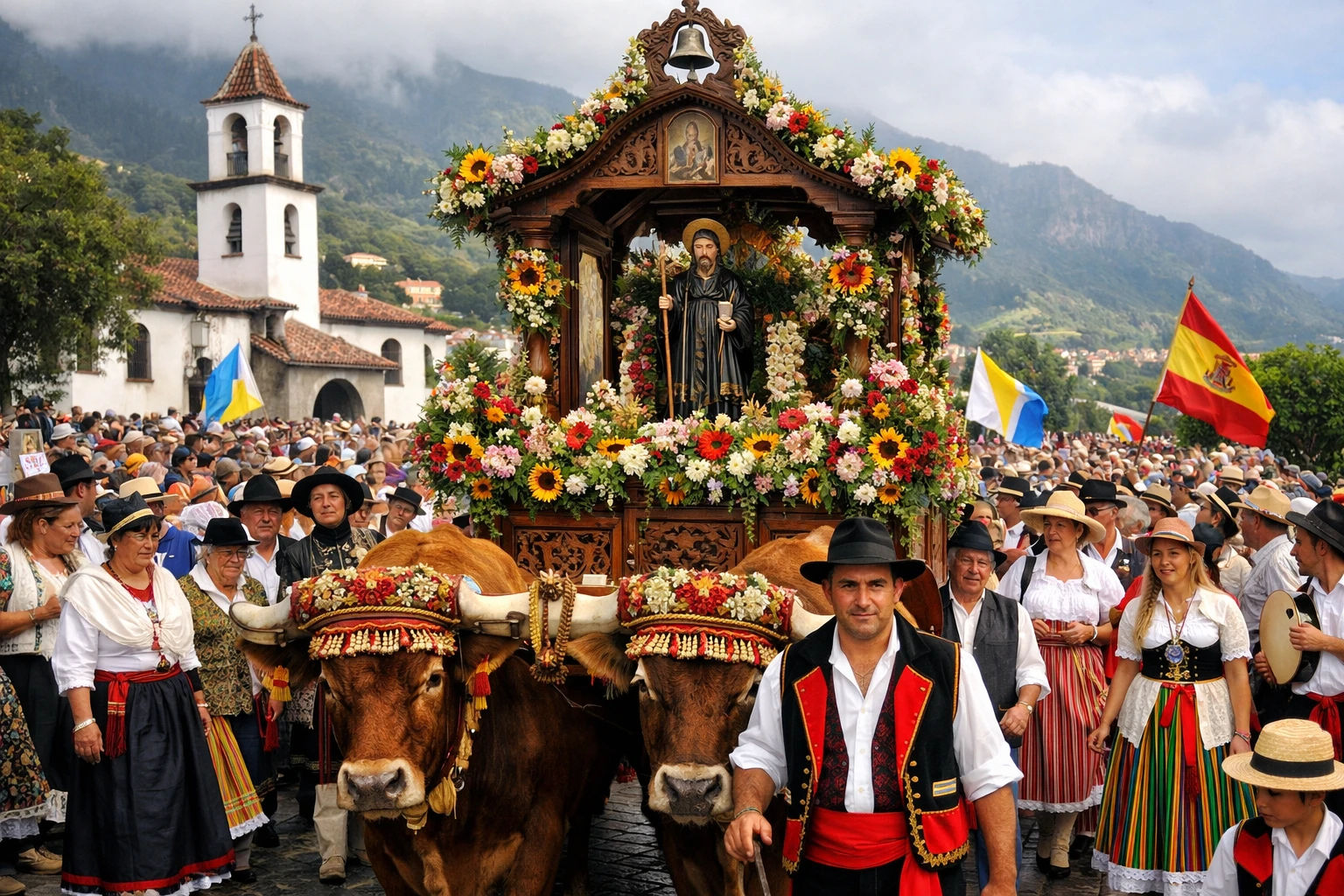
Romería de San Benito Abad 2026 in Tenerife: The Island's Greatest Pilgrimage Festival Returns to La Laguna
The Romería Regional de San Benito Abad is one of the most beloved and culturally significant festivals in all of the Canary Islands, held every year on the second Sunday of July in the UNESCO World Heritage city of San Cristóbal de La Laguna in Tenerife. Based on the confirmed annual pattern, the 2026 edition will fall on Sunday, July 12, 2026. The event is free to attend, has been declared a Festival of National Tourist Interest by the Spanish government, and has drawn more than 43,000 people to the streets of La Laguna in a single edition.
For visitors who want to experience Tenerife beyond its beaches and resort life, this is one of the most authentic and emotionally resonant island events on the calendar. It is a day when La Laguna opens its historic streets to ox carts, folk music, traditional dress, livestock, and an enormous procession of community life that connects present-day Tenerife to a story stretching back almost five centuries.
What Is the Romería de San Benito Abad?
A romería is a pilgrimage festival with deep roots in Spanish and Canarian culture, combining religious devotion with agricultural celebration, community gathering, folk music, and traditional food. The word romería comes from the early Christian tradition of pilgrimages to Rome, but on Tenerife, the form has evolved into something entirely its own, a procession of decorated ox carts, women in traditional island dress, livestock, musicians, and thousands of participants moving through the streets of a town or city.
The Romería de San Benito Abad is the most famous romería in Tenerife and one of the most important in the Canary Islands as a whole. Wonderful Tenerife describes it as a popular fiesta held on the second Sunday of July that has been declared an event of national tourist interest, with a cortege made up of seven young women each wearing the traditional dress of one of the seven inhabited Canary Islands, who carry flowers and fruit as an offering to the saint.
That seven-island representation is one of the details that makes this romería feel genuinely regional rather than purely local. It is not just La Laguna celebrating its patron. It is all of the Canary Islands gathering under one procession.
The 500-Year Story Behind the Festival
The origins of the Romería de San Benito Abad go back to 1532, when the island of Tenerife suffered a devastating drought that threatened the island's entire agricultural economy. According to Wikipedia's account of the event, the union of farmers gathered and placed the names of several Catholic saints onto folded papers in a hat. Three times they drew from the hat, and three times the name of Saint Benedict emerged.
That triple selection was interpreted as divine guidance. San Benito, or Saint Benedict of Nursia, became the patron saint of Tenerife's farmers from that moment onwards, and the annual celebration of his protection became institutionalized in La Laguna through the city's own council ordinances.
La Laguna's Turismo page describes how since then the festival has been held every year and San Benito has become the protector and keeper of fields and cattle, with the romería evolving from a purely religious observance into a meeting of agricultural and urban worlds.
Gestión Patrimonio Cultural notes that in the eighteenth century, during a cicada plague that threatened crops, the entire community went out in procession with the Saint carried on his throne, seeking his protection for the harvest. That kind of practical, urgent relationship between community and saint gives the festival a depth of meaning that purely theatrical or commercial events simply cannot match.
The City That Hosts It: San Cristóbal de La Laguna
The Romería de San Benito Abad takes place in San Cristóbal de La Laguna, one of the most extraordinary cities in the entire Spanish archipelago. La Laguna was declared a UNESCO World Heritage Site in 1999 in recognition of its perfectly preserved 15th and 16th century urban layout, its colonial-era churches and convents, its pastel-painted buildings, and its historical role as the first non-fortified Spanish colonial city in the Americas.
The city sits in the northeast of Tenerife at an altitude of about 550 meters, giving it a cooler and more overcast climate than the southern coast. The streets of the historic center, many of which are pedestrianized, were designed for foot traffic and human gathering long before cars existed, which makes them perfect for a procession of ox carts, musicians, and thousands of people in traditional costume.
The old city is connected to Santa Cruz de Tenerife by the modern tram line, which makes La Laguna one of the most accessible historic centers in the island. You can travel from the center of Santa Cruz to the heart of La Laguna in about twenty minutes on the tramway without touching a car.
What Happens During the Romería
The romería is structured around a morning mass and a long festive procession that moves through La Laguna's historic streets across the day. The La Laguna tourism page confirms that the event includes a misa romera, a pilgrim's mass, with a flower tribute and a blessing of cattle, before the romería parade begins.
Wonderful Tenerife describes the cortege as including the seven-island representative women with their floral and fruit offerings, decorated floats, rondallas, parrandas, and livestock that parade through the streets of La Laguna.
The key elements that make the day so visually and emotionally compelling include:
- Ox carts, decorated with flowers, fruit, and agricultural produce, many of which have been passed down through generations of Tenerife farming families.
- Traditional Canarian costume worn by both participants and many spectators, with the women's dress being particularly colorful and elaborate.
- Rondallas and parrandas, Canarian folk music groups playing instruments such as the timple, guitar, and bandurria, that accompany the procession with traditional songs.
- The blessing of animals, including cattle and other livestock, which reflects the festival's agricultural origins and gives the event a unique quality that you simply do not find at modern commercial festivals.
- Food sharing throughout the day, as participants and families stationed along the route offer typical Canarian products to bystanders.
Web Tenerife UK describes the 2025 edition and uses the word "captivating" to describe the atmosphere when thousands of people and ox carts fill La Laguna's streets, and notes that food, music, and culture are the stars of the show throughout the day.
The Scale of the Event
One of the details that helps visitors understand just how significant the Romería de San Benito Abad is, is the scale at which it operates. Web Tenerife UK noted in an earlier coverage that around 43,000 people gathered at the celebration in a recent edition, and that more than 55 carts participated.
Those numbers show that this is not a small-town parish event. It is a regional festival of genuine mass participation, comparable in community scale to many of the most celebrated Spanish festivals on the mainland.
The national tourist interest declaration also reflects this scale. Only events that demonstrate significant cultural value, historical importance, and broad public participation are granted that designation by the Spanish authorities, and the Romería de San Benito Abad has held it for many years.
The Festive Days Around the Romería
The romería itself falls on the second Sunday of July, but the Festividades de San Benito Abad in La Laguna extend around it with additional days of celebration. Webtenerife.co.uk and the city tourism page both confirm that the festivities include other cultural activities, evening celebrations, and community events in the days immediately before and after the main Sunday procession.
The evening before the romería often features music and informal gatherings in the streets and plazas of the historic center. The days that follow carry a relaxed, post-celebration atmosphere that makes spending two or three nights in La Laguna around the festival weekend a genuinely satisfying island experience.
Food, Music, and Canarian Culture
One of the things the Romería de San Benito Abad showcases most powerfully is Canarian food and drink culture. As the ox carts pass and participants share food with bystanders along the route, the range of traditional products on offer covers a lot of Tenerife's agricultural heritage.
You can expect to encounter gofio, the toasted grain flour that is central to Canarian cooking, mojo sauces, fresh cheeses, papas arrugadas, cured meats, honey from the island's interior valleys, wine from Tenerife's D.O. vineyards, and various locally made sweets and pastries.
The folk music of the rondallas and parrandas is the other cultural centerpiece of the day. The timple, a small ukulele-like instrument, is the most distinctively Canarian sound in island music, and hearing it played live in procession through the streets of a UNESCO-listed city is the kind of experience that stays with you long after you leave the island.
Practical Travel Tips for the 2026 Romería
If you plan to attend the Romería de San Benito Abad on July 12, 2026, a little practical planning goes a long way.
Getting to La Laguna
- The easiest way to reach La Laguna from anywhere in the greater Santa Cruz metropolitan area is the Tenerife Tram, which runs from Santa Cruz to La Laguna at regular intervals and takes about 20 minutes.
- Tenerife Norte Airport is close to La Laguna, only about 5 to 10 minutes by taxi.
- Driving into the historic center is not recommended on romería day because the streets are closed for the procession. Take the tram or park on the city outskirts and walk in.
Where to Watch and Stand
- The procession moves through the main streets of the historic center, with the most popular viewing spots filling early. Arriving by mid-morning gives you a good position along the route.
- Plazas and street corners near the old cathedral and the historic center's main axes tend to offer the best views of the ox carts and the full cortege.
What to Wear and Bring
- Comfortable shoes are essential for a day of standing and walking through cobblestone streets.
- A light layer is wise as La Laguna's elevation makes it noticeably cooler than the coast, especially in the evening.
- Bringing some cash for food and drink from vendors and stalls along the route is helpful.
Staying in La Laguna
- La Laguna has a modest but growing range of accommodation including guesthouses, boutique hotels, and apartments within and near the historic center.
- Santa Cruz de Tenerife is also a very convenient base, with the tram giving you fast and easy access on the day.
- Puerto de la Cruz in the north is further away but still reachable by road, and some visitors combine the romería with a wider northern Tenerife itinerary.
Why the Romería de San Benito Abad Matters for Tenerife Visitors
The romería is Tenerife at its most honest and most generous. It does not charge admission. It does not have a backstage. It does not separate the performers from the audience behind barriers. The whole city is the stage, the participants are the performers, and the only requirement for attendance is a willingness to stand in a UNESCO-listed street and let five hundred years of island culture walk past you.
For visitors who have come to Tenerife and spent their time in the southern resort areas without encountering anything of the island's pre-tourist identity, the Romería de San Benito Abad in La Laguna is the single most powerful antidote available. It shows you what this island was, what it still is underneath the hotels and beaches, and why the people who were born here are proud of it in a way that a beach holiday can never fully reveal.
Verified Information at a Glance
- Event name: Romería Regional de San Benito Abad, also known as Romería de San Benito Abad.
- Event category: Annual religious and agricultural pilgrimage festival, Canarian cultural celebration, free public event.
- Confirmed official status: Declared a Festival of National Tourist Interest by the Spanish government.
- Confirmed annual timing: Second Sunday of July every year.
- Calculated 2026 date based on confirmed annual pattern: Sunday, July 12, 2026.
- Confirmed location: San Cristóbal de La Laguna, Tenerife, Canary Islands, Spain.
- Confirmed UNESCO status of host city: San Cristóbal de La Laguna is a UNESCO World Heritage Site.
- Confirmed admission: Free.
- Confirmed patron honored: Saint Benedict of Nursia, patron saint of Tenerife's farmers since 1532.
- Confirmed procession elements: Seven women in traditional dress of each Canary Island, decorated ox carts, rondallas, parrandas, livestock, floats.
- Confirmed festival activities: Pilgrim's mass, flower tribute, blessing of cattle, procession, folk music, food sharing.
- Confirmed attendance scale from recent editions: More than 43,000 people and more than 55 carts.
- Confirmed origin: 1532 drought in Tenerife, when Saint Benedict's name was drawn three times.
- Nearest transport: Tenerife Tram from Santa Cruz to La Laguna, approximately 20 minutes.