Church Harvest Festivals in Tobago 2026: A Full Guide to the Island's Most Heartfelt Tradition
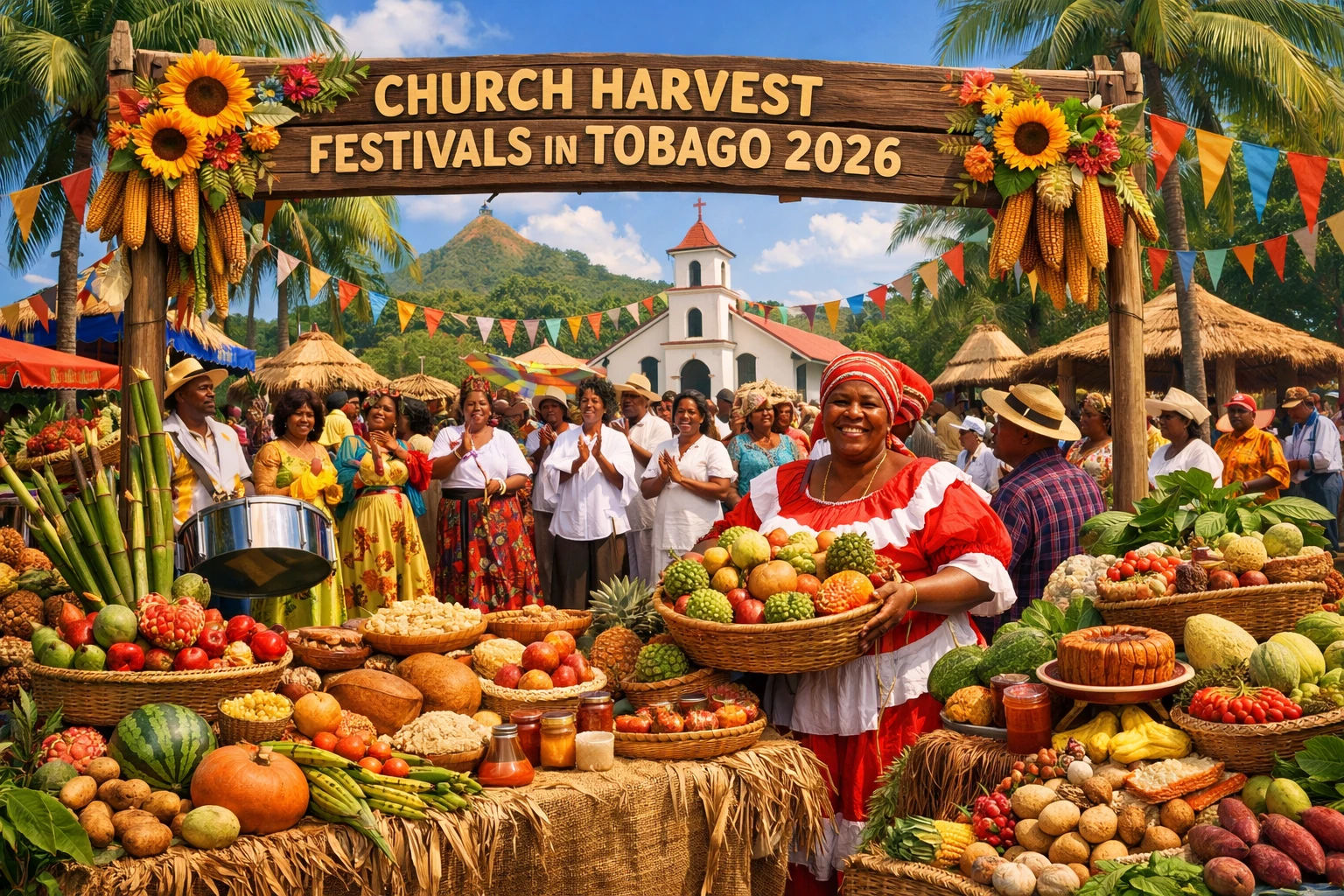
Every Sunday of the year, somewhere across the 116 square miles of Tobago, a village opens its arms to everyone within reach. Tables groan under the weight of callaloo, stewed chicken, crab and dumplings, fresh fish, ground provisions, and roti. Church choirs rehearse for months in preparation. Properties get a fresh coat of paint. Families travel back from Trinidad, from Canada, from New York, from London, specifically to be there.
This is the Tobago Church Harvest Festival, and in 2026, it runs every single month of the year with confirmed dates across more than twenty villages from Parlatuvier on the wild north coast to Scarborough in the south. The official Visit Tobago tourism website has published the full 2026 Harvest Festival calendar, making it easier than ever before for visitors to plan a trip around one of the most genuinely beautiful cultural traditions in the entire Caribbean.
The Story Behind the Tradition
The Tobago Harvest Festival is rooted in Christian thanksgiving, specifically the biblical instruction in Exodus 23:16 to "celebrate the Festival of Harvest with the first fruits of the crops you sow in your field." Annette Alfred, a Tobago harvest historian and former schoolteacher, traces the formal observance of Harvest Sunday to the Methodist, Anglican, and Delaford Roman Catholic churches, from where it spread across other denominations and then beyond formal church membership entirely to become a communal island celebration.
As TobagoFirst explains, "It started as a Christian thanksgiving tradition where people thank God for the harvest (crops, food, blessings). Today, it has grown into a village-wide celebration held throughout the year in different communities."
That growth from denominational observance to island-wide tradition happened organically, driven by the same generous spirit that still defines the festival today. Nobody locked it down to one church or one Sunday or one denomination. It expanded until every village on the island had its own harvest Sunday, its own choir, its own cook-up, and its own moment at the center of island life.
What a Harvest Sunday Actually Feels Like
National Geographic Travel described attending a harvest in Tobago as experiencing something "not your typical Sunday service," where strangers are actively pulled in with the words "Come on over, no questions asked," and where the day builds from a formal morning service into something much freer and more joyful.
The TobagoFirst guide to the harvest experience lays out exactly what to expect:
- Massive community cook-ups with large pots of local food including stews, fresh fish, rice, and callaloo.
- People moving from house to house eating and socializing across the afternoon and evening.
- Everyone welcome without reservation, locals, visitors, and complete strangers treated identically.
- Food is shared freely, not sold. The spirit of the festival is giving, not commerce.
- Strong focus on unity, generosity, and cultural identity that brings together families, neighbors, and entire villages.
The day begins with the church cantata, a musical performance where the village choir presents a programme specifically rehearsed for harvest Sunday. Visit Tobago confirms the cantata as one of the oldest and most important elements of the celebration, with choir preparation beginning weeks or months before the event. Churches are decorated with fresh fruit, flowers, vegetables, and coconut palm fronds shaped into arches over the entrance.
After the service, the feast begins. Ohana Villa describes the sequence: "Days begin with church services, followed by preparing and feasting on delicious local dishes." The Charlotteville harvest is specifically noted for including a re-enactment of the traditional cocoa dance, connecting the celebration directly to the island's agricultural history as a cocoa-producing island.
The Full 2026 Tobago Harvest Festival Calendar
The Visit Tobago official tourism website published the complete confirmed 2026 Harvest Festival calendar in December 2025, village by village, date by date. This is the most detailed official calendar ever made available for public planning purposes.
January 2026
- Pembroke and Glamorgan: January 4 (historically the first village to open the harvest year).
- Parlatuvier: January 11.
- Spring Garden: January 11.
- Bethesda (Plymouth): January 18.
- St. Patrick, Mt. Pleasant: January 18.
February 2026
- Hope: February 1.
- Mason Hall-Adelphi: February 8.
- Bon Accord: February 22.
- Franklyn: February 22.
March 2026
- Mt. St. George Methodist: March 1.
- Mason Hall: March 8.
- Betsy Hope: March 22 or 29.
April 2026
- Bethel: April 5.
- Mt. Pleasant: April 6.
- Buccoo: April 7.
- Bon Accord St. Francis Anglican Church Harvest: April 8.
- Moriah: April 12.
- Calder Hall: April 19.
- Canaan and Bon Accord: April 26.
- Goodwood Methodist Church Harvest: April 26.
May 2026
- Belle Garden, St. Edward Anglican Church Harvest Festival: May 3, 10:00 am.
- Canaan and Bon Accord Methodist Church Harvest: May 3.
- L'Anse Fourmi Harvest Festival: May 10.
- Whim, St. Michael Anglican Church Harvest Festival: May 10.
- Golden Lane: May 17.
- Delaford, St. Paul Anglican Church Harvest Festival: May 24, 3:00 pm.
June 2026
- L'Anse Fourmi Methodist Church Harvest: June 3.
- Bloody Bay Anglican Church Harvest Festival: June 7.
- Roxborough, St. Barnabas Anglican Church Harvest Festival: June 7.
- Roxborough: June 14.
- Lambeau, St. Nicholas Anglican Church Harvest Festival: June 21.
July 2026
- Castara: July 5.
- Black Rock: July 12.
- L'Anse Fourmi: July 26.
- Speyside Anglican: July 26.
September 2026
- Charlotteville: September 13 (featuring the traditional cocoa dance re-enactment).
October 2026
- Signal Hill and Patience Hill: October 25.
November 2026
- Plymouth: November 1.
- Les Coteaux Anglican Church: November 15.
- Scarborough: November 29.
The Food That Defines the Feast
Tobagonian food culture is one of the most distinct and deeply rooted culinary traditions in the Caribbean, and the harvest festival is its fullest expression.
The confirmed dishes at a standard Tobago harvest table include:
- Callaloo: a rich, creamy green soup made from dasheen leaves cooked down with coconut milk, ochroes, and seasoning, considered by many to be the national dish of Trinidad and Tobago.
- Crab and dumplings: fresh sea crab slow-cooked with garlic, herbs, and provisions, one of the most iconic dishes on the island.
- Stewed and curried meats: chicken, pork, or goat prepared in deep, spice-rich sauces developed through generations of creole and Indian culinary fusion.
- Fresh fish: kingfish, snapper, carite, and flying fish prepared in multiple ways, from grilled to curried to escovitch.
- Ground provisions: boiled cassava, sweet potato, dasheen, eddoe, and green plantain, the foundation of Tobagonian cooking, grown in the island's fertile volcanic soil.
- Roti and buss up shut: flatbreads with Indian roots that have become central to the Tobagonian food identity, used for scooping curries and stews.
- Fresh seasonal fruit: mangoes, pomerac, sapodilla, and passion fruit from the island's gardens.
All of it is shared freely. The Visit Tobago site is explicit: "food is usually given freely" and "everyone is welcome." The feast is an act of generosity, not a transaction.
The Villages You Should Know
Each harvest village has its own character, shaped by its geography and community history.
Charlotteville sits in a bay at the northern tip of the island, accessed by a winding road through the Main Ridge Forest Reserve, the oldest legally protected rainforest in the Western Hemisphere, declared protected in 1776. The village is known for its harvest re-enactment of the cocoa dance, a living connection to the island's agricultural heritage.
Parlatuvier sits on the north coast in a bowl-shaped bay surrounded by steep forested hills, one of the most photogenic villages on the island and one of the most remote. Attending the Parlatuvier harvest means experiencing the festival in a setting that feels genuinely untouched.
Bloody Bay on the northwest coast is close to the spectacular Man-O-War Bay and the Pirate's Bay beaches. The June 7 harvest here sits in one of the least-visited but most dramatically beautiful parts of Tobago.
Speyside on the northeast coast is internationally known as one of the best scuba diving locations in the Caribbean, with access to Goat Island, Little Tobago, and the famous manta ray cleaning stations at Angel Reef and Japanese Gardens. The July 26 harvest here combines deep community culture with one of the world's great dive destinations.
Lambeau in the southwest is accessible from Crown Point in under twenty minutes and sits within easy reach of Scarborough, making the June 21 harvest at St. Nicholas Anglican Church one of the most practical for international visitors to attend.
Practical Travel Tips for Attending the Harvest
The harvest festival is free and open to everyone. There are no tickets, no dress codes beyond the general courtesy of modest church attire for the morning service, and no formal reservation required.
Getting to Tobago
- A.N.R. Robinson International Airport at Crown Point receives regular inter-Caribbean flights and connections via Caribbean Airlines from Piarco International Airport in Trinidad, with a flight time of approximately 20 to 25 minutes.
- The inter-island ferry from Port of Spain to Scarborough takes approximately 2.5 hours and is a scenic, affordable option.
Getting around the island
- A rental car is strongly recommended for reaching harvest villages beyond Crown Point and Scarborough, particularly the remote north coast communities like Parlatuvier, Bloody Bay, L'Anse Fourmi, and Charlotteville.
- The road across the Main Ridge to the north coast is narrow, winding, and spectacular, passing through the heart of the rainforest reserve. Allow plenty of travel time, especially for morning services.
Where to stay
- Crown Point and Store Bay offer the widest range of accommodation near the airport, from budget guesthouses to boutique hotels and private villas.
- For north coast harvests, staying in Speyside or Charlotteville for a night or two transforms a day trip into a full island exploration experience.
- May and June are excellent months for Tobago travel: post-dry-season lushness, warm weather, and reasonable accommodation prices before the peak summer period.
On the day itself
- Arrive in time for the morning church service, typically around 9:00 to 10:00 am. The cantata is one of the most moving parts of the whole experience.
- Dress modestly and respectfully for the church portion. A light, breathable outfit in a neutral color works well for the tropical heat of the later outdoor feast.
- Confirm dates locally before traveling, as the official Visit Tobago calendar notes that dates are subject to change. The Tobago Festivals Commission at tobagofestivalscommission.com and Tobago Beyond at tobagobeyond.com are the most reliable local sources for up-to-date confirmation.
A Tradition That Will Stay With You
The numbers behind the Tobago Harvest Festival cycle are staggering when you look at them closely. More than twenty confirmed villages. Twelve months of consecutive coverage. Four Christian denominations participating. Generations of families returning to the same village, the same church, the same table, the same food, year after year.
And at the heart of all of it: the belief that what you have is better when you share it. That belief has kept this tradition alive for centuries through every difficulty Tobago has faced, and it will keep it alive long after anyone alive today is gone.
If you travel to Tobago this year and you find yourself on a Sunday morning within driving distance of any village on that calendar, go. You will be welcomed. You will be fed. And you will leave with a clearer, warmer, deeper understanding of why people who have visited Tobago once almost always find a way to come back.
Verified Information at a Glance
- Event name: Tobago Church Harvest Festival, also known as Harvest Sunday or Tobago Harvest Festival.
- Event category: Annual island-wide religious and community cultural celebration, free public event.
- Admission: Free. Open to all, residents and visitors.
- Format: One or more villages host a harvest Sunday each month, rolling throughout the year across the full Tobago calendar.
- Location: Island-wide, Tobago, Trinidad and Tobago.
Confirmed 2026 dates by month:
May 2026:
- Belle Garden, St. Edward Anglican Church Harvest: May 3, 10:00 am.
- Canaan and Bon Accord Methodist Church Harvest: May 3.
- L'Anse Fourmi Harvest Festival: May 10.
- Whim, St. Michael Anglican Church Harvest: May 10.
- Golden Lane: May 17.
- Delaford, St. Paul Anglican Church Harvest: May 24, 3:00 pm.
June 2026:
- L'Anse Fourmi Methodist Church Harvest: June 3.
- Bloody Bay Anglican Church Harvest: June 7.
- Roxborough, St. Barnabas Anglican Church Harvest: June 7.
- Roxborough: June 14.
- Lambeau, St. Nicholas Anglican Church Harvest: June 21.
July 2026:
- Castara: July 5.
- Black Rock: July 12.
- L'Anse Fourmi: July 26.
- Speyside Anglican: July 26.
September 2026: Charlotteville, September 13 (includes cocoa dance re-enactment).
October 2026: Signal Hill and Patience Hill, October 25.
November 2026: Plymouth, November 1; Les Coteaux Anglican, November 15; Scarborough, November 29.
- Lambeau confirmed contact: 1-868-639-8832.
- Churches involved: Anglican, Roman Catholic, Methodist, Moravian denominations.
- Official calendar source: Visit Tobago at visittobago.gov.tt.
- Secondary calendar sources: Tobago Festivals Commission at tobagofestivalscommission.com; Tobago Beyond at tobagobeyond.com.
- Note: All dates are subject to change. Visitors are encouraged to confirm locally closer to travel.