Tobago Heritage Festival 2026: A Month-Long Celebration of Everything That Makes the Island Extraordinary
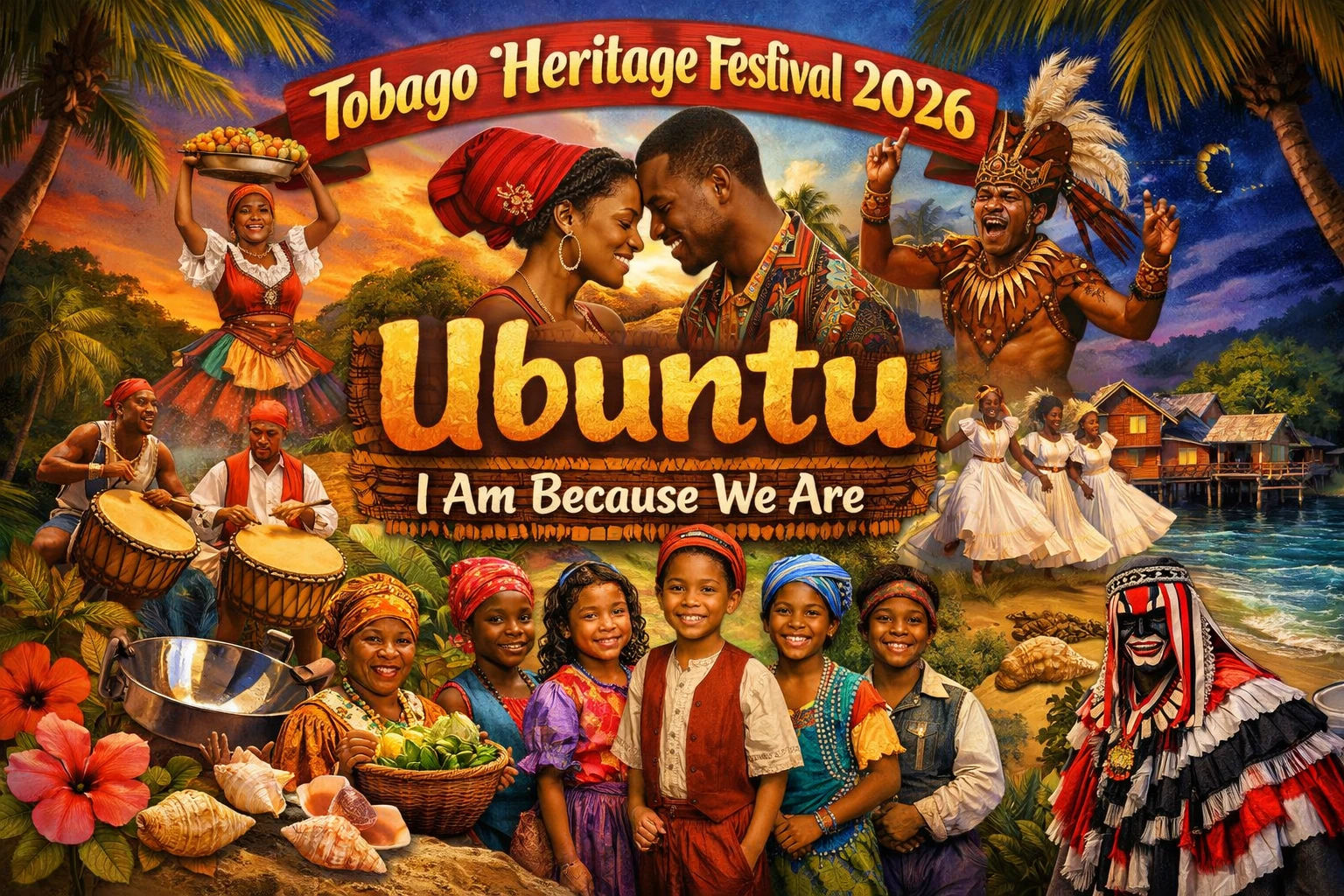
From July 16 to August 1, 2026, the island of Tobago hosts its most important cultural event of the year, the Tobago Heritage Festival, a month-long programme of village performances, traditional re-enactments, folk music, storytelling, food, and community celebration that spreads across communities from the northern tip of the island to the capital Scarborough and draws visitors from across the Caribbean, North America, Europe, and the world.
The 2026 theme, confirmed by the official Visit Tobago website, is "Ubuntu: I Am Because We Are," a phrase from the African philosophical tradition that captures the collective, community-rooted spirit of the festival with extraordinary precision. It is a theme that could have been designed specifically for a celebration built on the idea that Tobago's identity, its music, its customs, its food, and its stories, belongs to everyone who has ever called the island home and everyone who comes to bear witness to it.
Where the Heritage Festival Came From
The Tobago Heritage Festival was first held in 1987, the brainchild of Dr. J.D. Elder, a noted Tobagonian anthropologist who was at the time Secretary of Culture in the Tobago House of Assembly. The National Archives of Trinidad and Tobago confirm the three original aims he set for the festival:
- To develop an event by which Tobago could be recognized locally, regionally, and internationally;
- To assist in the preservation of indigenous art forms and heritage that were slowly disappearing;
- To sell Tobago as a holiday destination while contributing to the island's social, cultural, and economic development.
Those three aims remain as relevant today as they were in 1987. The festival has now run for nearly four decades, and it is confirmed by Outlook Travel Magazine as "one of the region's most anticipated cultural events, drawing visitors from across the world to experience a rich tapestry of song, dance, folklore, and culinary delights."
The Tobago Heritage Festival PDF published by the Punasec Social organization describes it simply and accurately as "the largest single, most outstanding annual cultural event to take place in Tobago," and notes that "throughout the entire Heritage period, visitors and residents are able to visit the many quaint and friendly villages of Tobago and be a part of its history."
How the Festival Works: Villages as the Stage
What makes the Tobago Heritage Festival structurally unique among Caribbean cultural events is that it has no single stage and no central venue. The entire island is the stage. Each village in Tobago hosts its own Heritage Festival event on an assigned night or weekend during the July 16 to August 1 window, performing and presenting its own specific traditional practices, music, and history for audiences who travel from across the island to attend.
Villagers dress in traditional costumes depicting village life from the early 1900s. Performances range from ole time mas, ole time dance, old time wedding re-enactments, limbo and jig, to stick fighting. The TNT Island guide confirms the range: folk singing, dancing, and feasting in every community.
National Geographic's full feature on the 2026 season describes arriving at the Ole Time Wedding in Moriah and finding a tent where "a band begins to play on goatskin tambourines and fiddles" while guests "perform the reel and jig, symbolizing the ebb and flow of marriage." They describe the whole experience of the Heritage Festival as something that blurs the line between performance and genuine community life in a way that few events anywhere in the world manage.
The Confirmed Village Events and What to Expect
Multiple confirmed sources describe the specific village events that make the Heritage Festival what it is.
The Ole Time Wedding in Moriah
The Ole Time Wedding in Moriah is the most internationally recognized single event of the Heritage Festival and the one that has appeared most frequently in travel media coverage of the island.
Ohana Villa describes it precisely: "the Ole Time Tobago Wedding in Moriah, featuring groom in stovepipe hat and tailcoat and bride with trousseau on head, processing slowly with the distinctive three-step 'brush back.'"
Outlook Travel Magazine confirms: "A particularly popular event is the Ole Time Wedding in the village of Moriah, a reenactment of an 18th-century wedding procession that reflects the island's colonial past and traditional customs."
The wedding is not a staged theatrical performance. It is a full community production involving the entire village, with specific roles played by community members, a procession through Moriah's streets, music from the tambrin band, and the full solemnity and celebration of a wedding ceremony as it would have been conducted in post-emancipation Tobago.
Charlotteville Natural Treasures Day: The Cocoa Dance
Charlotteville, the remote northern village whose Fisherman Festival we have already covered in this series, hosts Natural Treasures Day as its Heritage Festival contribution, and it is one of the most extraordinary events on the entire programme.
The centrepiece is Dancing the Cocoa, described by Outlook Travel Magazine as "local people dancing on cocoa beans to the sound of a tambrin band, a practice once used to make the beans shinier for sale at market."
Newsday's coverage of Charlotteville's 2024 Natural Treasures Day documents the full richness of the event: the village trek and parade with the Tamboo Bamboo Band, folk songs, and traditional re-enactments including the washing of the dead bed, cutting wood in a saw pit, making sugarcane juice with a batty mill, and baking bread in an earthen oven.
National Geographic describes the Tamboo Bamboo Band beginning their march from Fort Campbelton, the 18th-century British stronghold overlooking Man-O-War Bay, "striking the bamboos on the ground in unison, creating a cacophony of homemade percussion instruments producing various frequencies, from plastic barrels to car-part cowbells." That combination of ancient tradition and improvised community creativity is the essence of the Charlotteville Heritage event.
Folk Tales and Superstitions in Golden Lane and Les Coteaux
One of the most unusual and specifically Tobagonian events on the Heritage Festival calendar is the Folk Tales and Superstitions night held in Golden Lane and Les Coteaux.
Ohana Villa describes two specific traditions explored: "learn about the Les Coteaux jumbie (spirit), and about Gang Gang Sara and the Witch's Grave in Golden Lane."
Gang Gang Sara is one of the most famous folk stories in Tobago: the tale of an African witch who flew from Africa to Tobago and settled in Golden Lane, only to discover when she tried to fly home that she had eaten salt in the Caribbean and lost her power of flight. Her grave in Golden Lane is one of the island's most visited heritage sites, and the Heritage Festival night dedicated to her story brings the oral tradition surrounding her to life in her own village.
The Belmanna Revolt Re-enactment in Roxborough
The re-enactment of the Belmanna slave uprising in Roxborough is one of the most historically significant events of the Heritage Festival. The 1876 Belmanna riots, a post-emancipation uprising by Tobagonian workers protesting conditions on the island's estates, are a central event in Tobago's history of resistance and self-determination.
The re-enactment brings this history back to life in the community where it happened, with participants in period dress acting out the events of the uprising in Roxborough's streets. It is the kind of living history that no museum can replicate, and it gives the Heritage Festival a dimension of political and cultural seriousness that elevates it beyond a folk performance programme into a genuine act of collective memory.
Heritage Queen Show
The Heritage Queen Show is the festival's formal competition event, bringing women from Tobago's communities together to be judged on their all-round representation of Tobagonian beauty and the year's festival theme.
The Heritage PDF describes it: "The Heritage Queen Show is where the beautiful women of Tobago are brought on stage to be judged to try to determine who best represents all-round beauty and the theme of the year's festivities."
August 1: Emancipation Day
The Heritage Festival runs to August 1, and that date is not coincidental. August 1 is Emancipation Day, the national holiday that commemorates the abolition of slavery in the British Caribbean in 1834, with full freedom following in 1838.
TobagoFirst confirms: "The festival usually takes place in July and August, coinciding with Emancipation Day (August 1), which commemorates the abolition of slavery in the Caribbean."
That anchor gives the entire festival a deeper meaning than a cultural showcase. It situates the celebration of Tobago's traditions within the historical context that produced them: the determination of an emancipated people to hold onto their cultural identity, their music, their language, their stories, and their customs in a world that had every reason to take those things away.
Kern Cowan, CEO of the Tobago Festivals Commission, expressed this to National Geographic: "We are committed to preserving our traditions, ensuring our legacy endures, and remaining steadfast in our identity as Tobagonians."
Tobago in July and August: What the Season Looks Like
July and August in Tobago represent the full height of the summer season and the most vibrant period on the island's cultural calendar.
Overseas Tobagonians from the United Kingdom, Canada, and the United States return home in large numbers during this period. The diaspora community's presence adds a specific energy to the festival: people who have been away for months or years reconnecting with the traditions they grew up with and bringing their children into contact with an identity they may only know through family stories.
The Blue Food Festival at Shaw Park Food Hub follows on October 18, with Tobago Carnival running October 30 to November 1, meaning that a July Heritage Festival visit can be positioned as the cultural anchor of a broader Trinidad and Tobago travel plan.
Practical Information for Visitors
The Heritage Festival is the most logistically complex event to plan around on the Tobago calendar, precisely because it is not a single-venue event but a month-long island-wide programme.
Getting to Tobago
- A.N.R. Robinson International Airport in Crown Point receives Caribbean Airlines connections from Piarco International Airport in Trinidad (approximately 20 to 25 minutes flight time) and select direct international routes.
- The inter-island ferry from Port of Spain to Scarborough takes approximately 2.5 hours and is comfortable and affordable.
Getting around for the festival
- A rental car is essential for attending multiple village events spread across the island. Some of the most significant Heritage events, Charlotteville, Moriah, Golden Lane, Roxborough, require driving on varying road conditions.
- The Heritage Festival calendar is typically published by the Tobago Festivals Commission at tobagofestivalscommission.com closer to the July start date.
Where to stay
- Crown Point and Store Bay offer the widest accommodation range and the most flexible base for island-wide travel.
- For deeper immersion in the festival's northern village events, staying overnight in Speyside, Charlotteville, or Castara gives you direct access to the north coast programme without the long daily drive.
- July and August are the busiest accommodation weeks of the year. Book well in advance.
Admission
- Village Heritage Festival events are free and open to the public.
- The Heritage Queen Show and some competition events may require tickets. Check the Tobago Festivals Commission closer to the event for specific ticketed events.
Come Before It Changes
National Geographic captured the spirit of the Heritage Festival more precisely than any calendar listing can: it is a celebration of Tobago's future and its past simultaneously, where young people are performing the same dances and telling the same stories their great-grandparents performed and told, not because they have been told to but because the community has decided these things matter.
The Ubuntu theme for 2026, "I Am Because We Are," says it directly. Tobago's identity does not exist in isolation. It exists in the collective memory of every village, every family, every harvest, every wedding procession, every cocoa dance, every jumbie story told in a tent in Les Coteaux on a warm July night. The Heritage Festival is the annual moment when all of that comes alive simultaneously across the whole island.
If there is one event in Trinidad and Tobago that every culturally curious traveler should make the effort to attend, it is this one.
Verified Information at a Glance
- Event name: Tobago Heritage Festival 2026.
- Event category: Annual island-wide cultural festival, living heritage and folk traditions programme.
- Confirmed 2026 dates: July 16 to August 1, 2026.
- Confirmed 2026 theme: "Ubuntu: I Am Because We Are."
- Festival launch date: July 16, 2026.
- Close date and significance: August 1, 2026 (Emancipation Day).
- Founded: 1986 (pilot project), first full festival 1987. Founder: Dr. J.D. Elder, anthropologist and Secretary of Culture, Tobago House of Assembly.
- Location: Island-wide, Tobago, Trinidad and Tobago.
- Format: Village-based events each weekend, no single central venue.
- Confirmed signature events: Ole Time Wedding (Moriah), Charlotteville Natural Treasures Day including Dancing the Cocoa, Folk Tales and Superstitions (Golden Lane and Les Coteaux), Belmanna Revolt re-enactment (Roxborough), Heritage Queen Show.
- Admission: Village events free and open to all. Selected competition events may be ticketed.
- Organizer: Tobago Festivals Commission Limited.
- TFCL contact: tobagofestivalscommission.com, telephone 1-868-639-4441.
- Official event listing: visittobago.gov.tt.
- Full 2026 programme: To be published by the Tobago Festivals Commission closer to the July 16 launch.