Bastille Day 2026 in Bora BoraBastille Day 2026 in Bora Bora: A Unique Polynesian Celebration
Bastille Day 2026 in Bora Bora falls on Tuesday, July 14, 2026, and marks one of the most genuinely unique expressions of France's national holiday anywhere in the world, blending the traditions of the French Republic with the deep cultural identity of Polynesia in a way that only this island, in the middle of the South Pacific, 15,000 kilometers from Paris, could create. In Bora Bora, July 14 sits at the heart of the Heiva festival season, which means that the national holiday of France is celebrated within a month-long immersion in ancient Polynesian dance, music, and community traditions that are themselves historically linked to this very date.
July 14 in Paris means a military parade down the Champs-Élysées, the President of France reviewing the troops, aircraft trailing blue, white, and red smoke over the Arc de Triomphe, and fireworks erupting over the Seine at midnight. All of that is happening on the same date.
In Bora Bora, July 14 means something both deeply connected and fascinatingly different. Here, in the lagoon-ringed island with Mount Otemanu rising above the palms and the air thick with frangipani, the Fête Nationale is woven into the Heiva, the month-long Polynesian cultural festival whose very existence is historically inseparable from Bastille Day itself.
To understand why July in Bora Bora is what it is, you need to understand that connection.
The Historical Thread: How Bastille Day Gave Birth to Heiva
The story of Heiva and Bastille Day in French Polynesia begins in 1881, when France formally annexed most of what is now French Polynesia. The colonial authorities, seeking to win community goodwill, made a calculated cultural concession: they permitted traditional Polynesian dancing and cultural demonstrations as part of Bastille Day celebrations on July 14.
This was significant because at the time, European missionaries and colonial administrators had spent decades suppressing traditional Polynesian cultural practices, particularly dance forms like the ʻōteʻa hip dance, classifying them as immoral or pagan. The permission granted for July 14 became a crack in the wall of suppression, and that crack widened over generations.
The celebration, initially called Tiurai (from the French word "juillet," meaning July), became the annual occasion when Polynesian communities could openly practice and celebrate their cultural arts. Over the following century, Tiurai transformed into the modern Heiva festival, and by the time French Polynesia's cultural revival gathered momentum in the 1970s and 1980s, the festival had grown into the most important cultural event in the entire French Polynesian archipelago.
The paradox is beautiful: France's national holiday became the vessel through which Polynesian cultural resistance and revival were carried. When you watch the ʻōteʻa dancers compete at Heiva i Bora Bora during Bastille Day week, you are watching a tradition that the French government accidentally preserved by trying to keep it contained within a single annual holiday.
What Bastille Day Looks Like in Bora Bora on July 14
Bora Bora celebrates July 14 with a distinctly Polynesian character, and the day typically unfolds across multiple community events that honor both the French national holiday and the island's own cultural identity.
The Heiva Festival Context
The most visible celebration surrounding July 14 in Bora Bora is the ongoing Heiva festival program. By July 14, the Heiva i Bora Bora will be in its second week of performances at Place Tu Vavau in Vaitape, the ceremonial square in the main village. The evening program on or near July 14 typically features some of the competition's most watched performances, as the festival reaches its competitive peak around this period.
Vaʻa Canoe Racing
Outrigger canoe (vaʻa) racing is a central Bastille Day sporting tradition across French Polynesia, and Bora Bora's extraordinary lagoon provides one of the world's most dramatic settings for it. The calm, turquoise inner lagoon and the dramatic Mount Otemanu backdrop make watching vaʻa racing here an utterly distinctive experience. The racing formats include V1 (single), V3, V6, and V12 categories, with teams from different Bora Bora districts competing before community audiences gathered along the waterfront.
Community Celebrations, Feasts, and Games in Vaitape
The streets and waterfront of Vaitape take on a festive character throughout July 14. Local families gather in the public spaces, communal meals are organized, and the community's social life moves outdoors in the tradition of French national holiday celebrations. Local vendors sell food and drinks along the waterfront, and the atmosphere is informal, welcoming, and distinctly communal.
Fireworks Display
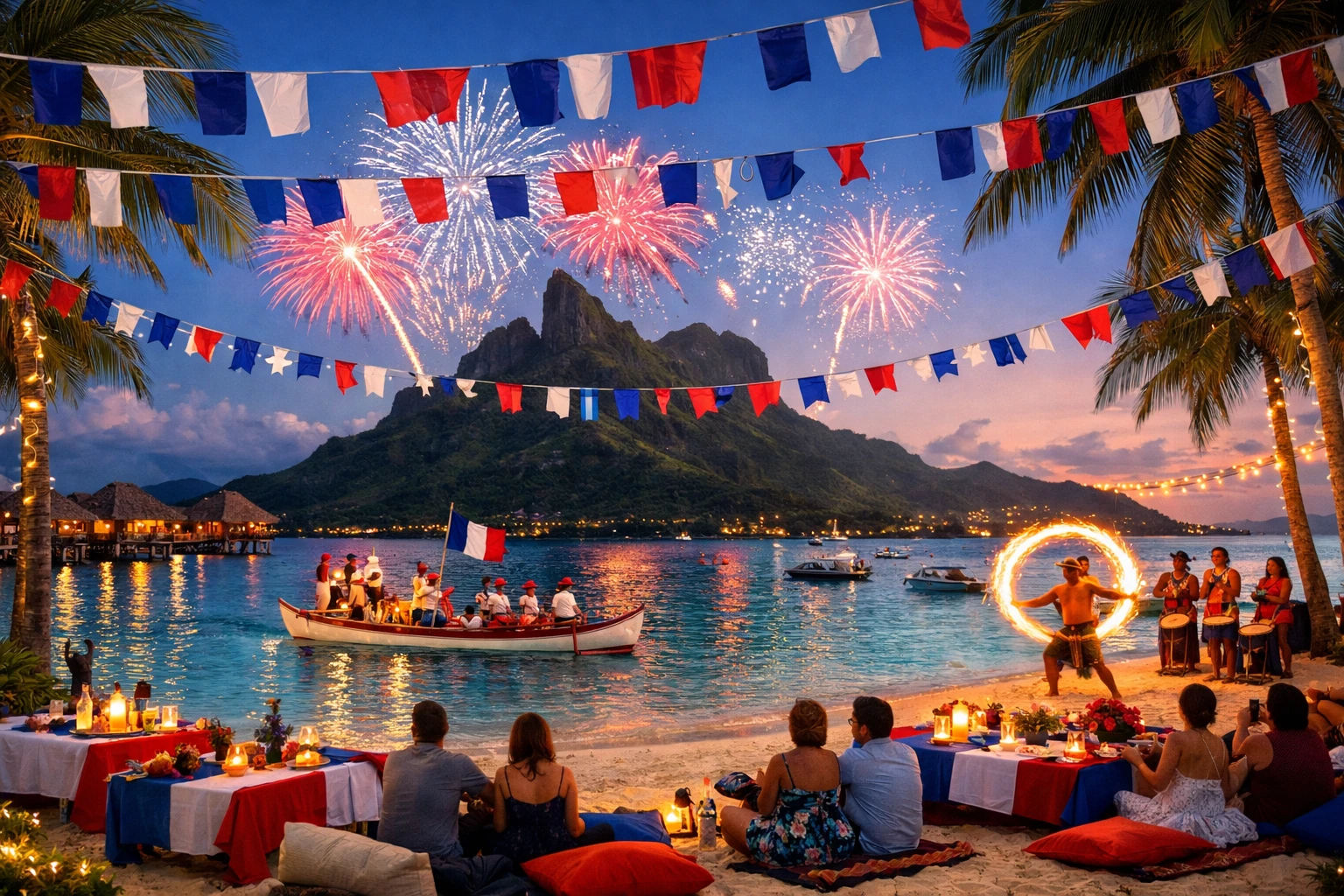
Fireworks over the Bora Bora lagoon are the traditional climax of Bastille Day evening celebrations in French Polynesia. The combination of fireworks reflecting off the turquoise water, with the dark silhouette of Mount Otemanu above the palm treeline, is an image that visitors consistently describe as one of the most visually extraordinary moments of any trip to this island. From the waterfront of Vaitape or from the terraces of overwater bungalow resorts across the lagoon, the fireworks on July 14 are the definitive Bastille Day Bora Bora experience.
Traditional Polynesian Sporting Competitions
The broader Heiva calendar around July 14 includes the Tuaro Māohi, traditional Polynesian athletic competitions that are free to watch. These include:
- Coconut husking: competitors husk coconuts at competitive speed using a sharpened post
- Patia Fa (javelin throwing): traditional wooden javelin thrown at a coconut target mounted up to 9.5 meters high
- Stone lifting: lifting heavy stones that increase in weight, testing raw strength against traditional cultural standards
- Fruit carrying race: teams carry heavily loaded shoulder poles in a race of strength and balance
These daytime events bring the village waterfront and Kamehameha Park-equivalent community spaces to life with festive athletic competition, and they are genuinely participatory to watch in a way that stadium sports are not.
Heiva i Bora Bora in the Week of July 14: Confirmed Program Context
The Bora Bora Insider's comprehensive Heiva guide confirms that in 2025, the main program for Heiva i Bora Bora ran from July 7 to 14, making Bastille Day the closing week of the Bora Bora Heiva season. This means July 14, 2026 is expected to fall within or at the close of the main Heiva competition weeks, making it one of the culturally richest days of the entire festival season.
The evening program at Place Tu Vavau on or near July 14 will include:
- Himene choral competition from 8:00 pm
- ʻŌteʻa dance competition from 9:00 pm
- Fire dancing performances between competition passes
For visitors, this overlap of Bastille Day with Heiva's peak week creates an evening that is both a French national holiday celebration and the culminating competitive moment of one of the Pacific's most extraordinary cultural festivals.
Celebrating with the Four Seasons and Luxury Resorts
Bora Bora's major luxury resort properties, particularly the Four Seasons Resort Bora Bora on its private motu, have historically organized dedicated Bastille Day programming that extends the celebration into the resort experience. In recent years this has included:
- Dedicated Heiva dinners with Polynesian cultural performances
- Lagoon-view fireworks watching from resort terraces and overwater bungalow decks
- Polynesian Heiva Ambassador services providing guests with guided access to the Vaitape festivities
- Traditional Polynesian feast dinners with live music from local musicians
For visitors staying at overwater bungalow properties, July 14 is the one evening when watching fireworks from your bungalow deck, with the entire lagoon reflecting the lights and the mountains as a dark backdrop, is a genuine option rather than a fantasy.
The Broader French Polynesia Context on July 14
While Bora Bora's celebration has its own local character, the islands of French Polynesia celebrate Bastille Day collectively. In Papeete, Tahiti, the Fête Nationale includes a military parade along the waterfront, a flyover by French Polynesian armed forces aircraft (Falcon Gardian, Casa, and Dauphin helicopter), and the major Heiva performances at the To'ata Amphitheater that are the cultural centerpiece of the national holiday.
For visitors using Bora Bora as part of a broader French Polynesia itinerary that includes Tahiti, traveling between islands during the July 7 to 14 period gives access to both the intimate community celebrations of the outer islands and the larger-scale military and cultural events in Papeete.
Practical Travel Tips for Bastille Day in Bora Bora 2026
Arriving in Bora Bora for the Heiva Season
Arriving on July 10 to 12 gives you two to three days of Heiva performances before Bastille Day, which means you will be fully oriented to the festival by the time the July 14 celebrations peak. All inter-island arrivals to Bora Bora require a connection through Papeete's Faa'a Airport (PPT) on Tahiti, with Air Tahiti operating the 50-minute inter-island hop to Bora Bora's Motu Mute Airport (BOB).
Getting to the July 14 Fireworks
The best free viewing positions for the fireworks are along the Vaitape waterfront, which requires a boat transfer from resort motus. Most resort concierge teams can organize an evening shuttle to Vaitape for Bastille Day, and this should be arranged at least one day in advance given demand on July 14.
If you are staying in the Vaitape area or in a mainland-island property, simply walking to the waterfront by 8:00 pm ensures you are in position for both the Heiva evening program and the late-night fireworks.
What to Wear and Bring on July 14
- Festive island attire: A pareo in the French tricolor (blue, white, red) or floral Polynesian print are both equally appropriate and appreciated expressions of the dual French-Polynesian character of the day
- Insect repellent for outdoor waterfront evening events
- Cash in CFP for food stalls, drinks, and any ticketed event entries
- A camera for the fireworks over the lagoon, one of the most photographed moments in all of Bora Bora's event calendar
The Whole Week, Not Just the Day
The full value of being in Bora Bora for Bastille Day comes from treating the entire week of July 7 to 14 as your event window. Attending two or three evening Heiva performances before July 14 familiarizes you with the competition structure, helps you form genuine investment in the competing districts, and makes the July 14 performance carry the emotional weight of a known contest rather than a first impression.
Verified Information at a Glance
Item: Confirmed details
Event name: Bastille Day (Fête Nationale) 2026, Bora Bora, French Polynesia
Event category: French national public holiday with community celebrations including Heiva cultural festival performances, vaʻa racing, traditional sports, community feasts, and fireworks
Confirmed date: Tuesday, July 14, 2026
Confirmed location: Vaitape, Bora Bora, French Polynesia (waterfront, Place Tu Vavau, Heiva performance arena)
Heiva i Bora Bora context: Bastille Day falls within Heiva performance season; in 2025 the Bora Bora Heiva ran July 7 to 14
Confirmed Heiva i Tahiti 2026 dates: July 2 to 18, 2026 (Bora Bora follows parallel schedule)
Evening performance times: Himene from 8:00 pm; ʻŌteʻa from 9:00 pm at Place Tu Vavau, Vaitape
Fireworks: Traditional Bastille Day fireworks over the Bora Bora lagoon, evening of July 14
Vaʻa canoe racing: Traditional event during Heiva/Bastille Day period in the lagoon
Traditional sports: Coconut husking, Patia Fa javelin, stone lifting, fruit carrying (free to watch, Heiva program)
Admission: Evening Heiva tickets approximately 1,500 to 2,500 CFP per show; daytime events and fireworks free
When you are watching fireworks burst over the Bora Bora lagoon on the evening of July 14, 2026, knowing that the same celebrations that banned traditional Polynesian dance for over a century eventually became the date on which those dances were revived and preserved, and that the ʻōteʻa performances you watched at 9 pm would not exist without the paradox of colonial permission granted on this exact day in 1881, the fireworks become something more than beautiful.
%202026.webp)