Heiva i Bora Bora 2026: The Soul of French Polynesia in the World's Most Beautiful Setting
The Heiva i Bora Bora 2026 is expected to follow its established annual pattern of running from late June through early August 2026, with main performances in the first three weeks of July at Place Tu Vavau (the ceremonial square), Vaitape, Bora Bora, French Polynesia, in line with the confirmed Heiva i Tahiti 2026 dates of July 2 to 18 across the archipelago. Specific 2026 Bora Bora dates and the detailed performance schedule are published by the Heiva office (located next to the pier in Vaitape) closer to the season, typically from April onward.
There are festivals that take place in beautiful locations. And then there is Heiva i Bora Bora, where the setting and the celebration are so deeply matched that separating them feels almost wrong.
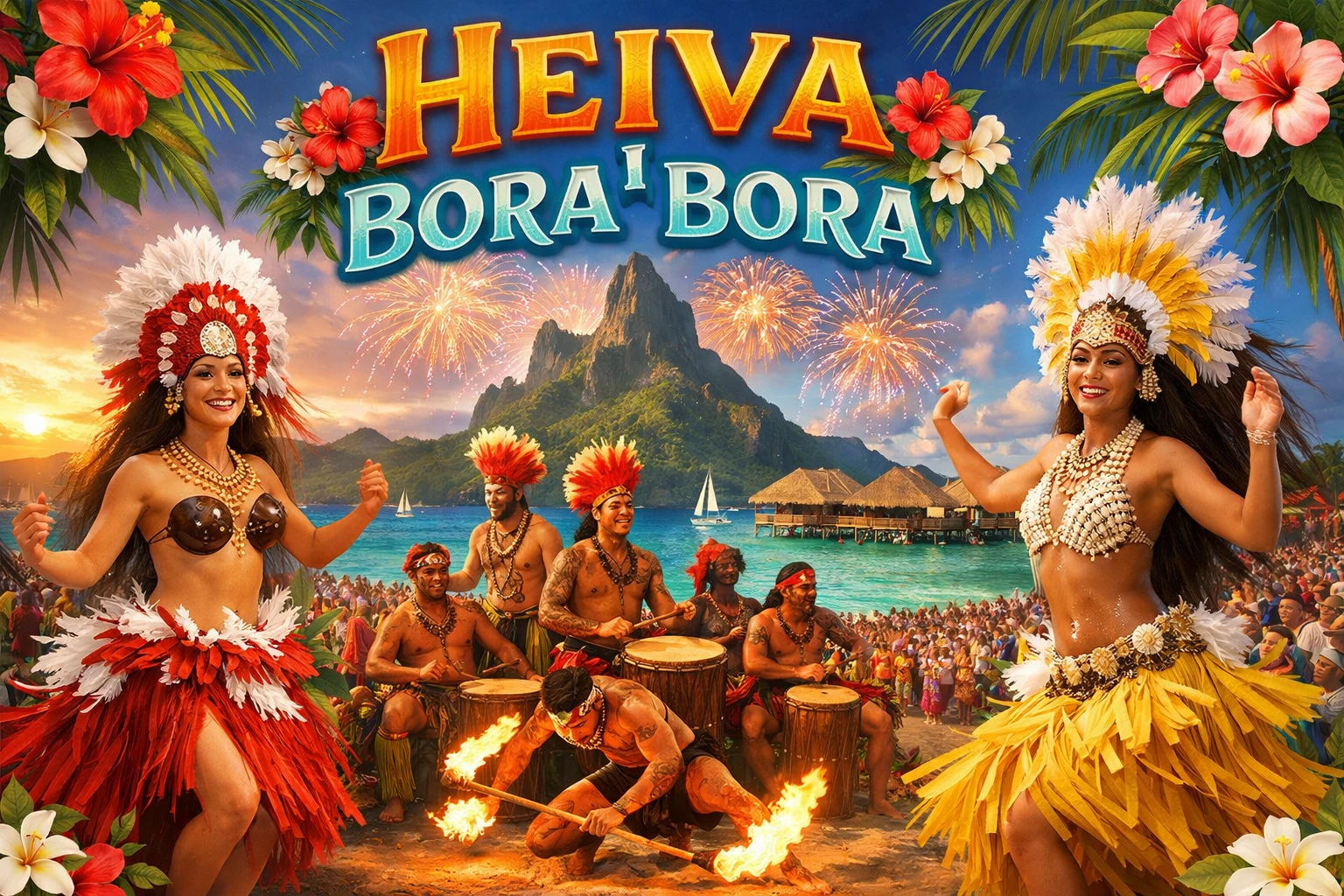
Picture an open-air arena of powdery white sand at the foot of Mount Pahia, one of the dramatic twin peaks that rise from Bora Bora's interior. The lagoon, one of the most photographed bodies of water on earth, glimmers beyond the performance space in every shade of blue and green. At 8 pm, the ancient himene chants begin, their harmonies older than any written record of this island. At 9 pm, the percussion rises, the drumlines ignite, and dozens of dancers in handmade costumes of natural materials explode into the ʻōteʻa, the traditional Tahitian dance form whose footwork, hip movement, and precision embody centuries of Polynesian cultural memory.
This is Heiva. It is simultaneously a competition and a ceremony, a sporting event and a cultural parliament, a tourist spectacle and a deeply sacred community ritual. The word itself carries meaning: hei means "to assemble" and va refers to "community places," so Heiva literally means the gathering of community. And for six weeks every year, the community of Bora Bora assembles around these ancient forms to judge, celebrate, compete, and remember who they are.
The Historical Roots of Heiva: Suppression and Revival
The Heiva did not simply appear as a tourism product. Its roots stretch back to pre-European Polynesian culture, and its modern form carries the scars and the resilience of a tradition that was nearly erased.
When Christian missionaries arrived in French Polynesia in the early 19th century, they classified Polynesian dance, particularly the hip-swinging ʻōteʻa, as immoral and worked to suppress it. For decades, traditional Tahitian dance and chant were officially discouraged or banned in colonial Polynesia. It was only in 1956, with the establishment of the first formal Heiva competition, that these traditions began to be openly celebrated in a public competitive format.
The decades since have seen a gradual and deliberate cultural renaissance. Heiva transformed from a small celebration into one of the most technically demanding cultural competitions in the Pacific. Today, dance troupes from every district of French Polynesia spend months preparing their programs, composing original music, hand-making every costume, and training their performers to standards that are judged by cultural experts in dance, traditional percussion, musical composition, singing, and lyrics. The depth of that preparation is visible in every performance.
The Competition Structure at Heiva i Bora Bora
The Heiva i Bora Bora follows a competition structure that is both formal and deeply communal.
The districts of Bora Bora compete against each other across different event categories. In 2025, the competing districts included Amanahune, Faanui, Nunue, Tiipoto, Anau, and Hitia, each fielding groups in the himene and ʻōteʻa competition categories.
Each group performs twice during the festival: a first presentation round and a second concours (competition) round, in which they are formally judged. This structure means that the same program evolves and is refined between the first and second performance, which rewards audiences who attend multiple evenings.
Himene: The Ancient Choral Tradition
The himene opens every evening's program from 8 pm. These are traditional Polynesian choral compositions, performed a cappella or with minimal percussion, in a style that blends pre-contact Polynesian vocal traditions with harmonic forms developed during the colonial mission period. The sound of a large himene group in full voice is one of the most distinctive and moving sounds in all of Pacific music, and experiencing it under the open sky with the mountains of Bora Bora overhead gives it a resonance that no recording can convey.
ʻŌteʻa: The Heartbeat of Heiva
The ʻōteʻa dance competition begins at 9 pm. This is the performance element that draws the largest audiences and carries the most intense competition.
What spectators witness in a Heiva ʻōteʻa is not simply choreography. Each troupe creates an original composition that tells a story drawn from Polynesian mythology, legend, history, or contemporary life. The costuming, composed entirely of natural materials including tapa bark cloth, shells, feathers, seeds, plant fibers, and bone, is judged independently. The musical composition written for each performance is an original work. The dancers, who may number anywhere from 20 to over 100 in a single troupe, coordinate their movements to a live percussion ensemble performing with traditional pahu drum, tōere (slit drum), and fa'atete.
The judging criteria are among the most demanding in any cultural competition: experts assess the quality of dance technique, originality of choreography, historical and cultural accuracy of narrative, quality of costume construction and visual coherence, quality of musical composition and performance, and quality of lyrics. A troupe that wins Heiva has passed through a gauntlet of expert scrutiny that represents genuine mastery of multiple traditional art forms simultaneously.
The Tuaro Māohi: Traditional Polynesian Sports
Alongside the evening performance competitions, Heiva encompasses a full program of Tuaro Māohi, traditional Polynesian sports competitions, which take place during daytime hours at various locations around Vaitape. These events are free to watch and are some of the most participatory and enjoyable elements of the Heiva experience for visitors.
Paʻaro Haʻari: Coconut Husking
Coconut husking (Paʻaro Haʻari) is one of the Heiva's most celebrated daytime events. Competitors use a sharpened post driven into the ground to split and husk coconuts at extraordinary speed, a skill that was central to the copra industry that supported Polynesian island economies for generations. The competition takes place on white sand with traditional percussion providing rhythm, and the skill level of the best competitors, who can process dozens of coconuts in minutes, is genuinely astonishing.
Patia Fa: Javelin Throwing
The Patia Fa javelin competition tests athletes' ability to throw handmade wooden javelins at a coconut mounted on a pole up to 9.5 meters high. The coconut is divided into five scoring zones, with points increasing toward the top. Each competitor throws eight javelins over multiple rounds, and the pole is lowered slightly after each round before a fresh coconut is hoisted. The combination of precision, strength, and ceremonial significance makes Patia Fa one of the most compelling athletic events at Heiva.
Porteurs de Fruits: Fruit Carrying Race
The fruit carrying race is exactly what it sounds like: competitors carry baskets loaded with substantial weights of fruit on shoulder poles and race across a set distance. This tests both strength and balance and is rooted in the traditional labor of provisioning community festivals with agricultural produce.
Vaʻa: Outrigger Canoe Racing
Vaʻa (outrigger canoe) racing takes place in Bora Bora's lagoon during Heiva, with formats including V1 (single), V3 (three-man), V6 (six-man), and V12 (twelve-man) categories. Watching vaʻa racing on Bora Bora's lagoon, with the dramatic profile of Mount Otemanu rising above the water in the background, is one of the most distinctly Pacific island sports experiences available anywhere. These races are free to watch from the waterfront.
Tickets, Pricing, and How to Attend the Evening Shows
Ticketed seating is available for the evening himene and ʻōteʻa performances. Purchasing tickets ensures comfortable seated placement directly in front of the performance area, which is strongly recommended for the major competition nights.
How to buy tickets:
- The Heiva office, located next to the pier in Vaitape alongside Radio Bora Bora, is the main ticket sales point
- Tickets can also be purchased on the evening of each performance, with the counter opening at the entrance to the seated area approximately 1.5 hours before the show
- For the opening night performance (the first and typically most spectacular show of the season), buying tickets in advance is strongly recommended, as the opening draws the largest audiences
Pricing: Specific 2026 ticket prices are set by the Heiva committee and announced at the beginning of the season. Past editions have priced seated tickets in the range of approximately 1,500 to 2,500 CFP (approximately $12 to $20 USD) per show.
What to expect at the venue:
- Arrive by 6:00 pm to browse the baraques (pop-up food stalls around the performance area) and eat before the show
- The himene begins at 8:00 pm, ʻōteʻa at 9:00 pm
- Attendees can purchase tickets for one or both shows on a single evening
- The performance area is open-air with seating under a covered section and standing viewing available outside the ticketed area
Practical Travel Tips for Heiva i Bora Bora 2026
Getting to Bora Bora
Bora Bora is served by Motu Mute Airport (BOB) on its northern motu (sandbar). All arrivals to the island require a short ferry transfer from the airport to Vaitape on the main island or to resort motu properties. Air Tahiti operates regular inter-island flights from Papeete (Faa'a Airport, PPT) on Tahiti, approximately 50 minutes flight time. International flights connect to Papeete from Paris (Air Tahiti Nui), Los Angeles (Air Tahiti Nui, French Bee), and Auckland (Air Tahiti Nui).
When to Visit for Heiva
The first three weeks of the Heiva season contain the primary competition rounds. In 2025, this meant the last week of June through mid-July. For 2026, Heiva i Tahiti is confirmed July 2 to 18, so Heiva i Bora Bora's main performance weeks will run on a parallel schedule. Arriving for the first performance week ensures you see the opening rounds of the competition, which are typically among the most energetic and well-attended.
Where to Stay During Heiva
Vaitape is the island's main town and the closest base to the Heiva performance ground at Place Tu Vavau. However, Bora Bora's famous overwater bungalow resorts, including Four Seasons Resort Bora Bora, Conrad Bora Bora Nui, and Intercontinental Bora Bora Le Moana Resort, are all within a short boat transfer of Vaitape and several have dedicated Heiva programs with concierge-curated access and transportation.
The Four Seasons Resort Bora Bora specifically provides a Polynesian Heiva Ambassador who gives guests personalized guidance throughout the festival, including access to performances and explanations of the competition structure. For first-time Heiva visitors, this kind of cultural guidance significantly deepens the experience.
What to Wear and Bring to Evening Performances
- Light clothing appropriate for a warm July evening in French Polynesia
- Insect repellent for outdoor evening events near the lagoon waterfront
- Cash (CFP) for tickets and food stall purchases
- A camera without flash for respectful photography during performances
Daytime Activities Around Heiva Week
The days between evening performances offer Bora Bora's world-renowned lagoon experiences: snorkeling above coral gardens and black-tip reef sharks in the shallow lagoon, overwater bungalow relaxation, and the short climb to the Bloody Mary's viewpoint on the main island for the classic panoramic view of Mount Otemanu rising above the emerald lagoon.
Verified Information at a Glance
Item Confirmed Details
Event name: Heiva i Bora Bora 2026
Event category: Annual Polynesian cultural festival and competition (himene chant, ʻōteʻa dance, Tuaro Māohi traditional sports, vaʻa canoe racing)
Confirmed 2026 dates: Late June to early August 2026 (exact dates TBA; main performance weeks in first 3 weeks of July, aligning with Heiva i Tahiti July 2 to 18)
Confirmed venue: Place Tu Vavau (ceremonial square), Vaitape, Bora Bora, French Polynesia
Evening show times: Himene: 8:00 pm; ʻŌteʻa dance: 9:00 pm
Ticket sales: Heiva office next to the pier, Vaitape and at venue entrance on performance evenings
Evening show ticket price: Approximately 1,500 to 2,500 CFP (~$12 to $20 USD) per show (2026 prices to be confirmed at season opening)
Daytime events admission: FREE (coconut husking, javelin, fruit carrying, vaʻa canoe racing)
Competing Bora Bora districts: Amanahune, Faanui, Nunue, Tiipoto, Anau, Hitia
If you are planning a French Polynesia trip and you want to be in Bora Bora at the moment when the island is most fully itself, when its ancient arts, its competitive spirit, its community bonds, and its extraordinary natural setting all converge in a single evening program, then the first week of the July competition season at Place Tu Vavau in Vaitape is the experience you build your itinerary around and tell people about for the rest of your life.
%202026.webp)