Ra o te Ui Ariki (Day of the Council of High Chiefs) 2026
Date: Friday, July 3, 2026
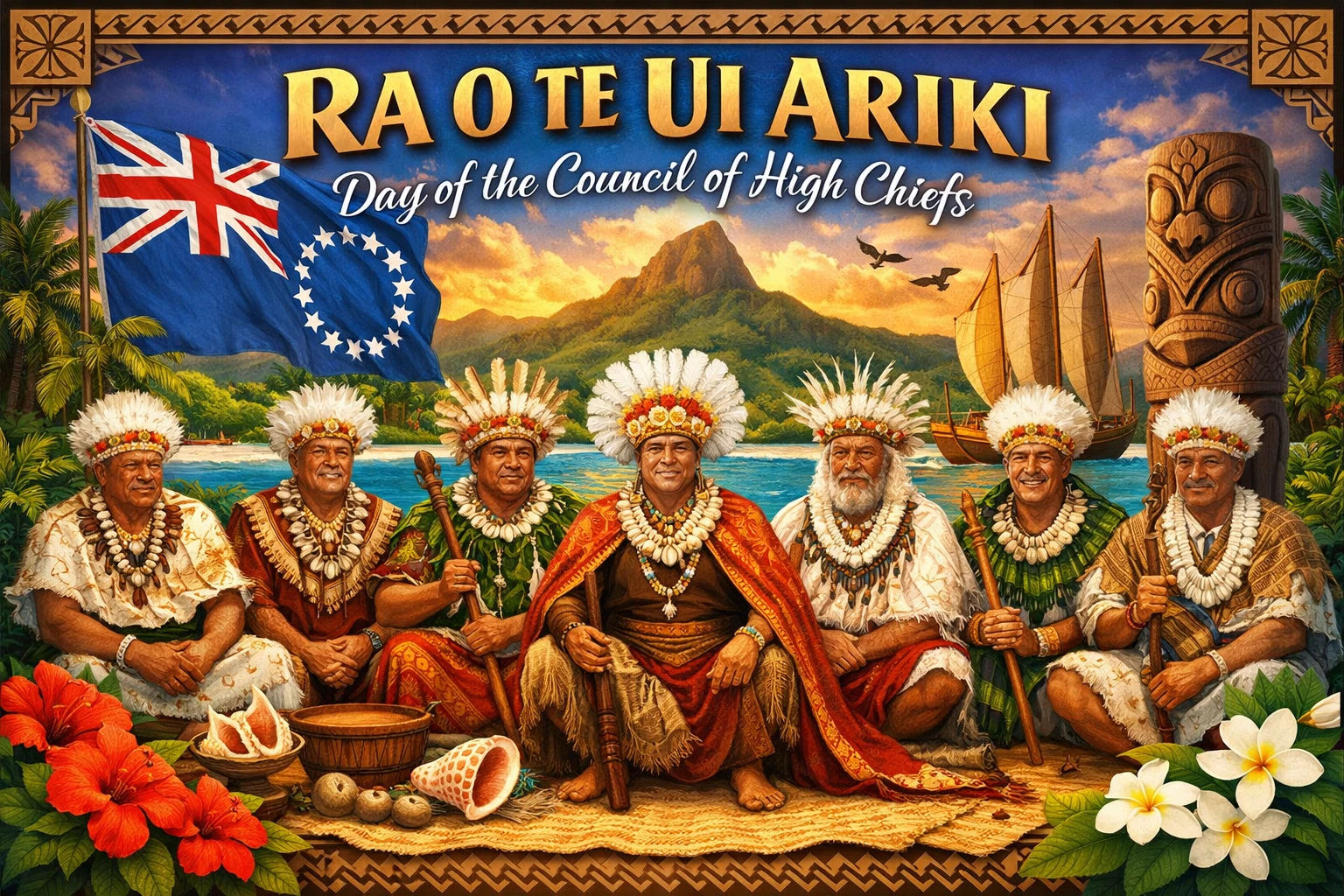
Ra o te Ui Ariki 2026 falls on Friday, July 3, 2026, creating a long weekend for the Cook Islands and making it one of the most culturally resonant days on the island nation's public holiday calendar. In 2026, the holiday carries particular historic weight: it coincides with Te Maeva Nui 2026, the Cook Islands' signature national celebration, which the Ministry of Culture has confirmed will specifically honor the 60th anniversary of the Ui Ariki (House of High Chiefs), established in 1967. Together, Ra o te Ui Ariki Day and the Te Maeva Nui 2026 festivities create one of the most significant cultural commemorations in the Cook Islands since the territory's 1965 self-governance.
Ra o te Ui Ariki 2026: Honoring 60 Years of Cook Islands High Chiefly Tradition
In the Cook Islands, leadership is layered in ways that no single government document can fully describe. There is the elected parliament, the democratic framework adopted at self-governance in 1965, which handles the territory's laws, its economy, its relationship with New Zealand, and its international affairs. And then there is something older, something that runs beneath the modern political architecture like the roots of a toa tree beneath a coral pavement: the Ariki.
The Ariki are the hereditary high chiefs of the Cook Islands. Their authority is not legislative. They do not pass laws, they do not control budgets, and their formal institution, the House of Ariki (Are Ariki), holds an advisory role that the elected parliament is under no legal obligation to follow. But to describe the Ariki's relevance in purely institutional terms is to miss the point almost entirely.
The Ariki are the living embodiment of Cook Islands genealogical heritage. Each Ariki holds the title of their family line, a title that in some cases extends back through oral tradition for thirty or more generations. Their authority in matters of land, custom, community dispute resolution, and cultural identity is real and is felt throughout the islands in ways that no constitution can mandate and no election can create.
When the Cook Islands created Ra o te Ui Ariki as a public holiday in December 2011, with former government minister Teariki Heather confirming the new observance, the decision was a formal acknowledgment of something the community had always known: that the Ariki are foundational to what the Cook Islands is, and that their contribution deserves a day of national recognition.
The History Behind the House of Ariki
The story of the Are Ariki begins in 1965, when the Cook Islands became a self-governing territory in free association with New Zealand. As the territory designed its modern governance framework, the question of how to integrate traditional chiefly authority with democratic governance produced a creative solution: a separate parliamentary body, the House of Ariki, which would give the Ariki a formal institutional presence alongside the elected Parliament.
The proposal was made in 1965. Construction and formal establishment took two more years. On July 6, 1967, the House of Ariki met for the first time, bringing together the hereditary high chiefs of the Cook Islands under a single roof for the first time in a formal political institution.
That date, July 6, 1967, is the foundation moment that Ra o te Ui Ariki commemorates. The holiday was initially fixed on July 6 annually, then later converted to the first Friday of July to create a consistent long weekend format for workers and families. In 2026, the first Friday of July is July 3.
The Are Ariki consists of 24 chiefs representing the islands of the archipelago. The number of Ariki representing each island reflects its size: Rarotonga, the largest island and the home of the capital Avarua, is represented by six Ariki. Other islands including Aitutaki, Mangaia, Atiu, Mauke, Mitiaro, Manihiki, Rakahanga, Pukapuka, and Nassau each contribute their own hereditary representatives.
2026: The 60th Anniversary Year and Te Maeva Nui
The 2026 Ra o te Ui Ariki observance is exceptional in the context of the broader Cook Islands national celebration season.
IFACCA (the International Federation of Arts Councils and Culture Agencies) reported in January 2026 that the Ministry of Culture of the Cook Islands confirmed that Te Maeva Nui 2026 will specifically mark the 60th anniversary of the Ui Ariki, with the role of the traditional high chiefs positioned as the central thematic focus of this year's national festival. The exact quote from the IFACCA report: "The role of the Ui Ariki as a cornerstone of Cook Islands society will take centre stage during Te Maeva Nui 2026."
Te Maeva Nui (meaning "Great Rejoicing" or "Celebrate the Greatness") is the Cook Islands' equivalent of a national birthday celebration, held annually in early August around Constitution Day (August 4) to mark the 1965 self-governance anniversary. It is the biggest cultural event in the Cook Islands' annual calendar, featuring traditional dance competitions between the islands, outrigger canoe racing, traditional sports, arts and crafts exhibitions, concerts, and the Te Maeva Nui Parade in Avarua.
In 2026, the combination of Ra o te Ui Ariki Day on July 3 and the Te Maeva Nui festival running through early August creates a four to six week window in which Cook Islands cultural identity is at its most visible, celebrated, and accessible.
What Ra o te Ui Ariki Day Looks Like on Rarotonga
As a public holiday, Ra o te Ui Ariki Day on July 3, 2026 means schools, government offices, and most businesses are closed across the Cook Islands. The day is observed with community activities that reflect the holiday's purpose: honoring the traditional cultural heritage of the islands and the chiefly system that has sustained Cook Islands community life for centuries.
Ceremonies Honoring the Ariki
On Ra o te Ui Ariki Day, formal acknowledgment of the high chiefs takes place across the islands. On Rarotonga, this typically involves community gatherings at which Ariki are honored through traditional protocols, including the presentation of first fruits offerings (umu kai), formal greetings, and community speech-making that traces the genealogical heritage of the chiefly families. These ceremonies are rooted in the same protocols that pre-contact Cook Islands communities used to mark the seasonal calendars and the acknowledgment of chiefly authority.
Cultural Performances and Tivaevae
The holiday is also an opportunity for community cultural performance, including ura (Cook Islands dance), himene (traditional choral singing), and the display of tivaevae, the intricately sewn patchwork quilts that are one of the Cook Islands' most distinctive and celebrated art forms.
Tivaevae are not merely decorative. They are community art objects made collectively by groups of women who gather in shared sewing sessions called taorengi, and each piece carries the identity of its makers as clearly as a signature. At public holidays and cultural celebrations, tivaevae are displayed in community halls and cultural venues across Rarotonga and the outer islands. For visitors, seeing tivaevae displayed in the context of a cultural celebration is a far more meaningful experience than seeing them in a souvenir shop.
The Punanga Nui Market and Avarua
Punanga Nui Cultural Market in Avarua, Rarotonga's capital and the hub of the island's cultural and social life, typically adjusts its schedule around public holidays but remains a central gathering point for community members. The market, held regularly on Saturday mornings along the Avarua waterfront, may feature special programming around the Ra o te Ui Ariki long weekend.
Avarua itself, the compact capital town of the Cook Islands, wears its Pacific island character without apology. The Cook Islands Parliament Building, the Cook Islands National Museum (currently under redevelopment), the CICC Church (Cook Islands Christian Church, founded 1853 and the oldest church building in continuous use in the Cook Islands), and the Beachcomber Building along the waterfront all sit within easy walking distance of each other in a town center that is simultaneously the political heart of a Pacific nation and a village-scale community where everyone knows the families and the genealogies that Ra o te Ui Ariki exists to honor.
The Outer Islands on Ra o te Ui Ariki Day
One of the most distinctive aspects of the Cook Islands' chiefly system is how it is distributed across the archipelago's 15 islands, scattered across 2 million square kilometers of the South Pacific Ocean.
Aitutaki, the lagoon island 259 kilometers north of Rarotonga that is consistently ranked among the world's most beautiful lagoons, has its own Ariki and its own distinct chiefly tradition. Ra o te Ui Ariki Day in Aitutaki has the quieter character of a small island observing a national holiday, with community gatherings at the main village of Arutanga and the general atmosphere of an island with deep traditional roots taking a day to acknowledge them.
Mangaia, the southernmost Cook Island, is one of the most ancient land surfaces in the Pacific and has one of the oldest continuous chiefly traditions. Its Ariki lineages are traced in oral histories that are among the most detailed in Polynesia, and the holiday on Mangaia is observed with a cultural seriousness that reflects an island community that does not take its ancestral heritage lightly.
Practical Travel Tips for Visiting the Cook Islands Around Ra o te Ui Ariki 2026
Getting to Rarotonga
Rarotonga International Airport (RAR) receives direct services from:
- Auckland (Air New Zealand, approximately 3.5 hours)
- Sydney (Virgin Australia, approximately 5 hours)
- Los Angeles (Air New Zealand, approximately 8 hours)
- Fiji (Fiji Airways, approximately 2 hours)
The July period, falling in the Cook Islands' winter (mild and dry), is one of the most pleasant times of year to visit Rarotonga, with average temperatures of approximately 23 to 26 degrees Celsius and lower humidity than the November to April wet season.
When to Arrive for Maximum Cultural Immersion
Arriving on Monday, June 29 or Tuesday, June 30 gives you three to four days on the island before Ra o te Ui Ariki Day on July 3, time to orient yourself, explore Rarotonga's interior rainforest cross-island track, visit Muri Lagoon on the south coast, and attend the Saturday Punanga Nui Cultural Market before the holiday itself. Staying through to Constitution Day (August 4) positions you for the full Te Maeva Nui national celebration, which in 2026 will be the 60th anniversary Ui Ariki edition.
What to Wear and How to Engage
The Cook Islands is a deeply respectful community, and traditional ceremony protocol applies at formal observances. For Ra o te Ui Ariki Day cultural events:
- Dress modestly for village and church community events (shoulders covered, knees covered in traditional ceremony contexts)
- Remove shoes when entering homes, church buildings, and ceremony spaces
- Ask before photographing Ariki and ceremonial participants
- Accept any offered food or drink with gracious appreciation, as rejecting hospitality is a social discourtesy
Cook Islands Cultural Experiences Around the Holiday
- Punanga Nui Cultural Market (Saturdays, Avarua waterfront): arts, crafts, tivaevae, local produce, himene performances
- Cross-Island Track: guided walking through Rarotonga's central rainforest, reaching the highland plateau with 360-degree views
- Muri Lagoon: calm, shallow lagoon on Rarotonga's south coast with excellent snorkeling over healthy coral and sea turtles
- Kayak to Koromiri Islet: paddling from Muri Beach across the shallow lagoon to the small uninhabited islet is one of Rarotonga's most popular short excursions
- Ura dance show: traditional Cook Islands dance performances at cultural shows organized by major resorts and the Punanga Nui facility provide an accessible introduction to the same dance tradition that the Ariki and their communities have practiced for generations
Verified Information at a Glance
Event Name: Ra o te Ui Ariki / Day of the Council of High Chiefs 2026
Event Category: National public holiday honoring the hereditary high chiefs (Ariki) of the Cook Islands; cultural observance
Confirmed Date: Friday, July 3, 2026 (first Friday of July)
Long Weekend: Friday, July 3 to Sunday, July 5, 2026
Original Commemorated Date: July 6, 1967 (House of Ariki first session)
2026 Significance: 60th anniversary of the Ui Ariki (1967 to 2027 counted as 60 years; Te Maeva Nui 2026 will mark this milestone)
Are Ariki Composition: 24 hereditary high chiefs representing all Cook Islands (6 from Rarotonga; others from outer islands)
Holiday Established: December 2011 by Cook Islands government
Main Island: Rarotonga, Cook Islands (Avarua capital)
Admission: Free (public holiday community observances)
Te Maeva Nui 2026 Connection: Confirmed by Ministry of Culture and IFACCA: 60th anniversary of Ui Ariki is the central theme of Te Maeva Nui 2026 (early August)
If you are standing in Avarua on the morning of July 3, 2026, hearing the name of an Ariki spoken aloud in the context of a formal community greeting, understanding that the title being spoken was passed down through a genealogical line that stretches back to the ancestral voyagers who navigated across 2 million square kilometers of open ocean to settle these islands in the first place, and that the Cook Islands government built a public holiday specifically to ensure no generation forgets that heritage, then you are experiencing one of the deepest and most honest expressions of Pacific island identity that any traveler to the South Pacific can find.