The island of Crete stands unrivaled when it comes to food. Its culinary tradition predates the concept itself: Minoan Cretans were pressing olive oil, cultivating vines, and harvesting wild herbs over four thousand years ago. The essential character of their diet—a blend of olive oil, legumes, fresh vegetables, herbs, fish, and goat and sheep cheese—has barely changed since. The Cretan Diet is not a wellness trend; it is the oldest continuously practiced food culture in Europe. In 2026, Crete carries a new recognition: it has been named the European Region of Gastronomy, the continent's most prestigious culinary designation.
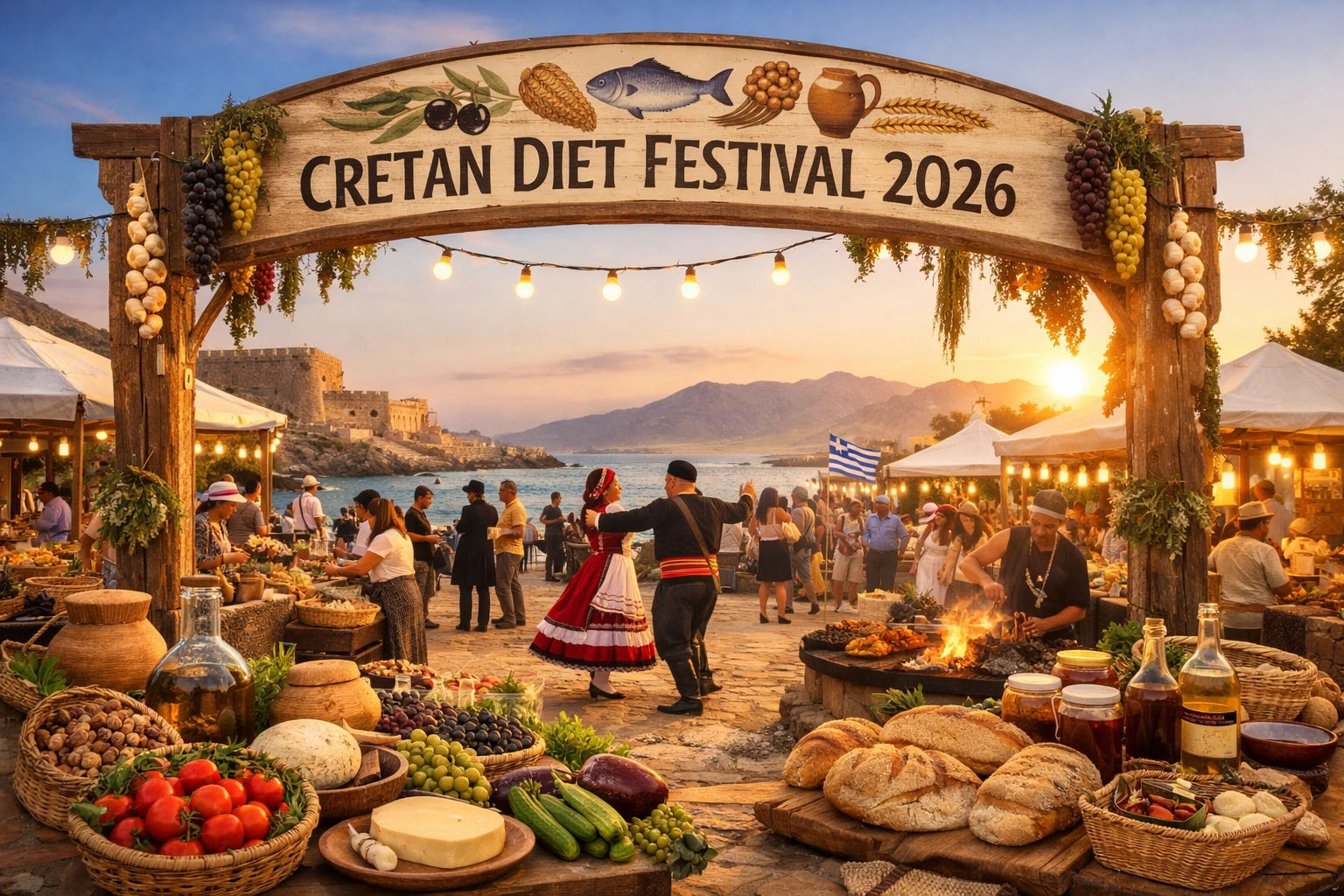
Into this landmark year arrives the Cretan Diet Festival 2026, returning to the Municipal Garden of Rethymno in early July. This event brings together the island's producers, chefs, winemakers, cheesemakers, and folk artists for a week of tastings, workshops, cooking demonstrations, music, and cultural celebration. It is not merely a farmers' market with a stage; it is a genuine cultural event that celebrates the food traditions of one of the Mediterranean's most significant culinary civilizations.
"The Cretan Diet is the oldest continuously practiced food culture in Europe."
The Story of the Cretan Diet
A UNESCO-backed Mediterranean Model
Before entering the festival, it helps to understand what the Cretan Diet is and why it matters enough to have a festival named after it. The Cretan Diet is a specific expression of the Mediterranean Diet, inscribed on the UNESCO Intangible Cultural Heritage of Humanity list in 2013. Within the Mediterranean context, the Cretan version holds a special position. The landmark Seven Countries Study conducted by American physiologist Ancel Keys in the 1950s and 1960s identified Cretans as having the lowest rate of cardiovascular disease and one of the longest life expectancies, attributed directly to their diet.
"The Cretan version of the Mediterranean Diet has always occupied a special position."
The specific components that make the Cretan Diet distinctive include:
- Extra-virgin olive oil as the primary fat, with Crete producing approximately 100,000 tonnes annually.
- Wild greens and herbs, harvested from Cretan hillsides for millennia.
- Legumes: chickpeas, lentils, fava beans, and black-eyed peas.
- Whole grains, particularly the iconic dakos rusk.
- Fresh vegetables and fruits, including Maleme oranges and Gerakario cherries.
- Fresh and preserved fish, sourced from Crete's 1,000 km coastline.
- Cretan cheeses, like graviera, a PDO product.
- Tsikoudia (raki), a PGI-status Cretan grape spirit.
- Thyme honey, considered among the finest in the world and a PDO product.
Crete: European Region of Gastronomy 2026
A Year of Culinary Celebration
The European Region of Gastronomy designation is awarded by the International Institute of Gastronomy, Culture, Arts and Tourism (IGCAT) to regions demonstrating exceptional food culture, innovation, and sustainable food practices. Crete's designation for 2026 was recognized by Wanderlust Magazine as a major food travel motivation, naming the Cretan Diet Festival as a key event to experience the island's gastronomy firsthand.
"Crete's food culture forms the heart of the Mediterranean diet and serves as a model for global healthy eating."
The 2026 designation means that the Cretan Diet Festival carries additional programming ambitions and international visibility, with events and participants from across the continent engaging with Crete's food culture.
The Festival Experience
A Week of Culinary and Cultural Immersion
The Cretan Diet Festival 2026 is organized by the Municipality of Rethymno, the Regional Unit of Rethymno, and the Chamber of Commerce of Rethymno. Based on the confirmed 2025 program and the 2026 framework, the festival takes place in early July at the Rethymno Municipal Garden, running for approximately one week.
"This is not a supermarket sample table. These are the small-scale farmers, cooperative producers, and artisan food makers of the island."
The heart of the daytime program is an open-air trade fair of Cretan products. Producers from across the island present their olive oils, wines, cheeses, honeys, rusks, herbs, cured meats, jams, and specialty foods directly to the public. The opportunity to meet a Sitia olive oil producer, taste their different oil varieties, and buy directly is an experience no restaurant visit can replicate.
The Wines of Crete organization highlights the festival's wine dimension, with seminars where visitors learn about production methods, attributes, quality standards, and health benefits. Cretan wine has experienced a renaissance, with native grape varieties like Vidiano and Kotsifali appearing on wine lists across Europe.
Workshops and Demonstrations
Hands-on Culinary Education
The festival's daily program includes hands-on cooking workshops and chef demonstrations on the main stage. Based on the confirmed 2025 schedule, workshops begin at approximately 7:15 pm and cover topics such as:
- Cretan paximadi (rusk): making, soaking, and serving this fundamental bread product.
- Traditional Cretan pastries: kaltsounia, sfakianes pites, and loukoumades.
- Cheese-making: demonstrations using Cretan sheep and goat milk.
- Wine and olive oil sensory evaluation: guided tastings with certified producers and sommeliers.
One highlight is "From Our Land to Your Table," featuring home cooks from southern Rethymno preparing traditional rural dishes. The Agri-Food Partnership of Crete hosts presentations about certified Cretan tavernas and restaurants, helping visitors continue their culinary exploration after the festival.
Evening Entertainment
Music and Cultural Performances Under the Stars
Each evening, the festival's main stage transitions to live cultural performances. Based on the 2025 program, evening entertainment runs from approximately 8:45 pm to 11:00 pm and includes:
- Traditional Cretan dance performances by local folk associations.
- Cretan lyra music concerts, featuring the island's defining musical instrument.
- Contemporary Greek music concerts, such as performances by Eva Politaki and the GreCanto Ensemble.
- Children's educational and entertainment program, including food education activities and craft workshops.
The Children's Program
Engaging the Youngest Food Lovers
The festival's investment in children's programming is one of its most distinctive features. The confirmed program includes educational activities where children learn about the origins of Cretan food products, participate in simple cooking activities, and engage with the island's food culture in age-appropriate ways. This dimension makes the Cretan Diet Festival genuinely family-friendly.
Rethymno: The Festival's Extraordinary Setting
A Historic Venetian City as Backdrop
The Cretan Diet Festival takes place in the Municipal Garden of Rethymno, a mature urban park in one of the most beautifully preserved Venetian cities in the Mediterranean. Rethymno's old city is a fine example of Venetian urban architecture, with the Venetian Fortress Fortezza, the Venetian Lighthouse, and narrow lanes preserving a concentration of Venetian palazzos, Ottoman fountains, and Byzantine church buildings.
"You can be watching a cooking demonstration while hearing the evening bells of the Nerantze Mosque from across the garden."
The Municipal Garden provides a setting that feels simultaneously intimate and civic, perfect for a festival celebrating Crete's culinary heritage. Rethymno's position between Heraklion and Chania makes it centrally accessible for visitors arriving at either of Crete's main airports.
Practical Guide to Attending
Making the Most of Your Festival Experience
Getting to Rethymno is straightforward:
- Heraklion International Airport (HER): approximately 75 km east of Rethymno.
- Chania International Airport (CHQ): approximately 75 km west of Rethymno.
- KTEL Bus: frequent services connect Heraklion and Chania to Rethymno.
- The Rethymno Municipal Garden is centrally located and walkable from old city accommodations.
Tickets and admission:
- Tickets are available at the entrance.
- The festival has historically been free, with some paid elements.
- 2026 pricing will be announced by the Municipality of Rethymno; monitor official channels for updates.
When to go for maximum program:
- First evening: the opening ceremony and introductory program.
- Midweek: detailed cooking workshops are typically scheduled mid-festival.
- Final evening: the festival traditionally closes with a special musical concert.
Where to stay: Rethymno's old city offers accommodation within a short walk of the Municipal Garden, with options ranging from boutique hotels to family-run guesthouses. Book early for early July, as Rethymno's peak summer season fills quickly.
Verified Information at a Glance
- Event Name: Cretan Diet Festival 2026 (Γιορτή Κρητικής Διατροφής)
- Event Category: Annual food, wine, and culture festival
- Confirmed Dates: Early July 2026
- Duration: Approximately 7 days
- Venue: Municipal Garden of Rethymno, Crete
- Admission: Tickets at entrance (historically free with some paid elements)
- Daily Programme: Producers market, workshops, concerts, children's programme
- Organizers: Municipality of Rethymno, Regional Unit of Rethymno, Chamber of Commerce of Rethymno
- 2026 Special Context: Crete designated European Region of Gastronomy 2026 by IGCAT
- Key Food Products Featured: Olive oil (PDO Cretan), graviera cheese (PDO), thyme honey (PDO), tsikoudia/raki (PGI)
- Official Information: Municipality of Rethymno
```