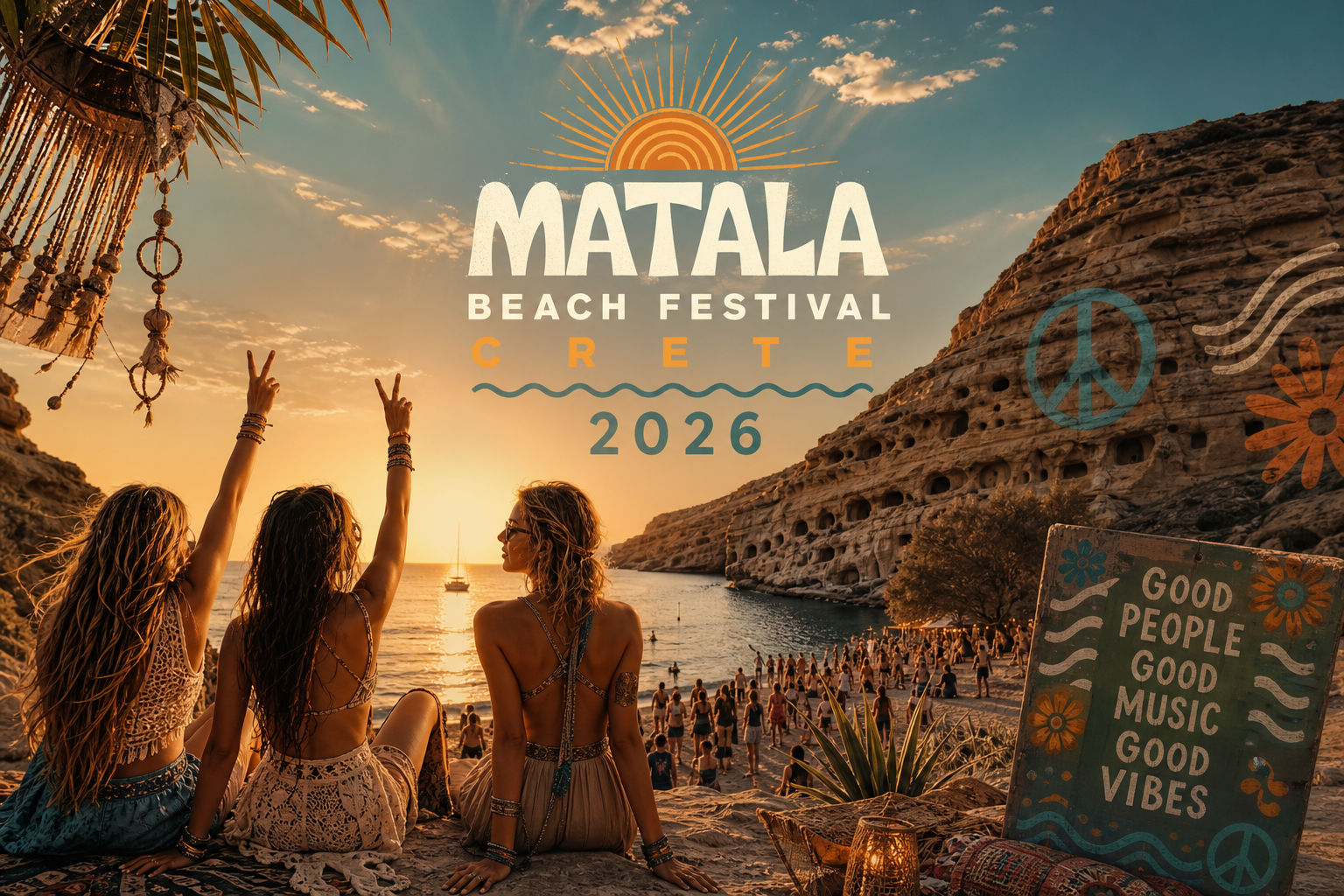
There is a beach on the southern coast of Crete where hippies lived in sandstone caves above the sea in the 1960s and 1970s, where Joni Mitchell walked barefoot in the moonlight and wrote music that changed the world, and where the spirit of peace, love, and freedom never truly left. That beach is Matala. And every summer it reclaims that spirit with a three-day free music and cultural celebration that has become the most beloved open-air festival in all of Greece. The Matala Beach Festival 2026 runs from Friday, June 19 to Sunday, June 21, 2026 — and it is completely free to attend.
"Europe's largest free beach music festival."
A Festival Born From Hippie Legend
Matala's Iconic Past and Present
Matala sits on the southern coast of Crete, approximately 63 kilometres south of Heraklion, nestled between red sandstone cliffs and a horseshoe bay of crystalline Libyan Sea water. In the 1960s and early 1970s, it became one of the most famous hippie destinations on the planet. Travellers from across Europe and North America arrived and never left, carving out lives in the ancient cave system cut into the cliffs above the beach. Joni Mitchell referenced Matala in her 1971 album For the Roses. Cat Stevens walked its shores. Bob Dylan is said to have passed through. The caves still stand above the beach today.
In 2011, the Municipality of Phaistos and the Cultural Association of Pitsidia-Matala decided to revive that spirit formally. The Matala Beach Festival was born — a free, open-air, three-day event on the beach itself, with the legendary caves as the backdrop and the Libyan Sea as the stage floor. Now in its 15th year, it has grown into what organisers and attendees consistently describe as Europe's largest free beach music festival.
The 2026 Dates and Format
Mark Your Calendars
The Matala Beach Festival 2026 runs from Friday, June 19 to Sunday, June 21, 2026 — confirmed on the official festival Instagram (@matala_beach_festival):
- Friday, June 19 — opening night
- Saturday, June 20 — peak festival day
- Sunday, June 21 — closing day and final concerts
Entry is completely free — the festival has maintained its free admission policy since its founding in 2011, a commitment to the hippie values of openness and access that the event is built around.
The 2026 lineup had not been fully announced at time of writing. The official programme typically drops 4 to 6 weeks before the June dates. Follow @matala_beach_festival on Instagram and matalabeachfestival.org for the confirmed artist programme.
What the Matala Beach Festival Includes
A Cultural Extravaganza
The festival is a full three-day cultural programme, not just a concert series:
- Live concerts featuring both international and Greek artists across rock, reggae, pop, folk, and traditional Greek music
- DJ sets running between live acts and into the late evening hours
- Art installations across the beach and cliff area
- The Matala Busking Project — street musicians and performers invited to perform freely across the village and beach area during the festival days, an initiative directly linked to the original hippie culture of Matala
- Street painting Sunday — the last Sunday before the festival, the streets of Matala village transform into a giant canvas where painters of all ages leave murals on the streets where the hippies once walked
- Beach yoga sessions on the sand in the early morning before the main music programme begins
- Painting workshops and art activities open to all ages
- Street food stalls serving local Cretan delicacies alongside international festival food
- The legendary caves above the beach are open for exploration throughout the festival, giving every attendee direct access to the physical space that started the Matala legend
The Cave Beach Setting: Nowhere Else in the World
Nature's Stage
The Matala Beach Festival's setting is the most extraordinary of any free music festival in Europe. The venue is not a field, a park, or an arena. It is a natural beach amphitheatre formed by the red sandstone cliffs that curve around the horseshoe bay, with the ancient cave system cut directly into the rock face above the sand:
- The main stage is set up on the beach with the cliff face behind it, giving every concert the backdrop of the legendary caves and the Libyan Sea horizon ahead
- Audience capacity reaches tens of thousands across the three days, spread across the beach, the cliffs, and the village above
- The Libyan Sea that laps Matala's shore is described as among the clearest and most dramatically blue water in the entire Mediterranean
- The sandstone caves above the beach are UNESCO-listed archaeological sites from the Minoan and early Christian periods, repurposed by hippies in the 1960s and now open as a cultural heritage site alongside the festival
No festival in Greece and very few in Europe can match the combination of natural beauty, archaeological history, and cultural mythology that Matala brings to its beach stage every summer.
Getting to Matala for the Festival
Your Journey to the Heart of Crete
Matala is on the southern coast of Crete, accessible from Heraklion and the island's main transport corridors:
- From Heraklion International Airport (HER): Approximately 1 hour to 1 hour 15 minutes by car or hire car via the E75 motorway south toward Mires and then south to Matala
- By bus from Heraklion Central Bus Station (KTEL): Regular daily buses operate Heraklion to Matala throughout the day; strongly recommended during festival weekend when Matala's parking fills completely
- By taxi from Heraklion: Approximately 1 hour; fares around 60 to 80 euros each way
- From Rethymno: Approximately 1 hour 30 minutes by hire car via the south coast road through Spili
- Parking: Matala has a large parking area at the village entrance but it fills completely during the festival. Organisers strongly recommend arriving early or using the bus service from Heraklion
Where to Stay for Matala Beach Festival 2026
Accommodations in Matala and Beyond
Accommodation options around Matala for the June 19 to 21 festival window:
- Matala village rooms and studios — a small collection of family-run accommodation directly in the village, within walking distance of the festival beach; book months in advance as these fill first
- Pitsidia village — the village immediately above and inland from Matala (5 minutes by car); larger accommodation supply and the home village of the festival's cultural organising association
- Xenophon Accommodations — one of the established Pitsidia-Matala accommodation options featured directly on the festival's partner listings
- Heraklion city — for visitors wanting full hotel infrastructure and a day trip approach to the festival; approximately 1 hour by bus, perfectly manageable for the daytime programme
- Agia Galini — a coastal resort town approximately 20 minutes west of Matala with more accommodation supply, good tavernas, and easy access to the festival
The June 19 to 21 window is one of the most in-demand accommodation periods in southern Crete. Book Matala and Pitsidia accommodation at least 2 to 3 months in advance.
The Cultural DNA of the Matala Beach Festival
Embodying Peace, Freedom, and Art
What separates the Matala Beach Festival from every other Greek summer event is its specific cultural philosophy. The festival is not organised around headliner bookings or sponsorship visibility:
- It is organised around the values of peace, freedom, and artistic expression that the Matala hippie era embodied and that the Municipality of Phaistos chose to honour rather than erase
- Free entry is not a marketing decision. It is a philosophical statement that music and culture belong to everyone
- The Matala Busking Project extends that philosophy by giving the streets and spaces of Matala village to street musicians during the festival days
- The street painting Sunday gives visual artists the same stage as the musicians — the streets of Matala become a temporary gallery that captures the festival's spirit in a permanent community artwork
- Past sponsors including Coca-Cola joining as a 2025 partner confirm the festival's growing commercial appeal while the organisers maintain the cultural commitments that make it unique
This is the festival that Joni Mitchell would attend today if she happened to pass through Matala again. The caves are still there. The sea is still that colour. And for three days in June, the music is free.
Travel Tips for the Matala Beach Festival 2026
Essential Advice for Festival-Goers
- Arrive on Thursday June 18 to secure accommodation and experience pre-festival Matala before the weekend crowds build
- Take the bus from Heraklion on festival days rather than driving; Matala's roads are narrow and parking fills by mid-morning
- Bring cash for food stalls and local vendors; card payments are limited at many of the beach-level stands
- Comfortable shoes and light layers for the evenings; the Matala cliff area can be breezy after sunset even in June
- Arrive early for front-of-stage positions on Saturday June 20 which is the peak festival day with the largest crowds and the biggest acts
- Explore the caves during the quieter morning hours before the main programme begins; the cave experience is most atmospheric in the early light
- Combine with southern Crete: The area around Matala includes the Minoan palace of Phaistos (30 minutes north), the ancient site of Agia Triada, and the wine villages of the Heraklion hinterland — a full week in southern Crete around the festival dates is one of the best Mediterranean travel experiences available in June 2026
June 19 to 21, 2026: Be There
A Celebration of Music and Freedom
The cliffs above Matala beach will be lit on the evening of June 19. The stage will face the Libyan Sea. The caves will be open above you, the same caves where the 1960s generation lived out its most idealistic and most musical chapter. The entry is free. The sea is there. The music is coming.
The Matala Beach Festival 2026 is the event that most completely captures why the Mediterranean summer still feels like the most alive place on earth for those three days in June. The southern coast of Crete is waiting.
Frequently Asked Questions
The Things People Always Want to Know
When is the Matala Beach Festival 2026?
The Matala Beach Festival 2026 runs from Friday, June 19 to Sunday, June 21, 2026 at Matala Beach, Crete, Greece.
Is the Matala Beach Festival free to attend?
Yes, completely free. The festival has maintained a free admission policy since it was founded in 2011.
Where is Matala, Crete?
Matala is on the southern coast of Crete, approximately 63 kilometres south of Heraklion — around 1 hour by car or bus from Heraklion city centre and Heraklion International Airport.
What kind of music is at the Matala Beach Festival?
A mix of rock, reggae, pop, folk, and traditional Greek music, with both international and Greek artists performing alongside DJ sets.
Who organises the Matala Beach Festival?
The festival is organised by the Municipality of Phaistos and the Cultural Association of Pitsidia-Matala, established in 2011.
How do I get from Heraklion to the Matala Beach Festival?
By bus from Heraklion Central Bus Station (KTEL) — daily services to Matala, approximately 1.5 hours, strongly recommended during festival weekend when parking in Matala fills completely.
Verified Information at a Glance
- Event: Matala Beach Festival 2026
- Category: Free open-air beach music and cultural festival
- Dates: Friday, June 19 to Sunday, June 21, 2026
- Venue: Matala Beach, Matala village, Municipality of Phaistos, southern Crete, Greece
- Entry: Free
- Founded: 2011
- Organisers: Municipality of Phaistos and Cultural Association of Pitsidia-Matala
- Music genres: Rock, reggae, pop, folk, traditional Greek, DJ sets
- Programme highlights: Live concerts, DJ sets, Matala Busking Project, street painting Sunday, beach yoga, art installations, art workshops, street food
- Official Instagram: @matala_beach_festival
- Official website: matalabeachfestival.org
- Nearest airport: Heraklion International Airport (HER) — approximately 1 hour by car or 1.5 hours by bus
- Best for: Free festival seekers, Greek island music lovers, hippie culture enthusiasts, Mediterranean beach festival travelers, Crete cultural tourism visitors, rock and reggae fans, June Greece travelers, island travel content creators