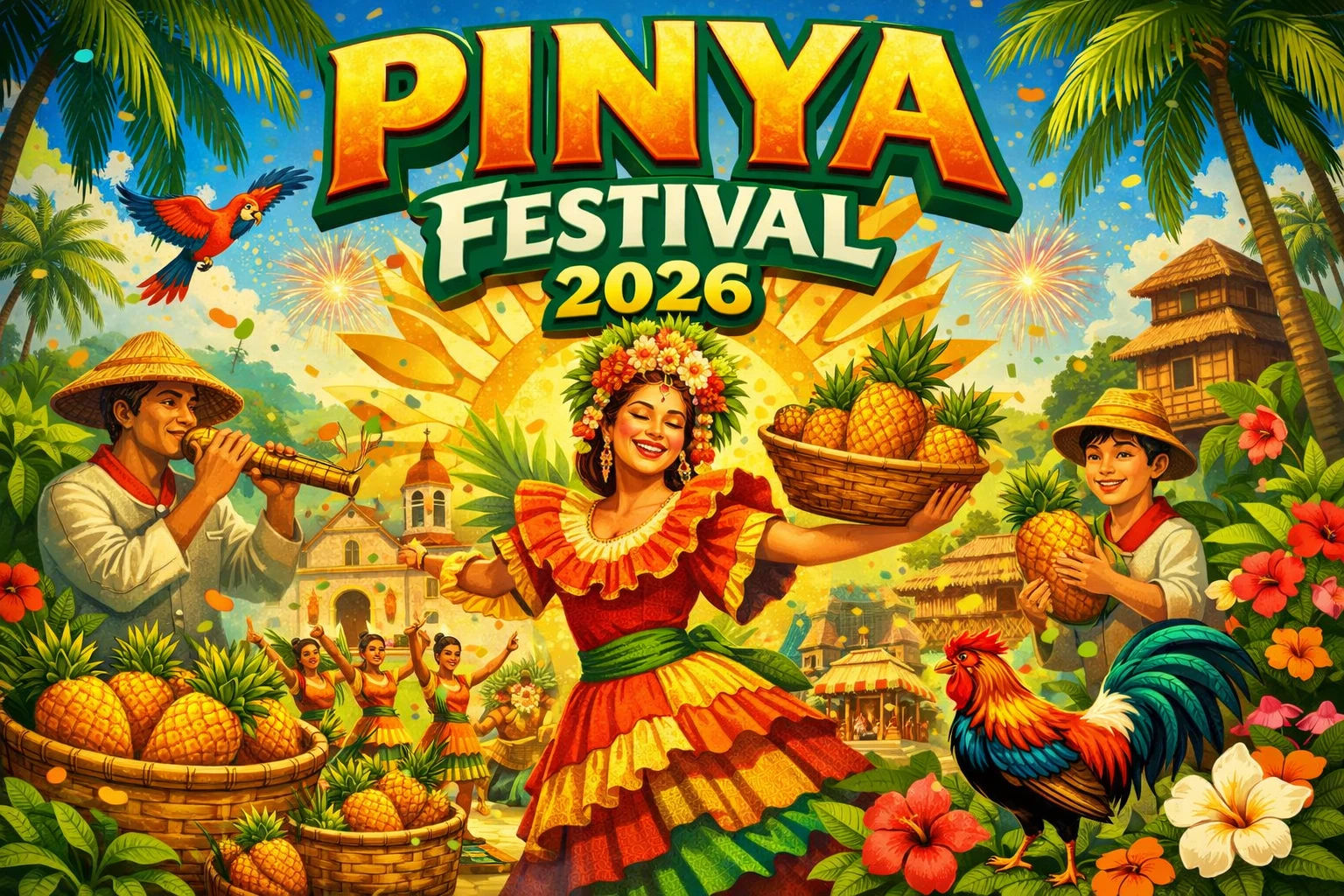
Pinya Festival 2026 Palawan: Bataraza's Sweetest Celebration Returns to the South
There is a corner of Palawan that most travelers never reach, a southern tip of the island where pineapple plantations stretch across the lowlands, where the Palaw'an indigenous people have farmed the land for generations, and where every July the entire town puts down its tools, picks up its colors, and throws one of the most genuinely joyful agricultural festivals in the Philippines. Welcome to Bataraza, and welcome to the Pinya Festival.
The Pinya Festival in Bataraza celebrates pineapple production, a cornerstone of the town's economy, with a colorful parade, cultural performances, and an agricultural trade fair showcasing local products from different barangays. In 2026, the festival is expected to return for its 8th annual edition in mid-July, following the established tradition of gathering the community, its farmers, its artists, and its visitors together for a multi-day celebration of everything that makes this quiet southern municipality remarkable. If you have been looking for a reason to explore southern Palawan beyond the well-worn trail to El Nido and Puerto Princesa, the Pinya Festival is it.
The Story of How a Pineapple Built a Festival
From Plantation to Parade: Bataraza's Agricultural Identity
Bataraza sits at the southern tip of Palawan's main island, roughly 350 kilometers south of Puerto Princesa, deep in the territory that locals simply call "the south." It is a first-class municipality that has grown significantly over the past four decades, with its population rising from around 10,000 in the 1970 census to more than 85,000 by 2020, driven by mining activity and agricultural development. But among all of Bataraza's economic pillars, it is the humble pineapple, or pinya in Filipino, that holds a special place in the town's heart.
Bataraza has almost 600 hectares of pineapple plantations, with Barangay Bulalacao serving as the town's pineapple production powerhouse, home to around 500 pineapple farmers who are mostly members of the Palaw'an indigenous group. These are not corporate farms managed by outside interests. They are family plots tended by people whose ancestors have worked this land for generations, producing pineapples that locals will tell you without any hesitation are among the sweetest in the Philippines.
The festival was born out of a strategic vision for agricultural tourism. As Bataraza's tourism officer explained at the inaugural event, the goal was to attract visitors to the south of Palawan and use the pineapple industry as the entry point, with the town aiming to grow from around 30,000 annual tourists to 100,000 in coming years.
The First Pinya Festival and the Journey to 2026
The Town of Bataraza launched its first ever Pinya Festival on July 12, 2019, with events beginning at SM Puerto Princesa before moving to the municipality, aiming to promote the town's products and tourism across the province and beyond. That debut event established a template that the festival has refined and expanded with each passing year, pausing during the pandemic years before resuming with renewed energy.
The fourth Pinya Festival in 2022 marked the resumption of face-to-face celebration after the pandemic hiatus, running from July 15 to 18 and reigniting the community's enthusiasm for this annual gathering. By the time the sixth edition arrived in 2024, the festival had found its full stride. July 15, 2024, marked the jubilant start of the 6th Pinya Festival, beginning with a colorful parade followed by a program attended by local and barangay officials, government agency staff, and members of various organizations and cooperatives.
The 2026 edition will be the eighth, and with each year the festival grows a little more polished, a little more ambitious, and a little better known beyond the borders of southern Palawan.
What Happens During the Pinya Festival
The Grand Float Parade: Art Made from Agricultural Pride
The Float Parade is a true spectacle, with each barangay flaunting its artistic prowess through intricately designed floats that showcase creativity and community spirit. From towering pineapple replicas to intricate floral arrangements, the floats turn the town into a vibrant mosaic of colors and craftsmanship.
Watching each barangay's float roll past is also a lesson in community identity. Each one reflects something specific about the neighborhood it represents, its geography, its products, its history, or its aspirations. The pineapple theme runs through everything, but the creativity within that constraint is genuinely impressive. Local artisans, students, and community groups spend weeks constructing these entries, and the pride they take in the finished product is visible in every carefully placed piece of foliage and every hand-painted detail.
The Agri Trade Fair: Where the South Sells Its Best
The Agri Trade Fair opens during the festival to promote Bataraza's agricultural products while boosting regional tourism. Farmers and producers from various barangays display a wide range of fruits, vegetables, and goods, showcasing the town's agricultural richness.
The trade fair is where visitors get the most direct and delicious access to what Bataraza actually produces. Fresh pineapples straight from Barangay Bulalacao are available for purchase, and their flavor really does live up to the local reputation. But the fair goes far beyond the fruit itself. Processed pineapple products, including jams, vinegars, wines, dried fruit snacks, and even textiles woven from pineapple fiber, give visitors a full picture of how deeply integrated the pinya is in Bataraza's economic and creative life.
Pineapple fiber textile, known as piña cloth in Philippine craft tradition, is among the most culturally significant products on display. This delicate, lustrous fabric has been used in traditional Filipino formal wear for centuries and is the material from which the barong Tagalog, the national dress shirt of the Philippines, has traditionally been made. Seeing it produced and displayed in the town where the raw material grows is a connection to something genuinely ancient in Philippine culture.
Street Dancing Competition: Color, Rhythm, and Community
The street dancing competition is where the festival sheds its agricultural origins and becomes pure celebration. The much-awaited Mardi Gras Street Dancing Competition features different schools competing with students wearing colorful costumes, and the energy it generates in Bataraza's central streets is unlike anything the town experiences at any other time of year.
Schools prepare their choreography and costumes months in advance. The dances incorporate traditional Filipino movement vocabulary alongside contemporary influences, and the pineapple theme appears in the costumes in creative and sometimes surprisingly elaborate ways. Watching students who have rehearsed through the heat of a Palawan summer finally perform their routines for the whole town is one of those moments that reminds you what festivals are really for.
The Pineapple Cooking Contest: A Culinary Celebration
The Culinary Contest is a cookfest wherein original recipes' main ingredient is the pineapple, and it draws participants who approach the brief with remarkable ingenuity. Pineapple's natural acidity and sweetness make it a versatile ingredient across savory and dessert applications, and the contest consistently produces dishes that visitors would never have imagined possible from a single fruit. Kare-kare with pineapple glaze, pineapple adobo, pinya-infused atchara, fresh pineapple sorbetes, and pineapple cake all find their way into the competition kitchen, and sampling the entries is one of the festival's most pleasurable activities.
Honoring the People Behind the Pineapple
One of the most meaningful moments of the Pinya Festival is the recognition of Bataraza's outstanding pineapple farmers. The awarding of outstanding pineapple farmers is among the festival's highlights, recognizing the members of the Palaw'an indigenous peoples from different barangays who have been producing pineapple for years.
This recognition matters because it centers the people whose labor makes the entire celebration possible. The Palaw'an, one of the indigenous groups native to southern Palawan, have historically been among the most marginalized communities in the Philippines. The Pinya Festival's consistent emphasis on honoring their contribution to the town's most important agricultural product is a gesture of respect that elevates the celebration beyond simple spectacle.
The Pineapple Landmark in Barangay Bulalacao
No visit to Bataraza during the Pinya Festival is complete without a trip to Barangay Bulalacao, the barangay at the heart of the town's pineapple industry. In Barangay Bulalacao, a one-hectare pineapple trade center was developed where tourists can buy pineapples, processed pineapple products, and native souvenirs. The main attraction is a 14.7-meter pineapple landmark with three floors that serves as a gallery showcasing the pineapple industry and its connection to the community.
That landmark, a towering three-story pineapple structure rising above the plantation landscape, has become one of the most photographed sites in southern Palawan. It is the kind of local landmark that reflects genuine community pride rather than tourist-industry manufacture, and standing at its base surrounded by actual pineapple fields stretching in every direction makes for a distinctly Philippine travel memory that no stock photography can quite prepare you for.
Bataraza and Southern Palawan: A Destination Worth Discovering
The Case for Going South
Most travelers who visit Palawan spend their time in Puerto Princesa or El Nido, and it is easy to understand why. The Puerto Princesa Subterranean River National Park is a UNESCO World Heritage Site. El Nido's limestone karst formations and turquoise lagoons are among the most photographed landscapes in Southeast Asia. But the south of Palawan has its own rewards, and the Pinya Festival provides the perfect occasion to explore them.
Bataraza lies about six to seven hours south of Puerto Princesa by road, a journey through the island's spine that passes through communities and landscapes that most visitors never see. The road south offers glimpses of mangrove coastlines, rice paddies, fishing villages, and the gradual transition from the tourist-oriented north to the genuinely working communities of the south. It is a long drive, but it is a genuinely interesting one.
Rio Tuba and the Rasa Island Wildlife Sanctuary
Bataraza is also the gateway to two of Palawan's most significant natural sites. The Rio Tuba area, home to one of the region's major nickel mining operations, is also where the Coral Bay Nickel Corporation has invested significantly in community development, including the pineapple trade center in Bulalacao. And just offshore lies the Rasa Island Wildlife Sanctuary, a crucial nesting site for Philippine cockatoos, locally known as katala, one of the most endangered birds in the country. Pairing a Pinya Festival visit with a cockatoo spotting excursion to Rasa Island makes for an extraordinarily full and meaningful southern Palawan trip.
The Balabac Islands, a cluster of pristine and largely undeveloped islands considered by many travelers to be among the most beautiful in the Philippines, are accessible from Bataraza by boat. Balabac's white sand sandbars, crystalline waters, and undisturbed marine ecosystems represent exactly the kind of off-the-beaten-path Palawan experience that is becoming increasingly difficult to find in the more developed north. Visiting during Pinya Festival season and then spending a few days island-hopping Balabac is a combination that a growing number of serious Philippine travelers have quietly adopted as their preferred south Palawan itinerary.
Practical Tips for Visiting the 2026 Pinya Festival
Getting to Bataraza from Puerto Princesa requires either a full-day bus journey along the national road south, which takes approximately six to seven hours, or a combination of van and bus services that depart from the Puerto Princesa bus terminal on Malvar Street. Several bus and van operators run daily services south, and booking a seat the evening before departure is advisable during festival week when demand increases noticeably.
If you are flying into Palawan, Puerto Princesa International Airport (PPS) is your gateway, with daily flights connecting to Manila on Philippine Airlines, Cebu Pacific, and AirAsia. The 2026 festival falls in mid-July, which is part of the Philippine rainy season, so packing light rain gear is sensible. July in southern Palawan is warm and humid, with afternoon rain showers that tend to be brief and followed by sunshine, making outdoor activities entirely manageable with a bit of flexibility.
Accommodation in Bataraza is modest but functional. The town has several small guesthouses and pension houses along and near the national road, and booking ahead during festival week is strongly recommended as rooms fill quickly. Puerto Princesa is always an option as a base for a day trip to the festival, though the road distance makes a same-day return a long and tiring commitment. Staying at least one night in Bataraza lets you experience the festival atmosphere across multiple days and gives you time to visit Barangay Bulalacao and its pineapple landmark without rushing.
The festival is free and open to the public. There are no entrance fees to attend the street dancing, parade, or open-air portions of the event, and the Agri Trade Fair is accessible to all visitors. Budget for food, pineapple product purchases from the fair, and transport, and you will find the Pinya Festival one of the most affordable cultural experiences in the Philippines.
A Festival That Celebrates People as Much as Pineapples
The Pinya Festival serves as a crucial platform for promoting pineapple production while reinforcing the community's agricultural roots and fostering collaboration and innovation. But spend a day at the festival and you quickly realize that the pineapple is really a vehicle for celebrating something deeper: the people of Bataraza themselves, their resilience, their creativity, their pride in a way of life that the rest of the world knows little about, and their determination to share it.
The Palaw'an farmers who tend the pineapple fields, the students who spend months rehearsing their street dancing routines, the barangay officials who work through the night to finish their float in time, the cooks who have been experimenting with pineapple recipes since January just for the chance to compete in July, the families who drive from Puerto Princesa and beyond to cheer on their relatives when the awards are announced: all of them are the Pinya Festival, and all of them are why it is worth making the journey south.
Palawan's north gets the attention and the tourist dollars. But the south holds something rarer: the genuine, unpolished warmth of a community celebrating what it has built, what it grows, and who it is. The Pinya Festival is your invitation inside that celebration, and if you accept it in July 2026, you will leave Bataraza understanding something about Palawan and about the Philippines that the island's more famous destinations simply cannot offer.
Verified Information at a Glance
Event Name: Pinya Festival 2026 Bataraza (8th Annual Edition)
Event Category: Annual Municipal Agricultural and Cultural Festival
Location: Bataraza, Southern Palawan, Philippines
Municipality: Bataraza, Province of Palawan, MIMAROPA Region
Organizer: Local Government Unit (LGU) of Bataraza, Municipality of Bataraza Tourism Office
Expected 2026 Dates: Mid-July 2026, consistent with the established annual schedule of July 15 as the traditional opening date. The festival has historically run for four to twenty days depending on the edition. Exact 2026 dates not yet officially confirmed at time of publishing.
Established: 2019 (1st Pinya Festival launched July 12, 2019)
Previous Editions: 6th Pinya Festival ran July 15, 2024. 2026 will be the 8th edition.
Festival Highlights:
- Grand Float Parade featuring floats from all barangays
- Agri Trade Fair showcasing pineapple and agricultural products
- Mardi Gras Street Dancing Competition
- Pineapple Cooking Contest
- Awarding of Outstanding Pineapple Farmers
- Cultural performances and tribal games
- Search for festival queen (beauty pageant)
Key Attraction: 14.7-meter Pineapple Landmark and Pineapple Trade Center, Barangay Bulalacao
Main Agricultural Product: Fresh pineapples, pineapple jam, pineapple vinegar, pineapple wine, piña cloth (pineapple fiber textile), dried pineapple products
Plantation Area: Approximately 600 hectares of pineapple plantations in Bataraza
Admission: Free and open to the public
Getting There: Puerto Princesa International Airport (PPS) is the nearest air gateway, approximately 6 to 7 hours by bus or van south to Bataraza along the national road
Accommodation: Small guesthouses and pension houses in Bataraza town proper; advance booking strongly recommended during festival week
Nearby Attractions: Rasa Island Wildlife Sanctuary (Philippine cockatoo habitat), Balabac Islands (pristine island-hopping), Rio Tuba coastal areas
Contact for Confirmation: Bataraza Municipal Tourism Office / Bataraza Public Information Office Facebook page
All details verified from official Philippine news sources including Palawan Daily News, YourPalawan, Nickel Asia Corporation bulletins, and Palawanderer.net. Specific 2026 dates, program schedule, and logistics will be announced by the Bataraza LGU closer to the event. Always confirm final details with the Bataraza Municipal Tourism Office before planning travel.