Rakudan Festival 2026 Palawan: Aborlan's Joyful Gathering Comes Alive Every June
There are festivals in the Philippines that draw hundreds of thousands of visitors, festivals that fill international travel magazines and trend on social media for weeks. And then there are the quieter ones, the ones held in towns that the tourist buses skip entirely, where the floats are built by neighbors and the roasted pigs are carried through the streets with the same pride that other towns parade their pageant queens. The Rakudan Festival in Aborlan, Palawan, belongs firmly in the second category, and anyone who has stumbled upon it will tell you that those are often the best ones.
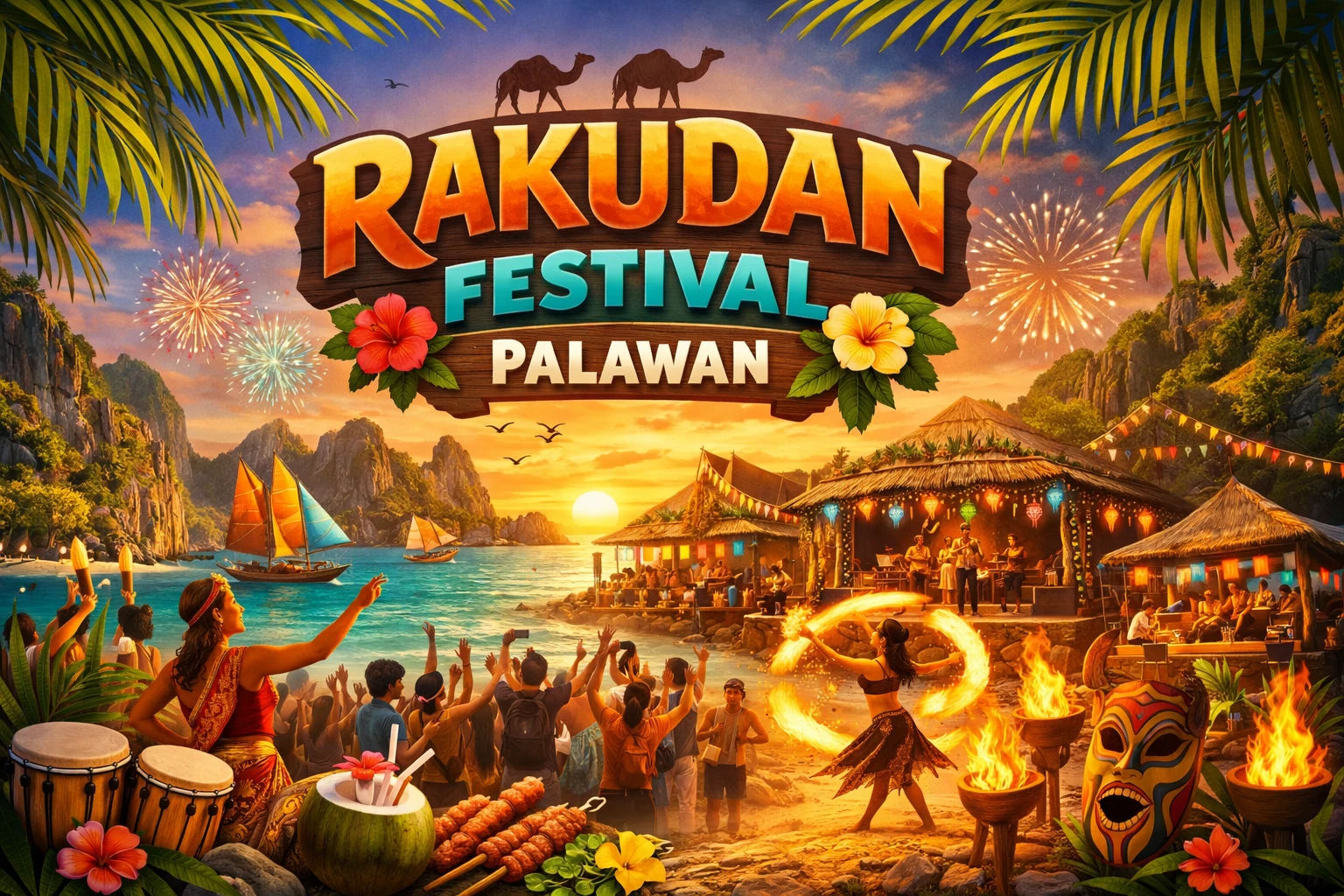
The Rakudan Festival takes its name from the Palawano language, meaning "gathering in an agreed place," underscoring the importance of community participation. Held annually on June 24, the Rakudan Festival celebrates the foundation of Aborlan. In 2026 the festival marks the municipality's 77th founding anniversary, a milestone that gives this year's edition added significance and an added layer of community pride. The event features a range of activities, including a float parade and the Parada ng mga Lechon, a procession showcasing roasted pigs, which remains one of its most anticipated highlights.
If you are traveling the national highway south of Puerto Princesa in June and you hear the sound of drums and smell the unmistakable aroma of freshly roasted pork drifting through a coastal Palawan town, follow it. You have found the Rakudan Festival, and it is exactly as good as it sounds.
The Town Behind the Festival: Understanding Aborlan
A Municipality That Earned the Right to Celebrate
Aborlan, officially the Municipality of Aborlan, is a first-class municipality in the province of Palawan, Philippines. With a population of 38,736 as per the 2020 census, this town has a rich and vibrant history. Once a municipal district, it became a municipality on June 28, 1949, thanks to Executive Order No. 232.
That date, June 28, 1949, is the anchor point of the entire Rakudan Festival. Every year when Aborlan celebrates, it is celebrating the legal recognition of what its community had already built through years of settlement, agriculture, and collective life on this stretch of Palawan's western coast. Although it lost the barrios of Berong and Alfonso XII to the newly created town of Quezon in 1951, Aborlan remains the province's only town with an agricultural college, now known as Western Philippines University, founded in 1910. That institution, over a century old, gives Aborlan a distinctive character among Palawan municipalities. It is a town built around learning as much as farming, and the presence of Western Philippines University on the festival grounds for activities like Zumba Kabataan makes the celebration a genuine town-and-gown affair.
The Origin Story That Explains the Lechon
The Parada ng mga Lechon is loosely tied to the town's origin story. Like many place-name legends across the Philippines, Aborlan's name origin comes wrapped in that familiar story of a linguistic misunderstanding between locals and their colonial visitors. As the story goes, unverified but retold for everyone's amusement, an American during the colonial era stumbled upon what is now Aborlan and after spotting several wild pigs roaming freely, shouted, "A boar land."
Whether the etymology holds any academic water is beside the point. It is the kind of story that a community adopts because it is charming, because it acknowledges the absurdity of colonial naming conventions with a laugh, and because it gives the town a mythology that belongs entirely to itself. And once you have a founding legend built around wild pigs, the logical conclusion is an annual festival where roasted pigs are paraded through the streets as the most cherished float in the procession. This is exactly the kind of locally rooted, unself-conscious pride that makes provincial Philippine festivals so endearing.
The Heart of the Rakudan Festival: The Parada ng mga Lechon
Forty-Six Lechon Dressed to Impress
The Parada ng mga Lechon is the most photographed, most discussed, and most delicious component of the entire festival, and the 2024 edition gives a vivid preview of what to expect in 2026.
The streets of Aborlan burst into life and color for the Rakudan Festival 2024, with the annual Lechon Parade at its heart. Imagine a parade, but with a delicious twist: 46 beautifully decorated roasted pigs, each one a mouthwatering masterpiece representing the different barangays, private sectors, and organizations in the municipality. It was a celebration that not only delighted the eyes but also tantalized the taste buds. This year's celebration saw lechon pigs dressed to impress, each showcasing unique and sumptuous designs. The festive atmosphere was palpable as these porky participants strutted their stuff down the streets. With every step, the aroma of roasted pork filled the air, making it impossible not to smile.
The competitive dimension of the parade adds to its energy. Special accolades were also given for Best in Food Arrangement, Orderliness on Food Distribution, and Cottage or Kubo. Each participating barangay or organization puts real creative effort into how their lechon is presented, decorated, and displayed, turning what is essentially a procession of pork into a genuine craft competition. The judging categories reward both aesthetics and the way food is eventually shared with the crowd, which keeps the celebration grounded in its purpose: feeding the community, not just dazzling it.
The Communal Boodle Fight: Everyone Eats Together
After the parade, each roasted pig is set up for a communal boodle fight. The boodle fight is one of the most distinctly Filipino communal eating traditions, where participants gather around a long table covered in banana leaves laden with rice, meat, seafood, and vegetables, and eat together using only their hands. No plates, no utensils, no pretension: just food, friends, and the understanding that sharing a meal this way creates a closeness that formal dining never quite achieves.
Participating in the post-parade boodle fight at the Rakudan Festival is the kind of travel experience that shows up in the memory years later with unusual clarity. The smell of the lechon, the warmth of the crowd gathering around the banana-leaf table, the sound of the municipality's barangay representatives laughing together over food they spent weeks preparing: these are not the kind of moments that happen at tourist-oriented events. They happen at community festivals, in towns that are not expecting outside visitors, which is exactly where the Rakudan Festival finds itself.
More Than Just Lechon: The Full Festival Program
Zumba Kabataan at Western Philippines University
As part of Aborlan's 75th Founding Anniversary, the energy was electric at Western Philippines University. Nearly 500 youths from various barangays participated in the Rakudan Festival's Zumba Kabataan 2024. The competition was fierce, the movements swift, and the choreographies nothing short of spectacular.
The Zumba Kabataan brings the youth of Aborlan's barangays together in a competitive format that channels the same community pride as the lechon parade but through dance rather than food. The involvement of Western Philippines University as the venue for this activity connects the academic institution to the broader civic life of the municipality in a way that reflects well on both. University grounds that serve as the stage for five hundred young people competing in choreographed Zumba routines during the town's founding anniversary is a genuinely wonderful image of what a functional community institution looks like.
The Float Parade: Creativity from Every Barangay
The event features a float parade in which barangays and community organizations build and decorate parade floats that reflect their identity, their products, or their pride in the municipality's history. Float parades at municipal festivals across the Philippines are competitive affairs where the quality of construction, the creativity of the design, and the coordination of the performers accompanying each float are all evaluated by judges and appreciated by the crowd.
In Aborlan, where the coastal landscape, agricultural heritage, indigenous cultural traditions, and educational history all provide rich raw material for visual storytelling, the float competition tends to produce entries that range from tributes to the Tagbanua and Batak peoples who have called this land home for centuries to representations of Aborlan's fishing and farming communities. The diversity of the floats gives the parade its educational dimension, turning what might otherwise be purely celebratory into a rolling introduction to the different communities that make up Aborlan's fabric.
Cultural Performances and the Soriano Dance
Aborlan is one of the richest municipalities in Palawan for indigenous cultural traditions, and the Rakudan Festival provides a platform for those traditions to be honored and shared. This event includes a tribal ritual practiced by the locals in the municipality of Aborlan in Palawan. Aborlan is home to significant Tagbanua and Batak communities, two of Palawan's most culturally distinct indigenous groups, and the festival's cultural programming reflects that heritage. The Soriano Dance is the most popular courtship dance of the Tagbanua lovers in Aborlan, Palawan, and is usually performed after any celebration.
Watching the Soriano Dance performed in the context of the Rakudan Festival, by community members for whom it is a living tradition rather than a staged demonstration, is one of those travel experiences that the most expensive resort packages in El Nido cannot replicate. It is the kind of thing you can only encounter by showing up somewhere that most people don't go, in a town that is celebrating itself rather than performing for tourists.
Sports Tournaments and Community Games
The multi-day structure of the Rakudan Festival accommodates the full range of activities that Filipino municipalities bring to their founding anniversary celebrations. Sports tournaments, particularly basketball, are a near-universal feature of Philippine provincial festivals, and Aborlan is no exception. The basketball competition during the Rakudan Festival draws teams from across the municipality's barangays and generates a competitive energy that keeps the community buzzing even on the days between the parade and the lechon procession. Volleyball, track events, and traditional games fill out the sports programming, giving participants of different ages and abilities ways to join the celebration.
Aborlan Beyond the Festival: A Municipality Worth Exploring
Natural Attractions That Most Palawan Visitors Never See
Though Aborlan may not cater to tourists in search of island-hopping adventures, it holds promise for a niche market of travelers seeking educational tours and deeper connections with the land and its people, an experience that extends beyond picturesque beaches to a clearer understanding of Palawan itself.
That observation, from one of the Philippines' most respected travel writers, captures exactly what Aborlan offers and exactly why it has been undervalued by a tourism industry fixated on lagoons and limestone cliffs.
Sea Eagle Beach at Tigman is a popular beach destination in Aborlan. It is well-known for its white sand and crystal-clear waters that are ideal for swimming, snorkeling, and other beach activities. A magnificent sea eagle can often be spotted soaring over the beach. The white sand beach island known as Isla Sombrero offers the kind of virgin coral reef snorkeling experience that has made Palawan's more famous destinations world-renowned, but without the crowds that those destinations now carry year-round.
The Talakaigan River System of Barangay Cabigaan runs with fresh, sparkling, crystal-clear water, and aside from being the main source of potable water, fertile soil surrounding the area allows healthy growth of a variety of crops that benefit the indigenous people. Within the system you can find Pintingan Falls, a 20-meter drop waterfall about two and a half hours from the center of Aborlan.
Rooted Coffee Farm: Aborlan's Agricultural Future
At Rooted Coffee Farm, visitors can tour a 50-hectare agricultural project focused on what its owners call the "three Cs": coffee, cacao, and coconut. The farm's mission is rooted in family history, inspired by the owner's grandfather who grew Liberica and Robusta coffee in Aborlan's fertile soil from the 1960s through the 1980s. Beyond producing high-quality beans, the farm empowers Tagbanwa farmers who tend the land. The farm offers coffee and cacao tours alongside nature hikes, and its newly built café has been drawing visitors who want a farm-to-table experience that is genuinely grounded in the land around it. Pairing a visit to the Rakudan Festival with a morning tour of Rooted Coffee Farm makes for a day in Aborlan that covers cultural celebration, natural beauty, and agricultural pride in a single, deeply satisfying arc.
Voluntourism in Aborlan: The Green Lion Connection
The Green Lion Philippines, part of a global volunteer organization founded in Thailand in 1998, has grown over the past two decades to offer community-focused travel programs in more than 40 countries, including the Philippines, with an approach rooted in forging strong local connections. At Blessie's Beach Cove Resort on Aborlan's eastern coast, Green Lion volunteers work alongside members of the local community. The presence of this organization in Aborlan rather than in the more obvious tourism centers of El Nido or Puerto Princesa speaks directly to the kind of authentic, community-embedded experience that the municipality offers to visitors willing to look past the surface.
Practical Travel Guide for the Rakudan Festival 2026
Getting to Aborlan
When traveling the 83-kilometer distance from Puerto Princesa to Aborlan, you can take the Cherry bus for about two hours, with fares ranging from 430 to 550 pesos. The van is the most convenient way to go from Aborlan to Puerto Princesa. Van services depart from Aborlan's transport area throughout the day and deliver you to Puerto Princesa in approximately the same two-hour window. The road south from Puerto Princesa along the national highway passes through agricultural landscapes, coastal views, and the kind of everyday provincial scenery that is genuinely beautiful once you stop expecting it to look like a postcard.
For visitors flying into Palawan, Puerto Princesa International Airport remains the primary gateway, with domestic connections from Manila via Philippine Airlines, Cebu Pacific, and AirAsia running daily. A June trip to the Rakudan Festival fits naturally into a broader Palawan itinerary that might include the Underground River and Honda Bay island hopping in Puerto Princesa before heading south to Aborlan for the festival, then continuing further south toward Narra, Brooke's Point, or Bataraza if the southern frontier's quieter charms appeal.
Accommodation and Getting Around
Aborlan is a pretty small town and most things to do there can be reached by foot. Scooters can be hired from local shops for exploring more widely. Car, van, SUV, and pickup rentals are also available from local shops for more adventurous day trips. During festival week, the handful of local guesthouses and beach resorts in the municipality fill up more quickly than usual. Green Mango Guest House, described as a farm-to-table enterprise with peaceful accommodation, and Surya Beach Resort on the eastern coast are among the properties that have hosted festival visitors in previous editions. Advance inquiry through the Aborlan LGU's official channels is the most reliable way to confirm accommodation availability before the June festival period.
The festival itself carries no admission fees and is free and open to all. The informal economy of food stalls, vendor booths, and community cooking that springs up around every Filipino municipal celebration means that bringing cash for food, local products, and transport is the only budget consideration beyond accommodation.
June Weather in Aborlan
June in Aborlan falls during the transition into the southwest monsoon season that affects most of Palawan's western coast. Afternoons frequently bring warm, brief rain showers that clear quickly and rarely derail outdoor activities in any meaningful way. The festival organizers have been running this event through Palawan's June weather for over two decades, and the programming accounts for the tropical rhythm of sun and rain that characterizes the month. Pack a light rain jacket, bring insect repellent, wear breathable clothing, and plan to embrace the weather rather than resist it.
The Gathering That Gives a Town Its Name
There is something philosophically satisfying about a festival whose name means "gathering in an agreed place." It suggests that the act of coming together, the physical, intentional, community-affirming act of showing up in the same location at the same time with the same purpose, is the celebration itself, not just the mechanism for delivering it. The Rakudan Festival in Aborlan understands this intuitively.
The Rakudan Festival, with its lively Lechon Parade and Zumba Kabataan, is a testament to Aborlan's rich cultural tapestry and spirited community. It celebrates a town that has built something genuinely worth celebrating over 77 years: a first-class municipality with its own university, its own indigenous cultural traditions, its own agricultural identity, and its own founding mythology involving wild pigs and an overeager American colonizer. It does all of this without a tourism board telling it how to package itself, without boutique hotels curating the experience, and without any particular ambition to be anything other than exactly what it is.
That authenticity is becoming rarer in Philippine festival culture as more municipalities discover the economic value of polishing their celebrations for outside audiences. Aborlan has not yet arrived at that stage, and every traveler who finds the Rakudan Festival before it does is experiencing something that the Philippines does best and that the world increasingly struggles to provide: a community celebrating itself, in its own language, on its own terms, for its own joy.
The road south from Puerto Princesa takes two hours. The smell of lechon will tell you when you have arrived.
Verified Information at a Glance
Event Name: Rakudan Festival 2026 (77th Aborlan Founding Anniversary Edition)
Event Category: Annual Municipal Foundation Day Festival and Cultural Celebration
Name Origin: Rakudan comes from the Palawano language meaning "gathering in an agreed place"
Location: Aborlan, Palawan, Philippines (Municipality of Aborlan)
Organizer: Local Government Unit of Aborlan, in coordination with barangay governments, community organizations, and Western Philippines University
Festival Date: June