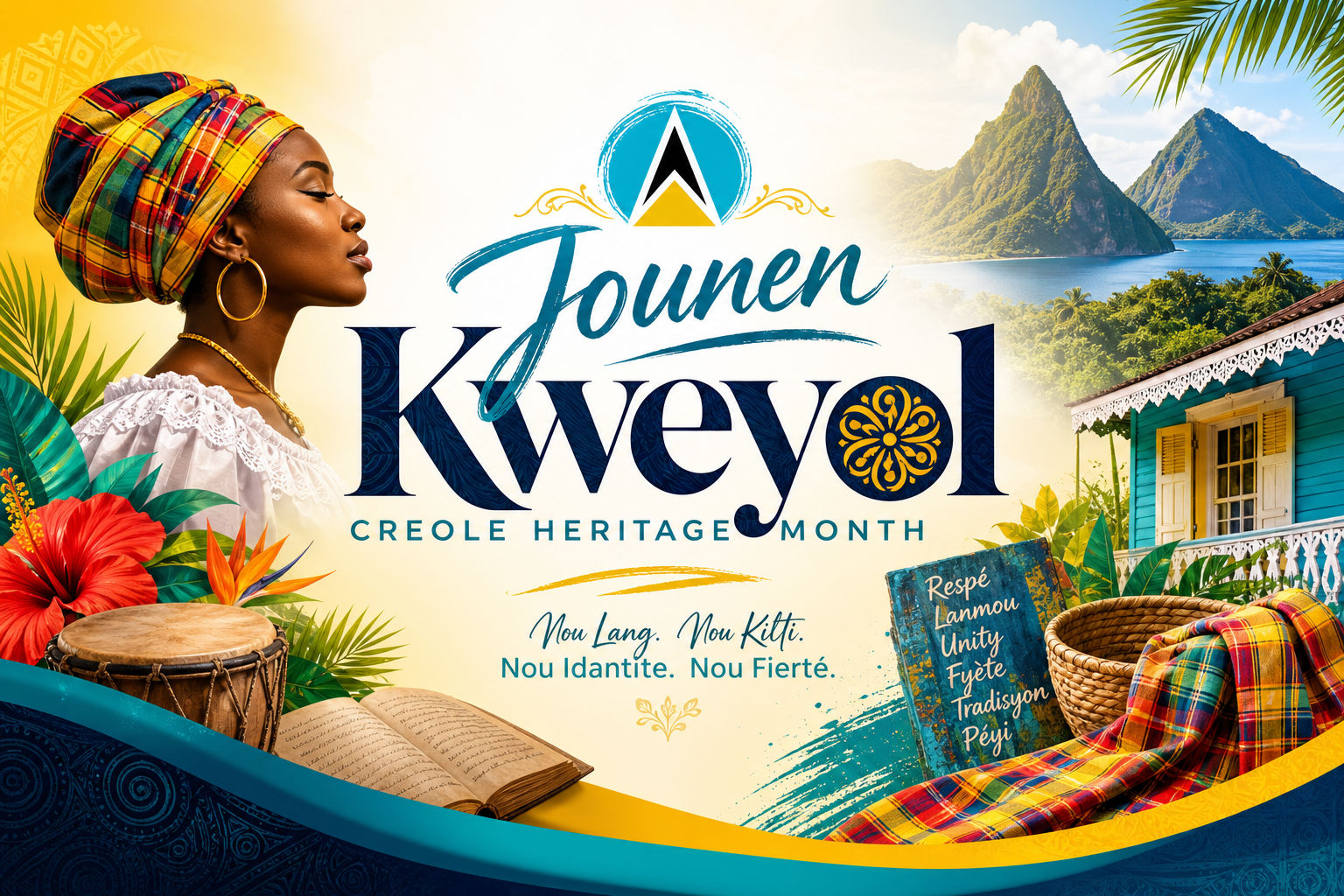
Every October, Saint Lucia does something that no marketing campaign could manufacture and no tourism board could invent. The entire island turns itself inside out to celebrate exactly what it is — the language, the food, the music, the fabric, the stories, and the community traditions that make Saint Lucian Creole culture one of the most distinctive and most joyful cultural identities in the entire Caribbean. Mwa Ewitaj Kwéyòl (Creole Heritage Month) 2026 runs across the full month of October, culminating in Jounen Kwéyòl (Creole Day) on Sunday, October 25, 2026 — the last Sunday of October — celebrated simultaneously in communities across the entire island.
The Saint Lucia Tourism Authority describes it simply as one of "the most authentic events Saint Lucia has to offer". That understatement is doing a lot of work. Jounen Kwéyòl is the biggest national cultural festival in Saint Lucia, with wider participation across the island's communities than any other annual event, including Carnival. When Saint Lucians say this is the best time of year to visit their island, they mean it with the conviction of people who genuinely believe it themselves.
"The most authentic event Saint Lucia has to offer."
The Origins: Forty-Two Years of Cultural Pride
A Celebration that Transcends Generations
Mwa Ewitaj Kwéyòl and Jounen Kwéyòl are programmes of the Msgr. Patrick Anthony Folk Research Centre (FRC), started in 1984 as a one-day celebration and expanding over four decades into the full month-long cultural programme it is today. Saint Lucia first celebrated Creole Day in 1981, making 2026 the 45th anniversary of the tradition.
The founding objective of the Folk Research Centre's programme has never changed: "to increase the awareness and pride among St. Lucians of their rich cultural heritage and to promote the Kwéyòl language and culture". In the four decades since, it has succeeded beyond any reasonable founding expectation — Jounen Kwéyòl is now observed not just across Saint Lucia but by the Saint Lucian diaspora in North America, the United Kingdom, and the wider Caribbean, a community of Saint Lucians who feel the pull of their cultural identity most intensely when October comes around and the madras fabric, the Creole cooking smells, and the kwadril dancing start.
The date connects to International Creole Day on October 28, proclaimed by UNESCO since 1983 as an annual celebration of Creole language and culture across the more than 10 million people worldwide who share Creole languages and heritage. Saint Lucia observes it on the last Sunday of October — making Sunday, October 25, 2026 the Jounen Kwéyòl date — while neighboring Dominica observes the same tradition on the last Friday of October.
Mwa Ewitaj Kwéyòl: A Full Month of Cultural Programming
From Late September to October's Grand Finale
Creole Heritage Month is not a single-weekend event that calls itself a month. It is a genuinely month-long cultural programme that begins in late September and builds week by week to the Jounen Kwéyòl weekend finale, with events spread across communities throughout the island. The 2026 theme continues the FRC's tradition of annual thematic focus — the 2025 edition ran under the theme "Kwéyòl Sé Fòs Nou" (Creole Is Our Strength).
The month's programming includes:
- Open-air cultural shows in village communities beginning as early as late September, featuring folkloric dance, traditional music, Creole drama, and storytelling that bring the performing arts dimension of the heritage to community audiences across the island
- Jazz Jwenn Kwéyòl: The jazz-meets-Creole cultural crossover event that connects Saint Lucia's internationally famous Jazz & Arts Festival legacy to the Creole heritage tradition, demonstrating the cultural synthesis that defines Saint Lucian identity
- Mizik an San Nou (Our Music): Traditional and contemporary Saint Lucian music performances that trace the lineage from ancestral folk forms to modern expressions of Creole musical identity
The Kwéyòl Language: The Soul of the Celebration
A Linguistic Bridge Across Generations
The Kwéyòl language (also written Kwéyòl, Patwa, or Saint Lucian Creole French) is the first language in which most Saint Lucians' grandparents and great-grandparents conducted their entire emotional and social lives, and the language that carries the oldest and most deeply felt layers of Saint Lucian cultural identity. It is a French-based Creole language with deep African structural influences, shaped by the particular history of an island that changed colonial hands between France and Britain fourteen times before finally becoming British in 1814, leaving a French Creole-speaking population under English colonial administration for 150 years.
The result is one of the most linguistically distinctive communities in the Caribbean: an island that speaks English officially, Kwéyòl culturally, and code-switches between the two with the fluency of a people who have always needed to operate across linguistic worlds. During Creole Heritage Month, Kwéyòl takes its rightful place at the center — in signage, in performances, in competitions, and in the everyday conversations that fill the community events of October with the sound of the language that Saint Lucians have been speaking since before any of the colonial powers arrived.
Jounen Kwéyòl Day: October 25, 2026 — One Island, Many Celebrations
Simultaneous Festivities Across Saint Lucia
Sunday, October 25, 2026 is the day when all of Creole Heritage Month's build-up culminates simultaneously across every corner of Saint Lucia. Jounen Kwéyòl is not a single-venue event with a headline act and a ticketed crowd. It is an island-wide simultaneous community celebration where every participating municipality hosts its own full-day programme at the same time:
The day begins before sunrise in the most committed communities — the Belle Vue 2025 programme started at 5:00 AM on the main day — and runs through the afternoon and evening with programming that covers every dimension of Creole cultural expression:
From dawn:
- Creole breakfast service at the community food stalls, with the traditional Saint Lucian morning foods — saltfish and green figs (green bananas), bakes (fried dough), cocoa tea, and the Creole provisions breakfast that is one of the most satisfying and most distinctively Saint Lucian meals available at any time of year
- The smell of wood fires and iron pots beginning in the early morning as community cooks start the slow preparations for the day's traditional Creole dishes
Through the morning and afternoon:
- Traditional cooking demonstrations where the preparation techniques for classic Creole dishes are demonstrated publicly, preserving the procedural knowledge that recipe cards cannot fully capture
- Craft stalls and artisan demonstrations filling the community grounds with the full range of Saint Lucian traditional material culture
- Storytelling sessions in the kontè tradition, where master storytellers hold audiences with the folk narrative forms that have been entertaining and educating Saint Lucian communities for generations
- Traditional games running across the community grounds with participation from children, adults, and elders in the multi-generational format that is one of Jounen Kwéyòl's most distinctive qualities
- Creole language workshops and activities that give visitors and younger participants practical engagement with Kwéyòl
In the afternoon and evening:
- Cultural performances — kwadril (the traditional quadrille-derived Creole dance form), folk singing, Creole theatre, and traditional music performances from groups representing the full breadth of Saint Lucian folk performance heritage
- Live music that spans the traditional-to-contemporary spectrum of Creole-rooted Saint Lucian sound
- The community fete — the evening celebration that brings the day's cultural programme to its most joyful conclusion with music, dancing, and the collective spirit of a community that has spent an entire day celebrating exactly who it is
The Madras: Dressing for Jounen Kwéyòl
A Fabric that Unites and Celebrates
No element of Jounen Kwéyòl is more immediately visually striking than the madras fabric, and no element more universally unites participants in a shared visual identity. The madras — a plaid cotton fabric in the characteristic colors of red, yellow, green, and blue, originally from the Madras region of India and arriving in the French Caribbean through the indentured labor migration of the post-emancipation era — became the defining textile of Creole identity across Martinique, Guadeloupe, Dominica, and Saint Lucia, worn in the traditional women's dress format of the jupe (skirt), caraco (blouse), tête-en-l'air (headwrap), and foulard (neckerchief).
On Jounen Kwéyòl, Saint Lucians across the island wear their madras as a collective statement of cultural belonging. The sea of plaid cotton in the community grounds, the church processions, the cooking demonstrations, and the cultural shows transforms every Jounen Kwéyòl venue into a visual celebration of the heritage that gives the day its meaning. For visitors, wearing madras to Jounen Kwéyòl is not cultural appropriation — it is the most respectful and most welcomed form of participation in the celebration, and many vendors sell madras garments in the weeks before the event specifically for this purpose.
The Food: Creole Cuisine at Its Most Traditional
A Culinary Journey Through Saint Lucian Heritage
The food of Creole Heritage Month and Jounen Kwéyòl is the most direct sensory experience of Saint Lucian cultural heritage available to any visitor, and the community cooking that fills the festival grounds from dawn to dusk is the most authentically prepared Creole food you will eat anywhere on the island at any time of year:
The Essential Creole Dishes
- Green figs and saltfish (Figues Verts épi Lanmori): The national dish of Saint Lucia, as fundamental to Saint Lucian identity as jerk chicken to Jamaica or roti to Trinidad. Boiled green bananas (called "figs" in the Saint Lucian French Creole tradition) with salted codfish seasoned in a sofrito of onion, tomato, garlic, and herbs — the breakfast that begins every Jounen Kwéyòl morning and the dish that most clearly expresses the combination of African culinary technique, European preserved protein, and Caribbean agricultural produce that defines the Creole kitchen
- Bouyon: The quintessential Saint Lucian one-pot hearty stew, where meat (typically beef, chicken, or pork), dasheen, yam, green banana, breadfruit, and ground provisions slow-cook together in a seasoned broth that becomes the most warming and most filling dish in the entire Creole culinary repertoire. Bouyon is the dish most associated with community gathering and communal cooking — it is made in large quantities for groups, it improves over the course of a long slow cook, and eating it together is one of the most elemental social acts in Saint Lucian community life
- Callaloo soup: Made from the leafy green dasheen bush (callaloo), okra, coconut milk, and crab or saltfish in the West Indian tradition, one of the most nutritionally rich and most historically continuous dishes in the entire Caribbean culinary heritage
- Accra (saltfish fritters): Flaked saltfish folded into a spiced batter of flour and herbs and fried to a golden crisp — one of the most universally beloved Creole street food forms across the French Caribbean, eaten hot from the oil with hot sauce
- Breadfruit dishes: Roasted, boiled, or fried breadfruit in the multiple preparations that reflect the fruit's central place in the provision crops of Saint Lucia's agricultural history. The tradition of roasting a whole breadfruit directly on a wood fire until the skin chars and the flesh steams is one of the most aromatic and most visually dramatic cooking techniques at any Jounen Kwéyòl food stall
- Coconut bakes: The traditional Saint Lucian fried bread incorporating coconut milk into the dough, producing a slightly sweet, dense, and deeply satisfying bread that is the vehicle for the saltfish and other Creole toppings of the morning food programme
- Cocoa tea: Hot chocolate made from real cacao balls grown in the Saint Lucian hills, grated into boiling water or milk and sweetened with raw cane sugar — the most traditional and most culturally significant hot drink in the entire Saint Lucian morning food tradition, served at every Jounen Kwéyòl breakfast station
- Sweets and traditional confections: Tablèt (peanut brittle in coconut and spice), coconut fudge, sugarcake, and the full range of Creole confectionery that reflects the island's sugar heritage
Hotel Programming: Creole Heritage Month at the Resorts
Connecting Visitors to Saint Lucian Culture
Saint Lucia's resort hotels use Creole Heritage Month as an opportunity to bring the cultural programme into the guest experience in ways that connect international visitors to the island's heritage without requiring them to navigate unfamiliar community events independently:
- Bay Gardens Hotel and Bay Gardens Inn host their Jounen Kwéyòl celebration on the day itself, beginning at 7:00 AM with a full-day outdoor event running from Creole breakfast through to dinner, with entertainment, traditional games, and competitions providing a complete cultural immersion programme for guests
- Bay Gardens Marina Haven typically hosts its Creole celebration on the Saturday night before Jounen Kwéyòl in a marina-view evening event
- Larger Rodney Bay and Cap Estate resort properties typically stage their own Jounen Kwéyòl dinners and cultural evenings, with Creole menus prepared by their kitchens and folk performance groups invited to perform for guests
For visitors who want the hotel experience as a starting point before venturing into the community celebrations, the resort programming provides the most accessible and most logistically straightforward entry point into Creole Heritage Month's cultural world.
Jounen Kwéyòl and the October Saint Lucia Cultural Calendar
A Month of Unparalleled Cultural Richness
October 2026 is Saint Lucia's most culturally dense month of the year:
DateEvent October 1Creole Heritage Month begins island-wide October 17La Marguerite Flower Festival — Grand Fete Day Throughout OctoberCooking competitions, storytelling, cultural shows, craft exhibitions, language workshops October 25, 2026Jounen Kwéyòl — Creole Day (last Sunday of October) October 28International Creole Day (UNESCO) The La Marguerite Flower Festival on October 17 and Jounen Kwéyòl on October 25 fall within the same week, creating the most compressed and most culturally rich 8-day period in Saint Lucia's entire annual calendar. A visitor arriving in Saint Lucia for the La Marguerite festival and staying through Jounen Kwéyòl experiences the two most distinctively Saint Lucian cultural events in consecutive weekends — a combination that delivers a depth of cultural engagement no other island destination in the Eastern Caribbean can match within a single trip.
Getting to Saint Lucia for Creole Heritage Month
Flights and Travel Logistics
Hewanorra International Airport (UVF) in the south and George F.L. Charles Airport (SLU) near Castries in the north serve Saint Lucia from international and regional connections respectively:
- London Heathrow: British Airways direct to UVF, approximately 8.5 hours
- New York (JFK): American Airlines and JetBlue to UVF, approximately 4.5 hours
- Miami: American Airlines to UVF, approximately 3 hours
- Toronto: Air Canada seasonal direct to UVF
- Regional Caribbean: LIAT, Caribbean Airlines, and BVI Airways into SLU from Barbados, Trinidad, Grenada, Martinique, and other Eastern Caribbean islands
October is shoulder season in Saint Lucia — past the summer peak but before the December high season — which means accommodation availability is better, prices are lower, and the crowds at resort beaches are thinner than in either high season. For cultural travelers, October is genuinely the best month of the year to visit Saint Lucia.
Practical Tips for Jounen Kwéyòl 2026
Make the Most of Your Cultural Experience
- Confirm the 2026 host communities through the Folk Research Centre (FRC) and stlucia.org/en/things-to-do/festivals in September 2026 — the host community announcement shapes the logistics of which part of the island to base yourself in for the main day
- Wear madras on Jounen Kwéyòl. Buy a piece of madras fabric or a ready-made garment from the market vendors in the weeks before October 25. Wearing it is the most respectful and most welcomed participation gesture a visitor can make
- Start early on Jounen Kwéyòl Day. The best community programmes begin before sunrise and the Creole breakfast service from the early morning is one of the most memorable food experiences of the entire event
- Attend a pre-Jounen Kwéyòl seance or cooking event in the weeks before October 25. The month's build-up events are less crowded, more intimate, and often more revealing of the authentic community character of the tradition than the main day's larger crowds
- Rent a car to move between community Jounen Kwéyòl events on the main day. The island-wide simultaneous format means different communities are offering different programmes at the same time, and having a car allows you to move from the host community's main programme to a secondary community event and back
- Book accommodation for the La Marguerite festival weekend (October 17) at the same time to combine both events in a single 10-day Saint Lucia cultural trip
Frequently Asked Questions
The Things People Always Want to Know
When is Jounen Kwéyòl 2026?
Sunday, October 25, 2026 — the last Sunday of October.
What is Mwa Ewitaj Kwéyòl?
Creole Heritage Month, running the full month of October across Saint Lucia, culminating in Jounen Kwéyòl.
Where does it take place?
Island-wide across multiple communities simultaneously, with two or three designated host communities receiving the main programme each year.
Who organizes it?
The Msgr. Patrick Anthony Folk Research Centre (FRC) has produced the event since 1984.
What is Kwéyòl?
The Saint Lucian Creole French language — a French-based Creole with deep African structural influences spoken as the mother tongue of Saint Lucian cultural identity.
Is it free?
The vast majority of community Jounen Kwéyòl events are free to attend. Hotel resort events and some ticketed dinners carry charges.
What should I wear?
Madras fabric in the traditional Saint Lucian Creole dress style — available from market vendors island-wide in October.
Verified Information at a Glance
- Event Name: Jounen Kwéyòl (Creole Day) / Mwa Ewitaj Kwéyòl (Creole Heritage Month)
- 2026 Jounen Kwéyòl Date: Sunday, October 25, 2026
- Creole Heritage Month: Full month of October 2026
- Format: Island-wide simultaneous community celebrations
- Organized By: Msgr. Patrick Anthony Folk Research Centre (FRC), since 1984
- 2025 Theme: Kwéyòl Sé Fòs Nou (Creole Is Our Strength)
- Programme: Cultural shows, storytelling, cooking competitions, craft exhibitions, language workshops, traditional games, Creole breakfast and dinner, folk dancing, live music
- Signature Dish: Green figs and saltfish
- Signature Garment: Madras fabric in traditional Saint Lucian Creole dress
- Language Celebrated: Kwéyòl (Saint Lucian Creole French)
- UNESCO Connection: Linked to International Creole Day (October 28), UNESCO proclaimed since 1983
- Admission: Mostly free across community events
- Adjacent Event: La Marguerite Flower Festival, October 17, 2026
- Primary Airport: Hewanorra International Airport (UVF), Vieux Fort
- Secondary Airport: George F.L. Charles Airport (SLU), Castries (regional)
- October Advantage: Shoulder season — better rates, less crowded resorts, perfect cultural travel timing
- Best For: Cultural immersion travelers, Caribbean heritage visitors, food tourists, language and folklore enthusiasts, families, repeat Saint Lucia visitors, diaspora communities, content creators covering authentic island culture, IsleRush Caribbean editorial content
```