Santorini Profitis Ilias Feast Day: A Sacred Pilgrimage to the Roof of the Aegean
Most people who visit Santorini see the island from its edges. They stand on the caldera rim in Oia and watch the sun slide into the sea. They look up at the white-washed villages stacked along the cliff from the deck of a boat crossing from Athinios. They walk the path between Fira and Imerovigli and look out at the volcanic islands in the middle of the bay. All of it is beautiful. But very few of them ever make it to the top.
Mount Profitis Ilias is the highest peak of Santorini. Being the highest mountain of the island, it is located almost in the middle of it, providing fantastic views in all directions. Akrotiri cape, the black beaches' southern shoreline, Pyrgos, Fira, Firostefani, Imerovigli and all the way up to Oia, the Volcano and nearby islands are all visible from here, while on the other side, beneath your toes, a striking view of Kamari coast and the airport takes your breath away.
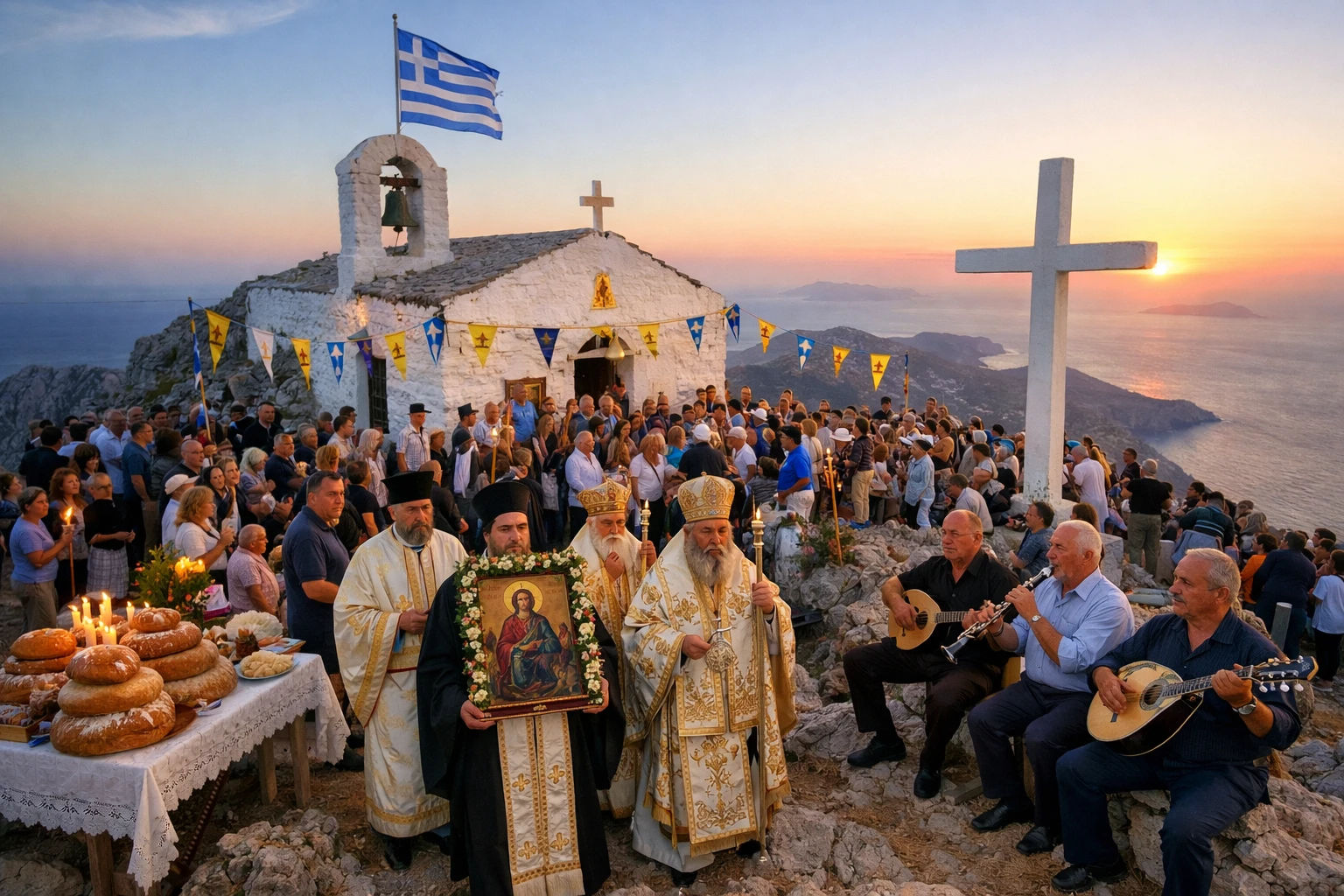
And at the very top of that mountain, on the feast day of Saint Elias on July 20th, locals flock to the monastery for the big esperinos and the vigil that follows. The Profitis Ilias Feast Day is one of the most genuinely moving and least-touristed experiences available on this extraordinarily popular island, and understanding it requires understanding not just the date on the calendar but the centuries of history, faith, and community life that have made this mountain the spiritual center of Santorini's soul.
The Monastery on the Summit: Three Centuries of Faith and Fortress
Founded in 1711, Still Standing Above the Volcano
It was here that two monks, Joachim and Gabriel, founded the Monastery of Prophet Elias in 1711. The founding letter authorising them to "build a monastery for men to work for God" was signed by Zacharias Gyzis, Bishop of Thira, on 6 March 1711.
The monks were required to hold an annual festival on the feast of the monastery's patron saint. From the very beginning, the monastery, built in fortress style, was an extremely important cultural, educational and even economic centre. It possessed numerous riches, including a ship used for trade with other centres in the Aegean and the Mediterranean.
That detail, a monastery on a mountain summit operating its own trading ship across the Mediterranean, gives an immediate sense of how different this institution was from a simple place of prayer. The Profitis Ilias Monastery was a hub of commerce, education, and civic life at a time when the island had no other institutions sophisticated enough to fill those roles. Between 1806 and 1845, the monks ran a school where Greek language and literature were mainly taught. During the Greek War of Independence in the 1820s, the monastery's position as a fortified hilltop stronghold gave it strategic importance that extended well beyond the religious. Patriots sheltered here. The resistance organized here. The mountain was, as it had been for centuries before the monastery existed, a place where people came when they needed safety and clarity.
The monastic community subsidised numerous educational and charitable projects over the years, including rebuilding the island after the great earthquake of 1956. That earthquake, which struck Santorini on July 9, 1956, caused devastating damage across the island and triggered a mass exodus of the population. The monastery itself suffered severe damage and required extensive restoration. The fact that the monks chose to help rebuild the secular community around them rather than retreat into purely internal concerns is characteristic of the institution's entire three-century history of engagement with the life of the island.
The Monastery Today
There are currently 9 monks living at the Monastery of Profitis Ilias on Santorini, and the abbot of the place is Father Damaskinos. The monastery continues its charitable activities for the benefit of the local community. All monks, in addition to prayer, are required to give something of themselves to the monastic community. Each of them is assigned specific duties called diakonima. In addition to their duties at the monastery, the monks are also involved in the cultivation of vines, olives and other vegetables and fruits, and their subsequent processing.
Nine monks maintaining a three-hundred-year-old fortified monastery on the highest peak of one of the world's most visited islands is a fact that deserves a moment of quiet appreciation. While tens of thousands of tourists crowd the caldera rim restaurants and the sunset-viewing spots of Oia every evening, this small community of men continues the same daily rhythm of prayer, agricultural labor, and community service that the monastery's founders established in 1711.
Around 10,000 plants, flowers and trees have been planted around the monastery, and an orchard of over 700 olive trees completes the picture. That orchard on a volcanic mountain summit, producing olives that the monks press into oil they sell from their small shop, is one of the more quietly extraordinary agricultural achievements you can encounter anywhere in the Greek islands.
July 20: The Feast of Prophet Elias
What the Day Actually Looks Like
The monastery of monks opens its doors only once a year on July 20, when Saint Elijah is celebrated. That fact alone makes the feast day exceptional. For most of the year, the interior of the monastery is not accessible to visitors. The monks live their secluded life behind the fortress walls, emerging occasionally to tend their olive trees and vines and to staff their small shop near the Chapel of St. Nectarios. But on July 20, the gates open, and the community of Santorini, along with the pilgrims and curious travelers who know to come, streams up the mountain.
On July 20th, the feast day of Saint Elias, locals flock to the monastery for the big esperinos and the vigil that follows. The esperinos, or evening prayer service, is the central liturgical event of the feast day. In Greek Orthodox tradition, the major services for a feast day begin the evening before with the Vespers and continue through the night with a vigil, culminating in the Divine Liturgy the following morning. The word "big" that local guides use to describe the July 20 esperinos reflects its amplified significance: this is not the routine daily service but the full ceremonial observance of the feast that the monastery was founded, legally required, to hold every year.
The service takes place inside the monastery church, which is normally closed to the public. Attending on this single day means experiencing the interior that most Santorini visitors never see: the iconostasis, the Byzantine icons, the preserved ecclesiastical objects, and the atmosphere of a working religious community in its most formal ceremonial mode. The contrast between the tourist experience that defines most visits to Santorini and the experience of standing inside a 300-year-old monastery church on its most sacred annual occasion is profound and deeply affecting.
The Vigil: Staying Through the Night
For those who choose to stay beyond the esperinos, the vigil that follows transforms the feast day into something considerably more immersive. A vigil in the Greek Orthodox tradition involves continuous prayer and chanting through the night, punctuated by the reading of scripture and the veneration of icons. On Mount Profitis Ilias, 567 meters above sea level, with the lights of Santorini spreading across the volcanic landscape below and the Aegean stretching out to the horizon in every direction, this night of prayer takes on a visual and atmospheric quality that no designed experience could replicate.
The pilgrims who attend are mostly Greek: local Santorinians for whom this mountain has been the spiritual center of island life for generations, visitors from other Greek islands who time their Santorini visit specifically for the feast, and Greek Orthodox faithful from the mainland and diaspora who make the July 20 pilgrimage to Profitis Ilias as a deliberate act of devotion. Foreign visitors who happen to be there are welcomed with the characteristically warm Greek hospitality that Greek Orthodox communities extend to respectful guests, regardless of their background or beliefs.
Prophet Elias in Greek Orthodox Tradition: Why the Mountain and the Saint Are Inseparable
The Prophet of Fire on the High Places
In Greek Orthodox Christianity, Prophet Elias (Elijah in the Hebrew scriptures) holds a uniquely dramatic place in the calendar of saints. The mountain of Prophet Elias is the highest peak of the island. The association between the Prophet and high mountain peaks is not coincidental. Throughout Greece, the summits of mountains are consecrated to Profitis Ilias, and the pattern is so consistent that Greek mountain place-names ending in "Profitis" reliably indicate a peak where a chapel or monastery dedicated to this saint has stood for centuries.
The biblical account of Elijah describes him ascending Mount Carmel, calling down fire from heaven, and ultimately being transported to heaven in a fiery chariot. In Greek popular tradition, that association with fire and high places connected him naturally to the mountains where lightning struck and where the divine seemed most immediately present. Naming the highest peak of a volcanic island after the prophet of fire is, in retrospect, an almost inevitable convergence of theology and geography.
For Santorini specifically, where the entire island is the remnant of one of the ancient world's most catastrophic volcanic events, the Prophet of fire on the island's summit carries particular resonance. The Minoan eruption of around 1600 BC, which destroyed the Bronze Age civilization documented at Akrotiri and may have contributed to Egyptian plague accounts through its atmospheric effects, left a landscape that was literally shaped by fire from the earth. The monastery at the top of the island's highest remaining peak, honoring the prophet most associated with divine fire, sits precisely where it belongs.
Getting to the Top: The Hike and the Drive
Two Ways Up, One Destination
There is a 2.5 km trail up to the monastery from the main square in Pyrgos. The village of Pyrgos, the highest permanently inhabited settlement on the island, sits about three kilometers below the monastery and provides the most convenient starting point for both the trail and the road. The drive up is on a paved, winding, and fairly narrow road with steep drop-offs.
Pyrgos itself is one of Santorini's most rewarding villages for visitors who want to experience the island away from the caldera-facing crowds. Unlike Oia and Fira, which have been entirely oriented toward tourism for decades, Pyrgos maintains the character of a working Santorinian village: medieval lanes, cat-populated courtyards, small tavernas serving local food at local prices, and the remains of a Venetian kastro at its summit. Spending time in Pyrgos before or after the feast day pilgrimage gives the visit a cultural depth that the white-and-blue postcard version of Santorini rarely achieves.
You may not expect much greenery looking at the mountain from the ground but you will be pleasantly surprised driving through the eucalyptus alley and walking in the shade of pines. The approach to the monastery through unexpected greenery, past the eucalyptus trees and pines that the monks have cultivated on what most people assume is bare volcanic rock, is a small revelation that prepares you for the larger revelation of the monastery itself.
For the July 20 feast day, many pilgrims make the journey on foot from Pyrgos as part of their devotional intention, arriving sweaty and breathless and deeply satisfied at the monastery gates. Others drive. Both are entirely appropriate, and the monks receive both with equal warmth.
What You Will Find Inside the Monastery
The Museum, the Church, and the Shop
Near to the village of Pyrgos and crowning Mount Profitis Ilias is a monastery of the same name, dedicated to the prophet Elijah. The solid facade of its exterior walls is reminiscent of a fortress. Once inside those walls, the monastery reveals its three centuries of accumulated cultural life. The monastery functions partly as a museum, housing a collection of rare ecclesiastical artefacts, handwritten books, Byzantine icons, and sculptures that represent some of the finest religious art in the Cyclades.
The ecclesiastical museum section includes vestments, liturgical objects, and documents that chronicle the monastery's involvement in Greek cultural and political life from the Ottoman period through Greek independence and into the modern era. The handwritten manuscripts and rare books speak to the educational mission the monks maintained for nearly four decades through their school, preserving Greek language and literature at a time when both were under pressure from Ottoman administration.
The former chapel of Agia Triada in Pyrgos, which once belonged to the monastery, houses a museum where visitors can see a collection of rare ecclesiastical artefacts, hand-written books, unusual Byzantine icons and sculptures. There are also exhibitions relating to local crafts, namely printing, shoemaking and candle making.
The monastery shop, located in the square next to the Chapel of St. Nectarios, sells products made by the monks themselves. Tourists can enjoy products such as wines, liqueurs, olive oil, olives and olive preserves, fig preserves, herbs, as well as other souvenirs. Buying a bottle of olive oil pressed from the trees of that implausible 700-tree orchard on the volcanic summit, or a jar of fig preserve made by the nine monks who tend this ancient place, is a way of taking something genuinely meaningful home from Santorini beyond the standard souvenir shop merchandise of the caldera villages.
Practical Information for Attending the Feast Day
What to Wear, When to Arrive, and How to Behave
Modest attire is advisable as a mark of respect for the religious nature of the monastery, covering shoulders and knees. This is standard practice across Greek Orthodox religious sites and the monks appreciate the gesture. Bringing a light scarf or wrap to cover bare shoulders is sufficient preparation, and most Greek churches maintain a small collection of wraps near the entrance for visitors who arrive underprepared.
Photography is restricted in certain areas, especially during religious services. Respect any signs or guidelines provided. The feast day attracts pilgrims who are there to pray, not to be photographed, and behaving as a respectful guest rather than a documenting tourist makes the difference between being welcome and being tolerated.
Typically, there is no entrance fee, but donations are appreciated to support the maintenance of the monastery. The monastery has been maintaining and restoring itself largely through the work of its monks and the generosity of visitors and the broader Greek Orthodox community for three centuries. A modest donation at the collection box is the appropriate gesture.
The immediate vicinity does not have extensive facilities, so it is a good idea to bring water and any essentials with you. July 20 in Santorini is deep summer, with temperatures regularly reaching 30 degrees Celsius or above. The mountain elevation provides some relief from the coastal heat, but the hike from Pyrgos in full summer sun requires genuine hydration preparation. Bring more water than you think you need, wear sun protection, and start the hike early in the morning if you intend to attend the evening esperinos rather than driving up later in the day.
Why This Pilgrimage Belongs on Every Santorini Itinerary
There are roughly two million visitors to Santorini each year, and the overwhelming majority of them leave having seen the caldera, the sunset, the black beach, and the cave hotels. All of those are worth seeing. But the island has another dimension that most visitors never find: the dimension of deep time, lived religion, community memory, and the particular kind of faith that grows in a place where the earth has demonstrated, repeatedly and catastrophically, that it is fully capable of destroying everything human beings have built.
The Profitis Ilias Monastery has stood on the summit of Santorini's highest peak for more than 300 years. It survived the earthquake of 1956 that drove most of the island's population away. It survived the Ottoman period, the War of Independence, and the complete transformation of the island's economy from agriculture and fishing to international tourism. Through all of it, nine men have kept their daily offices, tended their olive trees, made their preserves, and opened their gates once a year on July 20 for whoever chooses to make the climb.
If you find yourself on Santorini in July, do not leave without going to the top. Come for the view if you need a practical reason, but stay for the esperinos. Watch the evening light change across the caldera from 567 meters above the sea while the sound of Greek Orthodox chanting moves through the stone walls of a fortress-monastery that has been praying on this summit since before the United States existed. It is one of the most extraordinary experiences available on any island anywhere in the Mediterranean, and almost no one who makes it up there on July 20 ever quite recovers from it.
Verified Information at a Glance
Event Name: Profitis Ilias Feast Day (Feast of Prophet Elias / Saint Elijah) at the Monastery of Profitis Ilias, Mount Profitis Ilias, Santorini
Event Category: Annual Greek Orthodox Religious Feast Day, Pilgrimage, and Community Celebration
Date: July 20, annually (the fixed feast day of Prophet Elias in the Greek Orthodox calendar)
Typical Month: July
Venue: Monastery of Profitis Ilias (Prophet Elias Monastery), Summit of Mount Profitis Ilias, Santorini, Cyclades, Greece
Altitude: 567 meters above sea level (highest point on Santorini)
Nearest Village: Pyrgos (approximately 3 kilometers below the monastery by road; 2.5 km trail from Pyrgos main square)
Main Religious Events: Big Esperinos (evening prayer service), followed by an overnight vigil
Access: Paved but narrow winding road from Pyrgos (driving); 2.5 km trail on foot from Pyrgos main square
Monastery Open to Visitors (Interior): July 20 feast day only; exterior and adjacent Chapel of St. Nectarios accessible at other times
Admission: No entrance fee; donations welcomed and appreciated for monastery upkeep
Dress Code: Modest dress required (covered shoulders and knees); wraps available at most Greek Orthodox sites for