Liberation Day 2026 Seychelles: Understanding the Island Nation's Most Complex and Fascinating Public Holiday
June in the Seychelles is one of the most patriotically charged months in the calendar of any small island nation on earth. Three public holidays in the space of twenty-four days, each marking a different and distinct chapter of national history, create a sustained period of reflection, ceremony, and community celebration that gives visitors arriving in early June an extraordinary window into how this archipelago of 115 islands understands itself. At the beginning of it all, on Friday, June 5, 2026, Liberation Day opens the month with a holiday that is simultaneously the most historically complex and the most authentically Seychellois of the three.
Less than a year after gaining independence, a coup overthrew the government. James Mancham, the leader of the Seychelles Democratic Party, which won the majority vote, became president, and France Albert René became prime minister. René's supporters led the overthrow and ousted Mancham on June 5, 1977, an event commemorated as a public holiday on Liberation Day.
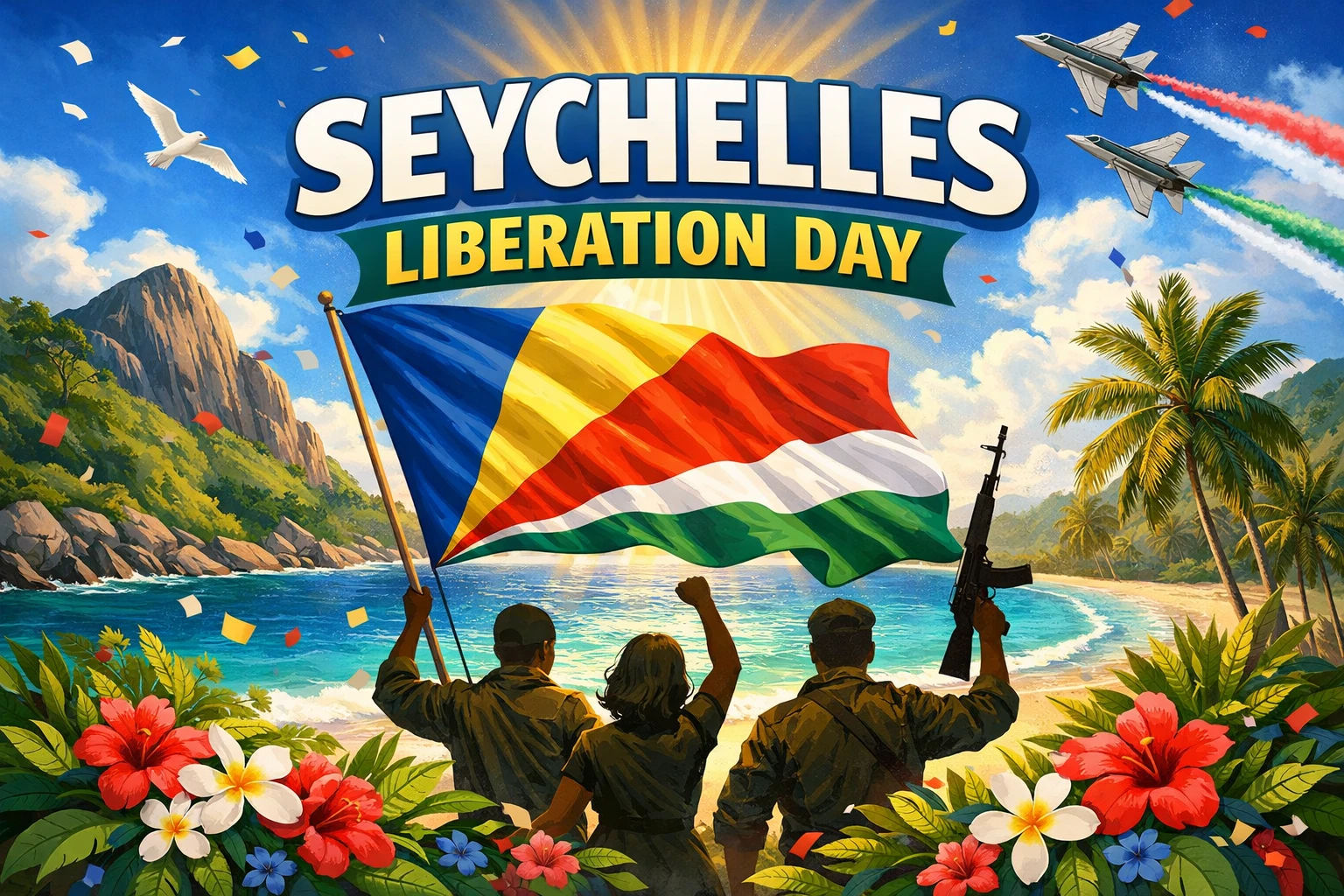
Liberation Day is annually observed in Seychelles on June 5. This holiday celebrates the events of June 1977, when the current head of state was overthrown by a revolt.
For visitors and curious observers of island culture and history, Liberation Day offers something rare: a public holiday whose meaning requires genuine engagement with a layered and honest national narrative, celebrated by a people who have chosen to honor their complex past rather than flatten it into simple patriotic convenience.
The Events of June 5, 1977: What Actually Happened
A Coup That Changed the Course of Island History
To understand Liberation Day in the Seychelles, you need to understand what June 5, 1977 actually was and why its commemoration as a public holiday says something interesting about the national character of this small island republic.
Seychelles gained independence from Britain in 1976 and became a republic within the Commonwealth. James Mancham became the first President of the republic; however, his presidency didn't last for a long time. He was overthrown by then Prime Minister France Albert René, who was supported by Tanzanian-trained revolutionaries supplied with weapons.
There were two legal leaders in the country, the President and a Prime Minister. The President left the nation to visit the United Kingdom, and the Prime Minister swooped in and took over. The timing was almost theatrical in its audacity. While James Mancham was in London attending the Commonwealth Heads of Government Meeting in late June 1977, France Albert René executed the coup with a combination of speed and resolve that left the international community with little time to respond before it was effectively complete. The new government was installed before the first morning was out.
What followed was a one-party state that lasted sixteen years. René ruled the country under a dictatorial one-party system until 1993, when he was forced to introduce a multi-party system. Many people in Seychelles are happy that the coup occurred; they are sure that it saved their lovely island nation from continued exploitation. All of this just goes to show you that one guy's illegal action is another guy's heroic deed.
That last observation captures the genuine complexity of Liberation Day's meaning for Seychellois people. René's government brought about significant social development programs, land reform, improved healthcare, and the establishment of free universal education during its sixteen years in power. Many of the social gains that the Seychellois people enjoy today were built during the René era. The word "liberation" in the holiday's name reflects a genuine popular sentiment among many of the islands' residents, not simply a government propaganda choice.
René's Legacy: The Socialist Island Leader Who Built Modern Seychelles
France-Albert René overthrew the first president. James Mancham became president, and the nation became a one-party state. President René never described himself as a communist; he was an Indian Ocean socialist. However, his regime aligned with the Soviet Union. René was a remarkable leader who held onto power despite several attempted coups. With the collapse of the Soviet Union in 1991 and the threat of international isolation, René announced a return to the multiparty system of government but continued as an elected president until he left office on his own in 2004.
The trajectory of René's career, from revolutionary coup leader to elected president to voluntary retirement, gives his story an arc that is genuinely unusual in the annals of African post-colonial politics. He did not hold on to power at all costs when the international environment changed. He introduced the multiparty system, stood for democratic elections, won them, and eventually stepped down of his own accord. The Seychelles today, with its extraordinary environmental protection frameworks, its universal free education system, and its relatively high standard of living by regional standards, bears significant marks of the policies his government implemented across sixteen years of often difficult governance.
Understanding that context transforms Liberation Day from a simple celebration of a coup into something more nuanced: a national reckoning with how progress sometimes arrives through irregular means, and a community's choice to honor that complicated history with honesty rather than pretending it did not happen.
How Seychellois Communities Mark June 5
A Public Holiday With a Distinctive Character
Liberation Day is an official public holiday in the Seychelles, which means government offices, schools, and most businesses observe the day with closures. The character of Liberation Day celebrations has historically been more civic and politically oriented than the broad community festivity of Independence Day on June 29 or the constitutional ceremony of June 18. It is a day that invites reflection alongside celebration, and the Seychellois people approach it with that dual intention.
Official ceremonies typically include flag raisings, addresses from government officials, and the kinds of civic programming that mark significant dates in national history. The presence of the holiday at the beginning of the June trilogy, eleven days before Constitution Day and twenty-four days before Independence Day, means that it functions as an opening statement about national identity, asking the community to begin its June period of commemoration by engaging honestly with the most complex and contested chapter of its post-independence history.
For younger Seychellois, Liberation Day is an educational opportunity as much as a celebration. The events of 1977 belong to their grandparents' generation, and the values and social programs that the René era produced are part of the fabric of the society they grew up in without their having lived through the political circumstances that produced them. Liberation Day is one of the moments when that history becomes visible and discussable across generations.
The political parties that have shaped modern Seychelles, and particularly the People's Party (formerly the Seychelles People's Progressive Front, which was René's political vehicle), treat June 5 as an important annual moment of political identity, marking the date with gatherings and party events that connect the current democratic organization to its revolutionary origins.
Seychelles in Early June: Why This Is a Genuinely Wonderful Time to Visit
The Southeast Trades Arrive, and the Islands Transform
Liberation Day falls at the very beginning of the Seychelles' southeast trade wind season, and from a purely practical visitor perspective, early June is among the finest times of year to be on these islands.
The southeast trades typically establish themselves across the archipelago in late May or early June, bringing a consistent wind that clears the air, cools the temperature from the humid warmth of the northwest monsoon months, and fills the sails of every boat in the Seychelles' waters with the reliable breeze that makes sailing and water sports here so reliably excellent. The seas on the northwestern coast of Mahé, including the famous Beau Vallon Bay, remain protected from the southeast winds by the island's mountainous spine, giving them the calm, clear water that makes this coast so accessible year-round.
The visibility for snorkeling and diving in June is typically at its annual best, as the ocean currents bring nutrients upwelling that feed the marine ecosystems while maintaining the clarity that makes the Seychelles' underwater world so spectacular. The whale shark season in the Seychelles extends from October through January, but the abundant marine life of the Marine National Parks around Mahé and Praslin is present year-round, and the early June period is excellent for seeing manta rays, sea turtles, and the extraordinary fish populations of the Sainte Anne Marine National Park just offshore from Victoria.
Victoria and the Three-Holiday Context
Visitors who arrive in the Seychelles before June 5 and stay through June 29 can experience the full arc of the nation's most patriotically significant month. Each holiday has its own character and its own way of expressing the Seychellois national identity, and experiencing all three in sequence gives a visitor a genuinely complete picture of how this island nation understands its own history.
Liberation Day on June 5 opens the cycle with the honest acknowledgment of a complicated political transition and the social development that followed it. Constitution Day on June 18 marks the moment when the islands chose democracy and codified that choice in fundamental law. Independence Day on June 29 celebrates the original moment of sovereignty from which everything else has flowed. Together, they trace a national story from decolonization through revolutionary transformation through democratic consolidation across nineteen years of Seychellois history, and experiencing them as a visitor in the islands gives that history a lived quality that no textbook description can approach.
Victoria, the capital city and the center of all three celebrations, is at its most energized during this triple-holiday June. The Sir Selwyn Selwyn-Clarke Market, normally the most colorful and olfactorily overwhelming few thousand square meters in the Indian Ocean, operates with a particular festive energy as the holiday preparations unfold. The harbor area along Independence Avenue is where the flag raisings and civic ceremonies tend to concentrate, and the Stade Linite national stadium provides the venue for the larger gathering events that accompany the most significant of the three dates.
The Food, Music, and Culture of Liberation Day
Creole Celebration at Its Most Genuine
Like all Seychellois public holidays, Liberation Day is marked in the most important way the culture knows: through food and music. It is a day for enjoying delicious foods such as grilled fish, coconut curry, breadfruit, and sausage rougaille with loved ones.
Rougaille is perhaps the most characteristically Seychellois of all culinary preparations: a slow-cooked tomato-based sauce that can carry fish, chicken, sausage, or salted cod and that carries the full fragrance of the Indian Ocean spice trade in every mouthful. Coconut curry, made with the freshly grated coconut milk that the islands' abundant palms produce, is another dish whose flavor connects directly to the Seychelles' geographic position between the East African coast and the Indian subcontinent. Breadfruit, roasted or fried, is a Seychellois staple whose starchy, filling satisfaction makes it the perfect accompaniment to the grilled fresh fish that the islands' waters produce so abundantly.
The music that accompanies Liberation Day celebrations draws on the same sega and moutya traditions that animate all Seychellois public celebrations. Most people who now live in the Seychelles are Creole, a mix of East African and Malagasy, Indian, Chinese, French, and British heritage. That extraordinary confluence of origins is audible in Seychellois music, where African drum traditions meet French melodic forms, Indian rhythmic complexity, and Malagasy vocal traditions in a synthesis that sounds like it belongs specifically and completely to these 115 islands and nowhere else on earth.
Practical Information for Visitors on Liberation Day
Public Holiday Logistics and What Remains Open
As a public holiday, Liberation Day on June 5 means that banks, government offices, and schools are closed. Most supermarkets and smaller shops observe the holiday with reduced hours or closures. Tourist services, beach bars, hotels, and restaurants operate normally, often with special holiday menus or extended evening programs that capitalize on the community atmosphere of the day.
The SPTC public bus service runs a reduced holiday schedule on Liberation Day, with less frequent services than on weekdays but regular enough connections to allow movement between the main settlements of Mahé. Taxis are available throughout the day from the main stands in Victoria and along the coastal roads. Rental cars can be used freely, as the roads of Mahé, particularly the coastal ring road and the mountain cross-island route, are at their best during holiday periods when the normal weekday traffic of school and government commuters is absent.
For visitors staying at Beau Vallon, the bay's beach bars and water sports operators treat Liberation Day as a regular holiday beach day, and the beach itself fills with a mix of visiting tourists and local families making the most of the public holiday afternoon. Arriving at Beau Vallon in the morning for a swim before the afternoon heat, following the coastal road into Victoria for any civic ceremonies or market activity, and returning for the evening sunset at the beach captures the day's rhythm well.
The Seychelles International Airport on Mahé operates normally on Liberation Day, as do the inter-island ferries connecting Mahé to Praslin and La Digue. For visitors island-hopping as part of a broader Seychelles stay, planning a ferry day to Praslin or La Digue around the Liberation Day holiday is entirely feasible and allows the day's public holiday atmosphere to be experienced across more than one island.
Why Liberation Day Matters: An Island Nation's Honest Self-Portrait
Very few countries mark the anniversary of a coup d'état as a public holiday. Fewer still name that holiday "Liberation" without either embarrassment or braggadocio. The Seychelles' choice to commemorate June 5, 1977 with honest public acknowledgment rather than historical revisionism or simple suppression reflects something genuinely admirable about the national character of a people who have always found it easier to be honest than to be comfortable.
June 5 celebrates the anniversary of the date in 1977 when the country was "liberated" from the government installed by Great Britain the year before. Whether you use the quotation marks or not around "liberated" depends on which side of that specific political argument you stand. What matters is that the Seychelles has chosen to engage with its own complexity rather than paper over it, and that engagement is visible every June 5 in the dignity with which the holiday is observed.
For visitors who come to the Seychelles for the beaches and leave understanding something about how small island nations carry their history, Liberation Day is one of the most quietly rewarding experiences the archipelago offers. Find a place in Victoria on the morning of June 5, watch the official proceedings with the respectful curiosity of a guest in someone else's national story, eat some rougaille from a market stall, and let the Indian Ocean trade wind carry the sound of sega music out across the most beautiful waters in the world.
Verified Information at a Glance
Event Name: Liberation Day, Republic of Seychelles
Event Category: Annual National Public Holiday Commemorating the Coup d'État of June 5, 1977
Date 2026: Friday, June 5, 2026
Historical Significance: Commemorates the overthrow of President James Mancham by Prime Minister France Albert René on June 5, 1977, one year after Seychelles gained independence from Britain on June 29, 1976
Status: Official National Public Holiday; government offices, schools, and most businesses closed
Type of Celebrations: Civic ceremonies, flag raisings, official government events, political party gatherings, community celebrations, family meals, and beach gatherings
Location: All islands of the Republic of Seychelles; principal ceremonies in Victoria, Mahé
Traditional Foods for the Holiday: Grilled fish, coconut curry, breadfruit, sausage rougaille, octopus curry
Admission: All public ceremonies are free and open to residents and visitors
Context in June Holiday Trilogy: June 5 (Friday): Liberation Day June 18 (Thursday): Constitution Day June 29 (Monday): Independence (National) Day
Transportation on the Day: SPTC bus service runs on reduced holiday schedule; taxis available; rental cars unrestricted; inter-island ferry operates normally
Nearest Airport: Seychelles International Airport (SEZ), Mahé (operates normally on public holidays)
Currency: Seychellois Rupee (SCR); major credit cards accepted at tourist venues; carry cash for market stalls and informal vendors
Official Public Holiday Confirmation Source: Official Seychelles public holiday listing at psb.gov.sc (Public Service Bureau of Seychelles)
Official Tourism Information: seychelles.travel and insideseychelles.com
All details verified from The Free Dictionary Encyclopedia, OfficialPublicHolidays.com, TimeAndDate.com Seychelles 2026 calendar, InsideSeychelles.com, Every Day Is Special educational reference, and the Seychelles Public Service Bureau at psb.gov.sc. The June 5 date for Liberation Day is confirmed as a consistent annual public holiday. Specific 2026 ceremony programs and community events will be announced through the official Government of Seychelles channels and local media closer to the date. Always verify current programming at insideseychelles.com before attending.