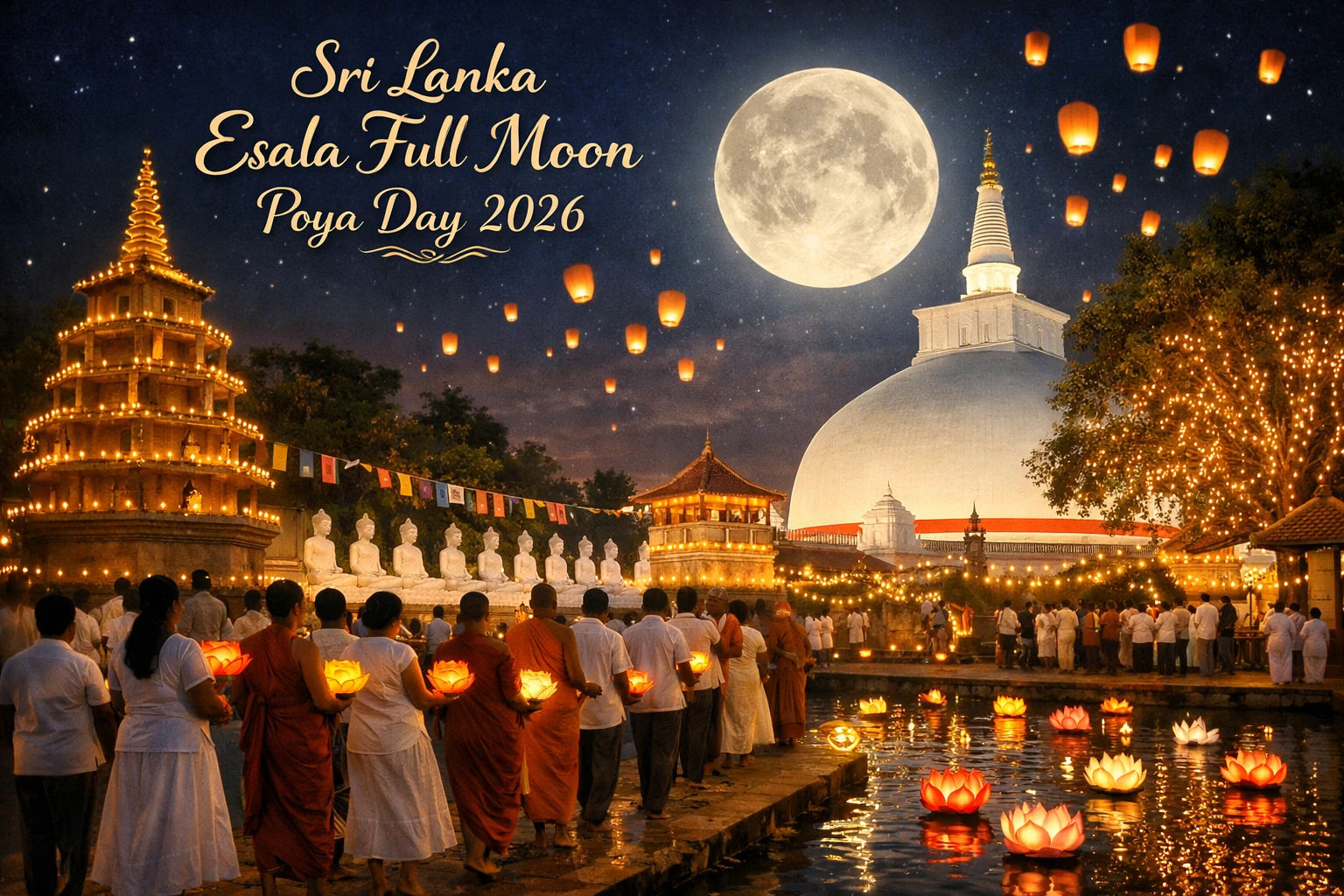
Sri Lanka Esala Full Moon Poya Day 2026: The Sacred Holiday That Launches Asia's Most Spectacular Festival
There is a quality to the full moon over Kandy in late July that is unlike any other full moon in the Sri Lankan calendar. By the time the Esala Poya rises above the misty green hills of the central province, the ancient city is already weeks into the ceremonial preparations that will culminate in the most magnificent religious procession in Asia. The elephants are being adorned. The drumbeats are rehearsed in temple courtyards. The white-robed pilgrims are beginning their journeys toward the Temple of the Tooth. And in every town and village across the island, oil lamps are being lit in doorways to honor a day that carries some of the most significant events in the entire Buddhist calendar.
Esala Full Moon Poya is observed every year on the full moon in the eighth lunar month and will be held on July 29 in 2026. The holiday commemorates the Buddha's first sermon and the arrival of the Tooth Relic in Sri Lanka.
Esala Full Moon Poya Day is a public holiday. It is a day off for the general population, and schools and most businesses are closed. For visitors on the island in late July, the confluence of the Poya holiday atmosphere and the approaching grandeur of the Kandy Esala Perahera makes this one of the richest cultural travel moments available anywhere in the Buddhist world.
The Spiritual Significance of Esala Poya: What the Holiday Actually Commemorates
Three Sacred Events in a Single Day
The lunar month of Esala is known as the season of festivals, most notably the great Esala Perahera in Kandy, Sri Lanka's most extravagant festival. During Esala, there are also elephant peraheras at Kataragama, Dondra and Bellanwila and a big seven-day celebration at Unawatuna.
The Esala Poya carries its spiritual weight from multiple converging sacred narratives, each of which is significant independently and collectively extraordinary.
Several legends are associated with Esala Full Moon Poya Day, including the conception of Siddhartha Gautama or Buddha by Queen Maya, the Great Renunciation, and Buddha's first sermon.
Of these, the first sermon is the event that resonates most broadly across the Buddhist world. After attaining enlightenment under the Bodhi tree at Bodh Gaya, the newly awakened Siddhartha Gautama traveled to the Deer Park at Sarnath in what is now the Indian state of Uttar Pradesh. There, on an Esala Full Moon day, he delivered the first teachings that would become the foundation of Buddhist philosophy to five ascetics who had previously accompanied him in his years of extreme self-denial. This first sermon, known as the Dhammacakkappavattana Sutta or the Turning of the Wheel of the Dhamma, set in motion the tradition of teaching that has carried Buddhism from northern India across Asia and eventually around the world.
Around three decades later, seeing the great suffering of the poor and needy on a visit outside the palace on Esala Full Moon Poya Day, Gautama abandoned his life of luxury and set out to find enlightenment. The Great Renunciation, in which the young prince Siddhartha left his palace, his wife, and his child to seek the end of suffering, is also commemorated on this same lunar date, connecting the beginning of his spiritual journey and the first public expression of its culmination in a single annual observance.
The third and specifically Sri Lankan dimension of the Esala Poya connects these Indian Buddhist events to the island's own sacred history:
Sri Lankan legends state that when Buddha died in 543 B.C., his body was cremated in a sandalwood pyre at Kushinagar, modern-day India, where Khema, his disciple, retrieved his left canine tooth. Subsequently known as "The Tooth Relic," the tooth was taken to Sri Lanka after a conflict in Kalinga in modern-day India. The Tooth Relic is revered by thousands in Sri Lanka, so much so that a new palace was built to enshrine the relic every time the capital of Sri Lanka changed. It was eventually taken to Kandy, where it is kept in the Temple of the Tooth.
The journey of the Tooth Relic to Sri Lanka, hidden in the hair of Princess Hemamala who traveled with Prince Danta from India to the court of King Kithsiri Meghawanna in the fourth century AD, established the relic as the most sacred object on the island and the symbol of sovereign legitimacy for the Sinhalese kings who housed it. The procession that began to honor this relic eventually merged with the pre-existing Esala ceremony and became the Kandy Esala Perahera that the island celebrates every year.
July 29 as a Public Holiday: What Closes and What Stays Open
Planning Your Day Around the Poya Observances
On Poya Days, Sri Lankan workers are legally guaranteed a paid off-work day, unless they are paid time and a half by their employer during Poya Day hours. Most businesses will be closed, and alcoholic beverages and meat are not allowed to be sold until the Poya is over.
The dual prohibition on alcohol and meat sales on Poya Day is one of the most immediately practical considerations for any visitor planning to be in Sri Lanka on July 29. Licensed bars, wine shops, and restaurants that normally serve alcohol are required to observe the restriction for the duration of the holiday. The same applies to fresh meat sales, reflecting the Buddhist principle of ahimsa, or non-harm, that is particularly observed on sacred days. For visitors, the practical implication is simply to plan accordingly: stock provisions before July 29 if needed, or embrace the holiday as an opportunity to explore the extraordinary depth of Sri Lankan vegetarian cooking, which is among the finest in South Asia and flourishes particularly on Poya Days when every restaurant that is open focuses on its meatless menu.
Most tourist-facing businesses, hotels, and international restaurants operate normally on Poya Day, though reduced hours are common and some smaller establishments close entirely. Temples, which are the primary focus of the day, are open to respectful visitors throughout and are at their most atmospheric in the early morning and evening hours when devotees gather for prayer and offerings.
The Esala Perahera: The Festival That the Poya Inaugurates
Ten Nights of Sacred Pageantry Beginning in August
The Esala Full Moon Poya on July 29 falls in the same lunar month that gives the Kandy Esala Perahera its name, and the Poya serves as the spiritual opening of the festival season. The Esala Perahera festival starts on Tuesday, August 18, 2026 (Esala Full Moon Poya Day), and ends on Friday, August 28, 2026 (Randoli Perahera finale).
The Kandy Esala Perahera is believed to be a unique combination of two different but interconnected processions: the Esala and Dalada. The Esala Perahera was originally a ritual performed to ask the gods for rainfall for the cultivation of crops dating back to the 3rd century BC.
The Esala Perahera festival is a sensory feast, with nightly processions winding through Kandy's streets, covering about 5 kilometers. A highlight of the festival, Kandy Esala Perahera elephants are adorned with ornate costumes, gold, and lights. The Maligawa Tusker often carries a golden casket with a replica of the Sacred Tooth Relic. Over 50 elephants participate, some from the Sri Dalada Maligawa, others from temples or tea plantations.
During the Festival of the Tooth, people from across Sri Lanka flock to Kandy to watch the huge procession. It includes some 5,000 dancers, drummers, whip crackers, fire jugglers and many other participants. These performers are all wearing elaborate traditional costumes. Over 100 decorated elephants also join the pageant. The Festival begins with the cutting of a sanctified young jack tree.
Visiting Sri Lanka for the Esala Poya on July 29 and remaining through August 18 to 28 for the Perahera itself gives a traveler the full arc of the festival season: from the Poya holiday and its temple observances, through the building excitement of the weeks before the processions begin, to the ten nights of the most spectacular religious parade in Asia.
Kandy: The City Where Esala Lives Most Fully
The Hill Capital and Its Sacred Heart
For the August Poya Day, visit Kandy in the centre of the island. There, the Esala Festival will be in full swing. You will see fire-walking, extreme acts of penance, gigantic cultural parades, dancers and musicians, and some truly amazing domesticated elephants.
Kandy occupies a natural bowl in the central highland province, surrounded by forested hills and centered on an artificial lake created by the last Kandyan king in the early nineteenth century. The Temple of the Tooth Relic, known in Sinhalese as the Sri Dalada Maligawa, stands on the lake's northern shore and is the most sacred Buddhist site in Sri Lanka.
For any Poya Day, visit the Temple of the Tooth, which purportedly contains a tooth of the Buddha himself. The possessor of the tooth of Buddha was once thought to give authority to govern the kingdom that Kandy was the center of, and the royal palace of Kandy is right next to the temple.
Visiting the Dalada Maligawa on the Esala Poya is an experience of considerable depth. The complex of buildings surrounding the inner shrine room, where the golden casket containing the Tooth Relic is kept and displayed at specific times for devotees to view, fills with white-robed pilgrims from early morning through late evening on Poya Day. The scent of flowers and incense, the sound of Kandyan drums in the inner courtyard, and the quiet intensity of the thousands of people who have made this journey specifically to be in this place on this day create an atmosphere that no casual tourist visit to the temple can replicate.
The broader Kandy city on Esala Poya is equally rewarding for the observant visitor. The streets around the Dalada Maligawa fill with flower sellers offering the lotus and jasmine garlands that devotees carry as offerings. The Bogambara Lake promenade, a peaceful route around the water, provides a vantage point from which the full architectural setting of the Temple and the surrounding hills can be appreciated in the particular quality of a Poya morning light.
Kataragama: The Southern Sacred Site of Esala Season
Fire-Walking and Devotion at the Edge of the Wilderness
During Esala, there are also elephant peraheras at Kataragama, Dondra and Bellanwila.
Kataragama, the small sacred city in the deep south of Sri Lanka near the border of Yala National Park, is the other great gathering point of the Esala season. Here, the devotion is more intense and more physically challenging than anything experienced at the Dalada Maligawa: devotees fire-walk and indulge in various forms of ritual self-mutilation such as piercing their skin with hooks and weights, and driving skewers through their cheeks and tongues.
The Kataragama shrine complex is sacred to Buddhists, Hindus, and Veddah indigenous communities simultaneously, a multireligious convergence that reflects the specific character of this site, which has been sacred in several traditions simultaneously for as long as recorded Sri Lankan history extends. During Esala season, the combination of Buddhist perahera and Hindu kavadi rituals creates one of the most visually diverse and emotionally charged religious gatherings on the island.
The journey to Kataragama from Colombo takes approximately four to five hours through the southern lowlands and past the boundaries of Yala National Park, where the possibility of seeing elephants, leopards, and sloth bears from the road adds a wildlife dimension to a trip that is already rich in cultural purpose.
Practical Information for Esala Poya 2026
Getting Around Sri Lanka on July 29
The public holiday status of July 29 creates high domestic travel demand on the island's roads and railway lines. The routes most affected are those heading toward Kandy and the Cultural Triangle, as pilgrims from Colombo and the western province move toward the island's sacred center for the holiday observances.
The railway from Colombo Fort to Kandy, one of the most scenic train journeys in South Asia, takes approximately two and a half hours through increasingly dramatic hill country scenery. Booking train seats in advance for travel around July 29 is strongly recommended, particularly for the comfortable second-class intercity seats that allow the full landscape to be appreciated without the crush of unreserved travel.
Although the procession usually starts at about 7 PM, you will still need to arrive before 5 PM because the roads will be closed for the procession beforehand. Alcohol is not sold on Poya days. But tea and coffee are available. And Thambili, king coconut water, is a safe and refreshing option.
For visitors planning to attend Kandy temple observances on July 29 and remain for the Perahera in August, booking Kandy accommodation for the full period early is essential. The hotels are fully booked around the city and the city is over-brimmed with the crowds gathered for this spectacular event.
You can stand along the streets and watch the parade for free, but space fills up early in the evening. For better comfort and visibility, purchase tickets through Kandy Temple or online via Sri Lanka Tourism, local tour agencies, or hotels. Prices range from $25 to $100 and above depending on location and night.
For those based in Colombo who want a more accessible Poya Day experience without traveling to Kandy, the Gangaramaya Temple in central Colombo, one of the most eclectic and culturally rich Buddhist temples in Asia, and the Kelaniya Raja Maha Vihara on the city's northern outskirts both hold significant Poya Day observances and are accessible by bus, tuk-tuk, or rideshare from any part of the city.
Dress modestly for all temple visits: covered shoulders and knees are required, and shoes are removed at the entrance to all sacred precincts. Bringing a small sarong or scarf for covering up is standard practice and ensures that no temple visit is turned away at the entrance for inappropriate dress.
The Month That Belongs to the Sacred: Esala in Context
The holiday helps to maintain the traditional practices in Sri Lanka, keeping the culture alive and vibrant. The people remember their history and respect it.
The Esala Full Moon Poya on July 29, 2026 is not simply a day off in the Sri Lankan public holiday calendar. It is the portal into the most ceremonially rich month of the Buddhist year on this island, the beginning of the preparation for a procession that has been running for seventeen centuries without interruption. Being in Sri Lanka for this Poya, and potentially staying for the Perahera that begins on August 18, puts the visitor at the intersection of some of the most ancient and most living ceremonial traditions in the entire Buddhist world.
Sri Lanka is popularly nicknamed the "Pearl of the Indian Ocean" and the "Teardrop of India." On the full moon of July 29, the Pearl shines most specifically with the light of the Esala Poya, and for visitors willing to find themselves in the right place at the right time, that light is genuinely extraordinary.
Verified Information at a Glance
Event Name: Esala Full Moon Poya Day 2026
Event Category: National Public Holiday and Annual Buddhist Religious Observance (Full Moon Poya Day)
Date: Wednesday, July 29, 2026
Status: Official National Public Holiday; schools, government offices, and most businesses closed; alcohol and meat sales legally prohibited until the Poya observance is over
What Is Commemorated:
- The first sermon of the Buddha (Dhammacakkappavattana Sutta) delivered at the Deer Park, Sarnath, India, to five ascetics
- The Great Renunciation of Prince Siddhartha Gautama (leaving palace life to seek enlightenment)
- The arrival of the Sacred Tooth Relic of the Buddha in Sri Lanka (4th century AD)
Ranking: One of the most significant annual Poya Days; inaugurates the Esala festival season
Primary Celebration Locations: Sri Dalada Maligawa (Temple of the Tooth), Kandy (most significant on island), Gangaramaya Temple, Colombo, Kelaniya Raja Maha Vihara, Colombo outskirts, Kataragama Shrine Complex, Southern Province, Temples island-wide
Connected Festival: Kandy Esala Perahera 2026 runs August 18 to 28, 2026 (begins on a separate Poya date; the July 29 Esala Poya marks the lunar month and initiates the broader Esala season)
Kandy Esala Perahera 2026 Dates: August 18 to 28, 2026
Key Customs on Poya Day: Temple visits and flower offerings; white clothing as sign of devotion; fasting; reading and listening to Dhamma; oil lamp lighting; kūdu (paper lanterns); dansal (free food distribution) at some temples and community organizations
Alcohol and Meat Sales: Prohibited by law on the Poya Day; plan accordingly
Admission: All public Poya Day celebrations and temple visits are free; donations welcomed at temples
Perahera Ticket Prices (for the August procession): Free to stand along streets; seated viewing through hotels or agencies: approximately $25 to $100 and above depending on location and night
Nearest Major Airport: Bandaranaike International Airport (CMB), Colombo, approximately