International Ethnic Folklore Festival 2026 Sri Lanka: Where the World Dances Together on the Pearl of the Indian Ocean
There is an idea embedded at the heart of every great folklore festival that no museum exhibit or academic paper can communicate as effectively as a live performance: the idea that the deepest things human beings feel, love, grief, celebration, the longing for home, the joy of harvest, the memory of ancestors, are expressed in every culture on earth, and that watching those expressions in their full physical and musical form is one of the most immediate ways available to understand something true about the species you belong to.
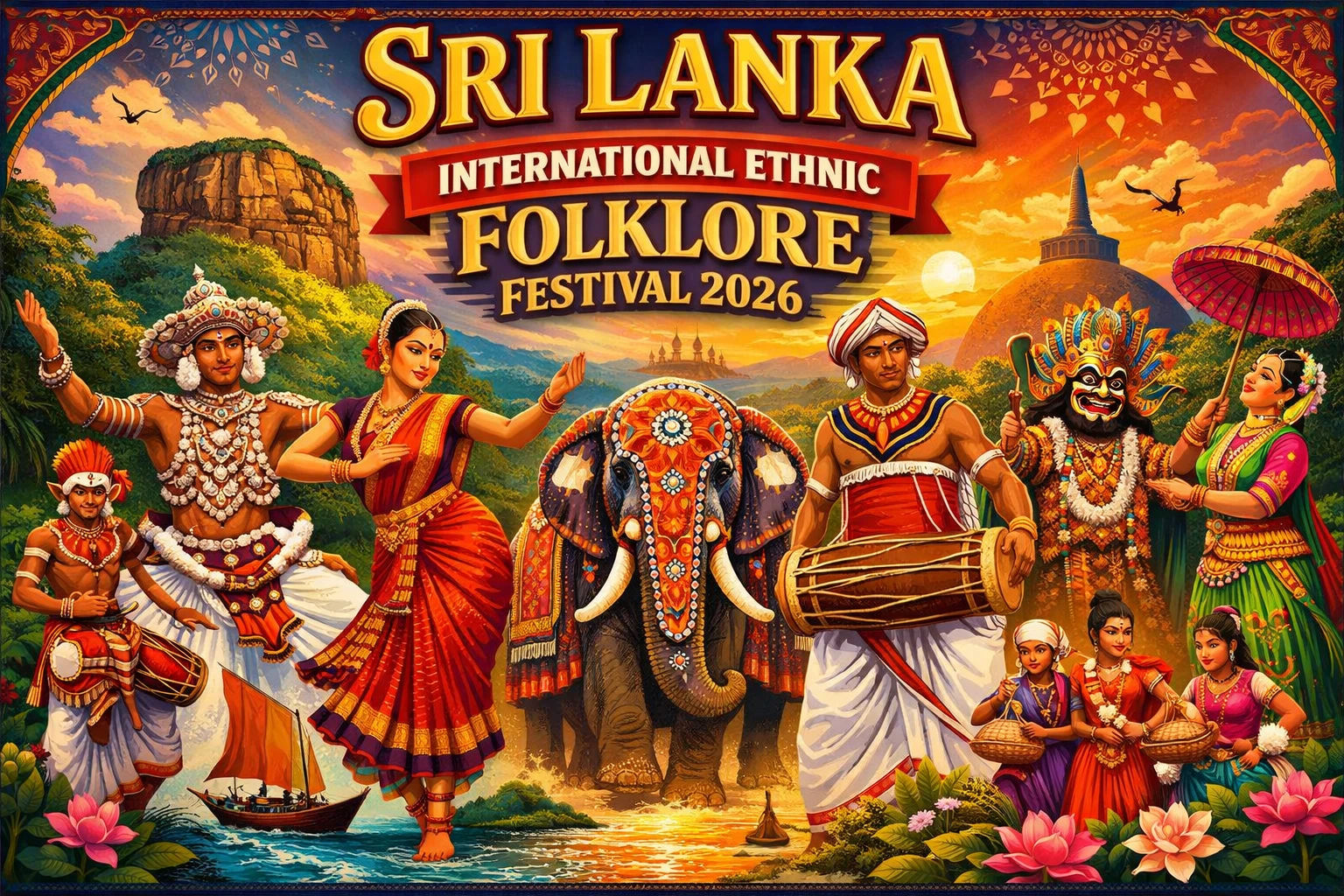
The International Ethnic Folklore Festival Sri Lanka, carrying the motto "Let's Dance for World Peace," is built entirely on that conviction. In 2026, Colombo becomes the stage for not one but two international editions of this extraordinary celebration, with the first edition running June 10 to 17 and the second edition running November 23 to 30. Together they give this island nation, already one of the most culturally rich destinations in Asia, two separate windows in the year when it becomes the gathering point for performing artists from across the globe.
The Organization Behind the Festival: A Decade of Cultural Bridge-Building
Driti Council of Performing Arts and the International Vision
Driti Council of Performing Arts, New Delhi, India, is a non-profit cultural organization dedicated to the preservation, promotion, and global presentation of India's rich and diverse folklore traditions and is a member of the European Association of Folklore Festivals. The organization began its journey in 2015 in Delhi-India, with the first international festival, and by 2026 has successfully completed 10 editions. In 2026, the organization proudly expands IEFF Festivals to Vietnam, Thailand, Sri Lanka, Mexico, and Nepal, opening new cultural bridges and global performance opportunities.
That expansion model is deeply significant. The Driti Council is not simply importing a festival template into new countries. It is building genuine partnerships with local cultural organizations in each destination country and creating platforms where local artists share the stage with international performers in ways that generate genuine artistic exchange rather than a one-way showcase.
The 1st Edition of International Ethnic Folklore Festival Sri Lanka is organized by Driti Council of Performing Arts India and Sri Lanka Cultural Dance Foundation. IEFF Sri Lanka is a place where world class artists may compete with great passion from heart, have fun and build fond memories of their competitive experiences.
The partnership with the Sri Lanka Cultural Dance Foundation gives the festival genuine roots in the island's own artistic community. International Ethnic Dance Festival and Competition is a great opportunity to the youth of Sri Lanka to share the stage with the International Folklore Festival Artists where 200 professional International Artists will be performing from 5 to 7 countries. That specific opportunity, for Sri Lankan young artists to perform alongside 200 international professionals in their own capital city, has a formative power for the participating performers that extends well beyond any individual performance.
The Setting: Colombo as a World Cultural Stage
A City Ready to Welcome the World's Dance Traditions
Sri Lanka is often described as a "land of cultures" due to its rich history of diverse ethnic and religious groups. Diverse culture of Sri Lanka has the treasure of variety of folk and classical dances in regions across the country.
That cultural diversity is not simply a tourist marketing description. Sri Lanka is home to Sinhalese, Tamil, Moor, Burgher, Malay, and Veddah communities, each carrying distinct artistic, religious, and linguistic traditions that have coexisted on this island of approximately 65,610 square kilometers for over two thousand years. The folk dance traditions alone span an extraordinary range: Kandyan dance from the central highlands, which UNESCO recognized as an Intangible Cultural Heritage of Humanity in 2016; the low-country Kolam masked dance drama; Sabaragamuwa dance from the southwest; and the Tamil Bharatanatyam and folk traditions of the north. This is an island that has been sustaining multiple sophisticated performing arts traditions simultaneously for millennia, and it provides exactly the kind of rich local artistic environment that gives a folklore festival its most meaningful context.
Colombo is Sri Lanka's vibrant capital, offering a blend of historical sites, cultural experiences, and modern attractions. Visitors can explore bustling markets, colonial-era architecture, serene temples, and enjoy diverse culinary delights. Colombo is a principal port on the Indian Ocean. It has one of the largest artificial harbours in the world and handles the majority of Sri Lanka's foreign trade.
The city offers a blend of historical sites, colonial-era architecture, serene temples, bustling markets, and diverse culinary delights, making it the perfect destination for cultural exchange and heritage exploration.
The city's cultural infrastructure for festival programming includes performance venues that range from formal proscenium theatres to outdoor amphitheatres, and its position as the nation's largest urban center ensures the logistical support, accommodation, and audience base that a large international festival requires.
What the Festival Actually Looks Like: Eight Days of Global Performance
The Performance Format and Who Participates
All dance and music groups of any style are welcome: Folklore, Choir, Majorette, Orchestra, Classical, Contemporary, Oriental, Marching and Brass Bands, and more. Performance requirements are three different dance items, ten to fifteen minutes each, once per day at provided venues. Age Category is 7 to 70 years and above. Group Members minimum 4, maximum unlimited. Live or recorded music is allowed.
The breadth of that performance taxonomy reflects the festival's inclusive philosophy. A Choir group from Eastern Europe sharing the stage with a Bharatanatyam ensemble from South India and a majorette troupe from West Africa creates exactly the kind of cross-cultural encounter that the "Let's Dance for World Peace" motto is genuinely trying to describe. The universal human response to rhythm and movement creates connections between audiences and performers across all the barriers of language, religion, and national origin that divide people when they are not dancing.
The eight-day duration of each edition provides enough time to develop the social bonds between participating groups that transform a shared performance schedule into a genuine community. By the third day of a folklore festival, the Peruvian ensemble is teaching their footwork to the Sri Lankan students in the hotel lobby. By the sixth day, the Bulgarian choir is learning a few phrases from the Japanese dancer in the next room. These informal transmissions are not incidental to the festival's mission. They are the mission, expressed in its most organic and most effective form.
Colombo's Cultural Landmarks: The Festival's Tourism Dimension
A City Whose History Deserves Its Own Time
The festival program includes dedicated tourism exploration, giving participants an organized introduction to the Colombo landmarks that frame the festival experience in the city's own cultural identity.
Among the sites covered in the tourism program are:
- Gangaramaya Temple
- Galle Face Green
- Viharamahadevi Park
- Independence Memorial Hall
- National Museum of Colombo
- Jami Ul-Alfar Mosque
- Beira Lake
- Seema Malakaya
- Lotus Tower
- Pettah Floating Market
Each of those sites tells a different chapter of Colombo's story. The Gangaramaya Temple, sitting on the edge of Beira Lake in the heart of the city, is among the most eclectic and culturally layered Buddhist temples in Asia, its chambers filled with religious objects gifted from Buddhist communities around the world. The Seema Malakaya Meditation Centre, a modern structure in the middle of Beira Lake designed by Geoffrey Bawa, Sri Lanka's most celebrated architect, brings the meditative quality of traditional island architecture into a contemporary form that is genuinely extraordinary.
The Pettah Floating Market, in the oldest commercial district of Colombo, offers a different kind of sensory education: the sounds and smells and colors of a traditional South Asian bazaar operating in the shadow of the Dutch-built Fort area that gives the city's most historic neighborhood its distinctive colonial-era character. For performers arriving from countries where this kind of market culture is unfamiliar, a morning in Pettah is as educational and affecting as any museum visit.
The Lotus Tower, completed in 2019 and rising 350 meters to become the tallest structure in South Asia at the time of its completion, represents the other end of Colombo's temporal spectrum: a modern city building its infrastructure toward a regional future while maintaining deep connection to the traditions that the festival itself celebrates.
The Competitive Dimension: Structure and Judging
A Platform for Serious Artistic Recognition
The International Ethnic Folklore Festival Sri Lanka is both a celebration and a competition, and the competitive structure gives the event a specific professional weight that pure celebration festivals do not carry.
Marking will be on Synchronization, Formations, Coordination, Space Utilization, Expressions, Dancing Moves, Costumes, and Audience Response. The judges are experienced. The festival runs on schedule and creates the festive vibe as amazingly positive and uplifting with a friendly environment. A panel of highly eminent personalities and professionals in the arts will judge all performances. Winners will be announced on the same day of the competition. On each day only 15 groups will compete along with International Participants.
The eight-point evaluation framework, covering everything from the technical precision of synchronization and formations to the more subjective but ultimately decisive qualities of expression and audience response, provides participants with genuinely useful professional feedback alongside whatever award outcome the competition produces. For young performers particularly, being evaluated against these specific criteria by a panel of experienced arts professionals is a development experience of significant value.
Groups will be allotted one day according to their category of dance form by the organizer. Winners will be announced on the same day of the competition. The same-day results policy reduces the tension of waiting and allows winning groups to celebrate in the immediate context of the performance that earned the recognition, which is always more emotionally resonant than an announcement made days later at a closing ceremony.
Practical Information for International Participants and Visitors
Getting to Colombo and What to Prepare
Colombo Bandaranaike International Airport (CMB) welcomes international visitors. The Bandaranaike International Airport, located approximately 30 kilometers north of Colombo's city center in Katunayake, is the island's primary international gateway. Direct flights connect Colombo to Dubai, Singapore, Kuala Lumpur, Doha, Abu Dhabi, Bangkok, and other major Asian hubs, with connections available from virtually every major international city within reasonable transit times. The drive from the airport to central Colombo takes approximately 45 minutes to an hour under normal traffic conditions, with the expressway providing the fastest connection.
Groups arrange their own round-trip flight tickets and travel health insurance. Participating groups are responsible for their own transportation to Colombo, and the festival organization arranges accommodation, meals, and local transportation between venues and tourism sites for registered groups.
For groups interested in participating, interested groups must contact the festival organizers for the application form at ieffsrilanka@gmail.com. The application deadline for both the June and November editions falls in early 2026, and the festival's official website at ieffsrilanka.com provides detailed registration information, terms and conditions, and the full competition framework.
The June edition falls at the beginning of the southwest monsoon season in Colombo, which means warm temperatures with the possibility of afternoon rain showers. The November edition sits in the northeast monsoon period, with generally stable conditions in Colombo itself, since the southwest coastal orientation of the city means it is relatively sheltered during the northeast monsoon that brings heavier rain to the eastern and northern parts of the island. Both periods are perfectly manageable for outdoor and indoor performance programming with appropriate weather contingency planning.
Sri Lanka's Own Dance Traditions: The Cultural Foundation Beneath the Festival
What This Island Brings to the Global Conversation
IEFF Sri Lanka's motive is to provide the live platform to the Folklore, Classical and Semi-classical Dance forms of Sri Lanka which have been eclipsed with the modernization of society. IEFF Sri Lanka aims to showcase the richest cultural heritage of Sri Lanka before World Folklore Artists of International Ethnic Folklore Festival and to the audience of Sri Lankan art lovers.
That dual mission, showcasing Sri Lankan traditions to international visitors while giving Sri Lankan artists access to global performing arts standards, captures exactly why an international folklore festival matters to an island like Sri Lanka. The Kandyan dance tradition, in particular, is one of the most visually spectacular and technically demanding classical performing arts traditions in the world, combining precise footwork, elaborate costume including the distinctive Kandyan crown, and the extraordinary physicality of certain advanced forms like the Ves dance that was traditionally performed only by trained male dancers in temple ritual contexts.
Sri Lanka, the tiny teardrop-shaped isle, offers myriad experiences ranging from world-class cultural and historical sites to palm-fringed beaches, verdant tea plantations, and spectacular national parks teeming with wildlife. Home to the four main religions of the world, the Pearl of the Indian Ocean is also a land of never-ending festivals and events celebrating all facets of life.
That description of Sri Lanka as home to all four major world religions, Buddhism, Hinduism, Islam, and Christianity, in a relatively small island community is the foundational cultural fact that gives every performance at the International Ethnic Folklore Festival Sri Lanka its deepest resonance. When a folk dance from Romania performs alongside a Kandyan ensemble on a Colombo stage, they are not merely exchanging artistic expressions. They are enacting, in the most physical and immediate way possible, the possibility that human beings from radically different religious and cultural backgrounds can share a stage, admire each other's traditions, and leave with something of the other's world living inside them.
That is what "Let's Dance for World Peace" means. And in Colombo in June and November 2026, it means it in a place that has been living that possibility, imperfectly and beautifully, for more than two thousand years.
Verified Information at a Glance
Event Name: International Ethnic Folklore Festival Sri Lanka (IEFF Sri Lanka)
Official Tagline: "Let's Dance for World Peace"
Event Category: International Cultural Dance and Performing Arts Festival and Competition
Organizer: Driti Council of Performing Arts, New Delhi, India, in partnership with Sri Lanka Cultural Dance Foundation
Association Membership: European Association of Folklore Festivals (EAFF) and World Festival Association (WOFAFESTIVALS)
2026 Editions:
1st Edition: Dates: June 10 to 17, 2026 Location: Colombo, Sri Lanka Registration/Application Deadline: March 15, 2026
2nd Edition: Dates: November 23 to 30, 2026 Location: Colombo, Sri Lanka Registration/Application Deadline: March 15, 2026
Festival Duration: 8 days per edition
Performance Format: 3 dance items per group, 10 to 15 minutes each, once per day at assigned venues
Eligible Styles: Folklore, Choir, Majorette, Orchestra, Classical, Contemporary, Oriental, Marching and Brass Bands, and any style of dance and music
Age Category: 7 to 70 years and above
Group Size: Minimum 4 performers, maximum unlimited
Music: Live or recorded music permitted
International Artists Expected: Approximately 200 professional performers from 5 to 7 countries per edition
Competition Judging Criteria: Synchronization, Formations, Coordination, Space Utilization, Expressions, Dancing Moves, Costumes, and Audience Response
Participant Responsibility: Groups arrange own round-trip flights and travel health insurance
Tourism Program Included: Gangaramaya Temple, Galle Face Green, Viharamahadevi Park, Independence Memorial Hall, National Museum of Colombo, Jami Ul-Alfar Mosque, Beira Lake, Seema Malakaya, Lotus Tower, Pettah Floating Market
Nearest Airport: Colombo Bandaranaike International Airport (CMB), approximately 30 km from Colombo city center
Official Website: ieffsrilanka.com
Contact Email: ieffsrilanka@gmail.com
Parent Organization Website: iefffestivals.com (Driti Council of Performing Arts)
All details verified from the official IEFF Sri Lanka website at ieffsrilanka.com, the European Association of Folklore Festivals listing at eaff.eu, the World Festival Association at wofafestivals.com, the Festival Association listings at festival-association.eu, and the parent organization website at iefffestivals.com. Both the June 10 to 17 and November 23 to 30, 2026 dates are confirmed across multiple official sources. Specific venue locations for competition days will be communicated to registered groups one month before the festival. Always contact the organizers directly at ieffsrilanka@gmail.com for the most current registration information and participation requirements.