Sri Lanka Poson Full Moon Poya Day 2026: The Island's Most Sacred Pilgrimage Month Arrives on June 29
There is a mountain in north-central Sri Lanka where, on a full moon evening more than two thousand years ago, a Buddhist monk appeared to a king who had been hunting deer, called him by his name, and changed the history of an entire island civilization in the space of a single conversation. That mountain is Mihintale. The monk was Arahant Mahinda, son of the Emperor Ashoka of India. The king was Devanampiyatissa of Anuradhapura. And the conversation that followed, in which the king answered a riddle about a mango tree and then listened to the first Buddhist sermon ever preached on Sri Lankan soil, set in motion a cultural transformation whose effects are visible in every stupa, every temple, every white-robed pilgrim on every full moon night across this island to this day.
On Monday, June 29, 2026, Sri Lanka observes Poson Full Moon Poya Day, the national public holiday that commemorates that moment and the twenty-three centuries of Buddhist civilization it initiated. Poson Full Moon Poya Day is a public holiday in Sri Lanka on June 29, 2026. It is a day off for the general population, and schools and most businesses are closed. For visitors fortunate enough to be on the island during the days surrounding this date, Poson offers one of the most genuinely moving and culturally immersive experiences available anywhere in the Buddhist world.
The Story Behind Poson: When Buddhism Came to the Pearl of the Indian Ocean
Arahant Mahinda and the Mango Tree Riddle
It was on a Poson Full Moon Poya day in the 3rd century BC that Buddhism was introduced to Sri Lanka by Arahant Mahinda, son of Emperor Ashoka who had become a Buddhist monk. This momentous event occurred in Anuradhapura, which has since then become the focus of Poson Poya religious observances each year.
King Devanampiyatissa was hunting deer on that Poson Poya day many centuries ago, when Arahant Mahinda appeared to him in a grove atop the mountain now known as Mihintale, meaning plateau of Mahinda, and called him by his first name. The King stopped his pursuit of the deer and answered a riddle about a mango tree which the Arahant asked him. He thereafter listened to the teachings of Arahant Mahinda and agreed to follow the teachings of the Buddha.
That encounter between a monk and a king, which reads with the character of a parable precisely because it is one, was not simply a personal spiritual conversion. It was the founding moment of a state Buddhism that would shape Sri Lankan law, architecture, agriculture, politics, and social organization for the next two and a half millennia. The King's conversion to Buddhism led to the construction of many Buddhist sites and learning centers around the capital. It helped form an official connection between Buddhism and Sri Lanka.
This is why Mihintale is often called "the cradle of Buddhism" in Sri Lanka. The focal point of the religious festival is the Buddhist monastic complex on the mountain of Mihintale, where Arahant Mahinda Thero preached Buddhism to King Devanampiyatissa.
On the exact site where the Arahant appeared to King Devanampiyatissa, now stands a Temple, the Ambasthale Dagoba. Ambasthale means Mango tree and the Temple has been given this name as a reference to the riddle which opened the discussion between the two of them. This monument stands tall above the Mihintale city and is reached by climbing 1,840 steps.
Those 1,840 steps are among the most meaningful stairways in the Buddhist world, and on Poson Full Moon Poya, tens of thousands of pilgrims climb them in the darkness of a June evening, carrying offerings, wearing white, and ascending to the place where the history of their civilization began.
Why Poson Is the Second Most Important Buddhist Holiday in Sri Lanka
The Poya Tradition and the Significance of the Full Moon
Poson is the most important Poya, or full moon holiday, of the year and the second most important Buddhist holiday of the year, being surpassed in importance only by Vesak.
Poya Day is not a single day but a name for any holiday in Sri Lanka that is held to mark a full moon. There are around a dozen Poya Days every year, in conformity with the Buddhist lunar calendar and moon-phase marking system. As 70 percent of Sri Lankans are Buddhist, most of the population celebrates each Poya Day as of religious significance. In Sinhalese, "poya" is derived from a word meaning "fast day," which explains why many Buddhists go to temple and fast during Poyas.
Sri Lanka is said to maintain the oldest Buddhist civilization. That distinction, as the world's oldest continuously Buddhist civilization, gives the Poson commemoration a particular depth that is not simply historical pride but a living connection to an unbroken transmission of teaching, practice, and community that has persisted through colonial suppression, civil war, and every other disruption the island has experienced across twenty-three centuries.
The Vesak Poya in May celebrates the birth, enlightenment, and death of the Buddha himself. Poson, one month later, celebrates the moment when those teachings reached Sri Lanka, and therefore the moment when the religious civilization that shapes approximately 70 percent of the island's population began. For the community that celebrates it, the distinction between the universal and the particular is exactly the distinction between Vesak and Poson: one belongs to all Buddhists everywhere, the other belongs specifically and personally to this island and these people.
Mihintale and Anuradhapura: The Sacred Heart of Poson Celebrations
A Pilgrimage Experience Unlike Anything Else in South Asia
Although Poson is celebrated across Sri Lanka, the main event is a mass pilgrimage to Anuradhapura, while thousands of white-robed pilgrims climb to the summit of Mihintale to the spot where Mahinda gave his first sermon.
Anuradhapura, the ancient capital of Sri Lanka and one of the most significant archaeological sites in Asia, sits approximately 220 kilometers north of Colombo in the island's North Central Province. As a UNESCO World Heritage Site, the ancient city encompasses some of the oldest documented stupas, monasteries, and irrigation systems in the world. A principal symbol during Poson is Mihintale, a mountain 220 km, or 135 miles, north of the modern-day capital, Colombo, and 15 km, or 9 miles, west of Anuradhapura.
During Poson week, the normally quiet sacred city of Anuradhapura transforms into one of the largest pilgrimage gatherings in South Asia. The roads leading into the city fill with buses, vans, and cars from every province of the island, all moving toward the same destination. The pilgrims, almost uniformly dressed in white, carry flowers and oil for the temple lamps, and the atmosphere around the major sacred sites, particularly the Sri Maha Bodhi, the ancient sacred fig tree grown from a sapling of the original Bodhi Tree under which the Buddha attained enlightenment, is one of concentrated, collective devotion that is difficult to adequately describe in words.
Visit the Sri Maha Bodhi Temple in Anuradhapura, where you can see a Bodhi tree thought to be directly derived from the Bodhi tree in India under which Buddha was first enlightened. The Sri Maha Bodhi is among the oldest historically documented trees on earth and is treated by Sri Lankan Buddhists as among the most sacred objects in existence. Standing before it during Poson, surrounded by thousands of white-robed pilgrims placing flowers at its base and reciting sutras in the warm June night, is an experience of considerable spiritual power regardless of the visitor's own religious background.
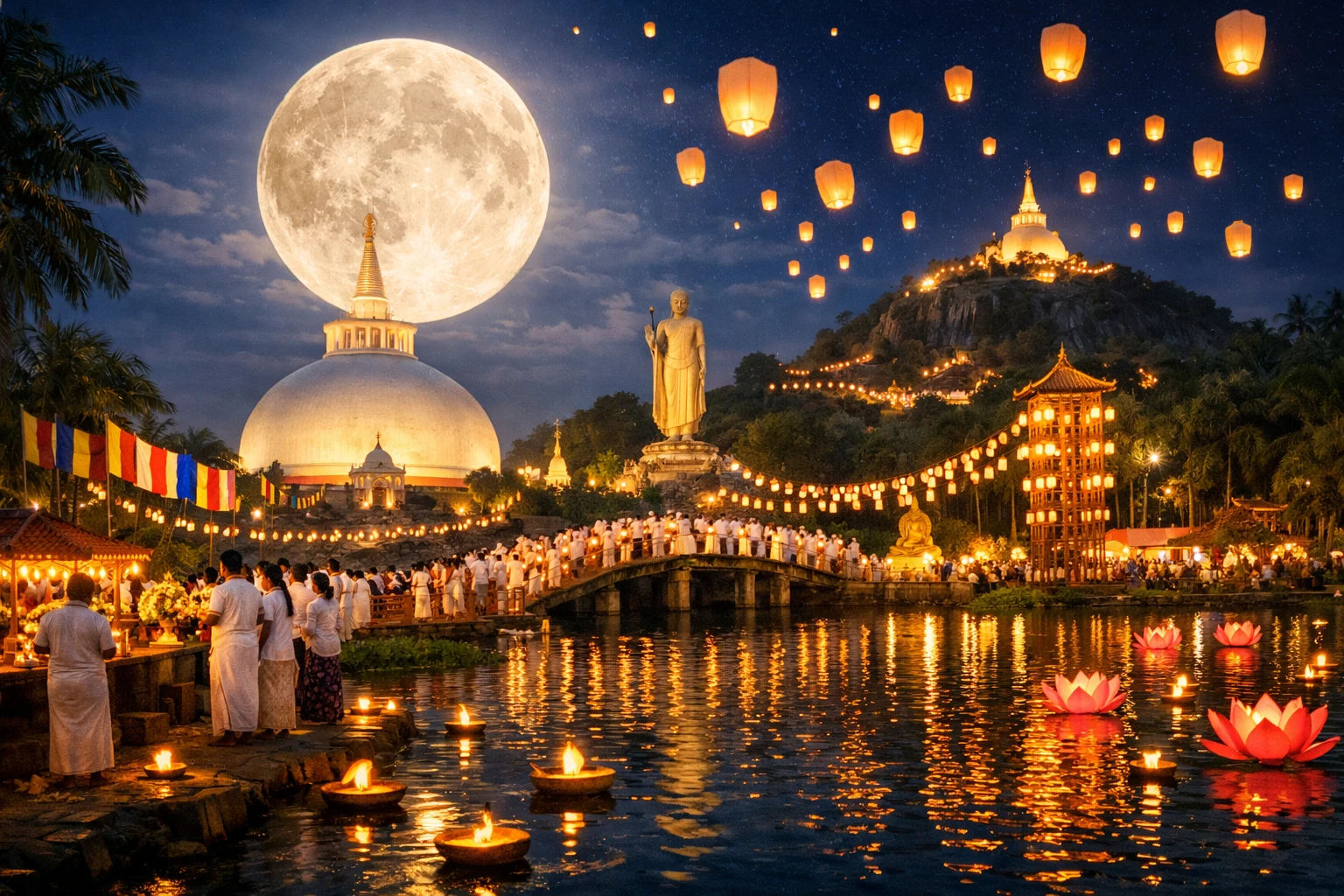
The climb to Mihintale itself, up the 1,840 carved stone steps that lead to the Ambasthale Dagoba, is undertaken by thousands of pilgrims during Poson, many of them climbing barefoot as an expression of devotion. The steps, some of which date to the period of the ancient kingdom itself, are lined with small oil lamps on Poson night, creating a visual spectacle of extraordinary beauty as the flames flicker against the stone in the darkness and the summit dagoba glows white in the light of the full moon above.
How Poson Is Observed Across the Island: Pandols, Dansalas, and Lanterns
The Communal Celebrations That Fill Every Town and Village
In Anuradhapura as well as the rest of the country, Poson celebrations are similar to Vesak, with Pandols and Dansal, or alms-giving stalls, to be seen everywhere.
The pandol tradition, in which elaborate illuminated panels depicting scenes from the life of the Buddha or from the Mahinda story are erected at street intersections and temple entrances across the island, is one of the most visually distinctive elements of Poson. The largest pandols, some of them tens of meters in height and lit from within, draw crowds who gather in the evenings to see the storytelling panels illuminate and, increasingly, animate with LED technology that brings the ancient scenes to contemporary life.
The dansal tradition is equally central. As you travel by three-wheeler, bus, or car, observe roadside dansals handing out food and drink. These free food distribution points, set up by temples, businesses, families, and civic organizations throughout Poson week, offer cooked food, fresh juices, and traditional sweet items to anyone who stops, with no payment expected or accepted. The dana, or generosity, that the dansal represents is itself a central Buddhist practice, and participating in it, either as the giver or the recipient, is a form of spiritual practice as much as social welfare.
A custom during Poya days is the lighting of intricate paper lanterns shaped like stars or lotus flowers known as kūdus. In the evenings of Poson week, the kūdu lanterns hanging from houses, temples, and street lamps transform the visual landscape of every Sri Lankan town and village into something that combines the devotional and the festive in the characteristically Sri Lankan way that makes these holidays feel genuinely alive rather than ceremonially preserved.
The Public Holiday Dimension: What June 29 Means for Travel in Sri Lanka
Planning Around the Poya Day
On Poya Days, Sri Lankan workers are legally guaranteed a paid off-work day, unless they are paid time and a half by their employer during Poya Day hours. Most businesses will be closed, and alcoholic beverages and meat are not allowed to be sold until the Poya is over.
The prohibition on alcohol and meat sales on Poson Poya Day is one of the most immediately practical pieces of information for visiting travelers to be aware of. All licensed establishments are required to observe the prohibition, meaning that the bars, wine shops, and restaurants that normally serve alcohol across Sri Lanka will not be doing so on June 29. The same applies to meat sales, reflecting the Buddhist principle of ahimsa, or non-harm, that makes fasting from meat a common Poya observance.
For travelers not observing the holiday's religious dimensions, this simply means planning meals and provisions accordingly: stocking up before June 29 if alcohol is important to your evenings, or embracing the rich Sri Lankan vegetarian culinary tradition for a day, which is its own rewarding discovery. The island's vegetarian cooking, drawing on its extraordinary range of tropical vegetables, coconut, and spice traditions, is among the finest in Asia and benefits from being experienced on its own terms rather than as a default option.
June 27, 2026, Saturday: Three days of long weekend starts from Saturday, 27 June on the occasion of Poson Full Moon Poya Day on June 29, Monday. That long weekend structure means the period from Saturday June 27 through Monday June 29 will see heavy domestic travel on the island's roads, particularly the routes toward Anuradhapura and Mihintale. Visitors planning to attend the Anuradhapura and Mihintale ceremonies should ideally arrive by Friday June 26 to avoid the worst of the traffic and to secure accommodation in what is otherwise a relatively small town.
Colombo's Kelaniya Temple: Poson Celebrations in the Capital Region
A Sacred Site Within Easy Reach
For visitors based in Colombo who cannot make the journey north to Anuradhapura and Mihintale, the Kelaniya Raja Maha Vihara temple on the northern outskirts of the capital offers one of the most significant Poson observances accessible from Colombo.
The ancient cities of Anuradhapura and Polonnaruwa, the Temple of the Tooth in Kandy, and the Kelaniya Temple are specific areas of Poson celebration. The Kelaniya temple, according to Buddhist tradition, was visited by the Buddha himself and is among the most venerated sites in the country. During Poson, its grounds fill with pilgrims from across the western province, the pandols along the approach road illuminate the neighborhood for kilometers in every direction, and the dansal stalls along the main road offer free food to the hundreds of thousands of devotees who visit across the holiday period.
The Temple of the Tooth in Kandy, housing the relic of the Buddha's tooth that is the most sacred object in Sri Lankan Buddhism, observes Poson with the full ceremonial devotion that characterizes all its religious occasions. The sight of the temple at night, illuminated and surrounded by thousands of pilgrims in white, with the Kandy lake reflecting the lights behind it, is among the most beautiful religious spectacles in the entire Buddhist world.
Practical Tips for Visiting Sri Lanka During Poson 2026
For visitors choosing to experience Poson in the ancient cities of the Cultural Triangle, advance booking of accommodation in Anuradhapura is essential. The town's hotel and guesthouse capacity is limited relative to the surge in visitor numbers during Poson week, and the best properties are typically fully booked weeks in advance.
The fact that the moon is largest and brightest when it is full is the rationale behind full moons being occasions for celebration. The full moon of June 29, 2026 rises over the Anuradhapura archaeological landscape and the mountain of Mihintale in what is, under clear June skies, one of the most visually extraordinary settings in Asia for a moonrise. Planning your evening at Mihintale to coincide with moonrise and the subsequent Poson ceremony creates a layering of natural and spiritual beauty that rewards the journey from wherever you are starting.
Visitors should dress modestly for all temple visits, covering shoulders and knees as a minimum. Shoes are removed before entering all sacred precincts, and many pilgrims wear white as a sign of devotional intent. Carrying water is essential, particularly for the Mihintale climb, which in June temperatures can be physically demanding. A torch or headlamp is useful for the evening stairway ascent when the stone steps, however beautifully lit by oil lamps, are shared with thousands of other pilgrims moving in both directions.
The long weekend of June 27 to 29 creates a domestic travel peak, so intercity transport should be booked well in advance. The trains from Colombo Fort station to Anuradhapura run several times daily and are the most comfortable and most scenic way to make the journey, with the rail line passing through the heart of the North Central Province's ancient tank-irrigated landscape that is itself a testament to the civilization that Buddhist rule built across this island.
An Encounter With a Living Civilization
Poson Full Moon Poya Day is not a historical re-enactment of something that happened long ago. It is the living expression of a civilizational identity that has been continuous, however turbulently, since Arahant Mahinda descended from Mihintale with the Dhamma and changed the course of the island's history. Poson is a very religious festival and temples on the island are filled with devotees and pilgrims to mark this great event. Others may perform religious activities like reading holy books or listen to monks tell stories about Buddha's life.
For any traveler with the curiosity and the flexibility to be in Sri Lanka during the last days of June, the experience of joining hundreds of thousands of white-robed pilgrims on the ancient roads of Anuradhapura, climbing moonlit stone steps to a mountain summit where a king was first asked a riddle about a mango tree twenty-three centuries ago, and standing at the Ambasthale Dagoba as the June full moon rises over the plains below, is one of the most profound travel experiences the Asian world has to offer.
Verified Information at a Glance
Event Name: Poson Full Moon Poya Day 2026 (also known as Poson Poya or Poson Festival)
Event Category: National Public Holiday and Annual Buddhist Religious Festival
Date: Monday, June 29, 2026
Long Weekend: Saturday June 27 to Monday June 29, 2026
Status: Official National Public Holiday; schools, government offices, and most businesses closed; alcohol and meat sales legally prohibited until the Poya is over
Historical Significance: Commemorates the introduction of Buddhism to Sri Lanka by Arahant Mahinda in 236 BC (3rd century BC) at Mihintale, near Anuradhapura
Ranking: Second most important Buddhist holiday in Sri Lanka after Vesak; most important of the annual Poya holidays
Primary Celebration Locations: Mihintale, North Central Province (14 km from Anuradhapura) – site of the first Buddhist sermon in Sri Lanka; 1,840 stone steps to Ambasthale Dagoba Anuradhapura, North Central Province – ancient capital and UNESCO World Heritage Site; Sri Maha Bodhi Tree (sacred fig tree); multiple ancient stupas and monasteries
Secondary Celebration Locations: Kelaniya Raja Maha Vihara, Colombo region Temple of the Tooth (Sri Dalada Maligawa), Kandy Polonnaruwa Archaeological Site, North Central Province Temples and pandols island-wide