AKRA Improvised Music Festival 2026 – Heraklion, Crete: Where the Venetian Walls Become a Canvas for Sound
Some of the best musical experiences in the world have no set list. No rehearsed structure, no predetermined sequence of notes, no final chorus you know is coming before it arrives. The music simply begins somewhere, moves through an hour of invention, surprise, friction, and resolution, and ends in a place that nobody in the room, including the musicians, could have predicted when the first note sounded.
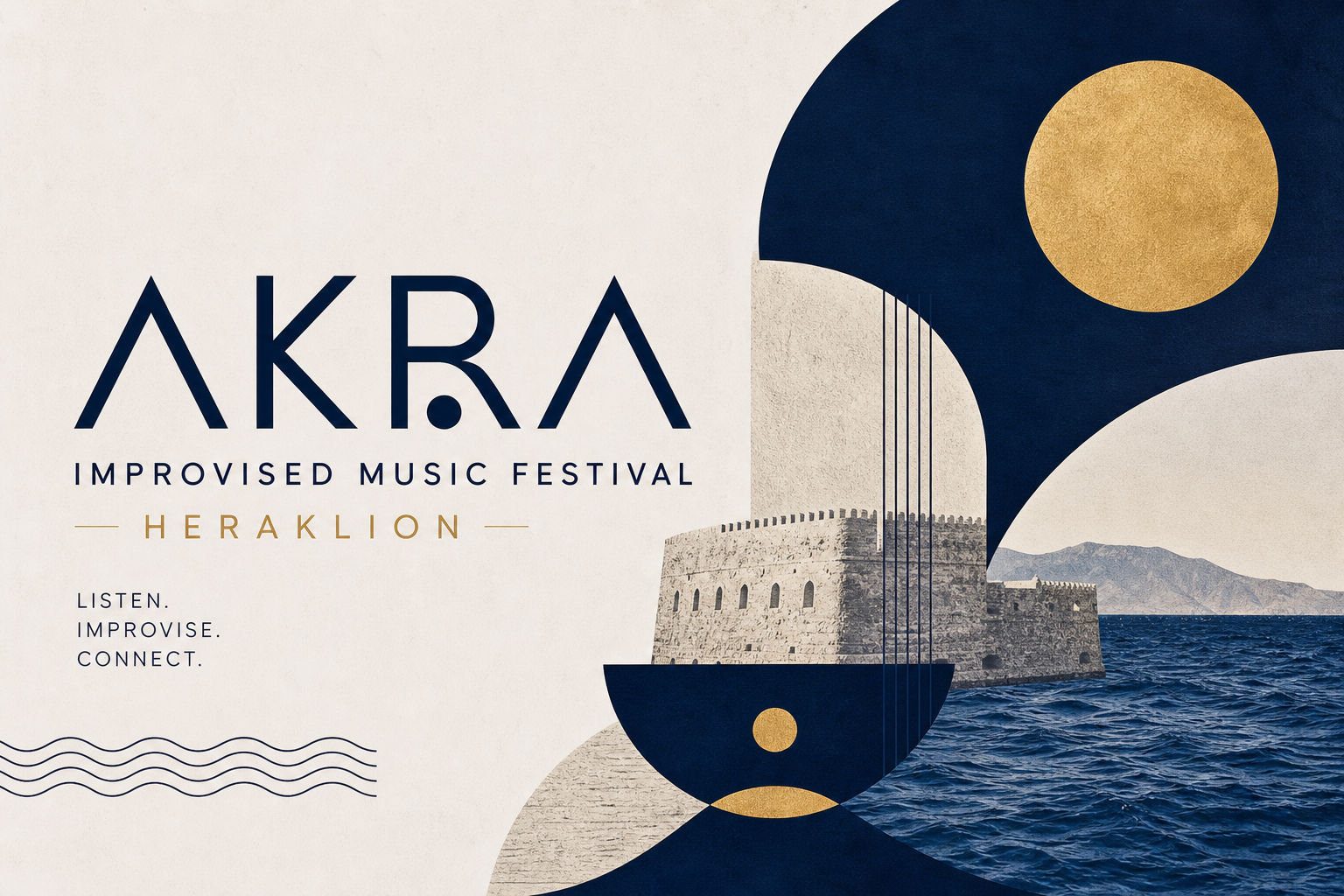
This is what improvised music is, and this is what the AKRA Improvised Music Festival brings to the Venetian Walls of Heraklion on Crete's island on the 4th and 5th of July 2026. Two days of free improvisation, contemporary experimental sound, and the kind of musical risk-taking that most festivals are too commercially cautious to program, staged inside one of the most historically layered architectural environments in the eastern Mediterranean.
The festival's own statement of intent is worth quoting directly: "At the edges where things begin and end, improvisation emerges." For a music festival, that is an unusually honest and precise description of what it is actually doing. AKRA is not trying to entertain you in the conventional sense. It is inviting you to stand at an edge, listen to what musicians do when they have no safety net, and find out whether you are someone who finds that experience thrilling or confusing. Most people who attend once discover they find it thrilling.
What AKRA is: A New Kind of Festival Rooted in an Ancient City
AKRA (Άκρα in Greek) means "edge," "extremity," or "headland" in classical and modern Greek. The word captures both a geographic idea, a promontory jutting into the sea, which is exactly what Heraklion's waterfront does along its harbor entrance, and a conceptual one: the edge of musical convention, the point where the known structure ends and free creation begins.
The festival describes itself as "a two-day festival dedicated to improvised music and contemporary experimental sound, rooted in the Venetian Walls of Heraklion." This language is careful and specific. It is not a jazz festival in the conventional sense, though improvised music and jazz share deep historical roots. It is not an experimental electronic festival, though some of the music played under its umbrella will use electronics. It is a festival specifically organized around the act of improvisation itself, which is the oldest and most fundamental form of musical performance and the one most profoundly suppressed by the conventions of contemporary commercial music culture.
AKRA's institutional home within the cultural life of Heraklion, a city that already sustains one of the richest summer cultural programs in Greece through the Heraklion Summer Arts Festival, positions it as a focused and artistically specific counterpoint to the broader municipal program: a two-day deep dive into one of the most challenging and rewarding forms of live music, using the same extraordinary physical setting that the city's larger festivals have established as a performance landscape.
The Venue: Inside the Venetian Walls of Heraklion
The choice of the Venetian Walls of Heraklion as AKRA's venue is one of the most musically and historically resonant venue decisions of any festival in Greece.
The Venetian Walls (Ενετικά Τείχη Ηρακλείου) are among the most significant examples of Renaissance military engineering anywhere in Europe. Constructed between the 1420s and the 1640s by Venetian military engineers, including the brilliant Michele Sanmichele who also designed the Chania fortifications, the walls encircle the old city with a perimeter of approximately 4 kilometers, rising to heights of up to 29 meters at their most massive bastions. They were designed by the Republic of Venice to defend its most important eastern Mediterranean possession against Ottoman attack, and they succeeded in doing so for an extraordinary period: the Siege of Heraklion from 1648 to 1669 lasted 21 years, the longest siege in recorded history, before the city eventually fell.
Today, these walls stand fully preserved and accessible to the public, integrating into the city's daily life in a way that few historic fortifications anywhere in Europe manage. The venues used for cultural events within and adjacent to the walls include the Vittouri Gate, the Jesus Gate, the Makassi Arch, the Garden Theaters, and the ramparts and low interior squares built into the wall structure. AKRA uses these spaces not as a backdrop but as an acoustic and atmospheric environment: music improvised in a space that has absorbed 600 years of human history sounds different from music improvised in a purpose-built concert hall, and the festival's organizers understand this.
The Instagram post announcing the 2026 edition describes the festival as moving "from stone to sound, from Aspendos to now," referencing the ancient Turkish amphitheater as a meditation on how stone spaces have always been the setting for live musical performance. In Heraklion's Venetian Walls, AKRA has found a specific and extraordinary version of that ancient relationship between architecture and music.
The Music: What Improvised and Experimental Sound Means in Practice
Visitors who are new to improvised music sometimes approach it with uncertainty, unsure of whether they are supposed to understand a framework that their listening experience has not prepared them for. The answer, which every improvised music festival eventually communicates to its new audiences, is that improvised music requires no prior knowledge, no theory background, and no ability to recognize its references. What it requires is a willingness to listen without anticipation.
The global tradition of free improvisation that AKRA draws on includes several distinct tributaries:
Free Jazz, which emerged in the United States in the early 1960s through musicians including Ornette Coleman, Cecil Taylor, Albert Ayler, and Archie Shepp, who collectively challenged the harmonic and rhythmic conventions of bebop and created music that prioritized collective spontaneity over predetermined structure. Coleman's 1960 album Free Jazz: A Collective Improvisation gave the movement its name and established the basic paradigm that AKRA builds on: a group of musicians playing simultaneously without a pre-agreed framework, listening intensely to each other, creating form in real time.
European Free Improvisation, which developed from the late 1960s in the UK, Germany, and the Netherlands through musicians including Derek Bailey, Peter Brötzmann, Han Bennink, and the AMM collective, took the American free jazz impulse and pushed it toward even greater abstraction, removing the last vestiges of blues and swing from the music and creating a purely European improvisational language rooted in contemporary classical music and live electronic experimentation.
Mediterranean and Greek improvised music: Greece has its own deep improvisational tradition rooted in the makam (modal) structures of Byzantine and Ottoman music, the taksim (solo improvisation) tradition of the urban Greek rebetiko genre, and the more recent work of Greek musicians who have engaged with both the European free improvisation tradition and the specific modal language of Greek and Middle Eastern music. In Heraklion specifically, the Cretan lyra tradition itself contains a strong improvisational dimension, as the best lyra players have always understood the instrument as a vehicle for spontaneous melodic invention within traditional modal frameworks.
AKRA 2026 brings all of these tributaries into a two-day program staged on an island that itself represents a historical crossroads between European, Byzantine, Ottoman, and Mediterranean musical cultures. The combination is not coincidental.
The 2026 Edition: What We Know
The AKRA Improvised Music Festival 2026 is confirmed for Saturday, July 4 and Sunday, July 5, 2026, at the Venetian Walls of Heraklion, Crete.
The festival announced its 2026 dates in early January 2026, with an atmospheric promotional image created by artist Maria Prokopaki, whose visual contribution to the festival reflects the same commitment to contemporary artistic craft that the music program embodies. The announcement was described by one of the organizers as a "huge announcement" and "something big is coming to Heraklion this summer," indicating that the 2026 edition is planned at a scale that exceeds previous editions.
The festival's visual identity is built around the concept of edges, specifically the edge between sound and silence, between structure and freedom, and between the ancient stone of Heraklion's walls and the living sound produced within them. These are not abstract artistic concepts for this festival: they describe literally what happens when a musician stands in a space that has been acoustically alive for six centuries and begins to play without a predetermined plan.
The full lineup for AKRA 2026 had not been formally published at the time of writing, with the organizing team indicating that full artist announcements would follow through the festival's official channels. Following @akra.her on Instagram and the AKRA Festival Facebook page provides the most direct route to lineup announcements as they emerge.
AKRA in the Context of Heraklion's July Cultural Season
AKRA 2026 falls on July 4 to 5, which places it at the opening of Heraklion's fullest cultural season.
On the same weekend, Calvi on the Rocks in Corsica would have run (had it not been cancelled in 2026), and several other Mediterranean music festivals are in full swing. Within Crete specifically, the Cretan Diet Festival opens in Rethymno in early July, and the Kornaria Festival in Sitia is entering its main phase. Heraklion's Heraklion Summer Arts Festival is beginning its July program at the Nikos Kazantzakis and Manos Hatzidakis Garden Theatres.
For a visitor to Crete who plans a July visit around the cultural calendar, the first weekend of July in Heraklion offers a remarkable pairing: AKRA's two days of improvised music at the Venetian Walls, followed by the broader Summer Arts Festival's theater and classical music program throughout July, provides a cultural itinerary of exceptional range and depth in a single city.
Why Improvised Music and Why Heraklion
There is a philosophical dimension to AKRA's existence in Heraklion that is worth acknowledging directly.
Crete is the island where European civilization has its deepest roots. The Minoan civilization, which flourished from approximately 3000 BCE to 1100 BCE, predates classical Greece by over a millennium and represented the first high culture on European soil. The Minoans were traders, artists, seafarers, and builders, and they were improvisers in the broadest sense: a civilization that was inventing its own forms, structures, and expressions as it went, without a prior model to copy.
Heraklion, which sits above the ruins of Knossos at a mere 5 kilometers' distance, and whose own layers of history span Byzantine, Arab, Venetian, Ottoman, and modern Greek culture, is a city that has absorbed and processed multiple civilizational influences over four thousand years without losing its specific Cretan identity. Improvisation, in music and in culture, is precisely this process: the ability to absorb influences, respond to the present moment, and produce something new without losing the essential thread of who you are.
AKRA takes this city and this island as its physical and conceptual home for exactly these reasons.
Practical Guide to AKRA 2026
Getting to Heraklion
Heraklion International Airport (HER / Nikos Kazantzakis) receives direct flights from Athens, Thessaloniki, and across Europe during July, including London, Amsterdam, Frankfurt, Paris, and Vienna. The airport is approximately 5 kilometers east of the city center.
Finding the Venue
The Venetian Walls extend around the old city and are easily accessible on foot from most central Heraklion accommodation. The specific performance location within the wall complex for AKRA 2026 will be confirmed through the festival's social media channels as the date approaches.
Tickets and Admission
The festival's 2026 ticketing arrangements had not been formally published at the time of writing. Following the festival's official social media accounts for ticket and admission updates is strongly recommended.
Accommodation
July 4 to 5 is peak Cretan summer season. Heraklion's old city and harbor area accommodations should be booked well in advance.
Combining AKRA with Heraklion's Wider Cultural Season
- AKRA Improvised Music Festival: July 4 to 5, Venetian Walls
- Heraklion Summer Arts Festival: July through mid-September, multiple venues
- Palace of Knossos: daytime visit, 5 km from city center, accessible by city bus
- Heraklion Archaeological Museum: one of the finest collections of Minoan art in the world, walking distance from the Venetian Walls
Verified Information at a Glance
Item: Confirmed details
Event name: AKRA Improvised Music Festival 2026
Event category: Annual two-day festival dedicated to improvised music and contemporary experimental sound
Confirmed dates: Saturday, July 4 and Sunday, July 5, 2026
Venue: Venetian Walls of Heraklion (Ενετικά Τείχη Ηρακλείου), Heraklion, Crete, Greece
Announced: January 2026 by AKRA Festival team
Visual artist for 2026: Maria Prokopaki (festival artwork and visual identity)
Lineup: Full lineup to be announced; follow @akra.her (Instagram) and AKRA Festival (Facebook)
Admission/tickets: To be confirmed; monitor official social media channels
Musical focus: Free improvisation, contemporary experimental sound, jazz-rooted and post-jazz improvisation, electronic experimentation
Festival Instagram: @akra.her
Nearest airport: Heraklion International Airport (HER), approximately 5 km from city center
When the first sound goes up from the Venetian Walls of Heraklion on the evening of July 4th, 2026, and nobody in the room, including the musician playing it, knows exactly where it will go next, AKRA will be doing what improvised music has always done: reminding audiences that the most alive thing music can be is music that has not been decided yet. The walls that have stood for six centuries will hold the sound, the Cretan summer night will be warm, and whatever happens in those two days will not happen the same way again. That is the whole point.