Kornaria Festival 2026 – Sitia, Crete: the Eastern Island's Greatest Summer Cultural Celebration
At the far eastern edge of Crete, where the island narrows to its most rugged and unhurried self, the city of Sitia has been celebrating its greatest poet every summer since 1984. The festival is called Kornaria (Κορνάρεια), and it runs from early July through mid-August 2026 across the restored walls of a Venetian fortress, in village squares that fill with music and the smell of raki, along a harbor promenade where the summer evening lasts until the stars come out over the Libyan Sea.
It is not the most famous festival in Crete. The crowds who pack Heraklion for its summer arts season or fill the garden theatres of Chania often drive straight past Sitia on their way to the beach resorts further east. That, as anyone who has attended Kornaria will tell you, is entirely their loss. For over 40 years, the Municipality of Sitia has been quietly running one of the richest and most culturally specific summer festivals in the eastern Mediterranean, and 2026 marks another edition of this genuinely irreplaceable Cretan celebration.
The man behind the name: Vitsentzos Kornaros and the Erotokritos
The Kornaria Festival does not take its name from a place or a political institution. It takes its name from a person: Vitsentzos Kornaros (also written Vincenzo Cornaro), the 17th-century Cretan poet who was born in the Sitia region and who gave the Greek world its most beloved epic poem.
The Erotokritos is a romantic verse narrative of extraordinary length and beauty, running to approximately 10,000 lines of fifteen-syllable rhyming verse in the Cretan Greek dialect. Written between 1600 and 1650 (scholars debate the precise dates), the poem tells the story of Erotokritos, a young man of modest birth, and Aretousa, the daughter of the King of Athens, whose love for each other must survive separation, exile, and war before it can be fulfilled. The poem draws on ancient Greek, Byzantine, and Italian Renaissance literary sources and weaves them into something that is completely and distinctly Cretan in its emotional register and its language.
The Erotokritos was not merely read. It was sung. In the tradition of oral Cretan culture, the poem was transmitted through musical performance, and the practice of singing Erotokritos verses to the accompaniment of the Cretan lyra has never died out. Today, any Cretan who has grown up in a traditional family will know verses by heart, and at any proper Cretan panegyri (village festival), passages from the Erotokritos are still sung in the same modal musical style that has been used for four centuries. Kornaria, then, is not simply a cultural program with a poet's name attached to it. It is a festival that honors the living inheritance of the greatest work of Cretan literature, and every concert, every theatrical performance, every village panegyri held under its umbrella is a continuation of that inheritance.
The history of Kornaria: 40+ years of cultural dedication in eastern Crete
The Kornaria Festival was established in 1984 by the Municipality of Sitia, with the explicit purpose of honoring Vitsentzos Kornaros and promoting the cultural development of Sitia and the broader eastern Crete region. The founding vision was stated clearly in the organizing documents: to encourage the cultural life of Sitia's community and to give foreign visitors a direct experience of the customs and traditions of eastern Crete.
More than four decades later, both objectives remain firmly in the program. Kornaria has grown from a modest municipal program into what Tovima, one of Greece's most respected news organizations, describes as part of a broader "cultural revival" in Sitia that is "driving tourists to Crete's Sitia," with the municipality's cultural programming recognized as a significant factor in attracting visitors who might otherwise pass through eastern Crete without stopping.
The 2025 edition, like those before it, covered a period stretching from late June through the August high season, with dozens of events spread across the city of Sitia and the villages of the wider municipality. The 2026 edition follows the same established annual framework, with the full program to be announced by the Municipality of Sitia in the weeks preceding July.
The primary venues: Kazarma Fortress and the Polykentro
The Venetian Fortress Kazarma: a stage 500 years in the making
The center of the Kornaria Festival's evening program is the Venetian Fortress Kazarma (Ενετικό Φρούριο Καζάρμα), one of the most atmospheric open-air performance venues in all of Crete.
Kazarma (the name derives from the Italian casa di arma, meaning house of arms) was built by the Venetians on the elevated ground above Sitia's harbor, and the current restored structure represents the final chapter of a series of fortifications that have occupied this site since the Byzantine period. An earthquake in 1508 devastated Sitia so severely that the Venetians briefly considered abandoning the city entirely; the fortress was eventually rebuilt and served throughout the later Venetian period as the city's primary military installation before falling into Ottoman hands in 1651.
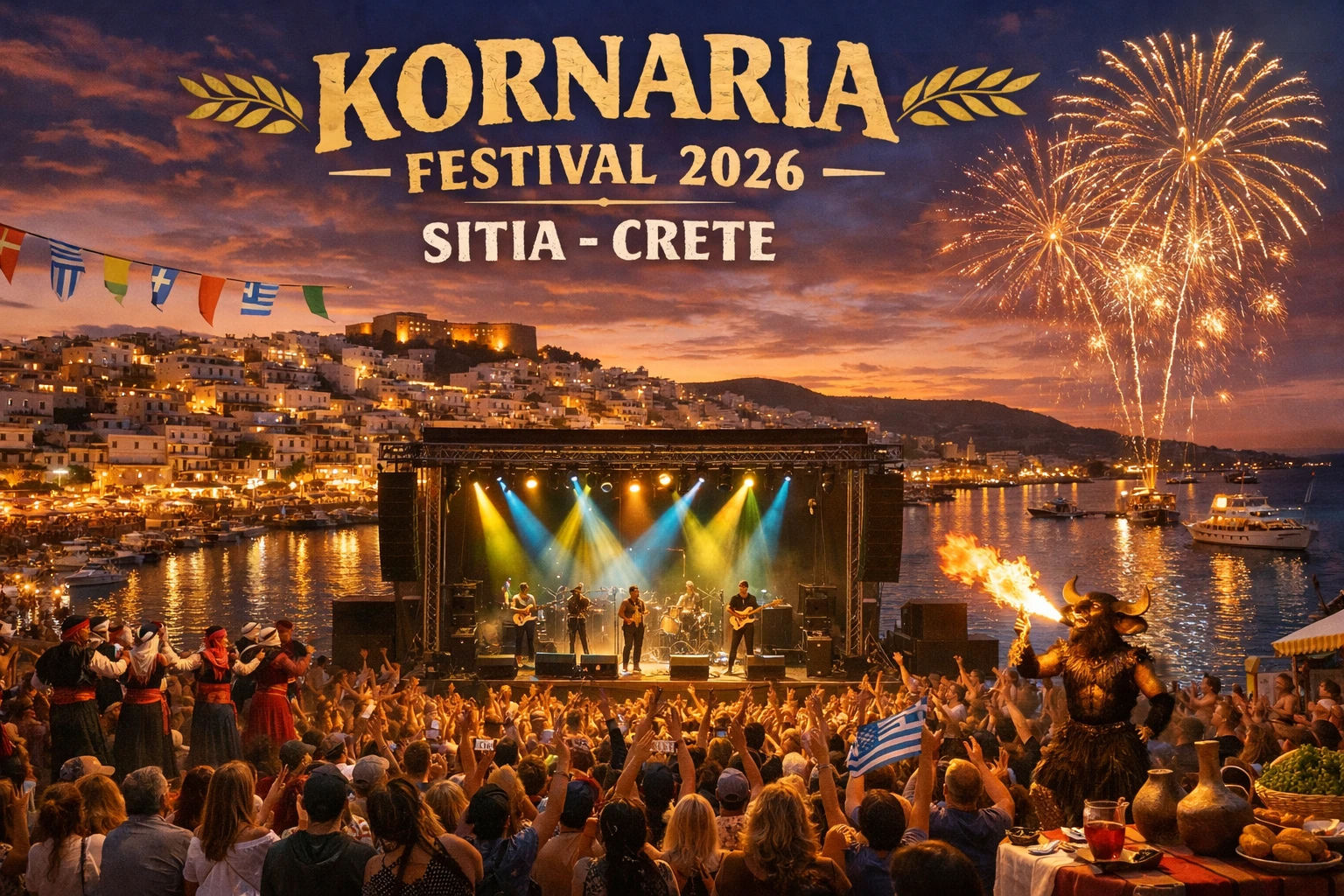
Today, the fully restored fortress hosts the Kornaria Festival's main concerts, theatrical productions, and dance performances from an outdoor stage set within the walls. The view from the fortress across Sitia's harbor and the Gulf of Sitia to the open sea is described by TheNewCrete as "impressive, especially at night," and it is hard to argue with that assessment: watching a performance of Cretan music or a theatrical production at Kazarma in July, with the fortress walls lit and the harbor lights reflecting on the water below, is the kind of experience that keeps visitors returning to eastern Crete year after year.
The Polykentro: indoor culture at the heart of the city
The Polykentro (Πολύκεντρο), the Municipality of Sitia's multi-purpose cultural center in the city center, serves as the indoor complement to the Kazarma's open-air program. The Polykentro hosts art and photography exhibitions, theatrical productions that require an indoor setting, lectures, educational events, and the more intimate musical performances that the open fortress stage cannot accommodate.
Together, Kazarma and the Polykentro give Kornaria a two-venue structure that allows the festival to program simultaneously at different scales and for different audiences, running an outdoor concert at the fortress and an art exhibition or lecture at the Polykentro on the same evening.
What Kornaria includes: the full program framework
The Kornaria Festival is one of the most programmatically diverse cultural events in eastern Crete, covering nearly every form of live cultural expression. Based on the confirmed annual framework, the 2026 edition will include:
Music and dance concerts
Live concerts at the Kazarma Fortress form the heart of the evening program throughout July and into August. The program typically spans:
- Cretan traditional music: lyra, laouto, and Cretan song, performed by some of the finest musicians from the Sitia region and eastern Crete
- Greek popular music (laïká): the genre that has defined mainstream Greek musical culture since the mid-20th century
- Contemporary Greek music: singer-songwriters, rock, and fusion acts who bring the festival's musical range into the present
- Traditional dance performances: regional dance groups performing the distinctive footwork and costumes of eastern Cretan dance traditions
Theatre and performing arts
Theatrical productions, including translations of classical works and contemporary Greek plays, are staged at Kazarma and the Polykentro throughout the summer season. Recent editions have included productions by professional Greek companies, youth theatre groups, and community theatre organisations from within the Sitia municipality.
Art and photography exhibitions
The Polykentro hosts rotating exhibitions of fine art and photography throughout the festival period, presenting both established Greek artists and emerging local talent from the eastern Crete region. The arts program gives Kornaria a visual dimension that many music-focused festivals lack, and the exhibitions are open to all visitors free of charge.
Lectures and educational events
In keeping with the festival's founding mission of honoring Vitsentzos Kornaros and the literary heritage of eastern Crete, the Kornaria program includes lectures, symposia, and educational presentations on Cretan history, literature, language, and culture. These events draw academics, writers, and cultural figures from across Greece and are often conducted in a public forum format open to all attendees.
Sports events: the Kornarios road race and beach volleyball
The Kornaria Festival extends beyond the cultural arts into sport, organizing the "Kornarios" road race, a competitive athletics event that draws participants from across Greece, and a beach volleyball competition held on Sitia's beach. The combination of competitive sport and cultural programming gives Kornaria a breadth that few other island festivals in Greece can match.
The village dimension: Kazanemata, Klidonas, and the panegyria
One of the most distinctive aspects of Kornaria is the way it extends far beyond the city of Sitia into the villages of the wider municipality, giving the festival a geographic range that connects eastern Crete's urban and rural communities.
Kazanemata: the raki feast
Kazanemata (Καζανέματα) are the traditional communal raki-distillation feasts that take place in eastern Crete every autumn, when the grape-pressing season ends and the distillation of tsikoudia (Cretan spirit, similar to Italian grappa) fills the mountain villages with the smell of heated copper stills and the sound of lyra music. Within the Kornaria framework, Kazanemata events are organized in the villages of the Sitia municipality, allowing summer visitors to experience a tradition normally associated with the September to November harvest season at a time when the weather is reliably warm and Crete is fully accessible.
The Tovima cultural report from 2024 describes how during these events visitors can learn about the "kazanema" tsikoudia distillation process, cheese-making practices, the use of local herbs, the legendary Cretan knives, the famous "stivania" boots, Cretan lyra making, and wooden shepherd's canes, representing a comprehensive immersion in the material culture of eastern Crete.
Klidonas: the midsummer fire ritual
Klidonas (Κλήδονας) is a traditional Greek midsummer festival associated with the feast of Saint John (June 24), in which young women place personal objects in water jars and immerse them overnight, then divine their romantic fortunes from the water the following morning. The tradition is accompanied by bonfires that young men and women jump over for luck, singing specific Klidonas songs, and communal celebration. Within the Kornaria framework, Klidonas events are organized in the villages of the Sitia municipality during the third week of June, just before the main festival opens in July.
The village panegyria
The village festivals (panegyria, singular: panegyri) organized under the Kornaria umbrella throughout July and August represent perhaps the most authentically Cretan component of the entire festival. Based on the confirmed 2025 Kornaria village program (published by CretaFocus in June 2025), the panegyria typically take place on religious saints' days across the villages of the Sitia municipality, with traditional Cretan bands performing from 9:00 pm or 9:30 pm onward.
Confirmed ticket pricing for village panegyria events: €15, which includes a full traditional Cretan menu served communally at tables set up in the village square or school courtyard. This combination of traditional food, live Cretan music, communal seating, and the specific setting of a small eastern Cretan village on a warm summer evening is one of the most honest and irreplaceable cultural experiences that Crete offers any visitor.
Sitia and eastern Crete: the wider destination
Sitia itself
Sitia (population approximately 9,000) is the administrative center of the Lasithi Prefecture's eastern section and one of the most relaxed and genuinely habitual cities on the island. Its harbor promenade, the long seafront lined with tavernas and cafes, is the social heart of city life throughout the summer, and the Sitia Archaeological Museum holds a collection of Minoan artifacts from the eastern Crete region that is second in Crete only to the Heraklion Archaeological Museum.
The city is also known for producing some of the finest olive oil in the world: the PDO Sitia designation covers a specific variety of Cretan olive oil from the region's ancient terraced groves, and the annual olive harvest in October is itself an event that draws visitors.
The wider eastern Crete landscape
Within a 30 to 60-kilometer radius of Sitia, visitors attending Kornaria can access:
- Vai Beach: the only natural palm forest in Europe, a beach bordered by thousands of wild date palms, approximately 25 kilometers northeast of Sitia
- Kato Zakros: the site of a Minoan palace on the eastern coast, accessible by sea or through the spectacular Valley of the Dead gorge hike
- Toplou Monastery: one of the most important and richly decorated monasteries in Crete, approximately 18 kilometers from Sitia, founded in the 14th century
- Mochlos: a tiny fishing village and archaeological site on Sitia's coast, where Minoan tombs carved into the cliffsides overlook an offshore islet that was once connected to the mainland
Practical information for Kornaria Festival 2026
Getting to Sitia
Sitia Airport (JSH) operates seasonal domestic flights from Athens during the summer months, making direct access to eastern Crete possible without driving the full length of the island. Alternatively, Heraklion International Airport (HER) is the main entry point, from which Sitia is approximately 2 hours 45 minutes by road via the Cretan north coast highway through Agios Nikolaos and Ierapetra.
KTEL (intercity bus) services connect Heraklion to Sitia multiple times daily throughout the summer season, making car-free access to Kornaria entirely practical.
Accommodation in Sitia
Sitia offers accommodation ranging from small family-run hotels on the harbor promenade to self-catering apartments and villas in the hills above the city. July and August are peak season; booking 6 to 8 weeks in advance is strongly recommended, particularly for Kazarma concert evenings when demand increases.
Ticket and event information
- Village panegyria: €15 per person (includes full traditional meal and live Cretan music)
- Main Kazarma concerts: specific 2026 pricing to be announced; many performances are free or at low cost consistent with the municipality's accessibility philosophy
- Art exhibitions and lectures at the Polykentro: free to attend
- Official information: Municipality of Sitia website (sitia.gr) and Visit Sitia (visitsitia.gr)
Verified Information at a glance
Event name: Kornaria Festival 2026 (Κορνάρεια 2026), Sitia, Crete
Event category: Annual multi-arts summer cultural festival: music, theatre, dance, exhibitions, sports, village panegyria
Confirmed dates: Early July to mid-August 2026 (pre-festival events including Klidonas from late June; full program to be announced by Municipality of Sitia)
Founded: 1984 (the 2026 edition marks 42 years of continuous programming)
Primary venues: Venetian Fortress Kazarma (outdoor) and Polykentro Municipal Cultural Centre (indoor), Sitia, Crete
Village events: Kazanemata (raki feasts), Klidonas (late June), and village panegyria across Sitia municipality
Named in honor of: Vitsentzos (Vincenzo) Kornaros, Cretan poet, author of the Erotokritos (c.1600 to 1650)
Village panegyria ticket price: €15 per person (includes full traditional Cretan menu)
Free events: Art exhibitions, photography shows, lectures at Polykentro; many outdoor performances
Sports events: "Kornarios" road race (pan-Hellenic participants); beach volleyball competition
Organizer: Municipality of Sitia
Official websites: visitsitia.gr / sitia.gr
Nearest airports: Sitia Airport (JSH) (seasonal); Heraklion International Airport (HER) (approx. 2h45m by road)
When the lyra player takes the stage at Kazarma as the summer night settles over the Gulf of Sitia and the fortress walls glow in the warm light, and the music that comes out is the same music that Vitsentzos Kornaros heard in these eastern Cretan hills four hundred years ago before he sat down