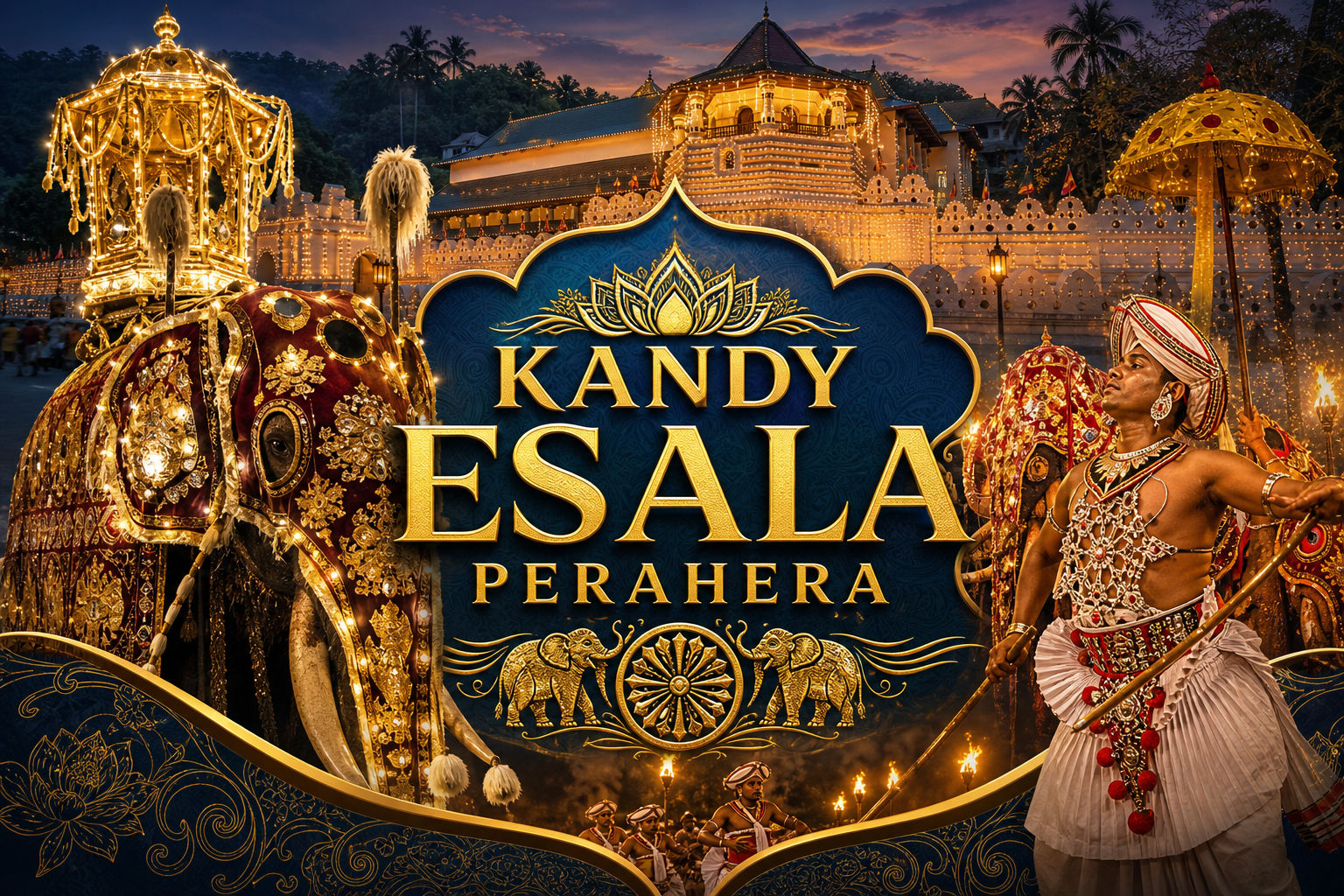
There is no night procession on earth quite like it. For ten consecutive nights in the ancient royal city of Kandy, over 70 magnificently decorated elephants, hundreds of Kandyan drummers and dancers, fire acrobats, whip crackers, flag bearers, and tens of thousands of devotees pour through the lamplit streets in a pageant of devotion that has been performed without interruption for over 2,000 years. The Kandy Esala Perahera 2026 runs from Tuesday August 18 to Friday August 28, 2026 — officially confirmed by the Sri Dalada Maligawa (Temple of the Sacred Tooth Relic) — making it the most precisely confirmed major festival in the entire Sri Lanka calendar and one of the most extraordinary public spectacles in Asia.
"The Kandy Esala Perahera is the most precisely confirmed major festival in the entire Sri Lanka calendar and one of the most extraordinary public spectacles in Asia."
The 2026 Confirmed Schedule
Every Night, August 18 to 28
The official 2026 schedule published by the Sri Dalada Maligawa and confirmed across all official sources is:
NightEventDate 11st Kumbal PeraheraTuesday August 18, 2026 22nd Kumbal PeraheraWednesday August 19, 2026 33rd Kumbal PeraheraThursday August 20, 2026 44th Kumbal PeraheraFriday August 21, 2026 55th Kumbal PeraheraSaturday August 22, 2026 61st Randoli PeraheraSunday August 23, 2026 72nd Randoli PeraheraMonday August 24, 2026 83rd Randoli PeraheraTuesday August 25, 2026 94th Randoli PeraheraWednesday August 26, 2026 10Final Randoli Perahera (Grand Randoli Procession)Thursday August 27, 2026 DayDahawal Perahera (Day Procession)Friday August 28, 2026 The festival is anchored to the Nikini Full Moon Poya Day — Saturday August 27, 2026 — which falls on the night of the Final Grand Randoli Perahera, giving the most spectacular night of the festival the additional sacred significance of the full moon.
What Is the Kandy Esala Perahera
A Tradition of Devotion and Protection
The Esala Perahera is the grand annual procession of the Sri Dalada Maligawa — the Temple of the Sacred Tooth Relic of the Lord Buddha, located on the banks of the Kandy Lake in the heart of the ancient royal capital. The relic — the left upper canine tooth of the Buddha, brought to Sri Lanka from India in the 4th century CE — is the most sacred Buddhist object in Sri Lanka and one of the most revered in the entire Buddhist world. The Perahera is the public celebration of that relic's divine protection over the island, a tradition that the Kandyan kings instituted and that has continued through colonial occupation, independence, and the modern era without a single year's interruption.
The month of Esala (July or August in the Sinhala lunar calendar) is the month that the Buddhist tradition identifies as when the Buddha gave his first sermon after attaining enlightenment — the teaching known as the Dhammacakkappavattana Sutta, the "Turning of the Wheel of the Dharma" — making it the most auspicious month in the entire Buddhist calendar and the natural context for the most important Buddhist festival in Sri Lanka.
The Procession Elements
What You Will See
The Perahera is organized as a joint procession of five institutions — the Sri Dalada Maligawa (Temple of the Tooth) and the four Devales (shrines to the guardian deities of Sri Lanka: Natha, Vishnu, Kataragama, and Pattini) — each with their own procession element that merges into the combined nightly spectacle:
The Sacred Casket and the Maligawa Tusker
The Procession's Heart
The absolute center and most sacred element of the entire procession is the golden casket containing a replica of the Sacred Tooth Relic (the actual relic remains protected within the temple), carried on the back of the Maligawa Tusker — the largest and most elaborately decorated elephant in the entire procession. The Maligawa Tusker is dressed in spectacular golden ceremonial cloth embroidered with traditional designs, its head and tusks decorated with golden ornamental covers, and its footpath is lined with white cloth that is unrolled ahead of the elephant and rolled up behind to ensure that the sacred casket never passes over ground that has been touched by human feet.
"The sight of the Maligawa Tusker moving through the firelit streets of Kandy in full ceremonial regalia, carrying the golden casket under its ornamental canopy, is the defining image of Sri Lanka's cultural identity."
The sight of the Maligawa Tusker moving through the firelit streets of Kandy in full ceremonial regalia, carrying the golden casket under its ornamental canopy, is the defining image of Sri Lanka's cultural identity — the single most photographed and most cinematically powerful moment in the entire festival.
Over 70 Decorated Elephants
A Grand Display of Ceremonial Grandeur
The Perahera fields over 70 elephants in each night's procession, each one decorated with ceremonial cloth, electric light displays, and ornamental headpieces in the distinctive Kandyan style. No other festival procession anywhere in the world deploys decorated elephants at this scale, and the combination of the animals' sheer physical scale, their ceremonial regalia, and the firelit night setting creates an effect of ceremonial grandeur that no other festival format can replicate.
Kandyan Dancers
The Heartbeat of the Procession
Kandyan dancers — performers in the highly codified classical dance tradition of the Kandyan kingdom, whose costume, movement vocabulary, and drum accompaniment are among the most precisely defined and most visually distinctive performance forms in all of South Asia — perform throughout the procession in their distinctive white and silver costumes with their towering headdresses. The Kandyan dance tradition encompasses multiple sub-styles including:
- Ves dance — the most sacred and most technically demanding form, performed only by male dancers of hereditary Kandyan dance families in the full ves costume whose silver breast-plate and elaborate headdress take up to an hour to assemble
- Naiyandi dance — a more accessible style performed in front of the elephant procession
- Udekki dance — performed with the small hand drum (udekki) that produces a distinctive rhythmic pattern woven into the broader percussion ensemble
The Drummers
The Sonic Force Driving the Perahera
The percussion ensemble that drives the Perahera forward is one of the most powerful and most physically overwhelming sonic experiences in world festival culture. The Kandyan drum tradition uses three primary instruments:
- Gata Beraya: The traditional Kandyan barrel drum, its deep resonance providing the fundamental pulse of the procession
- Davul: A larger double-headed drum with a more penetrating, more martial sound
- Tammattama: A paired kettle-drum played with curved sticks, its higher pitch providing rhythmic counterpoint to the lower drums
Hundreds of drummers performing simultaneously as the procession moves through the enclosed streets of Kandy creates a sound wall of extraordinary intensity — a collective percussion performance that visitors consistently describe as one of the most physically affecting musical experiences of their lives.
Fire Acrobats and Torch Bearers
Illuminating the Night
Fire dancers and torch bearers light the procession route through the night streets of Kandy, their performances with fire — spinning fire wheels, fire juggling, and the dramatic torch sequences that illuminate the performers and the elephants from below — giving the Perahera its defining visual quality of warm firelight against the darkness. The combination of firelight, the decorated elephants, the white-costumed dancers, and the drumming creates the most cinematically spectacular procession in all of Asia.
Whip Crackers
Announcing the Procession
Whip crackers precede each section of the procession, their synchronized cracking producing a sharp percussive counterpoint to the drums and announcing the arrival of each procession element to the watching crowd — a function that has its origins in the ceremonial practice of the Kandyan court, where whip crackers preceded royal processions to command attention and clear the way.
The Two Phases: Kumbal and Randoli
Building to the Grand Final
The Perahera's ten nights divide into two distinct phases that build in scale and intensity as the festival progresses toward the Grand Final:
The Kumbal Perahera — Nights 1 to 5 (August 18 to 22)
The Modest Beginning
The Kumbal Perahera is the smaller, more modest phase of the procession — the word "kumbal" referring to the type of ornamental cloth used in this phase's elephant decorations. Nights 1 to 5 (August 18 to 22) run progressively longer procession routes with increasing numbers of participants and elephants as the festival builds in scale. For visitors who can only attend a single Kumbal night, Night 5 (Saturday August 22) is the most fully developed of the five and serves as the transition into the Randoli phase.
"The Kumbal nights also serve as the practical option for visitors whose travel budget does not stretch to the premium pricing of the Randoli nights."
The Kumbal nights also serve as the practical option for visitors whose travel budget does not stretch to the premium pricing of the Randoli nights — the procession quality is genuinely impressive on every Kumbal night and the crowd density is significantly lower than the Randoli phase, making for more comfortable viewing and better photography.
Ticket prices for viewing galleries: USD $80 per person per Kumbal night at the Queens Hotel Viewing Gallery.
The Randoli Perahera — Nights 6 to 10 (August 23 to 27)
The Grand Escalation
The Randoli Perahera is the grand escalated phase of the festival, where the procession grows to its full magnificent scale and the sacred Randoli (golden palanquins representing the consorts of the guardian deities) are added to the procession elements. Nights 6 through 9 (August 23 to 26) build progressively toward the supreme climax:
Ticket prices escalate across the Randoli nights:
- 1st Randoli (August 23): USD $95
- 2nd Randoli (August 24): USD $95
- 3rd Randoli (August 25): USD $90
- 4th Randoli (August 26): USD $100
- Final Randoli (August 27): USD $110
The Final Grand Randoli Perahera — Thursday August 27, 2026
The Spectacle of a Lifetime
The Final Randoli Perahera on the full moon night of August 27 is the single most spectacular night of the entire festival and one of the most extraordinary public spectacles in Asia:
- The longest and most elaborate procession of the entire ten nights, with the maximum number of elephants, dancers, drummers, and performers
- The full moon illuminating the Kandy streets alongside the firelight and the electric decorations of the elephants
- The complete convergence of all five procession elements — the Dalada Maligawa and the four Devale processions — in their grandest combined format
- The streets of Kandy filled with hundreds of thousands of spectators from across Sri Lanka and the world
Arriving for the Final Randoli night and securing viewing gallery seats well in advance is the single most important logistical task for any visitor planning a Perahera trip.
Diya Kapeema: The Water Cutting Ceremony (August 27)
Closing with Sacred Renewal
Following the Final Grand Randoli Procession on the night of August 27, the Diya Kapeema — the Water Cutting Ceremony — takes place at the Mahaweli River at Getambe, a short distance from the Kandy city center. This purification ritual, in which a ceremonially designated individual cuts the surface of the river at midnight and draws the water into a vessel for the ensuing year's ritual use at the temple, closes the ten nights of procession with an act of sacred renewal that returns the festival's energy to the natural world.
The Diya Kapeema is a moving and more intimate ceremony than the procession's public grandeur, and visitors who follow the procession to the river witness the transition from the festival's spectacular public dimension to its private ritual conclusion.
Dahawal Perahera: The Day Procession (August 28)
The Festival's Ceremonial Conclusion
The Dahawal Perahera on Friday August 28 is the final ceremonial element of the entire festival — a daytime procession that formally concludes the Perahera cycle and returns the sacred casket to the temple in the daylight that contrasts with the ten nights of firelit grandeur. The Day Procession is smaller and less spectacular than the Randoli nights but has its own ceremonial completeness, and visitors who extend their Kandy stay through August 28 witness the full cycle of the festival from opening Kumbal night to daytime closing procession.
The Pre-Perahera Devale Ceremonies
The Ritual Foundation
The public ten-night Perahera is preceded by five nights of Devale Peraheras within the precincts of the four guardian deity shrines, typically beginning around August 13 to 17. These preliminary ceremonies are less publicly visible than the main Perahera but are the ritual foundation on which the ten public nights rest — the priest of each Devale taking the ceremonial pole each evening, accompanied by the musicians and flag bearers of their respective shrine, in the enclosed inner ceremonies that activate the sacred power that the public procession then carries through the streets of Kandy.
Kandy: The City and the Temple
The Historic Heart of Sri Lanka
Kandy is Sri Lanka's second city and the last royal capital of the Kandyan Kingdom, which maintained its independence from European colonial powers until 1815 — longer than any other kingdom in Sri Lanka. The city sits at an elevation of approximately 500 meters in the central Hill Country, surrounded by forested hills and centered on the Kandy Lake, whose still surface reflects the Temple of the Tooth on its northern shore in the most composed and most frequently reproduced image in Sri Lanka's tourism landscape.
Sri Dalada Maligawa — Temple of the Sacred Tooth Relic
The Holiest Buddhist Site in Sri Lanka
The Sri Dalada Maligawa is the holiest Buddhist site in Sri Lanka and one of the most important in the world. The complex on the northern shore of Kandy Lake comprises:
- The Pattirippuwa (Octagon) — the distinctive octagonal tower added in the 19th century whose silhouette is the most immediately recognizable element of the temple skyline
- The Vadahitina Maligawa — the inner shrine housing the multi-layered golden caskets within which the Sacred Tooth Relic rests
- The Alut Maligawa (New Shrine Room) — a contemporary addition housing the golden replica casket used in the Perahera procession
- The Audience Hall — a beautifully crafted wooden pavilion with intricately carved wooden columns in the Kandyan architectural tradition
- The Kandy Lake foreshore — the ceremonial approach to the temple from the lakeside, where morning puja (prayer) creates a daily fragrance of incense and frangipani blossoms
Three daily puja sessions — dawn (6:00 AM), midday (11:30 AM), and evening (6:30 PM) — open the inner shrine to devotees for darshan of the sacred caskets, and the evening puja in particular, with its drumming, singing, and the fragrant smoke of incense drifting through the gilded interior, is one of the most beautiful daily religious rituals available to a visitor in all of South Asia.
The Kandy Cultural Landscape
A UNESCO World Heritage Site
Kandy was inscribed as a UNESCO World Heritage Site in 1988 as the "Sacred City of Kandy" — specifically recognizing the Dalada Maligawa and the surrounding cultural landscape of the last Kandyan royal capital. Within easy reach of the temple:
- The Royal Botanical Gardens at Peradeniya — 15 minutes west of Kandy, one of the finest botanical gardens in Asia with over 4,000 labeled plant species and the most extraordinary collection of palms in the Indian Ocean region
- Pinnawala Elephant Orphanage — 45 minutes from Kandy, where rescued wild elephants are cared for in a sanctuary setting that gives visitors the closest and most intimate elephant encounter available in Sri Lanka
- Embekke Devale and Lankathilaka Temple — beautifully carved wooden and stone temple complexes in the rice paddy landscape southwest of Kandy, among the finest examples of Kandyan-era craft in Sri Lanka
- The Kandy Garrison Cemetery — the British colonial cemetery on the edge of the town whose quiet paths and old-growth trees provide a contemplative contrast to the Perahera's sensory intensity
Viewing the Perahera
Gallery Tickets and Free Standing
The Perahera can be watched from two positions — purchased gallery seats or free roadside standing — each with its own character:
Gallery Seats — Official Booking
Secure Your Spot
Official gallery seats are available through peraheratickets.com — the official ticket booking site recommended by Sri Lankan banks:
- Venue: Queens Hotel Viewing Gallery and Queens Hotel Corridor — the most elevated and most protected viewing positions along the procession route, directly on the main processional street
- Pricing: USD $80 per person (Kumbal nights 1 to 5), USD $90 to $110 per person (Randoli nights 6 to 10)
- Format: Elevated tiered gallery seating with clear sightlines above the street-level crowd
- Includes: Secured seat along the full procession route
- Book immediately — gallery seats for the Final Randoli (August 27) sell out months in advance
Additional gallery options are available through Viator, GetYourGuide, and directly through Kandy's major hotels including the Queens Hotel, Mahaweli Reach Hotel, and Earl's Regency whose positions along the processional route give their guests direct gallery access from hotel balconies and event spaces.
Free Roadside Viewing
Experience the Procession Up Close
The Perahera procession is a public event and the Kandy streets along the processional route are accessible to all spectators without payment. Roadside standing requires:
- Arriving 2 to 3 hours early to secure a front-row position — the crowds for Randoli nights and especially the Final Randoli fill the processional streets hours before the procession begins
- A clear sightline strategy — the elevated gallery seats have an obvious viewing advantage over ground level, but a front-row street position delivers the most immersive and most physically immediate experience of the procession passing just meters away
For photographers, a combination strategy — gallery seats for wide-angle processional shots and a street position for close-up detail photography — requires coordination with the official viewing regulations but is the most photographically productive approach.
Getting to Kandy for the Esala Perahera 2026
The Journey to an Iconic Festival
By Train from Colombo — Most Scenic
A Journey Through the Hill Country
The Colombo to Kandy train on the Kandy Line is one of the most scenic rail journeys in Asia and the most enjoyable way to reach Kandy from the capital:
- Duration: Approximately 2 hours 30 minutes to 3 hours from Colombo Fort to Kandy
- Service options: Intercity Express (reserved seating, most comfortable), regular services (unreserved seating)
- Scenery: The train climbs from Colombo's coastal plain through the rubber and tea estate landscape of the Hill Country foothills, crossing viaducts and passing through tunnels as the elevation increases toward Kandy — a journey of escalating natural beauty
- Book reserved seats for Perahera period travel well in advance at eticket.railway.gov.lk
By Road from Colombo
The Direct Route
The E01 expressway and A1 highway connect Colombo to Kandy in approximately 2 to 3 hours by car or bus depending on traffic. During the Perahera period, traffic approaching Kandy on Perahera nights is extremely heavy — allow additional time if driving, or use the train for the most reliable and most relaxed arrival.
From Other Sri Lanka Destinations
Connecting from Across the Island
- From Sigiriya / Dambulla (Cultural Triangle): Approximately 2 to 3 hours by road south through the Sri Lankan heartland
- From Nuwara Eliya (Hill Country): Approximately 2 hours by road through the tea country
- From the south coast beaches (Mirissa, Unawatuna, Galle): Approximately 3 to 4 hours by road
International Arrival
Gateway to Sri Lanka
Bandaranaike International Airport (CMB) in Colombo is Sri Lanka's primary international gateway:
- London Heathrow: SriLankan Airlines direct, approximately 10 hours 30 minutes
- Dubai: Emirates and SriLankan Airlines, approximately 4 hours
- Singapore: SriLankan Airlines and Singapore Airlines, approximately 3 hours 30 minutes
- Kuala Lumpur: AirAsia and Malaysia Airlines, approximately 4 hours
- Delhi / Mumbai: SriLankan Airlines and Air India, approximately 2 to 3 hours
- Doha / Abu Dhabi: Qatar Airways and Etihad
Where to Stay in Kandy During the Perahera
Accommodations for Every Traveler
On the Processional Route
Prime Locations
- Queens Hotel: The most historic and most strategically positioned hotel in Kandy, directly on the processional route adjacent to the Temple of the Tooth. The official gallery viewing venue for the Perahera — staying here means your hotel balcony IS the gallery. The most coveted Perahera accommodation in Sri Lanka
- The Kandy House: A boutique colonial heritage property a short distance from the processional route, offering the most atmospherically distinctive accommodation in Kandy in a beautifully restored Kandyan manor house
Hill View Properties
Scenic Retreats
- Mahaweli Reach Hotel: A larger, more modern property on the banks of the Mahaweli River with Perahera viewing gallery access and comfortable facilities
- Earl's Regency: A hillside resort above Kandy with panoramic views over the city and Perahera gallery access arrangements
Budget and Mid-Range
Affordable Options
- McLeod Inn and Kandy guesthouses: The well-established guesthouse network around the Kandy Lake foreshore provides the most affordable Perahera accommodation for independent travelers, with the trade-off of smaller rooms and simpler facilities in exchange for proximity and price
The Perahera and the Nallur Festival
The Perfect Sri Lanka Cultural Itinerary
The Kandy Esala Perahera (August 18 to 28) and the Nallur Kandaswamy Kovil Festival (August 16 to September 12) overlap in the most convenient possible way for a visitor combining both:
- Arrive Kandy August 18 to 22 — attend the Kumbal Perahera nights while Jaffna's Nallur Festival opens
- Return Kandy August 23 to 27 — attend the Randoli Perahera nights building to the Grand Final
- Travel to Jaffna August 28 to 29 — fly from Colombo to Jaffna (1 hour) immediately after the Dahawal Day Procession
- Jaffna August 28 to September 12 — experience the final two weeks of the Nallur Festival including the Grand Chariot Festival on September 11
This combined itinerary of approximately 3.5 weeks in Sri Lanka delivers the island's greatest Buddhist festival and its greatest Hindu festival in consecutive attendance — the most culturally complete Sri Lanka trip available in the 2026 calendar, and the most compelling dual-religion, dual-community, dual-north-south content pairing in the entire IsleRush Sri Lanka editorial universe.
Practical Tips for the Kandy Esala Perahera 2026
Maximize Your Experience
- Book gallery tickets immediately at peraheratickets.com — the Final Randoli (August 27) sells out months in advance
- The Queens Hotel viewing gallery is the single most strategically positioned seat for the procession — if you can only book one gallery night, book it here for the Final Randoli
- Arrive in Kandy at least 2 days before your first Perahera night to settle in, visit the temple during daily puja, and experience Kandy before the city's Perahera crowds reach their peak
- Evening puja at the Dalada Maligawa (6:30 PM daily) is one of the most beautiful religious experiences in Sri Lanka and should be attended on the days surrounding the Perahera
- The Full Moon night (August 27) is simultaneously the Final Grand Randoli Perahera and the Buddhist Nikini Poya public holiday — the convergence of the grandest festival night with the full moon makes it the single most significant night in the Sri Lanka August calendar
- Photography: The firelit procession conditions require a camera capable of shooting at high ISO with image stabilization. The Maligawa Tusker's golden casket under firelight on the Final Randoli night is the most frequently targeted and most challenging Perahera photograph — arrive early for the best gallery position
- Dress modestly for temple visits — shoulders and legs covered for both men and women entering the Dalada Maligawa complex
- Keep valuables secure in large Perahera crowds, particularly on Final Randoli night when street crowds are at their densest
- Book train tickets to and from Kandy well in advance — the Perahera period is the single most in-demand rail travel window in the Sri Lanka calendar
Frequently Asked Questions
The Things People Always Want to Know
When is the Kandy Esala Perahera 2026?
Tuesday August 18 to Friday August 28, 2026 — confirmed officially by the Sri Dalada Maligawa.
When is the Grand Final?
Thursday August 27, 2026 — the Final Grand Randoli Perahera on the full moon night, followed by the Diya Kapeema Water Cutting Ceremony.
How many elephants?
Over 70 decorated elephants in each night's procession.
Where is it held?
Kandy, Sri Lanka — the procession routes through the streets surrounding the Sri Dalada Maligawa (Temple of the Sacred Tooth Relic).
How do I buy gallery tickets?
Through peraheratickets.com (official) or via Viator, GetYourGuide, and direct hotel bookings.
How much do tickets cost?
USD $80 per person (Kumbal nights), USD $90 to $110 per person (Randoli nights) at the Queens Hotel gallery.
Can I watch for free?
Yes — street-side viewing along the processional route is free but requires arriving 2 to 3 hours early for a good position.
How long is the procession?
The nightly procession runs approximately 2 to 3 hours passing any single viewing point.
Verified Information at a Glance
- Event Name: Kandy Esala Perahera 2026
- 2026 Dates: August 18 to August 28, 2026 — officially confirmed
- Kumbal Perahera: August 18 to 22 (5 nights)
- Randoli Perahera: August 23 to 27 (5 nights)
- Grand Final Randoli: Thursday August 27, 2026 (Full Moon / Nikini Poya)
- Diya Kapeema: Thursday August 27, 2026 (Mahaweli River, Getambe)
- Dahawal Day Procession: Friday August 28, 2026
- Location: Kandy, Central Province, Sri Lanka — procession around the Sri Dalada Maligawa
- Sacred Object: Sacred Tooth Relic of the Buddha — Sri Dalada Maligawa
- Elephants: Over 70 decorated elephants including the Maligawa Tusker
- Performers: Kandyan dancers (Ves, Naiyandi, Udekki), drummers (Gata Beraya, Davul, Tammattama), fire acrobats, whip crackers, torch bearers
- Official Ticket Site: peraheratickets.com
- Gallery Prices: USD $80 (Kumbal) / USD $90–$110 (Randoli) at Queens Hotel
- UNESCO: Kandy listed as Sacred City of Kandy World Heritage Site, 1988
- Official Source: sridaladamaligawa.lk
- Primary International Airport: Bandaranaike International Airport (CMB), Colombo
- Best Hotel: Queens Hotel, Kandy — on the processional route with gallery access
- Book Accommodation: Immediately — Kandy fills months in advance for Perahera
- Combine With: Nallur Kandaswamy Kovil Festival, Jaffna (August 16 to September 12) — perfect back-to-back Sri Lanka itinerary
- Best For: Buddhist heritage travelers, Hindu festival visitors (combined with Nallur), cultural immersion tourists, photographers, South Asia travelers, elephant experience seekers, Sri Lanka cultural itinerary visitors, festival content creators, IsleRush Sri Lanka island editorial
```